
1527 to 1581 · Subject · The Cloud of Witnesses
The Witnesses of the Sixteenth Century
Anabaptists, Protestants and Catholics died for their faith in this century, and most of them died at the hands of other Christians.
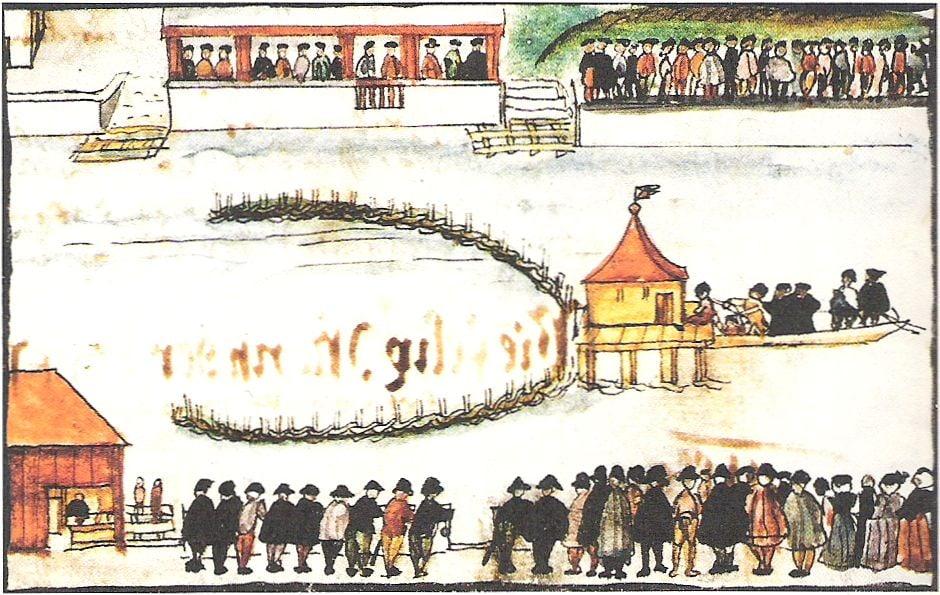
The council of Reformed Zurich sentenced Felix Mantz to be drowned for rebaptizing.
Then Jesus called out in a loud voice, “Father, into Your hands I commit My Spirit.” And when He had said this, He breathed His last.
- Books
- Luke, Acts, Matthew
- Hold in memory
- Luke 23:46, Acts 7:59 to 60
Summary
In this century the Western church split, and Christians on every side killed other Christians. Each church honours its own witnesses.
- Two Anabaptist leaders died in 1527, one killed by Protestants and one by Catholics.
- Tyndale was strangled and burned in 1536.
- Under Queen Mary, from 1555, the counts of those burned run from 277 to 288.
- The Jesuit Edmund Campion was put to death at Tyburn in 1581.
The Verses They Spoke at the End
Mantz sang the words of Luke 23:46 in the water, and Stephen's prayer of Acts 7 stands behind the fires of this century.
The records of this century keep the words of Scripture in the mouths of the dying. Mantz sang the Lord's own words from the cross, and Mantz's letter asks his brethren to show mercy to their enemies.
They spoke at the stake and in the water
While they were stoning him, Stephen appealed, “Lord Jesus, receive my spirit.” Falling on his knees, he cried out in a loud voice, “Lord, do not hold this sin against them.” And when he had said this, he fell asleep.
Stephen commits his spirit to the Lord Jesus and prays for those who stone him.
But I tell you, love your enemies and pray for those who persecute you,
Mantz's letter to his brethren says that the heir of Christ must be merciful, as the Father in heaven is merciful.
Matthew 5:44BSB
They will put you out of the synagogues. In fact, a time is coming when anyone who kills you will think he is offering a service to God.
Jesus warned that those who kill his disciples would think they were serving God.
John 16:2BSB
The Stations from Zurich to Tyburn
Each row names the record that fixes its date.
Within fifty-five years Zurich, Rothenburg on the Neckar, Vilvoorde, Smithfield, Oxford, Paris and Tyburn each saw Christians put to death for their faith.
- Felix Mantz is sentenced at Zurich5 January 1527Burrage, from the Zurich records (1882)
- Michael Sattler is burned at Rothenburg on the Neckar21 May 1527The Martyrs Mirror, Sohm's English (1886)
- William Tyndale dies at Vilvoorde1536Foxe, Townsend's edition (1838)
- John Rogers is burned at Smithfield4 February 1555Foxe, Cattley's edition (1838)
- Ridley and Latimer are burned at Oxford16 October 1555Foxe, Cattley's edition (1838)
- The massacre of St. Bartholomew's Day begins24 August 1572The Catholic Encyclopedia, volume 13 (1912)
- Edmund Campion is executed at Tyburn1 December 1581The Catholic Encyclopedia, volume 5 (1909)
A timeline of seven stations.
The era of the Reformation holds the wider story of the churches in this century.
Zurich and the Neckar, 1527
Zurich drowned Felix Mantz in January, and the imperial governor's court burned Michael Sattler in May.
On 19 November 1526 the council at Zurich confirmed its edict that Anabaptism be punished by drowning, as Henry Burrage gives it. The bailiff of Grüningen seized Mantz on 3 December and sent him to Zurich for trial.
Heinrich Bullinger, who opposed the Anabaptists, reports that Mantz praised God on the way to the boat. Bullinger writes that Mantz sang in Latin, committing his spirit into the Lord's hands, as the executioner drew him into the water.
The Martyrs Mirror, the Anabaptists' own book of martyrs, sets his death in 1526 and calls him “a witness of the sufferings of Christ.”
Michael Sattler was tried before the court of the imperial governor that May, at Rothenburg on the Neckar, as Burrage gives the place. The Martyrs Mirror prints his sentence, that his tongue be cut out and his body torn with red hot tongs before he was burned.
His fellow brethren were put to the sword and the sisters drowned. His wife was drowned a few days after him, and the record closes “Done the 21st day of May, A. D. 1527.”
Vilvoorde, Smithfield and Oxford
Tyndale died in the Low Countries, and under Queen Mary the English Protestants were burned from 1555.
William Tyndale had translated the New Testament into English from the Greek. Henry Phillips betrayed him at Antwerp, and he was held sixteen months at Vilvoorde before he was strangled at the stake and burned.
Foxe gives the year 1536 and no day, and Robert Demaus gives 6 October.
Foxe calls John Rogers the first of Mary's martyrs. Nicholas Ridley and Hugh Latimer were burned together at Oxford, and Thomas Cranmer there on 21 March 1556.
The counts of the burned differ. A paper among Burghley's manuscripts gives 288, Bishop Burnet 284 and John Speed 277, each as John Strype reports it.
Strype printed these tallies in 1721 and wrote that “the exact number I perceive is not known.”
Paris, 1572, and Tyburn, 1581
French Protestants were massacred on St. Bartholomew's Day, and England executed the Jesuit Edmund Campion as a traitor.
The massacre spread from Paris to the provinces of France in the weeks that followed, and its victims were Protestants. The Catholic Encyclopedia's article of 1912 gives the estimates of the dead with their makers.
The counts of the dead of 1572 run from 786 named to a range of 2,000 to 100,000 in the provinces.
| Count | Who made it | Its method |
|---|---|---|
| 2,000 in Paris | Leopold von Ranke and Henri Martin | An estimate, no method given |
| 2,000 to 100,000 in the provinces | The figures in the histories | The encyclopedia calls the number unknown |
| 15,138, with 786 named | The Martyrologe des Huguenots of 1581 | A Protestant martyrology that names 786 of the dead |
Edmund Campion, an Oxford scholar who became a Jesuit priest, came back to England on mission from Rome. He was dragged to Tyburn on a hurdle with Sherwin and Briant.
On the scaffold he was taunted to give his mind on the pope's bull against Elizabeth, and he answered with a prayer for “your Queen and my Queen.”
The Catholic Encyclopedia, a Catholic work of 1909, says that “historians of all schools are agreed that the charges against Campion were wholesale sham.”
Thomas More had died under Henry VIII on 6 July 1535, and the Catholic Church honours both men among its English martyrs.
In Their Own Words
Felix Mantz (died 1527)
His admonition to his fellow brethren, in The Bloody Theatre, or Martyrs Mirror, Felix Mantz, A. D. 1526, page 400
Mantz wrote that Christ forces no one into his glory.
“The Lord Christ compels no one to come to his glory; only those that are willing and prepared attain unto it by true faith and baptism.”
Anabaptist
About this saying1 paragraph
The Martyrs Mirror prints this from the admonition Mantz left to his brethren before his drowning.
William Tyndale (1494 to 1536)
Foxe, Acts and Monuments, volume 5, at the stake
Tyndale prayed for the king's eyes.
“Lord! open the king of England's eyes.”
Reformation translator
About this saying1 paragraph
Foxe gives these words at the stake at Vilvoorde in 1536 and names no witness.
John Rogers (died 1555)
in John Foxe, Acts and Monuments, the story of John Rogers, volume 6, page 611
John Rogers sealed his preaching with his blood.
“That which I have preached I will seal with my blood.”
Marian martyr
About this saying1 paragraph
Foxe gives this as Rogers's answer to the sheriff on the way to Smithfield on 4 February 1555.
Hugh Latimer (1487 to 1555)
in John Foxe, Actes and Monuments, book 11, the death of Ridley and Latimer, page 1937
Latimer told Ridley they would light a candle in England.
“Be of good comfort M. Ridley, and play the man: we shall this day lyght such a candle by Gods grace in England, as (I trust) shall neuer be put out.”
English Reformation
About this saying1 paragraph
Foxe's edition of 1570 gives these words of Latimer to Ridley at the fire.
Where Christians Killed Christians
Each church of the century put to death those it judged heretics or traitors, and each honours its own dead as martyrs.
The Zurich council sentenced Mantz for holding to Anabaptism against its edict and his oath. The Anabaptists honour him as a witness to the truth of the Gospel.
Mary's Parliament revived the old statutes against heretics in 1554, and the Protestants she burned are honoured in Foxe's book as martyrs.
Elizabeth's government tried Campion as a traitor, and the Catholic Church beatified him on 9 December 1886.
After Sattler's death the evangelical pastors of Strasbourg called him a martyr of Christ, as Burrage reports.
Books to Read Next
The Bloody Theatre, or Martyrs Mirror
Thieleman J. van Braght, translated by Joseph F. Sohm · 1886
It is the Anabaptists' own record of their martyrs, translated from the Dutch edition of 1660.
Free at the Internet ArchiveA History of the Anabaptists in Switzerland
Henry S. Burrage · 1882
Burrage tells the Zurich trials from the city's records and from Bullinger.
Free at the Internet ArchiveWhat These Witnesses Handed On
The witnesses of this century died at the hands of other Christians, in Zurich, on the Neckar, at Vilvoorde, London, Oxford, Paris and Tyburn. Their churches kept their names and their last words in the Martyrs Mirror, in Foxe and in the Catholic lists of the English martyrs.
Sources
Scripture is the Berean Standard Bible.
- The Holy Bible, Berean Standard Bible (read 2026)
- Henry S. Burrage, A History of the Anabaptists in Switzerland (Philadelphia: American Baptist Publication Society, 1882), pages 142, 167 to 168 and 171.
- Thieleman J. van Braght, The Bloody Theatre, or Martyrs Mirror of the Defenseless Christians, translated from the Dutch edition of 1660 by Joseph F. Sohm (Elkhart, Indiana: Mennonite Publishing Company, 1886), Felix Mantz, page 400, and Michael Sattler, pages 401 to 403.
- Georges Goyau, Saint Bartholomew's Day, The Catholic Encyclopedia, volume 13 (New York: Robert Appleton Company, 1912)
- Louise Imogen Guiney, Edmund Campion, The Catholic Encyclopedia, volume 5 (New York: Robert Appleton Company, 1909)
- John Foxe, Acts and Monuments, for Tyndale (Townsend's volume 5, 1838), John Rogers (Cattley's volume 6, 1838, page 611) and Latimer (the edition of 1570, page 1937)
Keep Studying
People and groups2
Subjects10
Church history2