
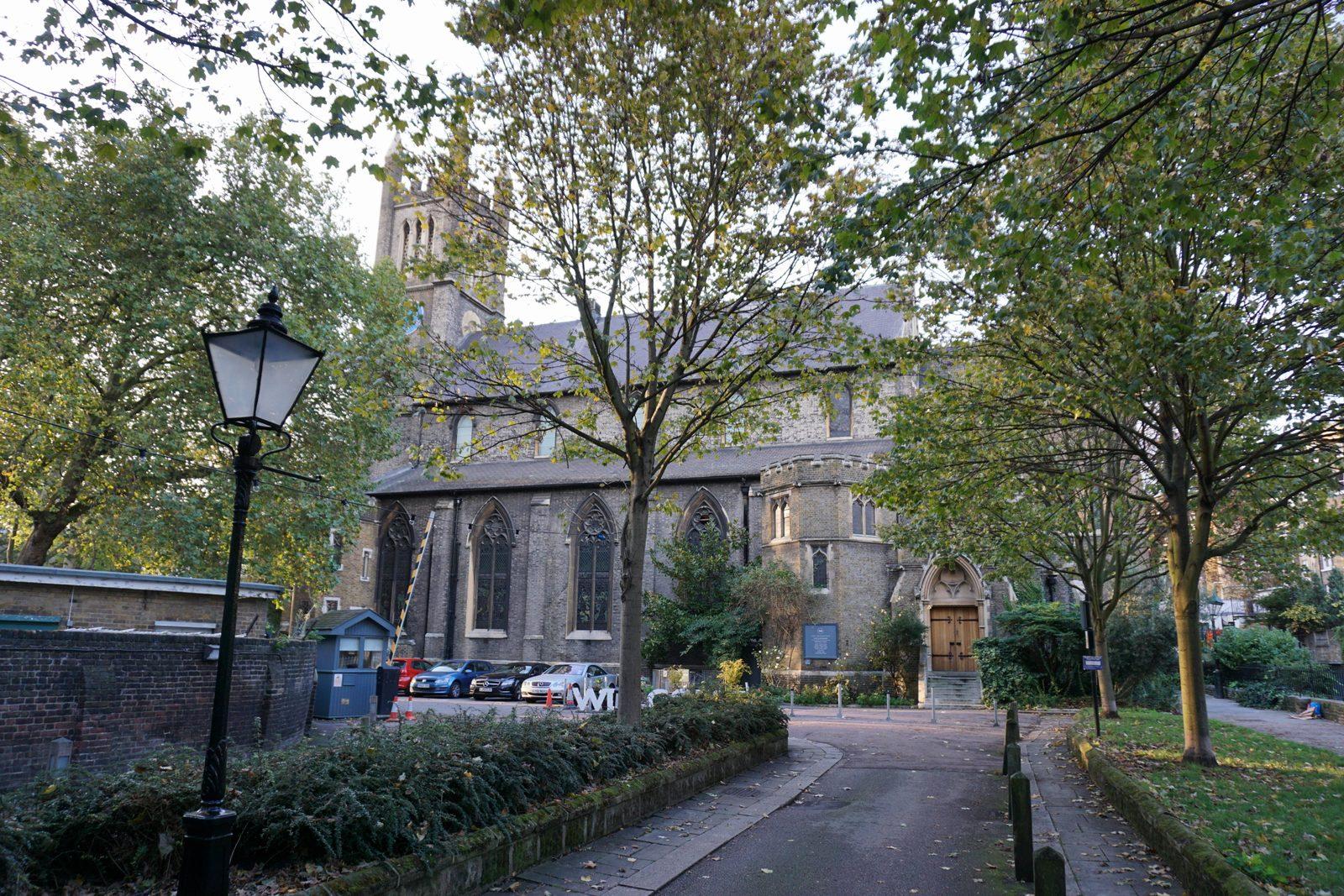
Holy Trinity, Brompton, Bill Boaden, 2014. CC BY-SA 2.0.
Toronto, 1994, and Pensacola, 1995 · Story · Featured Study
Toronto and Brownsville
Christian magazines and two Florida newspapers kept the fullest record of the meetings.
- Where
- Mississauga, near Toronto, London, Pensacola, Florida
- Who
- John Arnott, Randy Clark, John Kilpatrick, Steve Hill
- When
- From January 1994 and from Father's Day 1995
Christianity Today wrote in February 1998 that Pensacola had replaced Toronto as the hot spot for revival-seekers.
but test all things. Hold fast to what is good.
Summary
A Vineyard church near Toronto's airport began meetings in 1994. An Assemblies of God church in Pensacola, Florida, began its own in 1995. Both drew visitors from abroad and critics from their own side. Each later parted with someone who had helped carry it.
- Charisma says the name Toronto Blessing came from British reporters.
- The Toronto church later became Toronto Airport Christian Fellowship and then Catch the Fire.
- In 2014 Christianity Today gave that church a hall of 3,200 seats. The same report gave it 8 satellite campuses and 23 church plants.
The Texts Each Side Cited
Hanegraaff cites the key verse against public claims made without evidence.
This study asks what happened at the two churches in the 1990s and why Christians who shared the same Bible disagreed about it. It sets the meetings side by side, then tells Toronto and its road to London, Pensacola and its school, and the newspaper series that questioned Pensacola's money. It then gives the words of those who led, defended and opposed them. Four questions stay open: what the meetings were, how many were converted, how the separation should be named and how far the two were linked.
Beloved, do not believe every spirit, but test the spirits to see whether they are from God. For many false prophets have gone out into the world.
Gardner and Tingle cite this command in their case against the Toronto meetings.
1 John 4:1BSB
Repent, then, and turn back, so that your sins may be wiped away, that times of refreshing may come from the presence of the Lord, and that He may send Jesus, the Christ, who has been appointed for you.
The meetings were called a time of refreshing by the summer of 1994, from these verses.
On the last and greatest day of the feast, Jesus stood up and called out in a loud voice, “If anyone is thirsty, let him come to Me and drink.
Randy Clark preached from this text at the twentieth anniversary of the Toronto meetings in 2014.
John 7:37BSB
Then Saul stripped off his robes and also prophesied before Samuel. And he collapsed and lay naked all that day and night. That is why it is said, “Is Saul also among the prophets?”
Jon Ruthven, as Hanegraaff quotes him, cites this passage for unusual behaviour under the Spirit.
Acts 3:19 to 20, John 7:37, 1 Samuel 19:24
The Two Meetings Compared
Five questions are each answered for both churches from the reports.
Every visitor figure in the table is an estimate or a party's own report, and no source describes a count.
| The question | Toronto | Brownsville |
|---|---|---|
| When did it begin? | 20 January 1994, at a small church in Mississauga near the airport | Father's Day 1995, at Brownsville Assembly of God in Pensacola |
| Who was the pastor? | John Arnott, senior pastor at Toronto | John Kilpatrick, senior pastor at Brownsville until October 2003 |
| Who was the visiting preacher? | Randy Clark of the St Louis Vineyard | Steve Hill, an evangelist, who stayed until 2000 |
| How many came? | 50,000 in the first six months, says Lorna Dueck | 2.5 to 4.5 million in all, says the Associated Press |
| What did it become? | Weeknights of 100 to 500 by 2004, says Charisma | One night a week by 2004, says the Tampa Bay Times |
Toronto and the Road to London
A critic's article of the time and a writer who took part give most of the early record.
Arnott invited Clark to speak in January 1994. Jo Gardner and Rachel Tingle, writing against the meetings in Churchman, trace Clark's experience to Rodney Howard-Browne's meetings at Tulsa in the late summer of 1993. Clark then preached on 42 of the first 60 days.
Lorna Dueck, a reporter who says she received the blessing herself, lists the acts as "Laughing, falling over, shaking, roaring like a lion, and being 'drunk in the Holy Spirit'". Gardner and Tingle wrote of barking, howling and yelping as well.
Eleanor Mumford of the South West London Vineyard visited Toronto in May 1994. She prayed for Nicky Gumbel, a curate at Holy Trinity Brompton, and spoke at both services there the next Sunday. Gardner and Tingle also list Hong Kong, France, Germany, New Zealand, Korea, China and Israel among the places affected, and give no numbers.
John Wimber of the Vineyard flew to Toronto on 5 December 1995, and the church left the association that month. At a reunion in 2014 the two bodies apologized for any hurt the separation had caused.
Pensacola and Its School
The church was followed for nine years by the Tampa Bay Times, Christianity Today and Charisma.
Hill told Good News in 1996 that he read in Time magazine of what was happening in London and went to Holy Trinity Brompton, where its vicar prayed for him and he fell. He credits Carlos Annacondia in Argentina with his evangelist's anointing.
On Father's Day Hill was the guest preacher. Kilpatrick announced that he felt a wind blowing through the church, fell, and lay still for nearly four hours. The Tampa Bay Times gave a thousand at the altar in 1997 and hundreds in 2004.
By March 1997, with no source named, the Tampa Bay Times gave more than 1.5 million visitors, and people lined up before dawn for one of 2,000 seats. Thomas Trask, general superintendent of the Assemblies of God, said "The impact has been powerful".
The Brownsville Revival School of Ministry opened with 120 students, and Michael Brown, its dean, gave 511 by the fall of 1997. Charisma reports that Brown was fired as president in December 2000, with Kilpatrick citing irreconcilable differences over the school's vision, and Brown's own account has not been read. Charisma says Brown took eight of the ten instructors to start a new school across town, and more than half of the 1,100 students went there. The Times reported in 2004 that the two men said they had patched up their differences.
Hill moved his ministry to Dallas. The Associated Press dates the last nightly service to 2001.
The Newspaper Series of November 1997
Christianity Today reported the series and the reply together.
The Pensacola News Journal ran a five-day series of more than thirty stories, "Brownsville Revival: The Money and the Myths". It called the revival's businesses "a multimillion-dollar retail industry conducted within the walls of the church", and it questioned the integrity of Hill and Kilpatrick. It reported that only Brown had appropriately paid state sales tax on what he sold at tables inside the church.
The leaders said the series contained "misquotes, serious misrepresentation of facts, and misleading misquotes". They issued a six-page reply of 47 items to some of the charges and paid for two advertisements. They laid the tax on their inability to get a determination from state tax officials, and Hill called the money problems honest mistakes.
Christianity Today recorded on 9 February 1998 that no state or federal investigation had been implemented.
Earlier Revivals Under Test
Four writers of earlier revivals, on each side, wrote on testing a revival by its effects.
Jonathan Edwards (1703 to 1758)
The Distinguishing Marks of a Work of the Spirit of God, section I
A treatise of 1741 on 1 John 4:1 sets a limit on what the body can prove.
“A Work is not to be judged of by any Effects on the Bodies of Men; such as Tears, Trembling, Grones, loud Outcries, Agonies of Body, or the failing of bodily Strength.”
Congregationalist
Edward A. Stopford (1810 to 1874)
The Work and the Counterwork, the chapter on the physical phenomena
A writer of 1859 judged the cases he saw at Belfast.
“All the ‘cases’ I saw in Belfast were clearly and unmistakeably hysterical; and, as far as it is possible to judge from description, so was every case which has been described to me.”
Irish Established Church
William J. Seymour (1870 to 1922)
"Counterfeits", The Apostolic Faith 1:4 (Los Angeles, December 1906), in the Apostolic Faith Church's transcription of the article signed W. J. Seymour, vol. 1, no. 4
A pastor at the start of the Pentecostal movement wrote in 1906 of how the real and the false stand together.
“God has told us in His precious word that we should know a tree by its fruit. Wherever we find the real, we find the counterfeit also. But praise God for the real.”
Pentecostal
Charles Chauncy
Seasonable Thoughts on the State of Religion in New-England, part I, page 327
A critic of the Great Awakening answered in 1743 that the mind must govern.
“an enlightened Mind, and not raised Affections, ought always to be the Guide of those who call themselves Men; and this, in the Affairs of Religion, as well as other Things.”
Congregational minister
In Their Own Words
Six people who led, weighed or opposed the meetings speak in the press and journals of their day.
John Wimber (1934 to 1997)
Quoted in James A. Beverley, "Vineyard Severs Ties with 'Toronto Blessing' Church", Christianity Today, 8 January 1996, Wimber's statement
An authentic visitation
“I believe that there has been an authentic visitation of the Spirit there”
Independent (Vineyard)
About this saying1 paragraph
The Vineyard's leader said this in December 1995 in the same statement as the separation.
Steve Hill (died 2014)
Interview with Steve Beard, Good News, July/August 1996, the closing questions
The minors
“When the manifestations come, I welcome the manifestations, but I don’t major on the minors.”
Assemblies of God
About this saying1 paragraph
The evangelist at Pensacola drew this line in 1996 about the acts in the meetings.
John Arnott
Quoted in "Toronto Blessing Celebrates 10 Years", Charisma, 1 January 2004, the closing paragraphs
A greater expectation
“There’s a greater expectation that the presence of God should be felt and experienced in some way.”
Vineyard
About this saying1 paragraph
The pastor at Toronto named this in 2004 as the most significant result.
James A. Beverley
Quoted in Lorna Dueck, Christianity Today, 7 March 2014, the passage on the critics
Thousands and thousands
“Whatever the weaknesses are, they are more than compensated for by thousands and thousands of people having had tremendous encounters with God, receiving inner healings, and being renewed.”
Other
About this saying1 paragraph
A seminary professor weighed the movement this way in 2014.
Hank Hanegraaff
"CRI Statement on December Meetings between Hank Hanegraaff and Brownsville Revival Leaders", Christian Research Report 11/2, 1998, the closing paragraphs
From faith to feelings
“a shift from faith to feelings, from fact to fantasy, and from reason to esoteric revelation”
Christian
About this saying1 paragraph
The president of the Christian Research Institute wrote this after his meetings with the Brownsville leaders.
Michael L. Brown
Quoted in "Brownsville Revival Rolls Onward", Christianity Today, 9 February 1998, the closing paragraphs
Sanitize and demonize
“We tend to sanitize past revivals and demonize present revivals”
Other
About this saying1 paragraph
The dean of the Brownsville school answered the critics this way in 1998.
What the Holders Dispute
Pastors, journalists and apologists hold these positions, and each is named with the case made against it.
What were the meetings?4 paragraphs
Grant Mullen, a physician long tied to the Toronto church, calls the acts "strictly human reactions to the presence of a supernatural force". Clark says there is "a solid biblical basis" for what is taught, and grants the critics a weakness on the theology of suffering.
Gardner and Tingle hold that it is no revival in the historical sense, since they find "little evidence so far of it leading to the conversion of non-Christians". Kevin Reeves, a teaching elder who left a church of this stream in 2000, says "all everybody was talking about was their experience".
Hank Hanegraaff, in his book Counterfeit Revival and the Christian Research Journal, charges repetitive physical motions, Scripture out of context and exaggerated claims. Brown's book of 1997 calls Hanegraaff's "an unscholarly, often inaccurate, highly judgmental, and at times, even slanderous work". The two debated by radio and met privately in November 1997, and Hanegraaff wrote that there had been "no change of position on either side". Christianity Today reports that he left with "at least a few reservations about his earlier denunciations".
James Beverley's book of 1995 called the movement at best a "mixed blessing", and in 1997 he faulted Hanegraaff's book in Christianity Today. In 2014 he took what Dueck calls a more appreciative tone, and he still declined to call laughing, crying or roaring plain marks of the Spirit. He reads them as signs of deep pain and a need for comfort.
How many were converted?1 paragraph
Organizers told the Tampa Bay Times "Perhaps 100,000", and its reporter's random interviews over three days found people who had rededicated their lives and none newly born again. Christianity Today gave 122,000 decision cards for conversion or rededication. Hill says he counts a backslider's return as a salvation.
Withdrawal, resignation or expulsion?1 paragraph
Wimber said, "Our decision was to withdraw endorsement; their decision was to resign." Charisma says the church was "formally expelled". Arnott's letter says his staff agreed to a formal separation, and Christianity Today in 2014 dates the board's decision to 1996.
How far were the two linked?1 paragraph
Brown, as Hanegraaff quotes him, says "there is no formal or informal relationship between Toronto and Pensacola". Hanegraaff answers that Brenda Kilpatrick and staff members had made pilgrimages to Toronto before Father's Day. Brown's book itself was not read for this study.
Books to Read Next
Brownsville Revival Rolls Onward
Christianity Today · 1998
This report sets the critics, the series and the reply side by side.
Read the report at Christianity TodayEnduring Revival
Lorna Dueck, Christianity Today · 2014
Dueck returned to Toronto for the twentieth anniversary and asked Beverley again.
Read Dueck at Christianity TodayThe Counterfeit Revival, Part Three
Hank Hanegraaff, Christian Research Journal · 1997
Hanegraaff makes his case against Pensacola here, and his book does not.
Read Hanegraaff at the Christian Research InstituteWhat the Superintendent Asked
Trask's main concern in 1998 was that the leaders at Pensacola "don't try to perpetuate something that God wants to put a stop to".
Sources
Scripture is the Berean Standard Bible.
- The Holy Bible, Berean Standard Bible (read 2026)
- James A. Beverley, "Vineyard Severs Ties with 'Toronto Blessing' Church", Christianity Today, 8 January 1996.
- Tim Stafford and James A. Beverley, interview with John Wimber, Christianity Today, 14 July 1997.
- James A. Beverley, "Counterfeit Critique", Christianity Today, September 1997.
- Lorna Dueck, "Enduring Revival", Christianity Today, 7 March 2014.
- "Brownsville Revival Rolls Onward", Christianity Today, 9 February 1998.
- "Toronto Blessing Celebrates 10 Years", Charisma, 1 January 2004.
- "Brownsville Assembly of God Moves Forward After Split", Charisma, 1 February 2002.
- Jo Gardner with Rachel Tingle, "Ticket to Toronto", Churchman 109/1 (1995)
- "A dynamic revival rouses the faithful in Pensacola", Tampa Bay Times, 2 March 1997.
- "Faith drives revival's survival", Tampa Bay Times, 21 February 2004.
- Associated Press, "Church of famed revival struggles", in the Deseret News, 30 March 2012.
- Steve Beard, interview with Steve Hill, Good News, July/August 1996.
- Hank Hanegraaff, "The Counterfeit Revival, Part Three", Christian Research Journal 20/2, November to December 1997.
- Hank Hanegraaff, "CRI Statement on December Meetings between Hank Hanegraaff and Brownsville Revival Leaders", Christian Research Report 11/2, 1998.
Keep Studying
Read it5
People and groups8
Doctrines1
Subjects1
Go further3