
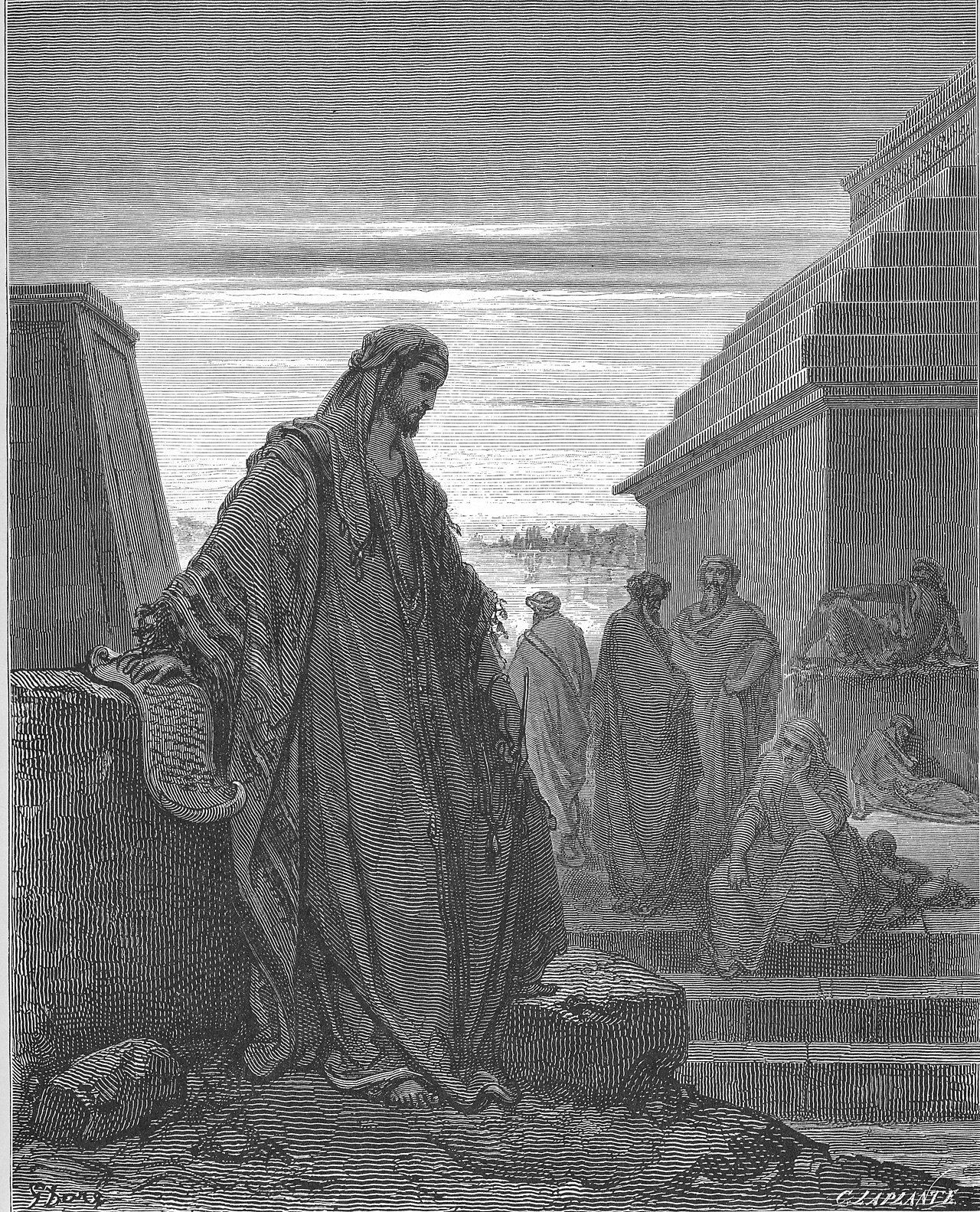
Danielchapter 12
13 verses · Daniel, by tradition · 6th century BC · The Prophets
And many who sleep in the dust of the earth will awake, some to everlasting life, but others to shame and everlasting contempt.
Introduction
Daniel, by tradition, The Prophets, Daniel Overview.
This chapter closes the book, and it closes the long vision that began by the Tigris two chapters earlier. It was kept for a people who had watched faithful men and women die without seeing any promise kept. It carries the plainest statement of the resurrection of the dead in the Old Testament. Listen for the question Daniel asks and the answers he is given, some of which he admits he does not understand. Listen last to the words spoken to Daniel himself, which close the book on one old man's future.
Context
- Who
- An old exile being told to stop asking and go rest
- What
- The close of the final vision, promising deliverance and resurrection, with Daniel's question about the end and the command to seal the book.
- Where
- The bank of the Tigris, with two figures standing on either side of the river.
- When
- The third year of Cyrus, about 536 BC, as part of the same vision as chapters 10 and 11.
- Why
- To give God's people hope beyond death, and to call them to wait faithfully for the end that God has set.
Historical context
The final chapter of Daniel contains the clearest resurrection statement in the Old Testament: many that sleep in the dust of the earth will awake, some to everlasting life, some to shame and everlasting contempt. Israel's earlier books speak of Sheol and of God's power over death, but nothing before this is this explicit about two destinies.
Show the rest of the historical context, 3 more paragraphs
Michael is named again as "the great prince which standeth for the children of thy people", the one who fought alongside the messenger in chapter 10. A time of trouble is announced that is worse than anything in national history, and deliverance is promised for everyone written in the book.
Daniel is then told to shut up the words and seal the book until the time of the end. Sealing a document in that world was physical: a rolled scroll tied and stamped with clay, meaning it was finished and not to be tampered with. Meanwhile knowledge would increase and many would run to and fro.
He asks how long, and does not get a clean answer, a time, times, and half a time, plus two numbers of days that readers have argued over ever since. Then he is told plainly: go your way, Daniel; the words are closed and sealed; rest, and stand in your lot at the end of the days.
Significance
For exiles who had watched faithful people die without seeing the promises, this was the answer that mattered most. The righteous who died in Babylon were not simply gone. They would rise, and they would shine like the stars.
Show the rest of the significance, 1 more paragraph
And Daniel, who had spent seventy years in a foreign capital and never went home, is told that his own portion is secure at the end of the days. He would not see it in his lifetime. He would see it.
This chapter in Jewish lifeWhat this chapter is in Jewish life and reading.
What is done
The book's last chapter is not read as a lesson in the synagogue. Probed for this lane, the site's own table in src/lib/hebraic/readings.ts printed parashot total 0 and haftarah uses total 0 for Daniel, and no festival reading. The site's book dossier records that Daniel stands among the Writings in the Hebrew Bible rather than among the Prophets, so no weekly portion is drawn from it and no Haftarah either.
It does reach the prayer book, and Rashi names the place. At the twelfth verse he reports that the Messiah is to be hidden after he is revealed and revealed again, citing Midrash Ruth, and he adds that "so did Rabbi Eleazar HaKalir establish (in the concluding poem of the morning service of the portion dealing with the month of Nissan): “and he will be concealed from them six weeks of years.”" (Rashi on Daniel 12:12:1). Rashi places that line in the closing poem of the morning service for the portion on the month of Nissan.
How it is read
Rashi is the one commentator on this chapter with English in the corpus, quoted from The Judaica Press complete Tanach with Rashi, translated by A. J. Rosenberg, which Sefaria reports as CC-BY at fifty words or fewer.
At the first verse Rashi reads Michael's standing up as silence. He "will see the Holy One, blessed be He, judging by Himself and saying, “How will I destroy a great nation like this for the sake of Israel?”" (Rashi on Daniel 12:1:1). The time of distress he reads from Ketubot 112b as a time of accusations against the scholars of the Torah (Rashi on Daniel 12:1:2).
The sleepers in the dust are read in four words: "The dead will come to life" (Rashi on Daniel 12:2:1). The wise who shine are those "who engaged in the Torah and in the commandments" (Rashi on Daniel 12:3:1).
Rashi reads Daniel's confusion at the eighth verse plainly: "I did not know what “the time of two times and a half” means" (Rashi on Daniel 12:8:1). The words are sealed "until our redemption draws near" (Rashi on Daniel 12:9:1). At the eleventh verse he adds the 1,290 days to a count of the exiles and the Temples and reaches 2,874, the same sum he drew from the evenings and mornings of chapter 8 (Rashi on Daniel 12:11:1). His last note sends Daniel home: "You will depart to your everlasting home" (Rashi on Daniel 12:13:1).
The corpus carries eleven further notes on this chapter without an English text, each marked linked because Sefaria holds no English version of the ref. They stand cited and unquoted: Ibn Ezra on Daniel 12:2:1, Daniel 12:3:1, Daniel 12:4:1, Daniel 12:5:1, Daniel 12:6:1, Daniel 12:7:1, Daniel 12:9:1 and Daniel 12:11:1 and Metzudat David on Daniel 12:4:1, Daniel 12:5:1 and Daniel 12:6:1.
What the rabbis say
The corpus carries forty rabbinic locators on this chapter. Two of them stand in the Talmud and its minor tractates and the rest in the Midrash. The corpus carries the text of none, so each is cited by ref here and never quoted.
On the first verse it holds Devarim Rabbah 11:10, Midrash Aggadah, Exodus 23:20:1, Midrash Lekach Tov, Exodus 23:20:2, Midrash Lekach Tov, Numbers 24:17:1 and Midrash Sekhel Tov, Bereshit 48:16:1. On the second verse it holds Aggadat Bereshit 23:4, Avot DeRabbi Natan 34:11, Bamidbar Rabbah 14:10, Bereshit Rabbati, Parashat Vayishlach 20 and Bereshit Rabbati, Parashat Vayishlach 35. On the third verse it holds Bamidbar Rabbah 2:13, Bava Batra 8b:13, Bereshit Rabbah 65:21 and Bereshit Rabbati, Parashat Bereshit 13. On the fourth verse it holds Bereshit Rabbah 98:2, Midrash Lekach Tov, Deuteronomy 29:28:1, Midrash Tanchuma, Vayera 6:7 and Midrash Tehillim 31:4. On the sixth verse it holds Bereshit Rabbati, Parashat Bereshit 21. On the seventh verse it holds Aggadat Bereshit 13:3, Bereshit Rabbah 43:9, Ein Yaakov (Glick Edition), Sanhedrin 11:46 and Ein Yaakov, Nazir 1:3.
On the eighth verse it holds Aggadat Bereshit 48:1. On the ninth verse it holds Mekhilta DeRabbi Shimon Ben Yochai 13:16 and Midrash Tehillim 9:2. On the tenth verse it holds Midrash Tehillim 119:24. On the eleventh verse it holds Bamidbar Rabbah 11:2, Ein Yaakov, Taanit 4:10, Otzar Midrashim, Midrashim of Rabbi Shimon bar Yochai, Prayer of Rabbi Shimon Bar Yochai 7 and Pesikta Rabbati 15:1. On the twelfth verse it holds Bereshit Rabbati, Parashat Bereshit 5, Midrash Lekach Tov, Deuteronomy 31:18:1, Midrash Lekach Tov, Exodus 11:2:1 and Midrash Lekach Tov, Genesis 49:10:6. On the thirteenth verse it holds Bamidbar Rabbah 14:4, Eikhah Rabbah 2:6, Midrash Aggadah, Exodus 15:6:2 and Midrash Aggadah, Numbers 1:11:1.
Under the anchor the corpus prints as Daniel 12:17 it holds Midrash Tanchuma, Lech Lecha 13:5.
What each locator teaches is a saying of the rabbis, and it is reported as theirs wherever this site quotes one. The quotations wait on a fetch that carries the text.
Sources: Rashi, Rashi on Daniel 12:1:1 to Daniel 12:13:1, The Judaica Press complete Tanach with Rashi, translated by A. J. Rosenberg, reported CC-BY; Ibn Ezra, Ibn Ezra on Daniel 12:2:1, Daniel 12:3:1, Daniel 12:4:1, Daniel 12:5:1, Daniel 12:6:1, Daniel 12:7:1, Daniel 12:9:1 and Daniel 12:11:1, cited by ref because the corpus carries no English text; Metzudat David, Metzudat David on Daniel 12:4:1, Daniel 12:5:1 and Daniel 12:6:1, cited by ref because the corpus carries no English text; The Sefaria corpus, scripts/data/sources/sefaria/daniel/12.json, the 40 Talmud and Midrash locators of this chapter; The site's own files, src/lib/hebraic/readings.ts, probed for this book and printing daniel parashot total 0 and haftarah uses total 0, and src/components/book/dossier-content/daniel.ts on the place of Daniel among the Writings.
The heads below are this chapter's scenes. The numbered points under each are its verses.
Michael stands up, and many sleepers awake
Michael, the great prince: “At that time Michael, the great prince who stands watch over your people, will rise up,” the same prince named at 10:13 and 10:21. “There will be a time of distress” and the outcome is deliverance for “everyone whose name is found written in the book”.
Daniel 12:1
“There shall be a time of trouble, threatening to all, but ruining to all the implacable enemies of God's kingdom among men, such trouble as never was since there was a nation. To the destruction of Jerusalem, which Christ calls (perhaps with an eye to this prediction) such a great tribulation as was not since the beginning of the world to this time, Matt. xxiv.”
Matthew Henry · Commentary on the Whole Bible (1707-1721)puritan
3 more voices on this verseWhat preachers and commentators have said about this verse, in their own words.
Daniel 12:1
“And at that time - At the period referred to in the preceding chapter. The fair construction of the passage demands this interpretation, and if that refers to Antiochus Epiphanes, then what is here said must also; and we are to look for the direct and immediate fulfillment of this prediction in something that occurred under him, however, it may be supposed to have an ultimate reference to other and more remote events.”
Daniel 12:1
“But if it seems better to understand Michael as the archangel, this sense will prove suitable, for under Christ as the head, angels are the guardians of the Church. Whichever be the true meaning, God was the preserver of his Church by the hand of his only-begotten Son, and because the angels are under the government of Christ, he might entrust this duty to Michael.”
John Calvin · Commentaries (1554)reformed
Daniel 12:1
“An archangel, not the Lord Jesus; for he is distinguished from "the Lord" in Jude 9. there shall be--rather, "it shall be." time of trouble, such as never was--partially applicable to the time of Antiochus, who was the first subverter of the Jews' religion, and persecutor of its professors, which no other world power had done.”
Jamieson, Fausset & Brown · Commentary Critical and Explanatory on the Whole Bible (1871)reformed
sleep in the dust of the earth: Isaiah 26:19 and John 5:28-29 speak of the same hope, and the older commentators read one resurrection revealed by stages. The word “many” has drawn comment: some see a near reference to Israel's national restoration, others a general resurrection.
Daniel 12:2
To all who reason rightly, the heaviest of punishments is shame. We also have learned this in the case of the judgment, when "some" shall rise "to everlasting life and some to everlasting shame and contempt."
Basil of Caesarea · written before 379 · Letter 260:4, to Optimus the Bishoppatristic
3 more voices on this verse
Daniel 12:2
“Many of them that sleep in the dust of the earth - This prophecy has been referred to the future restoration of the Jews. It will be also true of the state of mankind at the general judgment.”
Adam Clarke · Commentary on the Bible (1810-1826)evangelical
Daniel 12:2
“The Jews themselves understand this of the resurrection of the dead at the end of time; and Christ seems to have an eye to it when he speaks of the resurrection of life and the resurrection of damnation ( John v. 29 ); and upon this the Jews are said by St. Paul to expect a resurrection of the dead both of the just and of the unjust, Acts xxiv.”
Matthew Henry · Commentary on the Whole Bible (1707-1721)puritan
Daniel 12:2
“2 Maccabees 7:9, 14, 23, shows the fruit of this prophecy in animating the Maccabean mother and her sons to brave death, while confessing the resurrection in words like those here. NEWTON'S view that "many" means all, is not so probable; for Ro 5:15, 19, which he quotes, is not in point, since the Greek is "the many," that is, all, but there is no article in the Hebrew here.”
Jamieson, Fausset & Brown · Commentary Critical and Explanatory on the Whole Bible (1871)reformed
the brightness of the heavens: The wise are named by what they do, leading others to righteousness, and their reward lasts as the stars do. Jesus echoes the verse at Matthew 13:43, where the righteous shine like the sun in the age to come.
Daniel 12:3
“And they that be wise - This is the language which, in the Scriptures, is employed to denote the pious, or those who serve God and keep his commandments. See the book of Proverbs, passim. True religion is wisdom, and sin is folly, and they who live for God and for heaven are the truly wise. The meaning is, that they have chosen the path which true wisdom suggests as that in which man should walk, while all the ways of sin are ways of folly.”
2 more voices on this verse
Daniel 12:3
“Christ is the sun, the fountain, of the lights both of grace and glory; ministers, as stars, shine in both, with a light derived from him, and a diminutive light in comparison of him; yet to those that are earthen vessels it will be a glory infinitely transcending their deserts.”
Matthew Henry · Commentary on the Whole Bible (1707-1721)puritan
Daniel 12:3
“Answering to "they that understand" (Da 11:33, 35), the same Hebrew, Maskilim; Israelites who, though in Jerusalem when wickedness is coming to a head, are found intelligent witnesses against it.”
Jamieson, Fausset & Brown · Commentary Critical and Explanatory on the Whole Bible (1871)reformed
shut up these words: Daniel is told to “shut up these words and seal the book until the time of the end,” keeping the vision for a later generation. Verse 8 shows Daniel still did not understand it. The text sets no date.
Daniel 12:4
“Shut up the words, and seal the book - When a prophet received a prediction concerning what was at a considerable distance of time, he shut his book, did not communicate his revelation for some time after. This Daniel was commanded to do, Dan 8:26. See also Isa 29:10, Isa 29:11; Rev 22:10. Among the ancients, those were said to seal, who in the course of their reading stamped the places of which they were yet doubtful, in order to keep them in memory, that they might refer to then; again, as not yet fully understood.”
Adam Clarke · Commentary on the Bible (1810-1826)evangelical
1 more voice on this verse
Daniel 12:4
“Seal the book - The book was command to be sealed, because it would be long before the words would be fulfilled, whereas those that were shortly to be fulfilled, were forbidden to be sealed. Shall run - Shall diligently search these prophecies; and they shall know the signs of the times, and wait upon God in the way of his judgments: he means chiefly in gospel-times.”
John Wesley · Explanatory Notes upon the Old Testament (1765)evangelical
A time, times, and half a time
two others standing there: Barnes and Clarke take the two others standing on each bank as angels, and Barnes says the words around them require it. Clarke links them with the holy ones of 8:13 and says the river is most likely the Tigris. Jerome placed them on the river of Babylon.
Daniel 12:5-7
saw two others standing there: Daniel sees two others on opposite banks, and one asks the man in linen how long it will be until these wonders are fulfilled. He swears that it will be “for a time, and times, and half a time,” until the power of the holy people is shattered.
Daniel 12:5
“Then I Daniel looked - My attention was attracted in a new direction. Hitherto, it would seem, it had been fixed on the angel, and on what he was saying. The angel now informed him that he had closed his communication, and Daniel was now attracted by a new heavenly vision. And, behold, there stood other two - Two other angels. The connection requires us to understand this of angels, though they are not expressly called so.”
1 more voice on this verse
Daniel 12:5
“Concerning this we may observe, 1. Who it was that asked the question. Daniel had had a vision of Christ in his glory, the man clothed in linen, ch. x.”
Matthew Henry · Commentary on the Whole Bible (1707-1721)puritan
the man dressed in linen: Readers divide over the man dressed in linen. John Gill and Matthew Henry say he is Christ, dressed in linen as a priest, and Clarke says he is Gabriel. Jamieson, Fausset and Brown set these words beside 1 Peter 1:12, where angels long to look into such things.
a time, and times: Hippolytus and Augustine take the time, times and half a time as three and a half years under the Antichrist. Augustine says the Greek puts times in the dual. Jerome says Porphyry saw the same three and a half years, and allows that this fits the way Scripture speaks.
Daniel 12:7
“606, the very year that Phocas made the grant to the bishop of Rome, whence he assumed the title, The Universal Pastor; Antichrist thus setting both his feet on Christendom together, the one in the East, and the other in the West. Three and a half is the time of the world power, in which the earthly kingdoms rule over the heavenly [AUBERLEN].”
Jamieson, Fausset & Brown · Commentary Critical and Explanatory on the Whole Bible (1871)reformed
1 more voice on this verse
Daniel 12:7
“Christ's public ministry continued three years and a half, during which time he endured the contradiction of sinners against himself, and lived in poverty and disgrace; and then when his power seemed to be quite scattered at his death, and his enemies triumphed over him, he obtained the most glorious victory and said, It is finished.”
Matthew Henry · Commentary on the Whole Bible (1707-1721)puritan
Go your way, Daniel: you will stand in your lot
Daniel 12:8-9
but I did not understand: Daniel confesses, “I heard, but I did not understand,” only to hear the words are “closed up and sealed until the time of the end”. Revelation 22:10 tells John the opposite, to leave his prophecy unsealed because the time is near. His confession echoes 8:27.
Daniel 12:8
"And I heard, and understood not. And I said, 'O my lord, what shall happen after these things?'" The prophet wished to comprehend what he had seen, or rather, what he had heard, and he desired to understand the reality of the things to come. For he had heard of the various wars of kings, and of battles between them, and a detailed narrative of events; but he had not heard the names of the individual persons involved.
Jerome · written before 420 · St. Jerome, Commentary on Daniel, CHAPTER TWELVEpatristic
1 more voice on this verse
Daniel 12:8
1Pe 1:10-12 refers mainly to Daniel: for it is he who foretells "the sufferings of Christ and the glory that should follow"; it is he who prophesies "not unto himself, but unto us"; it is he who "searched what, or what manner of time the Spirit of Christ in him did signify."
Jamieson, Fausset & Brown · Commentary Critical and Explanatory on the Whole Bible (1871)reformed
the words are closed up: Barnes takes Go on your way as an end to asking, since all Daniel would receive had been given. Jerome asked what must become of those who presumptuously expound a sealed book, if Daniel heard and did not understand. Clarke says such prophecy is understood only when it is completed.
Daniel 12:9
"And he said, 'Go, Daniel, for the words are shut up and sealed until the time of the end.'" And if the prophet himself heard and did not understand, what will be the case with those men who presumptuously expound a book which has been sealed, and that too unto the time of the end, a book which is shrouded with many obscurities?
Jerome · written before 420 · St. Jerome, Commentary on Daniel, CHAPTER TWELVEpatristic
purified, made spotless, and refined: “Many will be purified, made spotless, and refined,” while “the wicked will continue to act wickedly,” none of them understanding; only “the wise will understand”. The verse gives coming suffering a refining purpose, the same purifying named at 11:35, where the wise fall so that they may be refined.
Daniel 12:10
“They maintain that Daniel also set forth the same thing when he begged of the angels explanations of the parables, as being himself ignorant of them. But the angel, hiding from him the great mystery of Bythus, said unto him, "Go thy way quickly, Daniel, for these sayings are closed up until those who have understanding do understand them, and those who are white be made white." Moreover, they vaunt themselves as being the white and the men of good understanding.”
Irenaeus · written before 202 · Against Heresies Book Ipatristic
1 more voice on this verse
Daniel 12:10
The fulfilment of God's decree is not a mere arithmetical problem which the profane may understand by arithmetical calculations, but a holy enigma to stimulate to a faithful observance of God's ways, and to a diligent study of the history of God's people [AUBERLEN]. To this Christ refers (Mt 24:15), "Whose readeth, let him understand."
Jamieson, Fausset & Brown · Commentary Critical and Explanatory on the Whole Bible (1871)reformed
the abomination of desolation set up: “1,290 days” are counted “from the time the daily sacrifice is abolished and the abomination of desolation set up,” the abomination of 9:27 and 11:31. The older commentators hold both a near fulfillment in the profaning of the temple by Antiochus and a fulfillment beyond him.
Daniel 12:11
“And from the time - Though the angel had said Dan 12:4, Dan 12:9 that his communication was closed, and that he imparted all that he was commissioned to communicate to Daniel, yet, as it would seem, in reply to the earnest request of Daniel, he volunteers an additional statement, in regard to certain important periods that were to occur in the future. The language, however, is very obscure; and it would appear, from Dan 12:13, that the angel scarcely expected that Daniel would understand it.”
Blessed is he who waits: The verse blesses the one who “waits and reaches the end of the 1,335 days,” a count forty-five days beyond the first. The older commentators read the gap as a further stage of blessing. Some take both counts as calendar days, and others as stages within one unfolding.
You will rest, and will arise: The book's last words are spoken to Daniel himself: “You will rest, and will arise to your inheritance at the end of the days”. Rest answers the distress of verse 1, and rising to his inheritance sets the resurrection promised at verse 2 into Daniel's own future.
Daniel 12:13
“He "received not the promise," but had to wait until the Christian elect saints should be brought in, at the first resurrection, that he and the older Old Testament saints "without us should not be made perfect" (Heb 11:40). stand--implying justification unto life, as opposed to condemnation (Ps 1:5). thy lot--image from the allotment of the earthly Canaan.”
Jamieson, Fausset & Brown · Commentary Critical and Explanatory on the Whole Bible (1871)reformed
Keep studying
Studies14
People and groups1
Words12
Subjects1
Sources for this chapter
The summary
Jamieson, Fausset & Brown, Commentary Critical and Explanatory; John Calvin, Commentaries; John Wesley, Notes on the Old Testament and Matthew Henry, Complete Commentary.
The exposition
Adam Clarke, Commentary on the Bible; Albert Barnes; Augustine of Hippo; Carl Friedrich Keil, Biblical Commentary on the Book of Daniel; Edward Bouverie Pusey, Daniel the Prophet; Hippolytus of Rome, Commentary on Daniel 4.56.6-8; Jamieson, Fausset & Brown, Commentary Critical and Explanatory on the Whole Bible; Jerome, St. Jerome, Commentary on Daniel, CHAPTER TWELVE; John Calvin, Commentary on the Prophet Daniel; John Gill; John Wesley, Explanatory Notes upon the Old Testament and Matthew Henry, Commentary on the Whole Bible.