
Numbers 16:3
in Numbers 16They came together against Moses and Aaron and told them, “You have taken too much upon yourselves! For everyone in the entire congregation is holy, and the LORD is in their midst. Why then do you exalt yourselves above the assembly of the LORD?”
BSB
The same verse in ASV and KJV ▾
ASV
and they assembled themselves together against Moses and against Aaron, and said unto them, Ye take too much upon you, seeing all the congregation are holy, every one of them, and Jehovah is among them: wherefore then lift ye up yourselves above the assembly of Jehovah?
KJV
And they gathered themselves together against Moses and against Aaron, and said unto them, Ye take too much upon you, seeing all the congregation are holy, every one of them, and the Lord is among them: wherefore then lift ye up yourselves above the congregation of the Lord?
⋯
This verse in Numbers 16
Commentary
9 notes on this verseA commentator
Albert Barnes1798–1870
Notes, Explanatory and Practical, on the Old and New Testaments (1832-1869)
All the congregation are holy - Compare the marginal reference. Korah’s object was not to abolish the distinction between the Levites and the people, but to win priestly dignity for himself and his kinsmen Num 16:10. This ultimate design is masked for the present in order to win support from the Reubenites by putting forward claims to spiritual equality on behalf of every Israelite.
This site's exposition
seeing all the congregation are holy
The premise is Exodus 19:6, a kingdom of priests and an holy nation, and it is true. What Korah builds on it is that the priesthood therefore stands open to any Israelite, and the rest of the chapter answers the inference rather than the premise. This is the one place in the Torah where a rebellion argues from Scripture, and Moses hands the same accusation back at the end of verse 7, ye take too much upon you, ye sons of Levi.
The record, by era
The Church Fathers3 voices
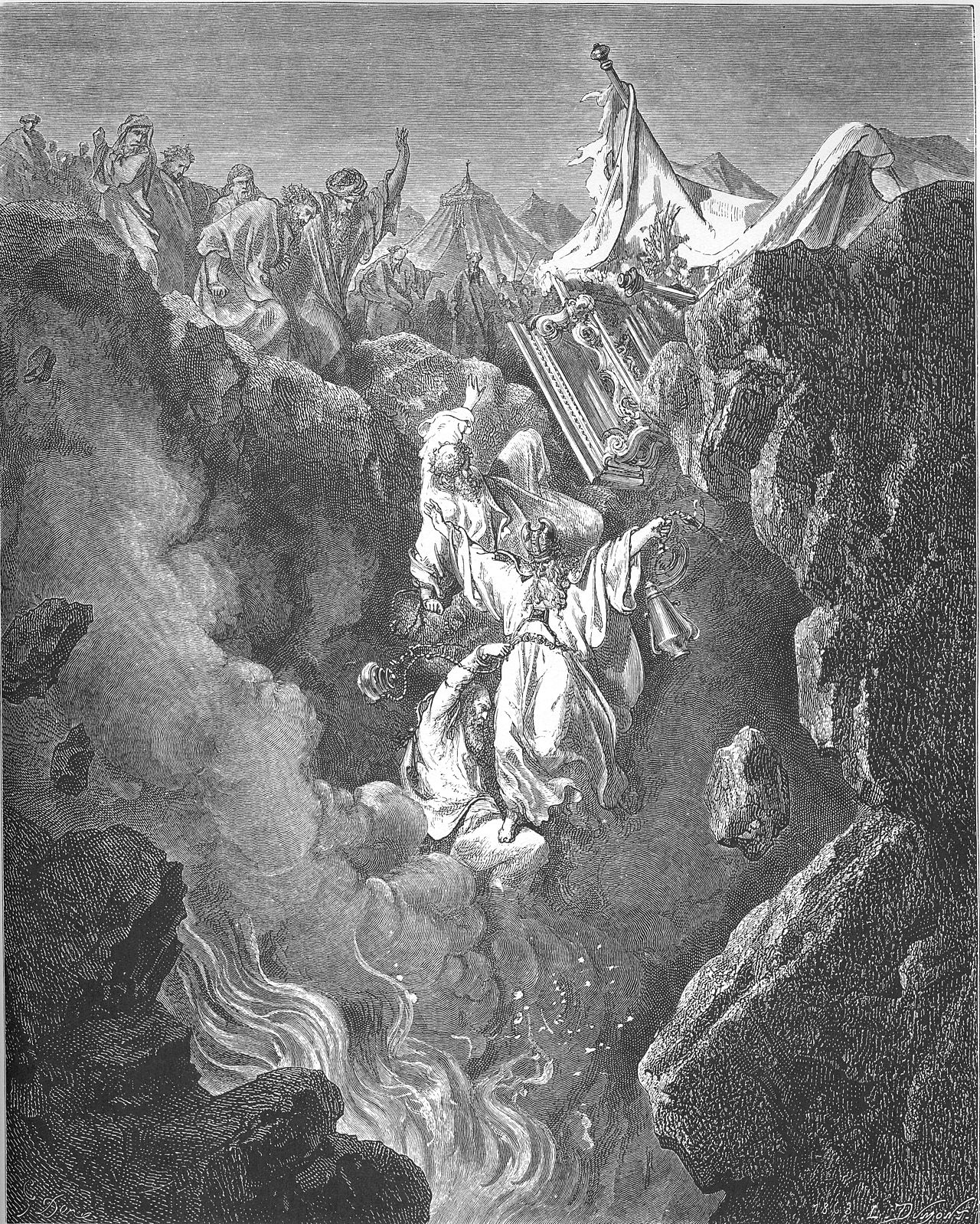
Thus Korah, Dathan and Abiram, who tried to assume for themselves in opposition to Moses and Aaron the freedom to sacrifice, immediately paid the penalty for their efforts. The earth, breaking its bonds, opened up into a deep chasm, and the opening of the receding ground swallowed up the standing and the living. And not only did the anger of the indignant God strike those who had been the authors [of the revolt], but also fire that went out from the Lord in speedy revenge consumed 250 others, participants and sharers in the same madness, who had been joined together with them in the daring plan. Clearly [this] warned and showed that whatever the wicked attempt by human will to destroy God's plan is done against God.
But that they are said to have the same God the Father as we, to know the same Christ the Son, the same Holy Spirit, can be of no avail to such as these. For even Korah, Dathan, and Abiram knew the same God as did the priest Aaron and Moses. Living under the same law and religion, they invoke the one and true God, who was to be invoked and worshipped; yet, because they transgressed the ministry of their office in opposition to Aaron the priest, who bad received the legitimate priesthood by the condescension of God and the ordination of the Lord, and claimed to themselves the power of sacrificing, divinely stricken, they immediately suffered punishment for their unlawful endeavours; and sacrifices offered irreligiously and lawlessly, contrary to the right of divine appointment, could not be accepted, nor profit them.
Let those then who dissent learn to fear to rouse up the Lord, and to appease His priests. What! did not the earthquake swallow up Dathan, Abiron, and Korah because of their dissension? For when Korah, Dathan, and Abiron had stirred up two hundred and fifty men against Moses and Aaron to separate themselves from them, they rose up against them and said: "Let it suffice you that all the congregation are holy, every one, and the Lord is amongst them." Whereupon the Lord was angry and spoke to the whole congregation.
The Puritans and the Awakening2 voices
All are holy - A kingdom of priests, an holy nation, as they are called, Exod. xix, 6, a people separated to the service of God, and therefore no less fit to offer sacrifice and incense, than you are. Among them - By his tabernacle and cloud, the tokens of his gracious presence, and therefore ready to receive sacrifices from their own hands.
They unjustly charge Moses and Aaron with taking the honour they had to themselves, whereas it was evident, beyond contradiction, that they were called of God to it, Heb. v. 4 .
2 more voices on this verse
The Puritans and the Awakening1 voice
And they gathered themselves together against Moses, and against Aaron,....
The Nineteenth Century1 voice
Ye take too much upon you - The original is simply רב לכם rab lachem, too much for you. The spirit of this saying appears to me to be the following: - “Holy offices are not equally distributed: you arrogate to yourselves the most important ones, as if your superior holiness entitled you alone to them; whereas all the congregation are holy, and have an equal right with you to be employed in the most holy services.” Moses retorts this saying Num 16:7: Ye take too much upon you, רב לכם rab lachem; Ye have too much already, ye sons of Levi; i.e., by your present spirit and disposition you prove yourselves to be wholly unworthy of any spiritual employment.
The words behind it
21 Hebrew wordsEvery Hebrew word of this verse in the order it stands, with what it means and the door to its own study. The last column counts the times a word stands in the whole Bible: the rarer the word, the more the places it appears belong together.
| Hebrew | Sound | Meaning | Word study | In the Bible |
|---|---|---|---|---|
| וַיִּֽקָּהֲל֞וּ | vaiyikahalu | and they assembled | H6950 → | 39 times |
| עַל־ | ʾal- | on | H5921 → | 5755 times |
| מֹשֶׁ֣ה | mosheh | Moses | H4872 → | 765 times |
| וְעַֽל־ | veal- | and on | H5921 → | 5755 times |
| אַהֲרֹ֗ן | ʾaharon | Aaron | H175 → | 347 times |
| וַיֹּאמְר֣וּ | vaiyomeru | and they said | H559 → | 5305 times |
| אֲלֵהֶם֮ | ʾalehem | to them | H413 → | 5510 times |
| רַב־ | rav- | enough | H7227 → | 454 times |
| לָכֶם֒ | lakhem | for <the> you | ||
| כִּ֤י | ki | that | H3588 → | 4482 times |
| כָל־ | khol- | all | H3605 → | 5413 times |
| הָֽעֵדָה֙ | haedah | the congregation | H5712 → | 149 times |
| כֻּלָּ֣ם | kulam | all of them | H3605 → | 5413 times |
| קְדֹשִׁ֔ים | kedoshim | [are] holy | H6918 → | 116 times |
| וּבְתוֹכָ֖ם | uvetokham | and [is] among midst of them | H8432 → | 418 times |
| יְהוָ֑ה | yahweh | Yahweh | H3068 → | 6520 times |
| וּמַדּ֥וּעַ | umadua' | and why? | H4069 → | |
| תִּֽתְנַשְּׂא֖וּ | titnaseu | do you exalt yourselves | H5375 → | 656 times |
| עַל־ | ʾal- | over | H5921 → | 5755 times |
| קְהַ֥ל | kehal | [the] assembly of | H6951 → | 123 times |
| יְהוָֽה׃ | yahweh | Yahweh | H3068 → | 6520 times |
וַיִּֽקָּהֲל֞וּand they assembled
vaiyikahaluH6950 →39 times
עַל־on
ʾal-H5921 →5755 times
מֹשֶׁ֣הMoses
moshehH4872 →765 times
וְעַֽל־and on
veal-H5921 →5755 times
אַהֲרֹ֗ןAaron
ʾaharonH175 →347 times
וַיֹּאמְר֣וּand they said
vaiyomeruH559 →5305 times
אֲלֵהֶם֮to them
ʾalehemH413 →5510 times
רַב־enough
rav-H7227 →454 times
לָכֶם֒for <the> you
lakhem
כִּ֤יthat
kiH3588 →4482 times
כָל־all
khol-H3605 →5413 times
הָֽעֵדָה֙the congregation
haedahH5712 →149 times
כֻּלָּ֣םall of them
kulamH3605 →5413 times
קְדֹשִׁ֔ים[are] holy
kedoshimH6918 →116 times
וּבְתוֹכָ֖םand [is] among midst of them
uvetokhamH8432 →418 times
יְהוָ֑הYahweh
yahwehH3068 →6520 times
וּמַדּ֥וּעַand why?
umadua'H4069 →
תִּֽתְנַשְּׂא֖וּdo you exalt yourselves
titnaseuH5375 →656 times
עַל־over
ʾal-H5921 →5755 times
קְהַ֥ל[the] assembly of
kehalH6951 →123 times
יְהוָֽה׃Yahweh
yahwehH3068 →6520 times
A shaded row is a word that stands 400 times or fewer in the Bible.
The walk
8 stopsEach card is a verse this one points to, and under it the verses that one points to in turn. Where several paths arrive at the same place, that place is listed first: the text keeps returning to it.
Through
Exodus 19:6And unto Me you shall be a kingdom of priests and a holy nation.’ These are the words that you are to speak to the Israelites.”
it leads to
- Revelation 5:10
You have made them to be a kingdom and priests to serve our God, and they will reign upon the earth.”
- 1 Peter 2:9
But you are a chosen people, a royal priesthood, a holy nation, a people for God’s own possession, to proclaim the virtues of Him who called you out of darkness into His marvelous light.
- 1 Peter 2:5
you also, like living stones, are being built into a spiritual house to be a holy priesthood, offering spiritual sacrifices acceptable to God through Jesus Christ.
- Deuteronomy 7:6
For you are a people holy to the LORD your God. The LORD your God has chosen you to be a people for His prized possession out of all peoples on the face of…
- Revelation 1:6
who has made us to be a kingdom, priests to His God and Father—to Him be the glory and power forever and ever! Amen.
- Revelation 5:10
Through
Acts 7:51You stiff-necked people with uncircumcised hearts and ears! You always resist the Holy Spirit, just as your fathers did.
it leads to
- Deuteronomy 10:16
Circumcise your hearts, therefore, and stiffen your necks no more.
- Jeremiah 4:4
Circumcise yourselves to the LORD, and remove the foreskins of your hearts, O men of Judah and people of Jerusalem. Otherwise, My wrath will break out like fire and burn with no one to…
- Ephesians 4:30
And do not grieve the Holy Spirit of God, in whom you were sealed for the day of redemption.
- Deuteronomy 10:16
Where this verse is studied
On this page
Studies3
On this verse
On this chapter
About Numbers
Who and where
2 names in this verse with a page on the site.
This page draws on 9 works. Open the list of works
This page draws on Adam Clarke, Commentary on the Bible; Albert Barnes, Notes, Explanatory and Practical, on the Old and New Testaments (1832-1869); Ambrose of Milan, Epistle 63; Cyprian, Treatise I. On the Unity of the Church 18; Cyprian, Epistle LXXV.8; John Gill, Exposition of the Old Testament (1748-1763); John Wesley, Explanatory Notes upon the Old Testament; Keil and Delitzsch, Biblical Commentary on the Old Testament: The Pentateuch and Matthew Henry, Commentary on the Whole Bible.