
Numbers 16:48
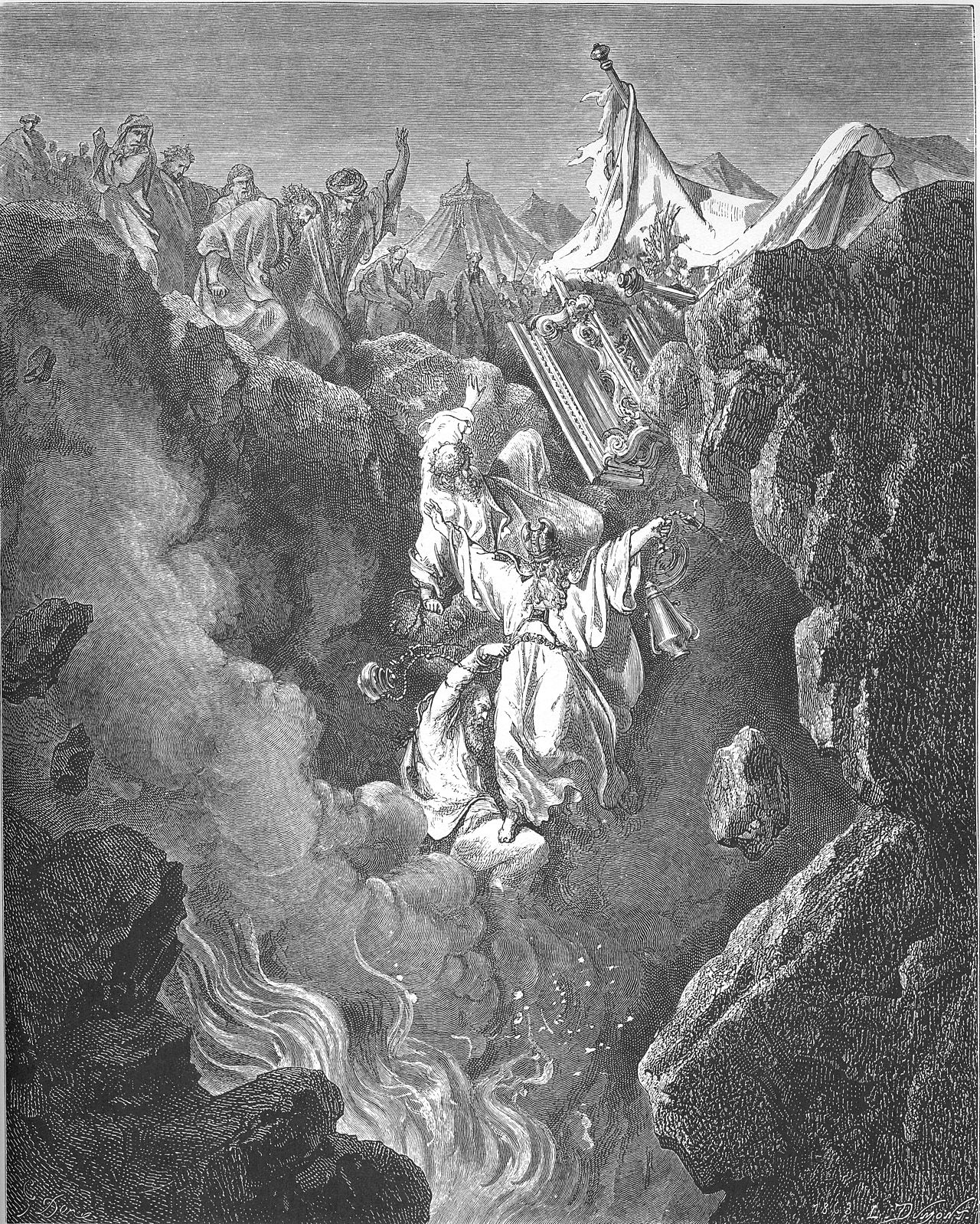
in Numbers 16He stood between the living and the dead, and the plague was halted.
BSB
The same verse in ASV and KJV ▾
ASV
And he stood between the dead and the living; and the plague was stayed.
KJV
And he stood between the dead and the living; and the plague was stayed.
⋯
This verse in Numbers 16
Commentary
8 notes on this verseThe living - Whereby it may seem that this plague, like that fire, chap. xi, 1, began in the uttermost parts of the congregation, and so proceeded destroying one after another in an orderly manner, which gave Aaron occasion and direction so to place himself, as a mediator to God on their behalf.
This site's exposition
Take a censer, and put fire therein from off the altar
on Numbers 16:46-48
The censer that killed two hundred and fifty men the day before now stops a plague, and what has changed is the hand that carries it and the fire that fills it, taken from off the altar. Aaron runs, which is the one action recorded of him in the chapter, and he stands between the dead and the living until the plague is stayed. The office Korah wanted is settled by what it does for the people who had just accused the man holding it.
The record, by era
The Puritans and the Awakening2 voices
And he stood between the dead and the living,....
11 For which cause both thou and all thy company are gathered together against the L ORD : and what is Aaron, that ye murmur against him? An account of the rebels, who and what they were, not, as formerly, the mixed multitude and the dregs of the people, who are therefore never named, but men of distinction and quality, that made a figure.
The Nineteenth Century3 voices
A commentator
Jamieson, Fausset & Brown1802–1910
Commentary Critical and Explanatory on the Whole Bible (1871)
proposed
he stood between the living and the dead--The plague seems to have begun in the extremities of the camp. Aaron, in this remarkable act, was a type of Christ.
quarantine:debris (2026-07-29) — starts-lowercase
WE HAVE ATTENTIVELY read the passage which contains the account of this transaction. The authority of Moses and Aaron had been disputed by an ambitious man belonging to an elder branch of the family of Levi, who had craftily joined with himself certain factious spirits of the tribe of Reuben, who themselves also sought to attain to power by their supposed rights through Reuben the firstborn. By a singular judgment from heaven, God had proved that rebellion against Moses was a mortal sin.
WE HAVE ATTENTIVELY read the passage which contains the account of this transaction. The authority of Moses and Aaron had been disputed by an ambitious man belonging to an elder branch of the family of Levi, who had craftily joined with himself certain factious spirits of the tribe of Reuben, who themselves also sought to attain to power by their supposed rights through Reuben the firstborn. By a singular judgment from heaven, God had proved that rebellion against Moses was a mortal sin. He had bidden the earth open its mouth and swallow up all the traitors, and both Levites and Reubenites had disappeared, covered in a living grave. One would have imagined that from this time the murmurings of the children of Israel would have ceased, or that at least even should they have daring enough to gather in little mutinous knob, yet their traitorous spirit never would have come to so great a height as to develops itself in the whole body openly before the Lord's tabernacle. Yet so was it. On the very morrow after that solemn transaction, the whole of the people of Israel gathered themselves together, and with unholy clamours surrounded Moses and Aaron, charging them with having put to death the people of the Lord. Doubtless they hinged this accusation upon the fact, that whenever Moses prayed God heard him; then would they say, "Had he prayed upon this occasion the people would not have been destroyed; the earth would not have opened her mouth, and they would not have been swallowed up." They would thus attempt to prove the charge which they brought against these two great men of God. Can you picture the scene now in your mind's eye.
1 more voice on this verse
The Nineteenth Century1 voice
He stood between the dead and the living; and the plague, etc. - What the plague was we know not, but it seems to have begun at one part of the camp, and to have proceeded regularly onward; and Aaron went to the quarter where it was then prevailing, and stood with his atonement where it was now making its ravages, and the plague was stayed; but not before 14,700 had fallen victims to it, Num 16:
The words behind it
7 Hebrew wordsEvery Hebrew word of this verse in the order it stands, with what it means and the door to its own study. The last column counts the times a word stands in the whole Bible: the rarer the word, the more the places it appears belong together.
| Hebrew | Sound | Meaning | Word study | In the Bible |
|---|---|---|---|---|
| וַיַּעֲמֹ֥ד | vaiyaamod | and he stood | H5975 → | 521 times |
| בֵּֽין־ | bein- | between | H996 → | 407 times |
| הַמֵּתִ֖ים | hametim | the dead | H4191 → | 839 times |
| וּבֵ֣ין | uvein | and between | H996 → | 407 times |
| הַֽחַיִּ֑ים | hachaiyim | the living | H2416 → | 498 times |
| וַתֵּעָצַ֖ר | vateatzar | and it was restrained | H6113 → | 47 times |
| הַמַּגֵּפָֽה׃ | hamagefah | the plague | H4046 → | 25 times |
וַיַּעֲמֹ֥דand he stood
vaiyaamodH5975 →521 times
בֵּֽין־between
bein-H996 →407 times
הַמֵּתִ֖יםthe dead
hametimH4191 →839 times
וּבֵ֣יןand between
uveinH996 →407 times
הַֽחַיִּ֑יםthe living
hachaiyimH2416 →498 times
וַתֵּעָצַ֖רand it was restrained
vateatzarH6113 →47 times
הַמַּגֵּפָֽה׃the plague
hamagefahH4046 →25 times
A shaded row is a word that stands 400 times or fewer in the Bible.
The walk
8 stopsEach card is a verse this one points to, and under it the verses that one points to in turn. Where several paths arrive at the same place, that place is listed first: the text keeps returning to it.
Through
Psalms 106:30But Phinehas stood and intervened, and the plague was restrained.
it leads to
- Numbers 25:6–8
Just then an Israelite man brought to his family a Midianite woman in the sight of Moses and the whole congregation of Israel while they were weeping at the entrance to the Tent of…
- Joshua 7:12
This is why the Israelites cannot stand against their enemies. They will turn their backs and run from their enemies, because they themselves have been set apart for destruction. I will no longer be…
- Numbers 25:14–15
The name of the Israelite who was slain with the Midianite woman was Zimri son of Salu, the leader of a Simeonite family.
- Jonah 1:12–15
“Pick me up,” he answered, “and cast me into the sea, so it may quiet down for you. For I know that I am to blame for this violent storm that has come upon…
- Deuteronomy 13:9–11
Instead, you must surely kill him. Your hand must be the first against him to put him to death, and then the hands of all the people.
- Numbers 25:6–8
Through
2 Samuel 24:25And there he built an altar to the LORD and offered burnt offerings and peace offerings. Then the LORD answered the prayers on behalf of the land, and the plague upon Israel was halted.
it leads to
- 2 Samuel 21:14
And they buried the bones of Saul and his son Jonathan in Zela in the land of Benjamin, in the tomb of Saul’s father Kish. After they had done everything the king had commanded,…
- 2 Samuel 24:14
David answered Gad, “I am deeply distressed. Please, let us fall into the hand of the LORD, for His mercies are great; but do not let me fall into the hands of men.”
- 1 Samuel 7:17
Then he would return to Ramah because his home was there, and there he judged Israel and built an altar to the LORD.
- 2 Samuel 21:14
Where this verse is studied
On this page
Studies3
On this verse
On this chapter
About Numbers
This page draws on Adam Clarke, Commentary on the Bible; Charles Spurgeon, The New Park Street Pulpit, Sermon No. 341: “The High Priest Standing Between the Dead and the Living” (lightly modernized text, CCEL edition); Jamieson, Fausset & Brown, Commentary Critical and Explanatory on the Whole Bible; John Gill, Exposition of the Old Testament (1748-1763); John Wesley, Explanatory Notes upon the Old Testament; Matthew Henry, Commentary on the Whole Bible and Sir Robert Anderson, Types in Hebrews.