
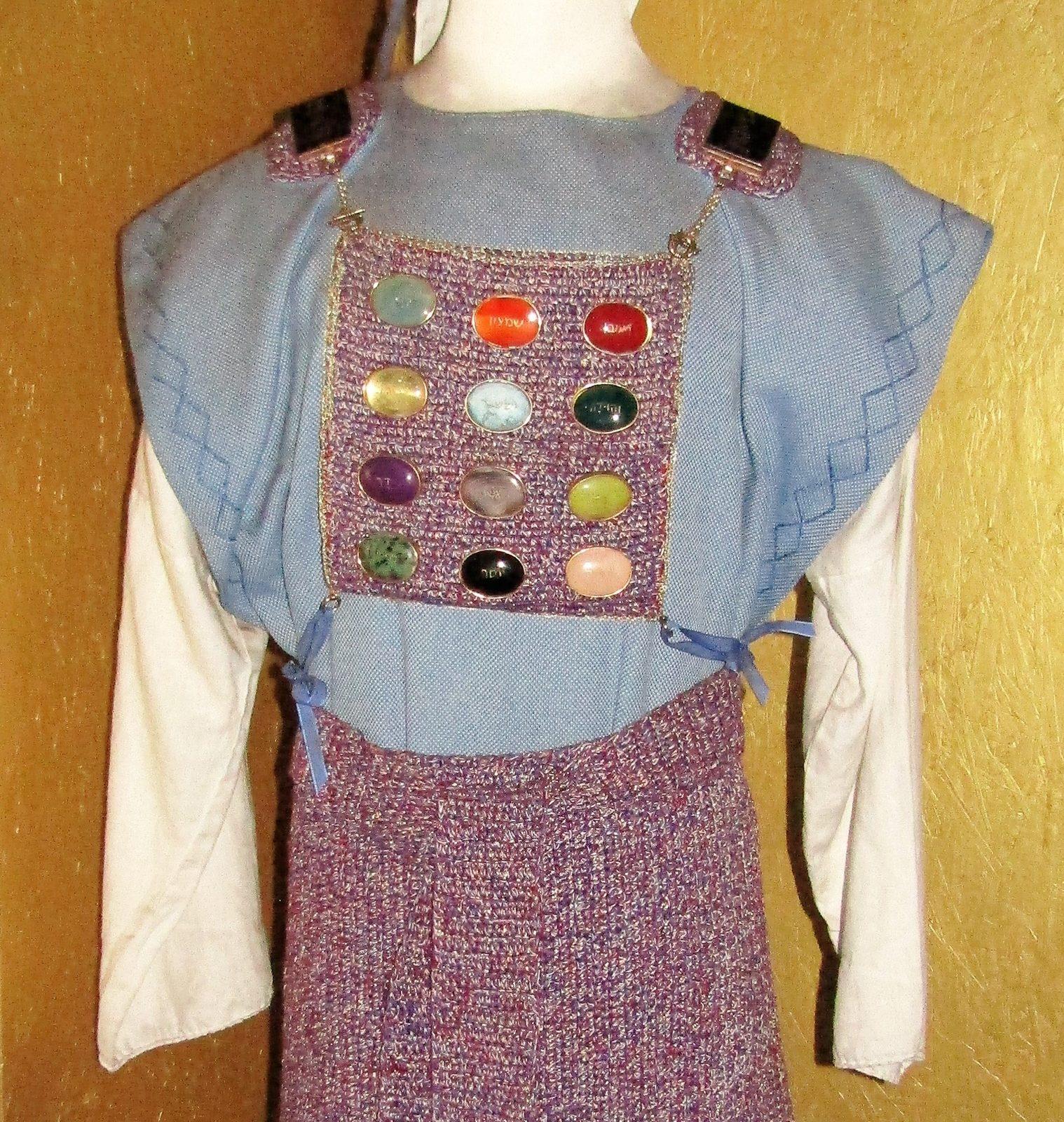
Ben P L, High Priests clothing, 2017. CC BY 2.0.
Exodus 28:15 to 30 · Symbol · Featured Study
The Breastplate
Exodus 28:15 gives it its full name, the breastpiece of judgment.
Exodus 28 gives the breastpiece sixteen verses, more than any other garment of the high priest.
You are also to make a breastpiece of judgment with the same workmanship as the ephod. Construct it with gold, with blue, purple, and scarlet yarn, and with finely spun linen. It must be square when folded over double, a span long and a span wide.
- The word
- חֹשֶׁן (choshen), H2833
- First appears
- Exodus 25:7 “and onyx stones and gemstones to be mounted…”
Summary
Exodus 25:7 is the first verse to name it.
- In Exodus 35:27 the leaders bring onyx stones and gemstones for the ephod and the breastpiece.
- In Revelation 9:9 the locusts had thoraxes like breastplates of iron.
- 1 Thessalonians 5:8 calls faith and love a breastplate.
Over Aaron's Heart
Exodus 28:4 names six garments for Aaron, and the breastpiece is the first.
The question here is what the breastpiece was and how it was worn.
So the breastpiece was a piece of woven work, doubled over into a square about a hand's span on each side. Exodus 28:29 has Aaron bear it whenever he enters the Holy Place. The other five garments Exodus 28:4 names are the ephod, the robe, the woven tunic, the turban and the sash. The breastpiece hung on the front of the ephod. Older English Bibles call it the breastplate, as the Berean text itself does once, in Exodus 29:5.
And place the Urim and Thummim in the breastpiece of judgment, so that they will also be over Aaron’s heart whenever he comes before the LORD. Aaron will continually carry the judgment of the sons of Israel over his heart before the LORD.It stands here because this verse says what Aaron carried over his heart besides the names.
The twelve stones, their names and the readings later teachers gave them are taught with the precious stones.
How the Breastpiece Was Fastened
Six parts named in Exodus 28:22 to 28 held the breastpiece in place.
The breastpiece hung between the shoulder settings above and the waistband of the ephod below.
one span
- The settings on the shoulder piecesgold filigree on the ephod's shoulders, where the chains endExodus 28:25
- Two braided gold chainsfastened to the rings at the cornersExodus 28:24
- Two gold rings at the upper cornersfastened to the two corners of the breastpieceExodus 28:23
- Two rings at the lower cornersThey sit on the inside edge next to the ephod.Exodus 28:26
- A cord of blue yarnties the breastpiece's rings to the rings of the ephodExodus 28:28
- Two rings on the ephodnear its seam just above the woven waistbandExodus 28:27
The rings, the chains and the cord stand where Exodus 28:22 to 28 places them; the lower rings sit on the inside edge, and the lengths of the chains and the cord are not given.
Each number marks a part the text names, and the Verse column opens the instruction for it.
A print of about 1874 gives Aaron a breastpiece of gold.
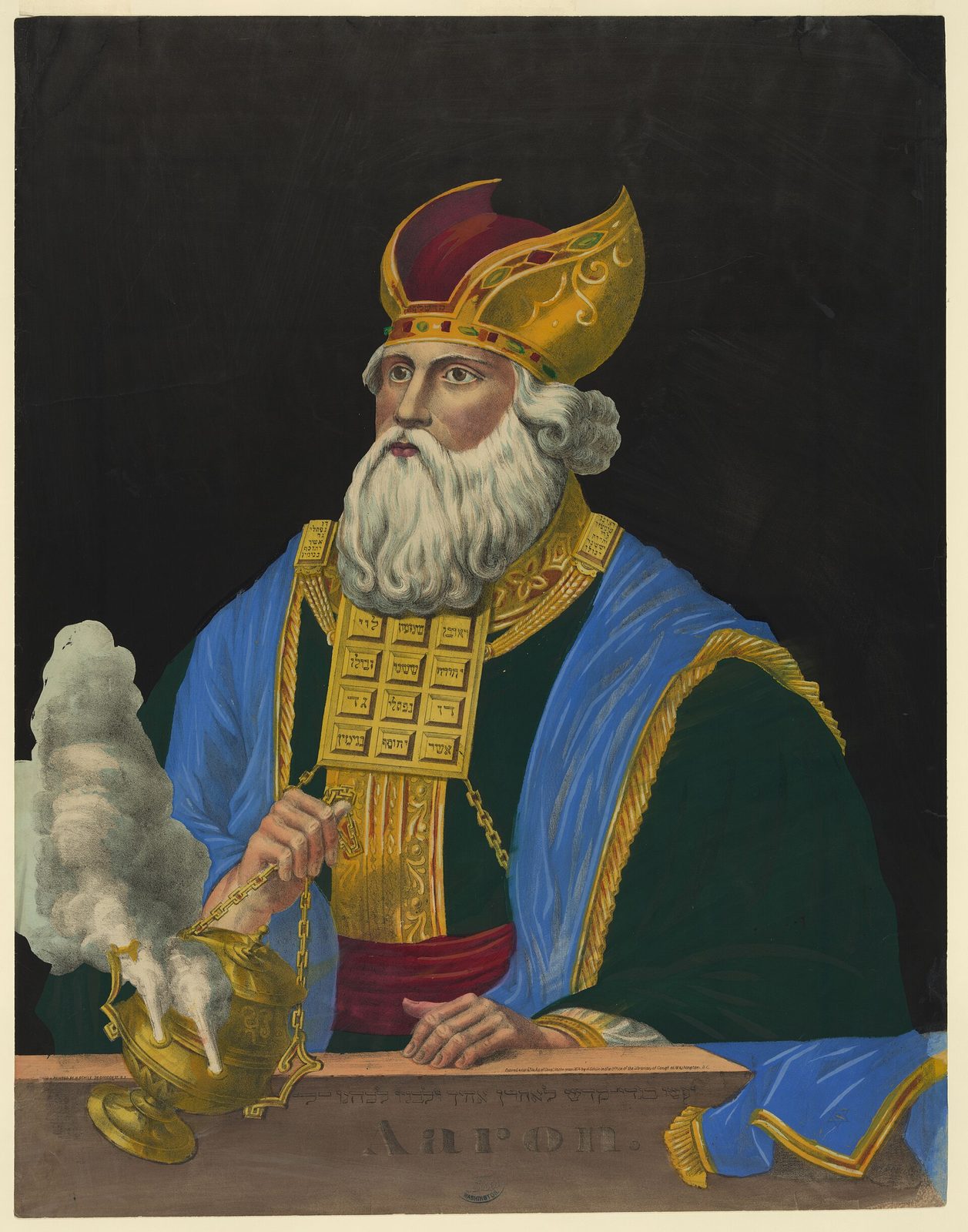
- The namestwelve names in Hebrew, in four rows of threeExodus 28:21
- The sasha red band at the waistExodus 28:39
- The censerheld on its chain, with smoke risingLeviticus 16:12
Henry Schile, Aaron, about 1874, hand-coloured lithograph, Library of Congress, Prints and Photographs Division, pga.02655. Public domain, as Wikimedia Commons states its licence. Wikimedia Commons, File:Aaron_-_Henry_Schile_c.1874.jpg.
Henry Schile, a nineteenth-century artist, departs from the text in six things the eye can see. He sets gold plaques where Exodus 28:17 to 20 has stones, and he makes the piece a little taller than wide against the square of Exodus 28:16. The shoulder pieces are gold plaques where Exodus 28:9 has onyx stones, and the robe is dark green where Exodus 28:31 makes it blue. He gives Aaron a gold and red cap where Exodus 28:39 has a turban of fine linen. He also hangs the chains below the piece, where Exodus 28:24 to 25 runs them up to the shoulders.
Made and Worn
The making and the first wearing follow the commands of Exodus 28.
The record of the work in Exodus 39 ends its account of the breastpiece at Exodus 39:21, on the cord of blue yarn. In Leviticus 8 Moses dresses Aaron in front of the whole congregation. The picture at the head of the page is a modern replica, taller than the square of Exodus 28:16.
Then he put the breastpiece on him and placed the Urim and Thummim in the breastpiece.It stands here because Moses puts the breastpiece on Aaron after the ephod of Leviticus 8:7, so it is tied to an ephod already worn.
Matthew Henry on Exodus 28:28Commentary on the Whole Bible
Matthew Henry, the Presbyterian commentator, reads the blue cord as a lesson. The ephod was the garment of service and the breastpiece of judgment an emblem of honour, and he writes that the two must by no means be separated.
The Words for the Breastpiece
Each card gives the word's gloss, its count and a verse.
choshen
25 uses in the canon
Strong's concordance gives perhaps a pocket, as holding the Urim and Thummim, or rich, as containing gems, and says the word is used only of the high priest's breastpiece.
shiryon
9 uses in the canon
The word means a corslet, as if twisted, and Isaiah uses it of the righteousness the LORD puts on like armour.
thorax
5 uses in the canon
The Greek word means the chest and so a corslet, the soldier's breastplate of Paul's letters.
What Scripture Leaves Unsaid
The silence concerns the garments of one day.
Leviticus 16:4 names the garments Aaron wears on the Day of Atonement, and the breastpiece is not among them.
A Priest Who Does Not Die
Hebrews 7:24 speaks of a permanent priesthood.
As Numbers 20:28 records, Moses removed Aaron's garments and put them on Eleazar his son, and then Aaron died on the top of the mountain.
Therefore He is able to save completely those who draw near to God through Him, since He always lives to intercede for them.Hebrews 7:23 has just said that death prevented the other priests from continuing in office.
The Name of Judgment
Rashi and Adam Clarke each give reasons for the name.
The Hebrew name is choshen mishpat. Strong's concordance gives mishpat as a verdict pronounced judicially, and also as justice, a right and an ordinance.
Rashi on Exodus 28:15Atonement for error, and clear answers
Rashi, the Jewish commentator of France who lived from 1040 to 1105, writes that it was called the breastpiece of judgment because it atoned for any error in judgment, citing the Talmud at Zevachim 88b. He gives a second reason, that its statements were clear and its promise true.
The objection is that Exodus 28:30 names no atonement for errors.
Adam Clarke on Exodus 28:15Counsel sought, and judgment given
Adam Clarke, the Methodist commentator, writes in his Commentary on the Bible that the high priest wore it when he went to ask counsel of the Lord to give judgment. He adds that it was worn when the high priest sat as judge to teach the law.
The objection is that Exodus 28:29 sets no such limit on when it was worn.
Books to Read Next
One Jewish commentary opens Exodus 28 for a reader who wants the next step.
Pentateuch with Rashi's commentary
Rashi, in the English of M. Rosenbaum and A. M. Silbermann · 1929 to 1934
It is free to read at Sefaria.
READ HIS NOTES ON EXODUS 28 →In the Presence of God
For Christ did not enter a man-made copy of the true sanctuary, but He entered heaven itself, now to appear on our behalf in the presence of God.It stands here because Hebrews sets the work of Christ beside the work of the high priest.
Sources
Scripture is the Berean Standard Bible.
- James Strong, Exhaustive Concordance of the Bible, 1890, entries H2833, H4941, H8302 and G2382.
- Rashi (1040 to 1105, France), Commentary on Exodus 28:15, in Pentateuch with Rashi's commentary, translated by M. Rosenbaum and A. M. Silbermann, 1929 to 1934.
- Adam Clarke, Commentary on the Bible, on Exodus 28:15.
- Matthew Henry, Commentary on the Whole Bible, on Exodus 28:28.
Keep Studying
Symbols5