
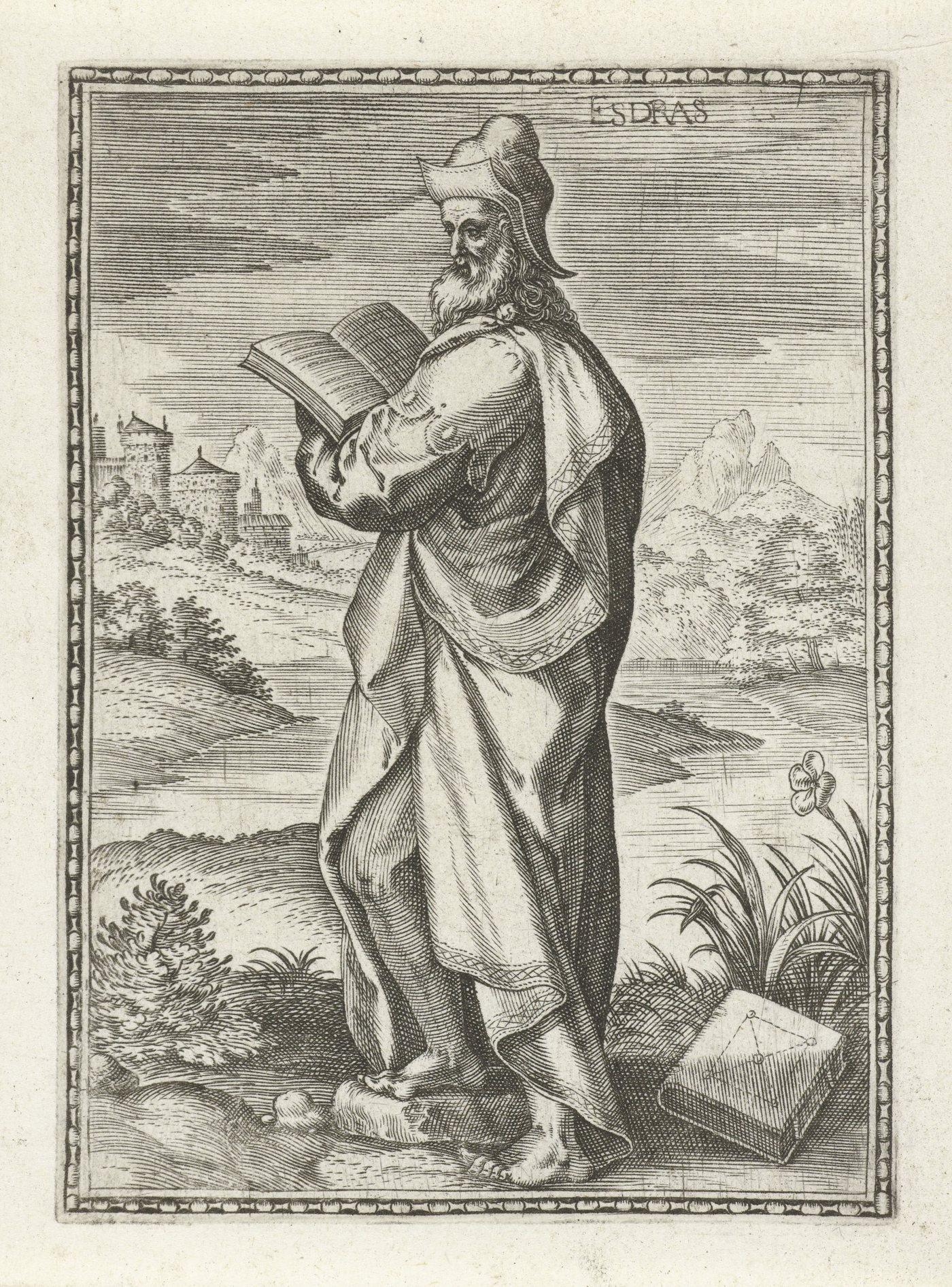
Johann Sadeler I after Crispijn van den Broeck, Ezra, 1575. Public domain.
Ezra 7 to 10 and Nehemiah 8 and 12 · Person · Featured Study
Ezra
Ezra the priest and scribe led a company of exiles from Babylon to Jerusalem in the seventh year of King Artaxerxes.
Ezra weighed the king's silver and gold into the hands of twelve priests and told them that they were holy to the LORD.
and who has shown me favor before the king, his counselors, and all his powerful officials. And because the hand of the LORD my God was upon me, I took courage and gathered the leaders of Israel to return with me.
and who has shown me favor before the king, his counselors, and all his powerful officials. And because the hand of the LORD my God was upon me, I took courage and gathered the leaders of Israel to return with me.
- Family
- forebear: Seraiah; forebear: Aaron
- Places
- Babylon, Jerusalem
- First named
- Ezra 7:1 “…of Artaxerxes king of Persia, Ezra son of…”
- Last named
- Nehemiah 12:36 “…David the man of God. Ezra the scribe…”
Summary
Ezra went to Jerusalem with the king's letter and with gifts for the house of God. There he wept over the marriages made with the peoples of the land. He read the Law to the people, and he walked with the singers when the new wall was set apart to God. His own words show a man who trusted God more than the king's horsemen.
- His company included 220 temple servants.
- He fasted again in the chamber of Jehohanan son of Eliashib.
- His name stands in twenty-five verses of Ezra and Nehemiah.
Where Ezra Stands in Scripture
Ezra enters the story at Ezra 7, after the temple is finished.
The book names his forebears before it tells how he went up.
Many years later, during the reign of Artaxerxes king of Persia, Ezra son of Seraiah, the son of Azariah, the son of Hilkiah, the son of Shallum, the son of Zadok, the son of Ahitub, the son of Amariah, the son of Azariah, the son of Meraioth, the son of Zerahiah, the son of Uzzi, the son of Bukki, the son of Abishua, the son of Phinehas, the son of Eleazar, the son of Aaron the chief priest—The list sets Ezra among the priests of Aaron's house before it names his work.
His Life, Turn by Turn
His recorded life runs from the road out of Babylon to the dedication of the wall.
Half of the ten turns came on the road and half in Jerusalem.
- Sets out on the first day of the first monthBabylonEzra 7:9
- Gathers the company of the returnthe canal that flows to AhavaEzra 8:15
- Sends for ministers of the house of GodCasiphiaEzra 8:17
- Proclaims a fast for a safe waythe Ahava CanalEzra 8:21
- Weighs the silver and gold into the priests' handsthe Ahava CanalEzra 8:25
- Arrives and rests three daysJerusalemEzra 8:32
- Hears the leaders' report and sits in horrorJerusalemEzra 9:3
- Puts the leaders and all Israel under oathbefore the house of GodEzra 10:5
- Reads the Book of the Law from daybreak until noonthe square before the Water GateNehemiah 8:3
- Leads a procession at the dedication of the wallthe wall of JerusalemNehemiah 12:36
Each turn with its verse.
Hears the leaders' report and sits in horror, Puts the leaders and all Israel under oath, Reads the Book of the Law from daybreak until noon, Leads a procession at the dedication of the wall
The report of Ezra 9 and the oath of Ezra 10 are taught at The Mixed Marriages of Ezra 9 and 10. The reading of Nehemiah 8 is taught at Ezra the Scribe and the Shape of the Canon.
The Road from Babylon
Ezra 8 follows the company from the Ahava Canal to Jerusalem.
The company at the canalEzra 8:15 to 20; Matthew Henry
Ezra camped three days by the canal. He sent leaders to Iddo at Casiphia, and they brought back Sherebiah and Hashabiah with their kinsmen, 18 men and 20 men.
“Some priests there were, but no others that were Levites. Where was the spirit of that sacred tribe? Ezra, a priest, like Moses proclaims, Who is on the Lord's side?”
Matthew Henry · Commentary on the Whole Bible · on Ezra 8:15Puritan
The fastEzra 8:21 to 23
For I was ashamed to ask the king for an escort of soldiers and horsemen to protect us from our enemies on the road, since we had told him, “The hand of our God is gracious to all who seek Him, but His great anger is against all who forsake Him.”This shame before the king is the reason Ezra gives for the fast of the verse before.
The weighed giftsEzra 8:24 to 34
The gifts came to 650 talents of silver, silver articles of 100 talents, 100 talents of gold and twenty gold bowls.
On the fourth day in Jerusalem the whole was weighed again into the hand of Meremoth son of Uriah, and the total weight was recorded.
The length of the roadEzra 7:9; Albert Barnes
Albert Barnes set the road against the map of the region.
“The direct distance of Babylon from Jerusalem is about 520 miles; and the circuitous route by Carchemish and the Orontes valley, which was ordinarily taken by armies or large bodies of men, is about 900 miles. The time occupied in the journey is long, and is perhaps to be accounted for by the dangers alluded to in Ezr 8:22, Ezr 8:31.”
Albert Barnes · Notes, Explanatory and Practical, on the Old and New Testaments (1832-1869) · on Ezra 7:9Evangelical
Seraiah and the Line of Aaron
Ezra 7:1 opens Ezra's line with the name of Seraiah.
The captain of the guard also took away Seraiah the chief priest, Zephaniah the priest of second rank, and the three doorkeepers.First Chronicles 6:14 names this Seraiah as the father of Jehozadak, who went into captivity.
Adam Clarke counted 121 years from that Seraiah's death to Ezra's going up, and took the word son to mean descendant. He also noted that 1 Chronicles 6 lists more generations between Aaron and Seraiah than Ezra 7 gives.
John Wesley wrote that Ezra was nearly related to the high priest without holding that office himself.
The Circle of Ezra
Nine people stand around him in the text.
His circle ran from the chief priests of his line to the king who sent him and the men who worked beside him.
Generation 1
Generation 2
- ArtaxerxesThe king of Persia who gave him the letter
- NehemiahThe governor who stood beside him at the reading
Generation 3
- IddoThe leader at Casiphia who sent him Levites
- SherebiahA Levite, a man of insight, who joined him at the canal
- Meremoth son of UriahThe priest who received the weighed gifts
- Shecaniah son of JehielThe man who promised him support
- Jehohanan son of EliashibThe man whose chamber Ezra withdrew to
Ring 1 holds his two forebears, ring 2 the two rulers and ring 3 his five companions.
The Places of His Story
Three places with a known site mark his story.
Ezra's road ran from Babylon to Jerusalem, and Riblah lies to the north, in the land of Hamath.
- 1Babylon, The city Ezra set out from. Ezra 7:9
- 2Riblah, The town where Seraiah the chief priest was put to death. 2 Kings 25:21
- 3Jerusalem, The city Ezra reached in the fifth month. Ezra 7:8
The coasts and rivers are simplified; each place stands at its place page's coordinates.
Babylon, Riblah and Jerusalem, each with its verse. The site of the Ahava Canal is disputed, and the site of Casiphia is unknown.
Questions His Life Raises
Two questions are taken up here from the commentators and later writers.
Are the Ezras of Nehemiah 12:1 and Nehemiah 12:33 the same man?Nehemiah 12:1 and Nehemiah 12:33; Wesley, Henry and Gill
Now these are the priests and Levites who went up with Zerubbabel son of Shealtiel and with Jeshua: Seraiah, Jeremiah, Ezra,Zerubbabel came up in the first year of Cyrus, long before Ezra went up.
John Wesley allowed either another Ezra or the same man at a great age. Matthew Henry wrote that this was supposed to be someone other than Ezra the scribe.
John Gill held that the Ezra of Nehemiah 12:33 was one of the princes, because Ezra the scribe has another place in the procession at Nehemiah 12:36.
Where was Ezra buried?Josephus and Benjamin of Tudela
Josephus, in his Antiquities, says that Ezra died an old man and was buried with great honour at Jerusalem.
Benjamin of Tudela describes the sepulchre of Ezra the priest beyond the river Samara, with 1,500 Jews living near it and a large synagogue in front of it. He writes that Ezra went from Jerusalem to King Artaxerxes and died there.
What the Text Leaves Unsaid
The text leaves three things about him untold.
The Gracious Hand of His God
Ezra credits each stage of the road to the hand of God upon him.
The phrase marks the king's favour, the finding of Levites and the safe road alike, and Nehemiah uses it of the king's favour to him.
On the twelfth day of the first month we set out from the Ahava Canal to go to Jerusalem, and the hand of our God was upon us to protect us from the hands of the enemies and bandits along the way.Ezra had told the king that this hand is gracious to all who seek Him, and the safe arrival bears it out.
Voices on Ezra
A modern teacher reads Ezra's choice at the canal as a test of faith.
Derek Prince (1915 to 2003)
Fasting for Self-Humbling (radio teaching, Fasting series pt. 1)
Prince set the two courses open to Ezra side by side.
“Really, Ezra had two alternatives there: the carnal or the spiritual. He could have resorted to the carnal and asked for that band of soldiers and horsemen; it would not have been sinful, but it would have been on a low level of faith.”
on Ezra 8:21 to 23Pentecostal-Charismatic
Where Was the Ahava Canal?
Readers differ on where Ezra gathered his company.
Now I assembled these exiles at the canal that flows to Ahava, and we camped there three days. And when I searched among the people and priests, I found no Levites there.Strong's dictionary calls Ahava a river of Babylonia, and the name stands in three verses of Ezra 8.
A town and river at HitAlbert Barnes
Albert Barnes held that Ahava was both a town and a river, at the place now called Hit on the Euphrates, famous for its bitumen springs, about 80 miles north-west of Babylon.
The objection: Jamieson, Fausset and Brown would say only that it lay in Babylonia, on one of the canals joined to the Euphrates.
A canal of BabyloniaJamieson, Fausset and Brown
Jamieson, Fausset and Brown judged it probable that Ahava was one of the streams or canals of Mesopotamia joined to the Euphrates, perhaps beside a town of the same name. They held it certain that it was in Babylonia.
The objection: Barnes gave the place a name and a distance, which their reading leaves open.
The Diava of AdiabeneAdam Clarke
Adam Clarke reported the view that Ahava is the river called Diava or Adiava, in the province of Adiabene.
The objection: Strong's dictionary and both other readings set Ahava in Babylonia.
Books to Read Next
Both works are in the public domain, and each has a free copy to read.
Commentary on the Whole Bible, Volume II (Joshua to Esther)
Matthew Henry · 1710
Henry's notes on Ezra 8 cover the company at the canal and the Levites Ezra sent for.
Read at the Christian Classics Ethereal LibraryThe Itinerary of Benjamin of Tudela
Benjamin of Tudela, translated by Marcus Nathan Adler · 1907
Page 73 gives Benjamin's account of the river Samara and what he was shown there.
Read at Project GutenbergI Took Courage
Sources
Scripture is the Berean Standard Bible.
- James Strong, Exhaustive Concordance of the Bible (1890), Hebrew and Chaldee dictionary, entries 163, 5830 and 5831, and the verses that carry them.
- Matthew Henry, Commentary on the Whole Bible, Volume II (Joshua to Esther) (1710), on Ezra 8:15 and Nehemiah 12:1.
- Jamieson, Fausset and Brown, Commentary Critical and Explanatory on the Whole Bible (1871), on Ezra 8:15.
- Albert Barnes, Notes, Explanatory and Practical, on the Old and New Testaments (1832 to 1869), on Ezra 7:9 and 8:15.
- Adam Clarke, Commentary on the Bible (1832), on Ezra 7:1 and 8:15.
- John Wesley, Explanatory Notes upon the Old Testament (1765), on Ezra 7:1 and Nehemiah 12:1.
- John Gill, Exposition of the Old Testament (1748 to 1763), on Nehemiah 12:33.
- Flavius Josephus, Antiquities of the Jews 11.5.5 (11.158), translated by William Whiston.
- The Itinerary of Benjamin of Tudela, translated by Marcus Nathan Adler, 1907, p. 73.
- Derek Prince, Fasting for Self-Humbling, radio teaching, the series on fasting, part 1.
Keep Studying
Read it5
People and groups5