
Place
Mount Hor
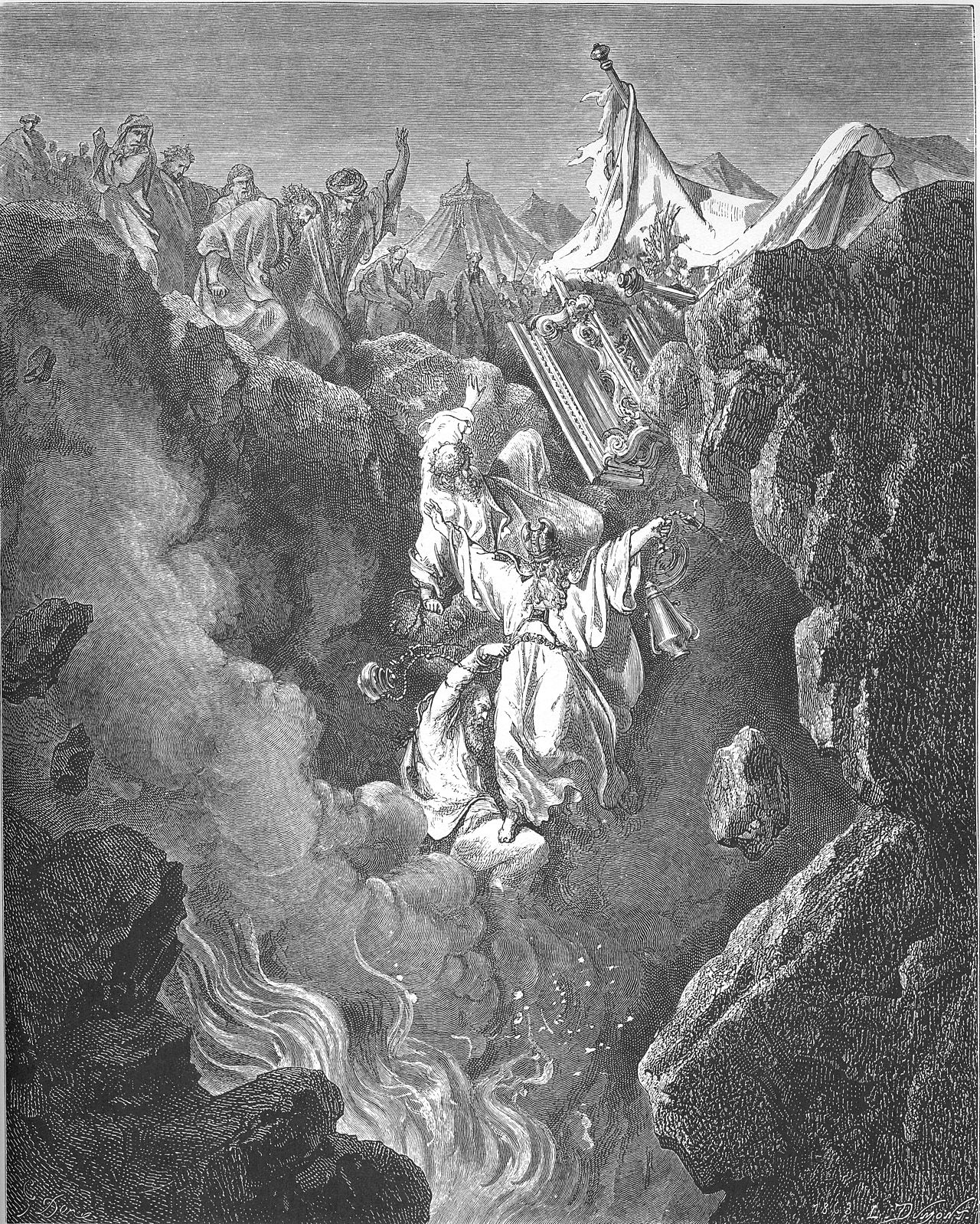
Gustave Doré, La Sainte Bible (Tours: Alfred Mame et fils, 1866). Public domain.
Summary
On the border of Edom, where Aaron was gathered to his people and the priesthood passed to Eleazar in the sight of the congregation.
- Mount Hor stands on the border of Edom, and it is where Aaron died in the fortieth year after Israel came out of Egypt.
- Moses took the priestly garments off Aaron and put them on Eleazar before Aaron died, so Israel was never without a high priest.
- The whole congregation watched three men climb and two come down, and the whole house of Israel mourned thirty days.
- Deuteronomy 10:6 says Aaron died at Moserah, and this page prints both texts with the readings that hold them together.
- The traditional site is Jebel Harun near Petra. That identification has been disputed since the nineteenth century, and this page does not settle it.
On this page
In Scripture
- Verses
- 12
- Books
- 2
Near Mount Hor
- Sela4.7 km · 3.0 mi E
- Bozrah50 km · 31 mi N
- Gomorrah94 km · 58 mi N
- Kadesh-Barnea97 km · 60 mi NW
- Sodom98 km · 61 mi N
- Beersheba116 km · 72 mi NW
Straight-line distances, computed from the gazetteer coordinates.
Where it is
the country around it
- Coordinates
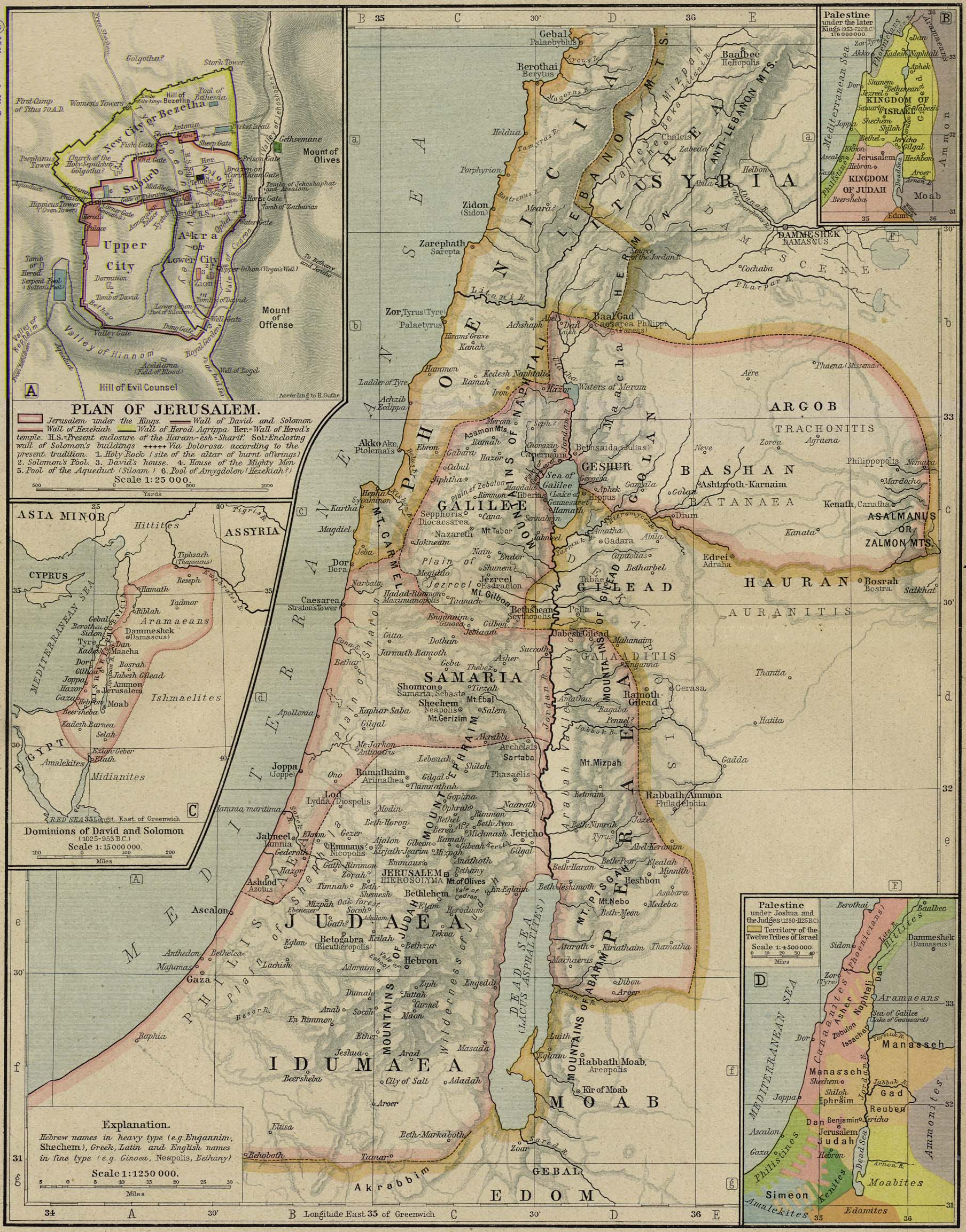
- 30.3174° N, 35.4072° Efind it on the Atlas →
- Region
- Edomite border
- Kind of place
- Mountain
- Located: the gazetteer fixes one site
Not located: Egypt, Edom, Moab, The Red Sea. The gazetteer records no location for them, so they are not marked.
Why Mount Hor matters
What has been found
the evidence, and where it is disputed
Aaron dies on Mount Hor, and the garments pass to Eleazar
Numbers 20:21 to 21:4, in the order it happens
Read Numbers 20:21 to 21:4, in the order it happens
- Edom shuts the roadNumbers 20:21So Edom refused to allow Israel to pass through their territory, and Israel turned away from them.
- The whole congregation comes to the mountainNumbers 20:22After they had set out from Kadesh, the whole congregation of Israel came to Mount Hor.
- The sentence named at the foot of itNumbers 20:24“Aaron will be gathered to his people; he will not enter the land that I have given the Israelites, because both of you rebelled against My command at the waters of Meribah.
- Take Aaron and Eleazar upNumbers 20:25Take Aaron and his son Eleazar and bring them up Mount Hor.
- Remove the garments, put them on his sonNumbers 20:26Remove Aaron’s priestly garments and put them on his son Eleazar. Aaron will be gathered to his people and will die there.”
- Three men climb, in full view of the campNumbers 20:27So Moses did as the LORD had commanded, and they climbed Mount Hor in the sight of the whole congregation.
- Aaron dies on top of the mountainNumbers 20:28After Moses had removed Aaron’s garments and put them on his son Eleazar, Aaron died there on top of the mountain. Then Moses and Eleazar came down from the mountain.
- Thirty days of mourningNumbers 20:29When the whole congregation saw that Aaron had died, the entire house of Israel mourned for him thirty days.
- The road out, the long way around EdomNumbers 21:4Then they set out from Mount Hor along the route to the Red Sea, in order to bypass the land of Edom. But the people grew impatient on the journey
Numbers 33:38 dates the death to the day, the first of the fifth month in the fortieth year after the exodus, and Numbers 33:39 gives Aaron's age as 123. No other death in the wilderness is dated that closely.
The Priest: the office that changed hands on the summitWhat happened here, in order
in the order the canon tells it
- The garments are promised to Aaron's sons after himExodus 29:29The holy garments that belong to Aaron will belong to his sons after him, so they can be anointed and ordained in them.
- Moses dresses Aaron as the first high priestLeviticus 8:7He put the tunic on Aaron, tied the sash around him, clothed him with the robe, and put the ephod on him. He tied the woven band of the ephod around him and fastened it to him.
- The sentence at the waters of MeribahNumbers 20:12But the LORD said to Moses and Aaron, “Because you did not trust Me to show My holiness in the sight of the Israelites, you will not bring this assembly into the land that I have given them.”
- Edom refuses Israel passageNumbers 20:21So Edom refused to allow Israel to pass through their territory, and Israel turned away from them.
- The congregation comes to Mount HorNumbers 20:22After they had set out from Kadesh, the whole congregation of Israel came to Mount Hor.
- The garments are to move before the deathNumbers 20:26Remove Aaron’s priestly garments and put them on his son Eleazar. Aaron will be gathered to his people and will die there.”
- Aaron dies on the summit, Eleazar comes down in the garmentsNumbers 20:28After Moses had removed Aaron’s garments and put them on his son Eleazar, Aaron died there on top of the mountain. Then Moses and Eleazar came down from the mountain.
- The whole house of Israel mourns thirty daysNumbers 20:29When the whole congregation saw that Aaron had died, the entire house of Israel mourned for him thirty days.
- Israel sets out from Mount Hor to bypass EdomNumbers 21:4Then they set out from Mount Hor along the route to the Red Sea, in order to bypass the land of Edom. But the people grew impatient on the journey
- Moses is told he will die as Aaron didNumbers 27:13After you have seen it, you too will be gathered to your people, as your brother Aaron was;
- The register: camped at Mount Hor, on the outskirts of EdomNumbers 33:37They set out from Kadesh and camped at Mount Hor, on the outskirts of the land of Edom.
- The date of the death, to the dayNumbers 33:38At the LORD’s command, Aaron the priest climbed Mount Hor and died there on the first day of the fifth month, in the fortieth year after the Israelites had come out of the land of Egypt.
- Aaron's age, 123 yearsNumbers 33:39Aaron was 123 years old when he died on Mount Hor.
- A second Mount Hor, on the northern borderNumbers 34:7Your northern border will run from the Great Sea directly to Mount Hor,
- Why Israel did not take Edom's road by forceDeuteronomy 2:5Do not provoke them, for I will not give you any of their land, not even a footprint, because I have given Mount Seir to Esau as his possession.
- Moserah, where Aaron died and Eleazar succeeded himDeuteronomy 10:6The Israelites traveled from Beeroth Bene-jaakan to Moserah, where Aaron died and was buried, and Eleazar his son succeeded him as priest.
- Moses will die on Nebo as Aaron died on HorDeuteronomy 32:50And there on the mountain that you climb, you will die and be gathered to your people, just as your brother Aaron died on Mount Hor and was gathered to his people.
- Jephthah recites Edom's refusal three centuries laterJudges 11:17Then Israel sent messengers to the king of Edom, saying, ‘Please let us pass through your land,’ but the king of Edom would not listen. They also sent messengers to the king of Moab, but he would not consent. So Israel stayed in Kadesh.
- A priesthood that death kept interruptingHebrews 7:23Now there have been many other priests, since death prevented them from continuing in office.
Where it points
The voices
each quoted from the work named
the children of Israel . . . came unto mount Hor--now Gebel Haroun, the most striking and lofty elevation in the Seir range
He is not cut off from his people, as the expression usually is concerning those that die by the hand of divine justice, but he is gathered to his people, as one that died in the arms of divine grace.
But although the time of his death was hastened by the divine displeasure as a punishment for his sins, the manner of his death was arranged in tenderness of love, and to do him honor at the close of his earthly service. His ascent of the mount was to afford him a last look of the camp and a distant prospect of the promised land.
4 more teachers on these versesAlbert Barnes · Ambrose of Milan · John Wesley · Charles Spurgeon
The priestly garments, wherewith Moses had invested Aaron Lev 8:7-9, were put upon Eleazar by way of solemn transference of Aaron’s office to him; compare 1Ki 19:19.
But what does this signify, that after Aaron was dead, the Lord commanded, not the whole people, but Moses alone, who is amongst the priests, to clothe Aaron's son Eleazar with the priest's garments, except that we should understand that priest must consecrate priest, and himself clothe him with the vestments, that is, with priestly virtues; and then, if he has seen that nothing is wanting to him of the priestly garments, and that all things are perfect, should admit him to the sacred altars.
We shall see little reason to be proud of our cloaths, our ornaments, or marks of honour, if we consider how soon death will strip us of all our glory, and take the crown off from our head! Aaron died there - He died in Mosera, Deut. x, 6. Mosera was the general name of the place where that station was, and mount Hor a particular place in it.
THE Apostle Paul is very much at home with his theme whenever he is extolling his Master. When handling the Jewish types and figures, with which he was so familiar, he was charmed to point out how far superior the Lord Jesus Christ is to any and all the priests of the Old Testament dispensation. In this case he is dwelling upon the special honor of our Lord, because His Priesthood is without end, seeing, He, Himself is not put forth from the priesthood by reason of death.
Mount Hor in Scripture
12 verses name it, in 2 books
Open a book to read its mentions here. Text: Berean Standard Bible.
Old TestamentNew Testamentsegment width = share of mentions
Old Testament2 books · 12 mentions
Numbers11 mentions
- Numbers 20:22After they had set out from Kadesh, the whole congregation of Israel came to Mount Hor.
- Numbers 20:23And at Mount Hor, near the border of the land of Edom, the LORD said to Moses and Aaron,
- Numbers 20:25Take Aaron and his son Eleazar and bring them up Mount Hor.
- Numbers 20:27So Moses did as the LORD had commanded, and they climbed Mount Hor in the sight of the whole congregation.
- Numbers 21:4Then they set out from Mount Hor along the route to the Red Sea, in order to bypass the land of Edom. But the people grew impatient on the journey
- Numbers 33:37They set out from Kadesh and camped at Mount Hor, on the outskirts of the land of Edom.
- Numbers 33:38At the LORD’s command, Aaron the priest climbed Mount Hor and died there on the first day of the fifth month, in the fortieth year after the Israelites had come out of the land of Egypt.
- Numbers 33:39Aaron was 123 years old when he died on Mount Hor.
3 further mentions in Numbers, read them in the book.
The account
Read the account as one telling
Israel came to Mount Hor from Kadesh in the fortieth year, at the end of the wilderness march. Miriam had died at Kadesh a few verses earlier, the water had failed there, and Moses had struck the rock twice instead of speaking to it. The sentence passed at those waters is why the camp moves on with two of its three leaders under notice.
From Kadesh, Moses asked the king of Edom for passage on the King's Highway and promised to stay on the road and pay for any water Israel drank. Edom answered with a refusal and then with an army. Israel turned away rather than fight, because Mount Seir had been given to Esau and Israel was told not to provoke his descendants. That refusal is the reason the whole congregation was standing on Edom's border at all.
At the mountain God spoke to Moses and Aaron together and named what was coming and why. Aaron would be gathered to his people and would not enter the land, because both men had rebelled at the waters of Meribah. Moses was to bring Aaron and Eleazar up the mountain, take the priestly garments off the father, and put them on the son.
The three men climbed in the sight of the whole congregation. Moses did on the summit what he had done at the beginning, when Leviticus 8 records him putting the tunic, the sash, the robe, the ephod, the breastpiece and the turban on Aaron for the first time. The same hands that dressed the first high priest of Israel undressed him forty years later. Aaron died there, Moses and Eleazar came down, and when the people saw that Aaron was dead the entire house of Israel mourned him for thirty days.
Numbers 33, the camp register of the whole march, supplies what the narrative leaves out. Mount Hor is a numbered stage between Kadesh and Zalmonah, on the outskirts of the land of Edom. Aaron climbed at the LORD's command and died on the first day of the fifth month in the fortieth year, aged 123. John Gill works that age back to the day Aaron stood before Pharaoh: "He was eighty three when he stood before Pharaoh, Exo 7:7, and forty years he had been with Israel since, which make this number; he was three years older than Moses."
What happened next was set in motion by the same refusal. Israel left Mount Hor on the route to the Red Sea in order to bypass Edom, and the detour broke the people's patience. They spoke against God and against Moses, venomous snakes came among them, and Moses made the bronze snake on the pole so that anyone who looked at it would live. The bronze serpent belongs to the road down from Mount Hor and not to the mountain, and a retelling that puts it on the summit has moved it. In the same stretch the Canaanite king of Arad attacked a nation that was still in mourning.
Twice more Scripture comes back to this mountain, and both times it is to tell Moses that his own death will match his brother's. Numbers 27:13 says he too will be gathered to his people, as Aaron was. Deuteronomy 32:50 makes the comparison a sentence: Moses will die on the mountain he climbs, just as Aaron died on Mount Hor. The differences teach as much as the likeness. Aaron climbed with two witnesses and Moses climbed alone; Aaron's successor was clothed on the summit while Joshua was commissioned before the climb, and Joshua was to stand before Eleazar, the man who had come down Mount Hor in his father's garments. Both men were mourned thirty days.
Deuteronomy also names a different place for the death. Deuteronomy 10:6 says Israel travelled from Beeroth Bene-jaakan to Moserah, where Aaron died and was buried and Eleazar his son succeeded him as priest. Both texts report the same two facts in the same order, that Aaron died and that Eleazar succeeded him. What differs is the place name and where the note sits in the itinerary, and the readings that hold the two accounts together are set out in the questions below.
Common questions
Where is Mount Hor?
Readers differ; the positions are named
The traditional site is Jebel Harun, the twin-peaked mountain by Petra in southern Jordan, which carries a shrine of Aaron on one summit. That identification goes back at least to Josephus in the first century, and a Petra papyrus of AD 573 names a monastery there as the House of our Lord the Saint High-Priest Aaron.
Beginning in the nineteenth century, Edward Wilton in 1863, Henry Clay Trumbull after his expedition of 1881 and Frants Buhl in 1893 argued instead for Jebel Madara, about fifteen miles northwest of Ain Kadis. Their reason is that Numbers calls Hor a mountain on the outskirts of the land of Edom while Jebel Harun sits well inside Edom. Nothing found on either mountain settles it, and this page does not settle it either.
Why did Aaron die outside the promised land?
Because of Meribah. At the rock in the Wilderness of Zin, Moses struck the rock instead of speaking to it, and God told both brothers that they would not bring the assembly into the land He had given them. Numbers 20:24 repeats the reason on the mountain itself.
Adam Clarke passes on Dr. Lightfoot's observation that this is proof "the earthly Canaan was not the utmost felicity at which God’s promises to the Israelites aimed since the best men among them were excluded from it."
What happened when the garments were put on Eleazar?
It was the transfer of the high priesthood, done in public and done before Aaron died. Moses removed the priestly garments from Aaron and put them on his son, and only then did Aaron die, so Israel was never without a high priest.
Albert Barnes notes that these were the same garments Moses had first put on Aaron in Leviticus 8. Ambrose of Milan read the scene in AD 397 as the pattern for ordination, that priest must consecrate priest. Eleazar was not anointed on the mountain; the text says only that the garments were put on him, and the anointing had been provided for long before in Exodus 29.
Deuteronomy says Aaron died at Moserah. Is that a contradiction?
Readers differ; the positions are named
Deuteronomy 10:6 says the people came to Moserah, where Aaron died and was buried and Eleazar his son succeeded him as priest, while Numbers puts the death at Mount Hor and lists Moseroth as a camp several stages earlier.
John Wesley and Adam Clarke both hold that Moserah was the name of the station or district and Mount Hor the particular height in it, which is the traditional harmonization. Wesley also reads Deuteronomy 10:6 to 10:9 as a parenthesis that is not in itinerary order. Jamieson, Fausset and Brown decline to explain it at all, receiving the text as it stands "although acknowledging our inability to explain the insertion of these encampment details in this place."
All three agree on what the verse reports. Aaron died, and Eleazar succeeded him.
Is the Mount Hor in Numbers 34 the same mountain?
No. Numbers 34:7 to 34:8 sets a Mount Hor at the start of Israel's northern boundary, running from the Mediterranean toward Lebo-hamath, which is at the opposite end of the map from Edom.
John Wesley says it directly: "Not that Hor where Aaron died, which was southward, and bordering upon Edom, but another mountain." He and others take it for a height in the Lebanon range, and Jamieson, Fausset and Brown read the Hebrew as the high double mountain and identify it with Amana. The reason one name lands on two mountains is that Hor sits beside har, the ordinary Hebrew word for a mountain, so the name means something close to "the mountain."
Why did Edom refuse Israel passage, and why did Israel not fight?
Moses asked for the King's Highway and promised to pay for water and stay on the road, and Edom answered with an army. Israel did not fight because the land was not theirs to take.
Deuteronomy 2:5 gives the reason in God's own words, that He would not give Israel any of Edom's land, not even a footprint, because He had given Mount Seir to Esau. Jephthah was still citing the refusal as public record three centuries later.
What does "gathered to his people" mean?
It is the phrase Numbers uses for the death itself, twice in this passage and again of Moses in Deuteronomy 32:50. It is not a figure for burial, and here it is used of a man dying under a sentence of judgment.
Matthew Henry draws the distinction that matters: Aaron "is not cut off from his people, as the expression usually is concerning those that die by the hand of divine justice, but he is gathered to his people, as one that died in the arms of divine grace." The sentence of Meribah was real, and so was the favour.
Does 1 Enoch or any Second Temple book say anything about Mount Hor?
No. The name Hor does not appear in 1 Enoch, and neither does the name Aaron. The Watchers of 1 Enoch descend on Mount Hermon and swear their oath there, and that book is a Second Temple study resource rather than Scripture. Hor has no part in it.
The one ancient witness outside the Bible that this page has is Josephus, who retells Numbers 20 in the Antiquities of the Jews and places it by Petra. On Mount Hor the Bible carries the whole weight, and that is worth knowing rather than guessing at.
What does Mount Hor have to do with Jesus?
Hebrews 7 answers the scene without naming the mountain. A priesthood in which the garments have to come off one man and go onto another is a priesthood that death keeps interrupting, which is what Hebrews 7:23 says of the priests before Christ.
Verse 24 gives the contrast, that because Jesus lives forever He has a permanent priesthood, and verse 16 calls Him a priest not by a law of succession but by the power of an indestructible life. Charles Spurgeon preached the passage in 1886 as "The Ever-Living Priest."
Sources cited
- OpenBible.info Bible Geocoding: Mount Hor 1read 2026-08-20The coordinates on this page. Used under CC-BY with attribution to OpenBible.info.
- Flavius Josephus, Antiquities of the Jews, Book 4, chapter 4, section 7The oldest named witness placing Aaron's death by Petra, with the garments given to Eleazar in sight of the army and the age of 123. William Whiston's translation, public domain.
- R. H. Charles, The Book of Enoch (London: SPCK, 1917)The public-domain translation of 1 Enoch that this site carries. Cited on this page only for what it does not contain, since neither Hor nor Aaron appears in it. A Second Temple study resource, not Scripture.
- The Petra Papyri, American Center of Oriental Research, with the University of Helsinki and the University of MichiganThe sixth-century archive found in 1993 in the Byzantine Church at Petra. The document of AD 573 names the place as the House of our Lord the Saint High-Priest Aaron.
- Zbigniew T. Fiema, “The Byzantine monastic/pilgrimage center of St. Aaron near Petra, Jordan” (2002), and Päivi Miettunen, Darb Al-Nabī Hārūn, University of Helsinki MA thesis (2004)The University of Helsinki work on the monastery in the saddle below the summit and on the veneration of Aaron in the Petra region. The thesis is held in the university's open repository.
- Edward Wilton, The Negeb; or, “South Country” of Scripture (1863)One of the nineteenth-century arguments for Jebel Madara against the Petra identification, cited for the position it argues.
- Henry Clay Trumbull, Kadesh-Barnea, written after his expedition of 1881The name most associated in English with the case for Jebel Madara. Catalogues differ on the year of publication, so this page names the expedition rather than a printing date.
- Frants Buhl, Die Geschichte der Edomiter (1893)The same proposal argued from the geography of Edom.
- Bruno Baentsch, commentary on Exodus, Leviticus and Numbers, and G. B. Gray, A Critical and Exegetical Commentary on Numbers, International Critical CommentaryThe two commentators who followed the Jebel Madara reading. Named without dates, because the editions were not confirmed for this page.
- Charles H. Spurgeon, The Metropolitan Tabernacle Pulpit, Sermon No. 1915: “The Ever-Living Priest” (1886)The sermon on Hebrews 7:23 to 7:25 that heads this page's Christ section. Public domain, CCEL edition.
- Robert Jamieson, A. R. Fausset and David Brown, Commentary Critical and Explanatory on the Whole Bible (1871)Gebel Haroun and its double top, the manner of Aaron's death, the northern Mount Hor, and the refusal to explain the Deuteronomy 10 travel note. Public domain.
- Albert Barnes, Notes, Explanatory and Practical, on the Old and New Testaments (1832 to 1869)The priestly garments as a transfer of office, the distance from Kadesh on his own identification of it, and the northern Mount Hor as the crest of Lebanon. Public domain.
- Adam Clarke, Commentary on the Bible (1832)Dr. Lightfoot on Canaan, the Moserah harmonization, and the two different sites Clarke gives on adjacent verses of Numbers 33. Public domain.
- John Gill, Exposition of the Old Testament (1748 to 1763)The arithmetic behind Aaron's age of 123, worked back from Exodus 7:7. Public domain.
- Matthew Henry, Commentary on the Whole Bible (1710)Gathered to his people rather than cut off from them, and the summit read as a figure of Christ's everlasting priesthood. Public domain.
- John Wesley, Explanatory Notes upon the Old Testament (1765)Moserah as the district and Mount Hor as the height within it, the Deuteronomy 10 parenthesis, and the northern Mount Hor distinguished from Aaron's. Public domain.
- Ambrose of Milan, Epistle 63 (AD 397)The earliest dated Christian comment this site holds on the handing over of the priestly garments. Public domain translation.
- Origen of Alexandria, Homilies on Numbers 27, about AD 253The third-century allegorical reading of the camp name, presented on this page as a reading and not as what the verse says.
- Theophylact of Ohrid, Commentary on Hebrews (1107)Quoted on this page in forty words only. The modern English translation is in copyright, so the citation is short by design.
- Gustave Doré, La Sainte Bible (Tours: Alfred Mame et fils, 1866)The one engraving on this page, plate 040, showing Aaron with his censer at Korah's rebellion. It does not show Mount Hor, and the caption says so. Plates 041 and 042 were dropped: neither depicts Aaron, and a wall does not carry an unrelated plate. Public domain.
Keep studying
On this page
Studies5
Books that name it2
Doorway2
Keep this page