Wisdom · Job
Not an Explanation — a Person
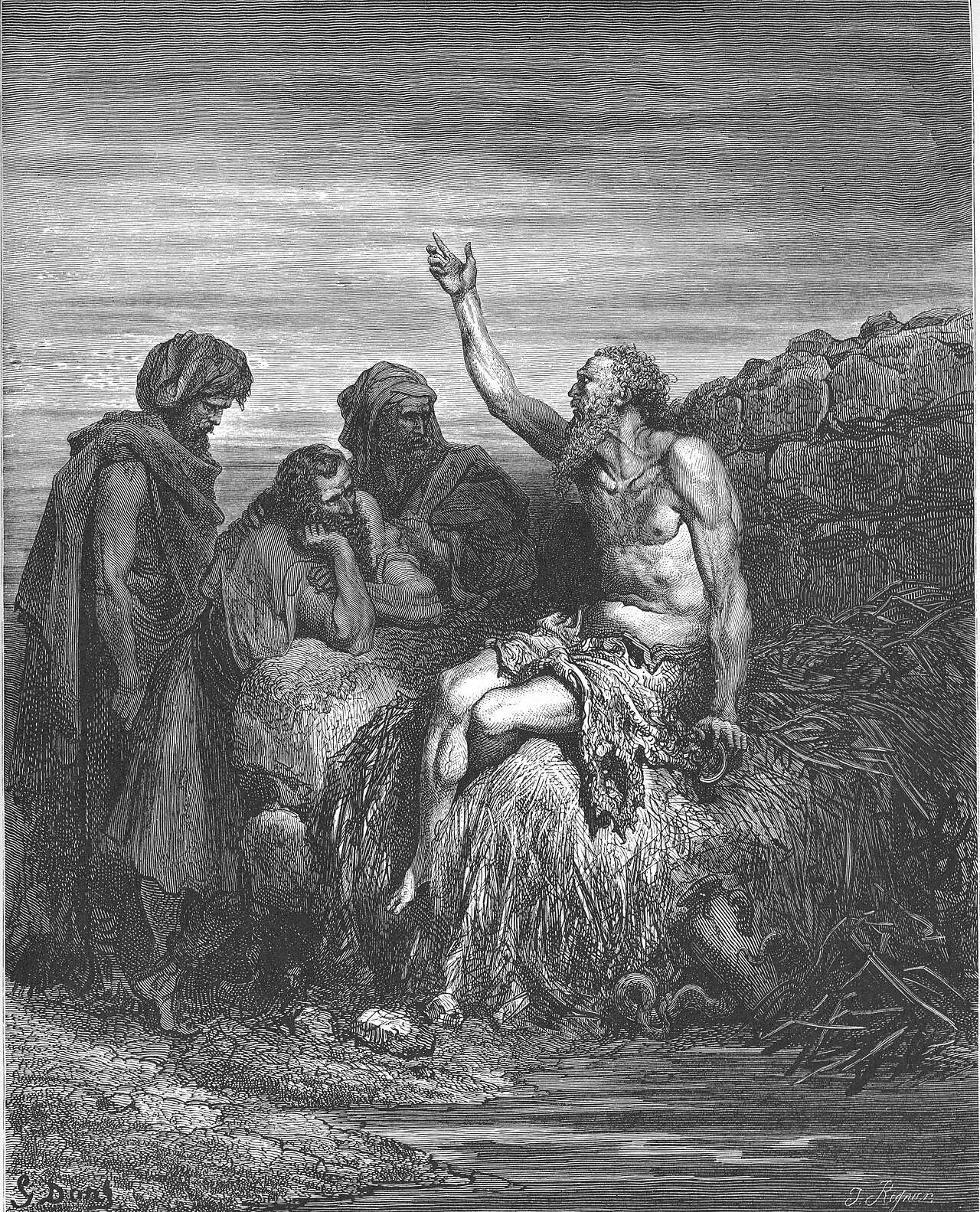
Job answers the problem of suffering not with a reason but with a revelation of Who God is. A blameless man loses everything — not for sin, but because the accuser has questioned whether his righteousness is bought, and God has staked His own honor on it holding without a reward attached. His friends insist the ledger must balance; Job insists on his innocence and demands a hearing; and when God finally answers from the whirlwind, He answers a different question than the one Job asked — not why, but who.

The Frame
— a prose frame around a poetic dialogue — ten movements, every chapter a doorJob is a deliberate literary construction, not raw transcript: prose narrative (chs. 1–2, 42:7–17) brackets 39 chapters of sustained poetry. Reading it as one long argument misses the shape; reading it as a frame around a dialogue that itself breaks down is the first correction.
- The PrologueJob 1:1–2:13Prose narrative · the double heavenly-court scene
“Hast thou considered my servant Job?” (1:8; 2:3)
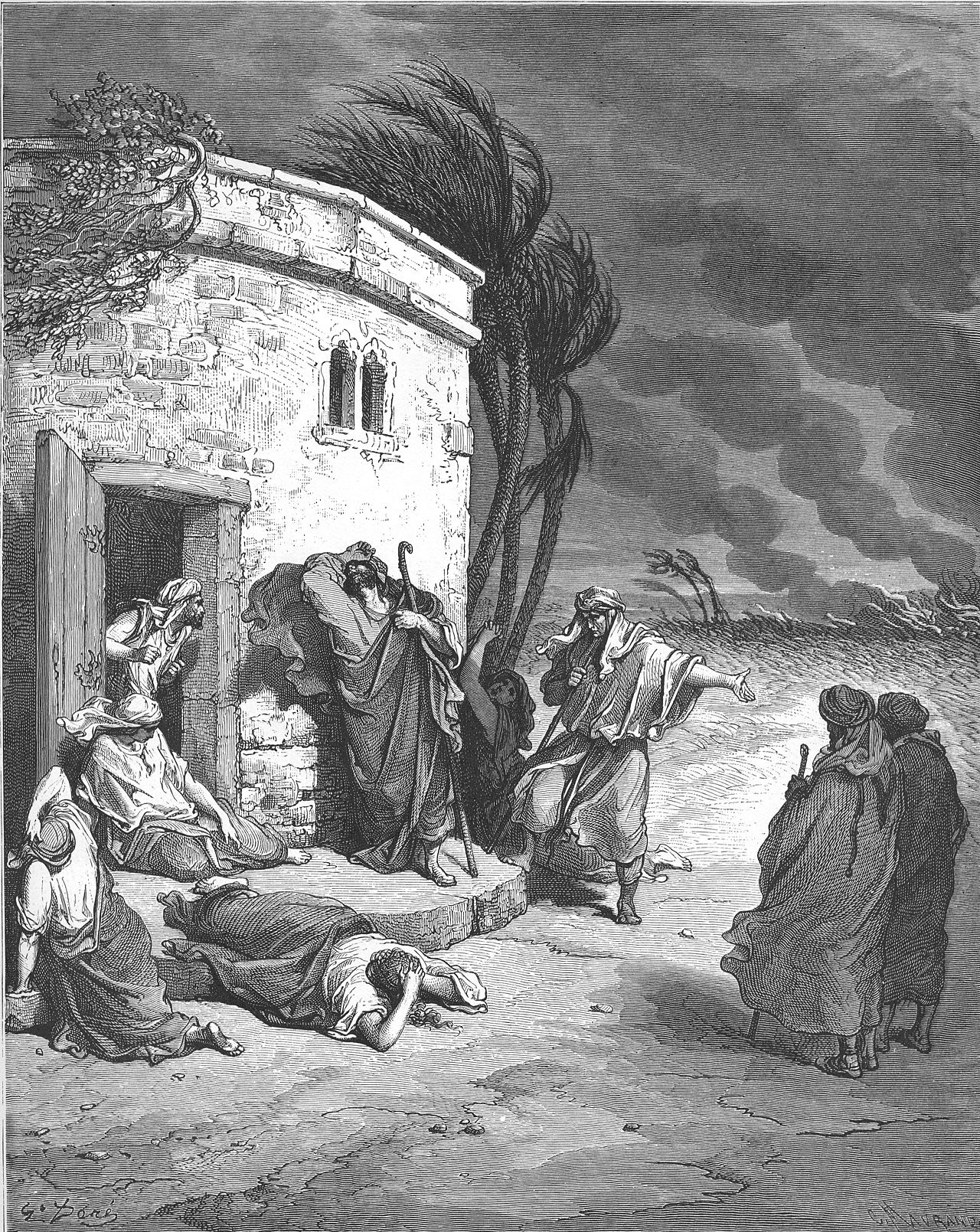
Job's blamelessness is God's own verdict, stated before the trial begins. The council scene runs twice, escalating — wealth and children first, health second — and the reader is let in on the wager Job will never learn of. Both strippings end in worship: “Jehovah gave, and Jehovah hath taken away” (1:21); “shall we receive good… and shall we not receive evil?” (2:10).
- Job's LamentJob 3:1–26The dialogue's opening cry
“Let the day perish wherein I was born” (3:3)
Job curses the day of his birth in cosmic, un-creation language — “Let that day be darkness” (3:4), inverting Genesis 1. Nothing in the prologue prepared for this register; it opens the poetry proper and sets the question the whirlwind will answer from the opposite direction (38:4–11).
- The First CycleJob 4:1–14:22Three friends, full strength
Eliphaz → Job → Bildad → Job → Zophar → Job
The friends open at full argumentative force: suffering is the wages of sin (4:7–8; 8:3–6; 11:6, 14). The reader already knows, from the prologue, that this premise is false in Job's case — every friend-speech from here runs on dramatic irony.
- The Second CycleJob 15:1–21:34Three friends, shorter and harder
The same order, the arguments sharpening toward accusation
Job's confession sits at the emotional low point of this round — “I know that my redeemer liveth” (19:25) — answered, in the same chapter, by Bildad's harshest speech yet on the fate of the wicked (ch. 18).
- The Third CycleJob 22:1–27:23The collapse — see the ledger below
Eliphaz → Job → Bildad (six verses) → Job → Zophar (silence)
The round set up by the first two never completes. Bildad's reply shrinks to 25:1–6; Zophar has nothing left to say at all. The friends run out of arguments before Job runs out of resolve — the book dramatizes it structurally, not just in what is said.
- The Hymn to WisdomJob 28:1–28An authorial pause, outside any speaker's voice
“Where shall wisdom be found?” (28:12, 20)
Gold and silver can be mined from the earth's depths; wisdom cannot. The poem answers, in miniature and in advance, the question the whole book is asking: wisdom belongs to God alone. “The fear of the Lord, that is wisdom” (28:28).
- Job's Final WordJob 29:1–31:40Job's climactic self-vindication
The oath of clearance
Job recalls his former honor (ch. 29), describes his present contempt (ch. 30), then swears a point-by-point oath of innocence (ch. 31) — covenant integrity under interrogation, not self-righteousness. He will not lie about himself to make his suffering theologically tidy.
- Elihu's SpeechesJob 32:1–37:24Four speeches from a voice silent until now
“I am full of words” (32:18)
A younger man widens the frame — suffering's disciplinary and revelatory purpose — preparing, without replacing, the whirlwind. God never answers Elihu directly, and the epilogue neither rebukes nor credits him by name; the text's restraint is deliberate (see Contested Points).
- The WhirlwindJob 38:1–41:34Two divine speeches · 70+ unanswerable questions
“Where wast thou when I laid the foundations of the earth?” (38:4)
God answers a different question than the one Job asked — not why, but who. The cosmos, the animal kingdom, Behemoth, Leviathan: sovereignty displayed, not defended. Job's two responses are silence (40:3–5), then repentance (42:1–6).
- The EpilogueJob 42:1–17Prose narrative · restoration
“Ye have not spoken of me the thing that is right, as my servant Job hath” (42:7)
God rebukes the three friends by name — not Elihu — for defending Him with a lie. Job intercedes for them; his fortunes are restored double; three daughters are named where the sons are not (42:14–15); Job dies old and full of days. Vindicated, not explained.
The Collapsing Cycle
— three rounds of speeches, set up identically — the third one breaks downEliphaz, Bildad, and Zophar each speak, with Job answering each in turn, across three rounds — but the third round is not like the first two. Bildad's reply shrinks to six verses (25:1–6); Zophar has nothing left to say at all. The text dramatizes the friends running out of arguments before Job runs out of resolve — structurally, not just in what is said.

The Argument
— the whole book in three sentences- Author
- Unstated — Jewish tradition proposes Moses; others Solomon or an unknown sage
- Setting
- MannaFest's flag: patriarchal era, roughly contemporary with or before Abraham
- Genre
- Prose frame around dramatic wisdom poetry — among the canon's most sophisticated
- Shape
- 42 chapters · 2 frame sections · 3 dialogue cycles · 1 collapse
- 1
A blameless and upright man is stripped of everything — children, wealth, health — not for sin but because the accuser has questioned whether his righteousness is bought, and God has staked His own honor on Job's integrity holding without a reward attached.
- 2
Job's three friends insist suffering must mean hidden sin; Job insists on his innocence and demands an audience with God to plead his case; a young man, Elihu, tries to widen the frame before God Himself answers — not with an explanation, but with a tour of the created order that dwarfs Job's question.
- 3
Job repents “in dust and ashes” not of hidden sin but of having spoken of what he did not understand, and is restored twofold — vindicated, not explained.
Christ in Job
— three lines run from this book to HimJob's central confession names God as his go'el — the kinsman with the legal duty to avenge, ransom, or vindicate: “But as for me I know that my Redeemer liveth, and at last he will stand up upon the earth.” Job expects to see him for himself — “Whom I, even I, shall see, on my side.” The OT's boldest anticipation of bodily resurrection and an embodied Vindicator standing on the earth, read by the church from its earliest centuries toward Christ.
Open the study →Twice Job cries out for an arbiter who can “lay his hand upon us both,” and a witness in heaven to plead for him. He asks for exactly what the New Testament declares exists: “there is one God, one mediator also between God and men, himself man, Christ Jesus.” Job's cry is answered, centuries later, by name.
Job 28 confesses that wisdom is inaccessible to human mining and belongs to God alone. The New Testament answers by naming Christ Himself “the wisdom of God,” in whom “are all the treasures of wisdom and knowledge hidden” — the place Job 28 says wisdom cannot be found is, in the fullness of time, a Person.
Open the study →“When Job had lost all his wealth and all his friends, yet he was not separated from Christ, nor cut off from his relation to him: ‘Still he is my Redeemer.’ That next kinsman adhered to him when all his other kindred forsook him, and he had the comfort of it.”
Matthew Henry, Commentary on the Whole Bible (1710), on Job 19:25 — public domain
Themes
— five load-bearing lines through the bookRetribution theology refuted
Eliphaz, Bildad, and Zophar all argue that suffering proves hidden sin. The prologue has already told the reader this premise is false in Job's case, so every friend-speech runs on dramatic irony. God's verdict is explicit: they have not spoken of Him the thing that is right, as Job hath.
Sovereignty, unexplained but unchallenged
God never tells Job about the wager in heaven — Job dies without learning why he suffered. The whirlwind answers a different question than the one asked: not why, but who. Job's response is worshipful submission, not intellectual satisfaction.
Integrity that costs
Job's oath of clearance is covenant integrity under interrogation, not self-righteousness. He will not lie about himself to make his suffering theologically tidy — not even to comfort his friends or himself.
Lament as faithful speech
Job's speeches model raw, accusatory, unresolved prayer addressed to God, not merely about Him — the canon's fullest brief for lament as an act of faith, not its absence.
Wisdom as God's alone
The Hymn to Wisdom's refrain — humanity can mine gold from the earth's depths but not wisdom — locates true wisdom transcendently: the fear of the LORD, that is wisdom.
Original Language
— eight keynote words — the vocabulary this book's theology runs onThe Approved Voices on Job
— the roster applied — the specific work named where one is confirmedno confirmed Job-specific work
Marcus Brown's formative teacher. What applies without a confirmed title is his integrated-design method and first-mention hermeneutic — natural to Job's likely status, on the patriarchal dating, as one of the earliest written books in the canon.
The Holiness of God (1985) · Chosen by God (1986)
God's “otherness” reframes, rather than resolves, the human complaint — the Reformed-register articulation of exactly what the whirlwind speeches do to Job. “If we lose our awe of God, we lose our dependence upon Him.”
The Problem of Pain (1940) · A Grief Observed (1961)
Suffering as the “megaphone” that rouses a deaf and self-satisfied creature; the rawer, Job-like unresolved lament of A Grief Observed tempers, but does not retract, the megaphone thesis.
persecuted-church testimony (no single confirmed title)
Modern witnesses who frame severe, undeserved suffering as integral to, not incidental to, gospel witness — the experiential counterpart to Job's ordeal, read alongside rather than instead of the text.
The Unseen Realm (Lexham, 2015)
The scholarly defense of the divine-council reading of Job 1:6/2:1's “sons of God” as real, created spirit beings, and of “the satan” as a functionary within that court.
The Case for a Creator · Darwin's Black Box
Adjacent to, not on, Behemoth and Leviathan directly: cited for the design-in-creation case the whirlwind speeches themselves make, not for a specific zoological identification.
sermons on Job, Metropolitan Tabernacle Pulpit — specific sermon ⚠ pending confirmation
Preached repeatedly from Job; the standing theme across his catalog is 13:15 in the KJV he preached from — “though he slay me, yet will I trust in him” — as a paradigm of faith clinging to God through the darkest providence. The ASV renders the same line from the alternate Hebrew reading: “Behold, he will slay me; I have no hope: Nevertheless I will maintain my ways before him.”
standard nineteenth-century public-domain commentary on Job
Devotional and historical-grammatical treatment of Job as patriarchal narrative — the public-domain floor beneath this workbench, used as support rather than as the apex voice.
159 sermons on Job (1554–55, published 1574) — not yet ingested in depth ⚠
One of Calvin's largest single-book preaching projects; public domain, quotable in full once a deep pass confirms specific citations.
No PD commentator is quoted verbatim on this page — the quote-pull ledger has not yet run for Job; every commentary reference above is paraphrase, cited by specific work. Marcus Brown's own commentary leads above all; within a tier, all voices are equal.
Contested Points
— presented at full strength, then MannaFest's flagDate and historicity — patriarchal-era vs. later literary composition
The patriarchal-historical reading
Wealth reckoned in livestock (1:3), Job's own priestly role in his household (1:5), his lifespan (140 years after the trial, 42:16), no reference to Israel, the Exodus, or the Law, and the divine name Shaddai (used 31 times, more than anywhere else in Scripture) place Job in or before Abraham's era. James 5:11 treats Job as a real historical example alongside the prophets, without literary qualification.
The later-composition reading
Job's sophisticated poetry, its affinities with international ANE wisdom literature (Ludlul Bel Nemeqi, the Egyptian Dispute of a Man with His Ba, the Sumerian Man and His God), and its Aramaic-flavored vocabulary are read by many scholars as evidence of later authorship, with a patriarchal setting deliberately archaized for the story's universal reach.
MannaFest flag — MannaFest holds the patriarchal-historical reading, consistent with the YEC/literal-history frame. The composition-date question — who wrote it down, and when — is separate from, and does not settle, the historicity of the events, and is held loosely.
“The satan” — office within the council, or the fully personal cosmic Satan?
The office reading
With the definite article, “the satan” functions in Job 1–2 as a role within the divine council — the prosecutor, the tester — with the fuller, personal, proper-named cosmic rebel of the New Testament crystallizing later across the canon.
The continuity reading
The office-reading is not a demotion of the being's reality or malice — even as “the satan,” this figure speaks, travels, wagers, and acts with real cunning and real cruelty. Many conservative readers hold continuity of identity: the same being, same malice, progressively unveiled.
MannaFest flag — MannaFest holds both together, not in tension — a real personal being, function named as an office in Job's court scene, identity continuous with the NT devil.
Behemoth and Leviathan — natural creatures, chaos-symbols, or extinct reptiles?
The natural-creature reading
Behemoth = hippopotamus, Leviathan = crocodile — the majority critical and much traditional-conservative reading, matching Nile-adjacent fauna Job's audience would know; Leviathan's fire-breathing language (41:19–21) read as ANE animal-praise hyperbole.
The chaos-symbol reading
Leviathan carries mythological freight elsewhere in the canon — God crushing Leviathan's heads (Ps 74:14), Leviathan judged eschatologically (Isa 27:1) — cognate with the Ugaritic chaos-serpent Litanu/Lotan. God's poetic claim to master forces of chaos no earthly animal fully embodies.
The extinct-reptile reading (YEC-apologetic stream)
Behemoth's tail “like a cedar” (40:17) is held by young-earth advocates as a poor fit for a hippopotamus and a better fit for a large sauropod-type creature — evidence, on this reading, of human and large-reptile coexistence within a young-earth chronology.
MannaFest flag — MannaFest presents all three and does not adopt one as settled fact — the text's own point (God alone tames what man cannot, 40:9–14; 41:1, 10–11) holds under any identification, and that shared point, not the zoological identity, is what the whirlwind speech is actually arguing.
The Cast
— seven people and five places — the whole world of the bookThe five places — none yet seeded in the entity store