
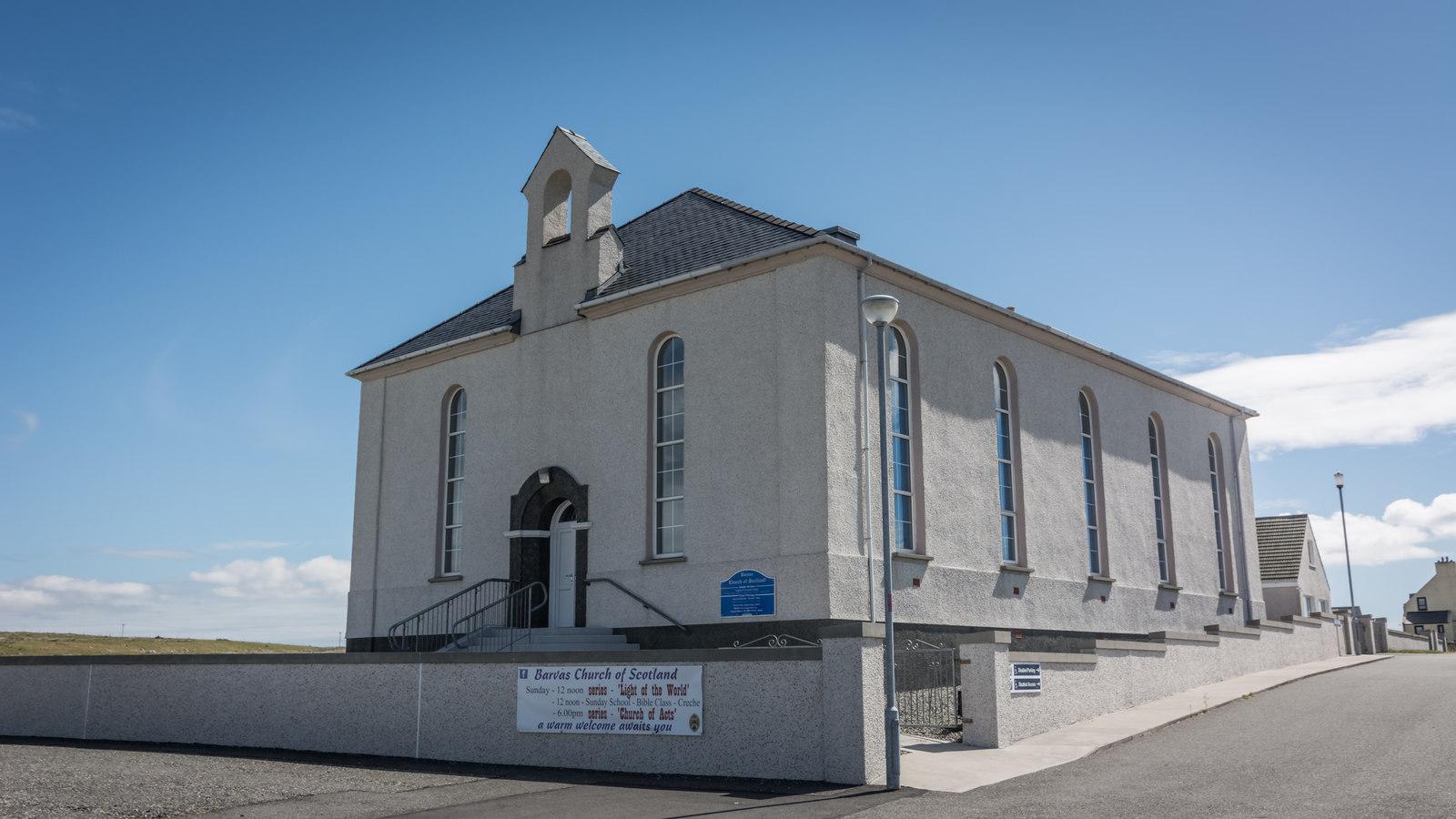
Barvas Church of Scotland, Peter Moore, 2018. CC BY-SA 2.0.
Argyll, Skye and Lewis, 1898 to 1972 · Person · Featured Study
Duncan Campbell
He was a Highland preacher of the Faith Mission who led the meetings of the awakening on the Isle of Lewis.
- Born
- 13 February 1898
- Died
- 1972
- Family
- Father: Hugh Campbell, a stonemason; Mother: Jane Livingstone; Wife: Shona Gray, married December 1925
- Places
- Ardchattan, Skye, Balintore, Falkirk, Barvas, Edinburgh
A piper at a concert walked off the stage and told the chairman he was on his way to hell.
Pursue peace with everyone, as well as holiness, without which no one will see the Lord.
Summary
Duncan Campbell was born in 1898 on a croft near Oban, and his first language was Gaelic. He came to faith at fifteen. He worked for the mission as a young man and then spent many years as a minister. At fifty he went back to the mission.
- He led meetings on Lewis and Harris from 1949 to 1953.
- He led the mission's Bible College in Edinburgh from 1958.
- The Free Church on the island warned its people against his teaching.
The Texts That Turned Him
A verse from Job brought him to faith, and a verse from Hebrews met him on a battlefield.
The meetings on Lewis and the people of its parishes are told in full in The Hebrides Revival.
For God speaks in one way and in another, yet no one notices.A pilgrim of the mission gave out this text on the night of his conversion in 1913.
The Life in Order
The early years stand on his recorded testimony as Afrin prints it, and the later years on the mission's books.
He was fifty when he went back to the mission.
- 13 February 1898BirthAfrin, page 9
- December 1913ConversionAfrin, pages 9 to 10
- 1918WoundedAfrin, page 11
- July 1920A pilgrimAfrin, page 13
- July 1925Ill health; marriageAfrin, page 13
- 1930Minister at BalintoreAfrin, page 14
- 1 January 1949Back with the missionAfrin, page 16
- 7 December 1949On LewisAfrin, page 20, from Peckham (2004)
- April 1954His booklet printedIts title page
- 1958Principal of the collegeGillies (1999)
- 1972DeathPeters (2008), page 34
Each step of the life stands with its witness.
1 January 1949, 7 December 1949, April 1954, 1958, 1972
From the Croft to the College
A Gaelic-speaking boy of Argyll became an evangelist, a minister and then an evangelist again.
He was born in February 1898 on the croft of Camus-Liath, in the parish of Ardchattan, north of Oban. His father, Hugh, was a stonemason. In 1901 two women pilgrims of the Faith Mission came to the district, and his parents were converted under them.
In December 1913 he was playing the pipes at a concert when, in his own telling, God spoke to him. He left, found his father praying in a lit church at eleven at night, and later knelt in the barn at home and prayed for mercy.
In 1918 he rode with a cavalry division and was badly wounded in one of the last charges. He told later of praying on the horse that carried him off the field, and of seven Canadians saved at the casualty clearing station within the hour.
After nine months of training he went out as a pilgrim in July 1920, to Northern Ireland, Mull and Skye. Ill health ended that work in 1925, and in December he married Shona Gray; they had five children. He served the United Free Church at Ardvasar on Skye, at Balintore from 1930 and then at Falkirk.
At Falkirk he heard Dr Thomas Fitch at a conference. After hearing him, he wrote, he cast himself afresh on the mercy of God on the floor of his study. He gave up his charge and rejoined the mission at fifty.
The minister of Barvas, James Murray Mackay, asked him to the island, and he arrived on 7 December 1949. He held meetings there until 1953. He became Principal of the mission's college in Edinburgh in 1958 and died in 1972.
In Their Own Words
Three lines from The Lewis Awakening, the account he wrote for the mission.
Duncan Campbell (1898 to 1972)
The Lewis Awakening 1949-1953 (Edinburgh: The Faith Mission, April 1954), page 19
The house at Arnol
“There are those in Arnol to-day who will bear witness to the fact that, while a brother prayed, the very house shook. I could only stand in silence as wave after wave of Divine power swept through the house.”
Revival witness
About this saying1 paragraph
He tells of a prayer meeting in the village of Arnol during the awakening, in the booklet of 1954, page 19.
Duncan Campbell
The Lewis Awakening 1949-1953 (Edinburgh: The Faith Mission, April 1954), page 30, the conclusion
Revival has not swept the Hebrides
“It is true, however, that exaggerated statements have appeared in the press carrying such lines as ‘Revival sweeping the Hebrides.’ Revival has not swept the Hebrides; there are many parts of the Western Isles still untouched by the movement.”
Revival witness
About this saying1 paragraph
In the conclusion of the same booklet, in 1954, he answered the newspapers' reports of the awakening.
Duncan Campbell
The Lewis Awakening 1949-1953 (Edinburgh: The Faith Mission, April 1954), page 33, chapter 5, an address given at a meeting for ministers at Oxford and Manchester
A demonstration of the supernatural
“It is my own deep conviction that the average man is not going to be impressed by our publicity, our posters or our programmes, but let there be a demonstration of the supernatural in the realm of religion, and at once man is arrested.”
Revival witness
About this saying1 paragraph
He gave this conviction in an address to ministers at Oxford and Manchester, printed with the booklet in 1954.
The People Around Him
The witnesses name his family, a speaker who changed his course, the people of Barvas and his critics.
A minister of Barvas called him to Lewis, and a minister of Stornoway opposed him.
| Person | Tie to Campbell | The witness |
|---|---|---|
| Hugh Campbell and Jane Livingstone | His parents | Afrin, page 9 |
| Shona Gray | His wife | Afrin, page 13 |
| Thomas Fitch | The speaker whose message at a conference sent him to his knees at Falkirk | Afrin, page 15, from God's Standards (1964) |
| James Murray Mackay | Minister of Barvas | Afrin, pages 16 and 21 |
| Peggy and Christine Smith | Two elderly sisters of Barvas who prayed for revival | Afrin, page 21 |
| Kenneth A. MacRae | Free Church minister at Stornoway who opposed his preaching | Afrin, pages 55 to 62 |
| Andrew A. Woolsey | His biographer | Afrin, page 14 and the bibliography; Gillies (1999) |
The Places of His Life
His life ran from Argyll to the Highland parishes and the islands, then to the college in Edinburgh.
Most of his work was in the Highlands and the islands.
| Place | What the witnesses say | The witness |
|---|---|---|
| Ardchattan, Argyll | His birthplace | Afrin, page 9 |
| Skye | Pilgrim work, then the church at Ardvasar | Afrin, page 13 |
| Balintore | His charge for ten years from 1930 | Afrin, page 14 |
| Falkirk | He became a full minister there, and there he resigned to rejoin the mission. | Afrin, pages 14 to 16 |
| Barvas, Lewis | The parish where the awakening began | His report of 14 December 1949, in Afrin, page 24 |
| Arnol, Lewis | He tells of the house that shook at prayer there. | The Lewis Awakening, page 19 |
| Edinburgh | The mission's Bible College | Gillies (1999); Peckham, Adventures of Faith |
God and the Human Agent
He taught that revival is God's work and that people are the means through which it comes.
In his address to ministers he held two lines together, "God is the God of revival" and "We are the human agents through whom revival is possible". He warned against any view of God's sovereignty that nullifies man's responsibility.
He spoke of a second work of the Spirit after his conversion and named it the baptism of the Holy Ghost. He called it, in its final analysis, "the revelation of Jesus".
How the Key Verse Was Taught
Two commentaries read the call to pursue peace and holiness.
Matthew Henry (1662 to 1714)
Commentary on the Whole Bible
Matthew Henry joined peace and holiness as two things that cannot be had apart.
“Secondly, Peace and holiness are connected together; there can be no true peace without holiness. There may be prudence and discreet forbearance, and a show of friendship and good-will to all; but this true Christian peaceableness is never found separate from holiness.”
on Hebrews 12:14Puritan
Jamieson, Fausset & Brown (1802 to 1910)
Commentary Critical and Explanatory on the Whole Bible
Jamieson, Fausset and Brown set the believer's holiness beside the holiness of God.
“Translate here ‘sanctification.’ His is absolute holiness: our part is to put on His holiness, becoming ‘holy as He is holy,’ by sanctification. While ‘following peace with all men,’ we are not so to seek to please them, as to make God's will and our sanctification a secondary object; this latter must be our first aim.”
on Hebrews 12:14Reformed
What the Witnesses Leave Open
Readers differ on his early doubts, on his doctrine and on how his accounts changed over the years.
How long his years of doubt lastedAndrew A. Woolsey, Campbell's own testimony and N. A. Afrin
Woolsey wrote in 1974 that the doubts Campbell picked up in his training were "short-lived and never openly expressed". In his recorded testimony Campbell speaks of seventeen years in "a barren wilderness". Afrin sets the two side by side and asks how far Woolsey's admiration shaped his account.
Holiness teaching or Arminian errorKenneth A. MacRae, J. P. Macqueen, the Free Church presbytery of Lewis and Professor Renwick
MacRae wrote in 1952 that "The theology of the Faith Mission is the theology of John Wesley", and Macqueen called its testimony Arminian. Iain H. Murray's edition of MacRae's diary records that the presbytery of Lewis called on its people to beware of the Arminian nature of Campbell's preaching.
Macqueen also reports that Professor Renwick rebuked MacRae at the Free Church General Assembly of 1950 for opposing the Faith Mission.
How his tellings changedN. A. Afrin and Campbell's booklet of 1954
Afrin finds a difference between Campbell's weekly reports to the mission and his later lectures, and he dates much of the exaggeration after the revival ended. The booklet of 1954 itself warns that the press had overstated the awakening.
Books to Read Next
The Lewis Awakening 1949-1953
Duncan Campbell · 1954
He wrote it for the mission, and his address to ministers is printed with it.
In print: find it wherever books are sold.
Channel of Revival: A Biography of Duncan Campbell
Andrew A. Woolsey · 1974
Woolsey wrote it two years after his death, and Afrin quotes it on his early years.
In print: find it wherever books are sold.
A Critical Analysis of the 1949-1953 Lewis Revival
N. A. Afrin · 2018
This thesis sets his reports of the time against his later tellings.
Read the thesis free at the University of GlasgowWhat Campbell Left
He left the booklet of 1954, books of sermons printed by the mission, and the reports he sent from the islands week by week.
Sources
Scripture is the Berean Standard Bible.
- The Holy Bible, Berean Standard Bible (read 2026)
- N. A. Afrin, A Critical Analysis of the 1949-1953 Lewis Revival, MRes thesis, University of Glasgow (2018), printing Campbell's Faith Mission reports and his recorded testimony.
- Duncan Campbell, The Lewis Awakening 1949-1953 (Edinburgh: The Faith Mission, April 1954)
- John Peters, Great Revivalists (Farnham: CWR, 2008), page 34, "Duncan Campbell (1898-1972)".
- K. A. Gillies, Gillies of Partick (Aberdeen: Cagey Lad, 1999), "In 1958, Duncan Campbell became Principal of the Faith Mission Training Home and Bible".
- Heritage of Revival (Edinburgh: The Faith Mission, 1986), "Duncan Campbell later became the Principal of the Faith Mission Bible College".
- Iain H. Murray, The Diary of Kenneth MacRae (Edinburgh: The Banner of Truth Trust, 1980), pages 444 to 449, as Afrin prints them.
- Colin Peckham, Adventures of Faith (Leominster: Day One Publications), "principal of the Faith Mission Bible College, Edinburgh".
- Matthew Henry, Commentary on the Whole Bible (1710), on Hebrews 12:14.
- Jamieson, Fausset and Brown, Commentary Critical and Explanatory on the Whole Bible (1871), on Hebrews 12:14.
Keep Studying
People and groups1
Church history3
Values3