
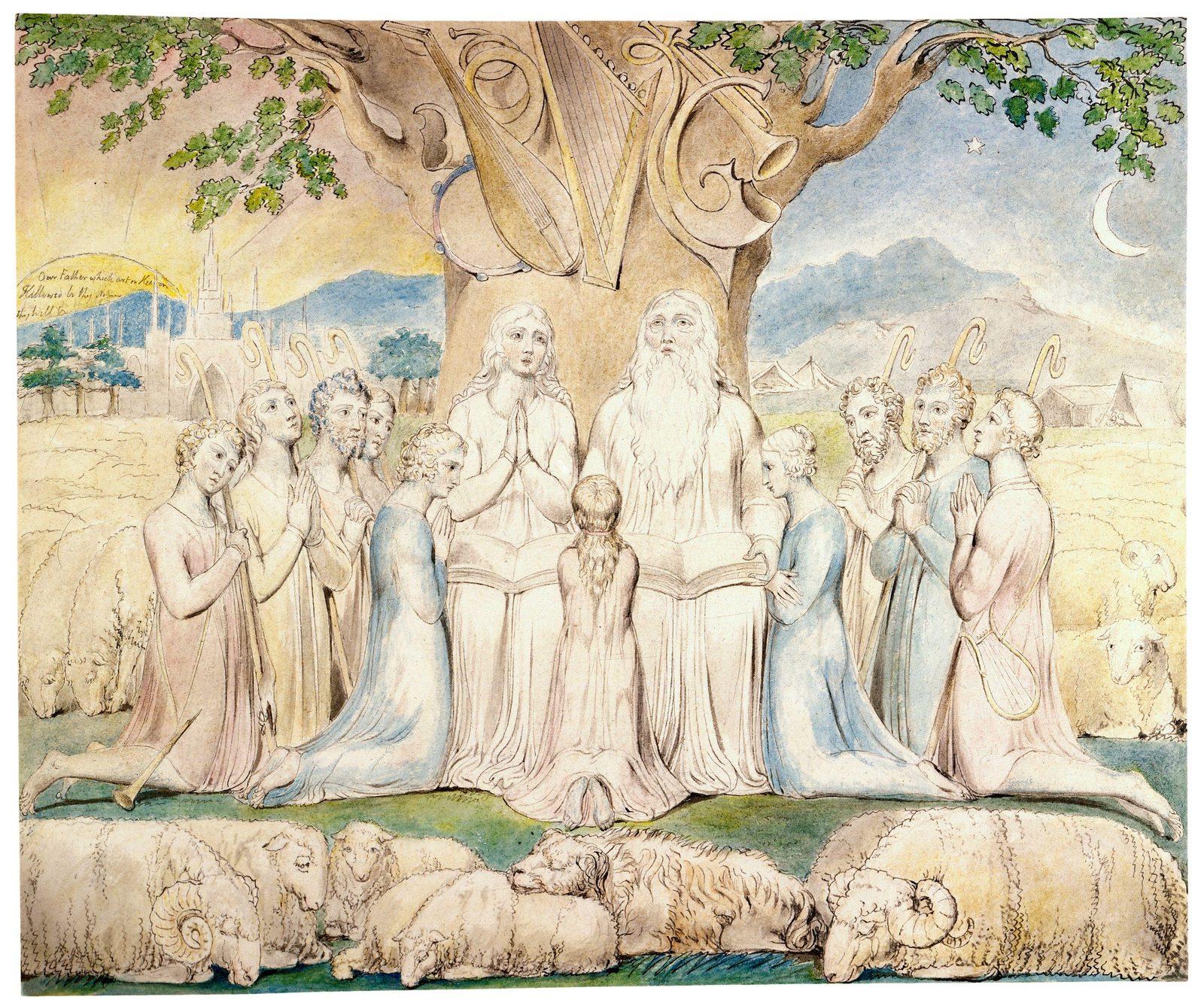
William Blake, Job and His Family, watercolour. Public domain.
Job 29 and 42 · Debate · Featured Study
Was Job a King? Jobab of Edom and the Septuagint's Ending
Job's rank is given three ways: a king of Edom, the ruler of his own land, or the chief of his city.
Two ancient books outside the Hebrew Bible make Job a king.
I chose their course and presided as chief. So I dwelt as a king among his troops, as a comforter of the mourners.
- The question
- The Hebrew book calls Job the greatest man of the East, and the Greek ending calls him a king of Edom: was he a king?
- The texts
- Job 29:25, Genesis 36:33, Job 1:3
Summary
The ending of the Septuagint, the old Greek Bible, and the Testament of Job crown Job, and Barnes, Wesley, Driver and Gray read him as the chief man at the gate.
- The Greek note that names Job as Jobab cites a Syriac book.
- Job compares himself to a king once, in his account of his former days.
- Gill reports that Aristeas, Philo and Polyhistor confirm the Greek ending.
The Texts Behind the Question
Two verses frame the question.
Was Job a King? sets out three answers to whether Job was a king, from the Greek Bible, from a Jewish retelling of Job, and from the commentators.
and he owned 7,000 sheep, 3,000 camels, 500 yoke of oxen, 500 female donkeys, and a very large number of servants. Job was the greatest man of all the people of the East.When Bela died, Jobab son of Zerah from Bozrah reigned in his place.Three Readings of Job's Rank
The readings part over Job's title, his former name and the rank of his friends.
Only the first reading sets Job in the list of the kings of Edom.
| The question | Jobab, king of Edom | A ruler of his own land | A chief who lived like a king |
|---|---|---|---|
| Was Job a king? | Yes, the second king of Edom. | Yes, over the land where he lived. | No; he presided at the gate. |
| Was Job once called Jobab? | Yes; his name before was Jobab. | Yes; the Lord renamed him Job. | No; the Hebrew gives him no other name. |
| Who were the three friends? | Kings of the Thaemanites, the Sauchaeans and the Minaeans. | Kings who visit a fellow king. | Chiefs of tribes near Job's land. |
Each Reading Stated
Two of the readings are ancient, and one belongs to the commentators.
Jobab, king of EdomThe Greek ending of Job; John Gill
In Brenton's English Septuagint, the Greek book adds five sentences after Job 42:17, numbered 17a to 17e. The first looks for Job to rise again. The rest cite the Syriac book, give Job's former name as Jobab, make him the son of Zare of the sons of Esau, and count him the fifth from Abraham.
The same ending lists the kings who reigned in Edom, which country he also ruled over: Balac the son of Beor first, and after him Jobab, who is called Job.
John Gill prints the account of 17b to 17e in his note on Job 42:17.
A ruler of his own landThe Testament of Job; Adam Clarke
In the Testament of Job, Job tells his children that before the Lord named him Job he was called Jobab. When his friends come, they are kings, and they ask in the city where Jobab is, the ruler of this whole land.
Adam Clarke reads Job 29:25 of Job's civil and military life: as supreme magistrate he sat chief, and as captain general he dwelt as a king in the midst of his troops.
A chief who lived like a kingAlbert Barnes; John Wesley; Driver and Gray
Albert Barnes reads the first words of Job 29:25, I chose their course, as Job becoming the guide and counsellor of his city. John Wesley reads Job's seat as that of a prince or judge, with the people waiting for his counsel.
S. R. Driver and G. B. Gray, in their commentary of 1921, call Job a great sheikh indeed but not a monarch.
The Word King in Job
The Hebrew word melek stands in eight verses of the book.
Seven of the eight verses speak of the kings of others.
| Who speaks | The king named in the verse | Whom the word means |
|---|---|---|
| Job | Job wishes he lay at rest with the kings and counselors of the earth, who built cities now in ruins. | Kings of the earth |
| Job | God loosens the bonds placed by kings and fastens a belt around their waists. | Kings of the earth |
| Eliphaz | Distress overwhelms the wicked man like a king poised to attack. | A picture of distress |
| Bildad | The wicked man is torn from his tent and marched off to the king of terrors. | A picture of death |
| Job | Job's comparison of himself, in his account of his former days. | Job |
| Elihu | God says to kings, You are worthless, and to nobles, You are wicked. | Kings of the earth |
| Elihu | God does not take His eyes off the righteous and sets them on thrones beside kings. | Kings beside the righteous |
| The LORD | Leviathan looks down on all the haughty and is king over all the proud. | Leviathan |
Elihu, The LORD
The Greek Ending and Its Age
Driver and Gray, Barnes and Eusebius bear on how old the ending is.
Driver and Gray find some reason for thinking that the additions after Job 2:9 and Job 42:17, which stand in every witness to the Greek, formed no part of the first Greek text. Albert Barnes calls the ending an unauthorized addition, since nothing like it occurs in the Hebrew.
Eusebius quotes Alexander Polyhistor's report of Aristeas, who wrote that Esau married Bassara in Edom and was the father of Job, and that this Job was formerly called Jobab. Aristeas calls the friends kings, and names Job no king.
What the Text Leaves Unsaid
Genesis and the Hebrew book of Job never join Job to Jobab.
Genesis 36 says nothing of a trial or of the land of Uz.
The name Jobab stands in Genesis, Joshua and 1 Chronicles, and never in the book of Job.
What the Readings Start From
The readings start from two facts.
JOB'S COUNSEL ENDED DEBATE
Men listened to Job, waiting in silence for his counsel, and after he spoke they said no more.
THE LAND OF UZ HAD KINGS
Jeremiah names all the kings of Uz among the nations who must drink the cup of the wine of wrath.
How the Teachers Read It
Matthew Henry read Job's place at the gate as a figure of Christ.
Matthew Henry (1662 to 1714)
He saw a picture of Christ in the man who sat as chief.
“I know not but we may look upon Job as a type and figure of Christ in his power and prosperity. Our Lord Jesus is such a King as Job was, the poor man's King, who loves righteousness and hates iniquity, and upon whom the blessing of a world ready to perish comes; see Ps. lxxii.”
Matthew Henry · Commentary on the Whole Bible · on Job 29:25Puritan
The Readings Weighed
Every reading has its objector.
The Greek ending and the Testament of Job make Job a king, and the commentators divide.
| Reading | Held by | Tradition | Representative work |
|---|---|---|---|
| Jobab, king of Edom | The Greek ending of Job; John Gill | The Septuagint | Brenton's English text of the Greek Bible, Job 42:17a to 17e |
| A ruler of his own land | The Testament of Job; Adam Clarke | Jewish writings outside the canon; Protestant commentary | The Testament of Job |
| A chief who lived like a king | Albert Barnes; John Wesley; Driver and Gray | Protestant commentary and critical scholarship | Driver and Gray, A Critical and Exegetical Commentary on the Book of Job (1921) |
Against the first reading1 paragraph
Barnes holds that no one knows where the ending came from, and that its line on the resurrection looks like a forgery from after the coming of Christ.
Against the second reading1 paragraph
Driver and Gray note that the Greek book tends to turn Job's friends, great sheikhs of neighbouring tribes, into kings and tyrants of nations.
Against the third reading1 paragraph
Gregory the Great reads the verse as Job sitting as a king with an army standing round him.
Books to Read Next
Two of the works this question rests on are free to read.
Preparation for the Gospel, Book 9
Eusebius, translated by E. H. Gifford · 1903
In chapter 25 Eusebius quotes the report of Aristeas on Job.
Read at tertullian.orgA Critical and Exegetical Commentary on the Book of Job, Volume 1
S. R. Driver and G. B. Gray · 1921
Driver and Gray set out the Greek version and Job's rank in their introduction.
Read at the Internet ArchiveThe King of the Needy
Henry's note on Job 29:25 points to Psalm 72 and its king.
For he will deliver the needy who cry out and the afflicted who have no helper.Sources
Scripture is the Berean Standard Bible.
- Strong's Hebrew lexicon, h4428 and h3103, with the index of every use.
- The Septuagint in English, translated by Sir Lancelot Brenton, Job 42:16 to 17e.
- Eusebius, Preparation for the Gospel, Book 9, chapter 25, translated by E. H. Gifford (1903)
- The Testament of Job, the English text at the Wesley Center Online.
- S. R. Driver and G. B. Gray, A Critical and Exegetical Commentary on the Book of Job, volume 1 (1921), pages xxix, xxx and lxxiii.
- Albert Barnes, Notes; John Wesley, Explanatory Notes (1765); Adam Clarke, Commentary (1832), each on Job 29:25.
- Albert Barnes, Notes, and John Gill, Exposition, each on Job 42:17.
- Matthew Henry, Commentary on the Whole Bible (1710), on Job 29:25.
Keep Studying
Read it4
Symbols1