
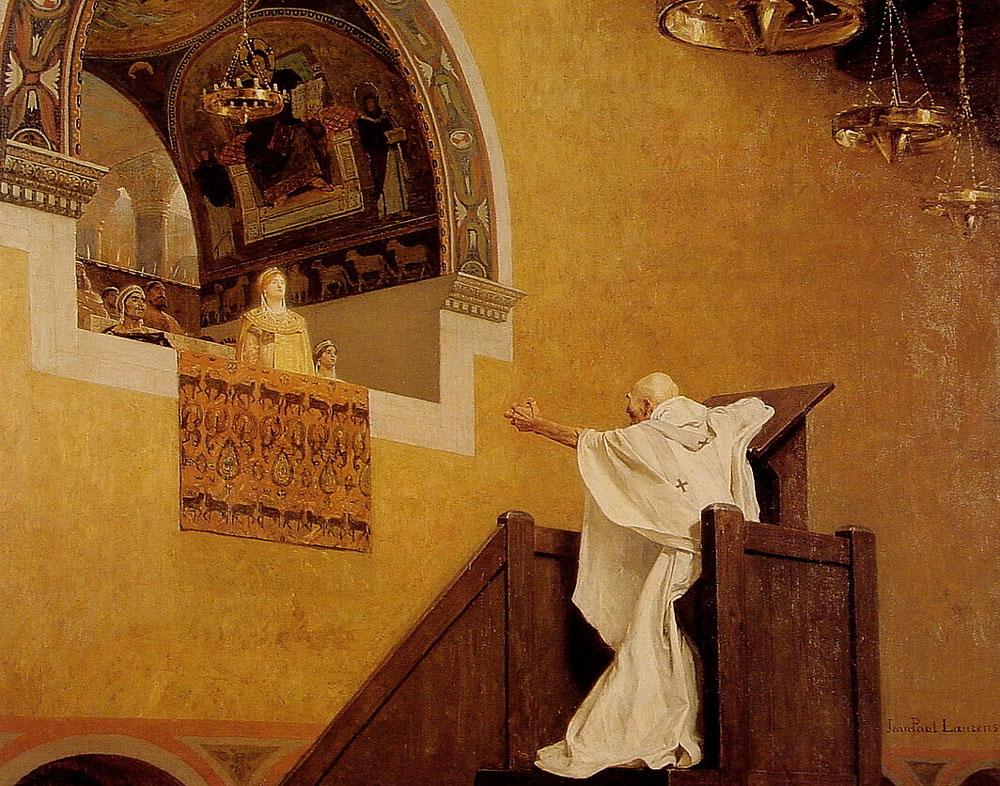
Saint John Chrysostom and the Empress Eudoxia, Jean-Paul Laurens, 1893. Public domain.
Antioch and Constantinople, to 407 · Person · Featured Study
John Chrysostom
He preached at Antioch for sixteen or seventeen years and became bishop of Constantinople in 398.
- The name means
- Chrysostom means the Golden Mouth
- Born
- 347 in the reckoning of Montfaucon and Stephens; others give 344 or 354 (probable)
- Died
- 14 September 407, near Comana in Pontus
- Family
- father: Secundus; mother: Anthusa
- Places
- Antioch, Constantinople, Cucusus, Comana
He told his hearers to clothe Christ in the poor before they dressed His table in silk.
And the King will reply, ‘Truly I tell you, whatever you did for one of the least of these brothers of Mine, you did for Me.’
Summary
John studied speech under the teacher Libanius at Antioch, and he was baptized in his early twenties. He lived as a monk for years until his health broke. From the end of the fifth century he was called Chrysostom, and that name has taken the place of his own.
- The Homilies on the Statues comforted a city that feared the wrath of the emperor.
- Theophilus and the empress Eudoxia drove him from his see.
- His sermons against the Jews stand among his works, and readers still weigh them.
The Poor at the Door
He cited Job and Ecclesiastes when fortunes turned, his own and another man's.
The question of this life is what a preacher owes the powerful when his sermon offends them. In Homily 50 on Matthew he joined two sayings of Christ, "This is my body" and the words of Matthew 25 on the least of these. From them he told Antioch that God has need of golden souls more than of golden vessels.
He kept that line when he reached the capital, and it helped to cost him his see. A letter from exile and a sermon over a fallen minister show two verses he reached for when fortunes turned.
saying: “Naked I came from my mother’s womb, and naked I will return. The LORD gave, and the LORD has taken away. Blessed be the name of the LORD.”He echoed Job's words in his letter to Bishop Cyriacus as he went into exile.
“Futility of futilities,” says the Teacher, “futility of futilities! Everything is futile!”He opened his sermon over Eutropius with this verse while the fallen minister clung to the altar.
The Life in Order
Philip Schaff set out the dates in 1889, drawing on Palladius and the church historians.
His fall ran from the synod at the Oak in 403 to the edict of June 404.
- 347He was born at Antioch in SyriaSchaff (1889), Prolegomena 2
- 369 or 370Bishop Meletius baptized him and made him a readerSchaff, Prolegomena 3
- 374 to 381He lived as a monkSchaff, Prolegomena 5
- 380 or 381Meletius ordained him deaconSchaff, Prolegomena 6
- 386Bishop Flavian ordained him presbyterSchaff, Prolegomena 6
- Lent 387He preached the Homilies on the StatuesSchaff, Prolegomena 6
- 26 February 398Theophilus consecrated him at ConstantinopleSchaff, Prolegomena 7
- January 401He held a synod at Ephesus that deposed six bishopsSchaff, Prolegomena 7
- 403The synod at the Oak deposed him, and he was recalledSchaff, Prolegomena 8
- September 403A silver statue of Eudoxia went up before his churchSchaff, Prolegomena 9
- Easter vigil 404Guards dragged him from the cathedralSchaff, Prolegomena 9
- 5 June 404Arcadius signed the edict of banishmentSchaff, Prolegomena 9
- 14 September 407He died on the road to PityusSchaff, Prolegomena 10
- 27 January 438His body was laid in the Holy Apostles at ConstantinopleSchaff, Prolegomena 10
Each step of the life stands with its witness.
26 February 398, January 401, 403, September 403, Easter vigil 404, 5 June 404, 14 September 407, 27 January 438
From the Pulpit to the Road
The story moves from a riot at Antioch to a chapel in the mountains of Pontus.
His father, an officer of the army of Syria, died while he was an infant. Anthusa, widowed at twenty, refused all offers of marriage and raised him and his sister. Libanius, the great defender of the old gods, is said to have cried on hearing of her, "what wonderful women there are among the Christians". When Libanius was asked near death who should succeed him, he named John and added, "if the Christians had not stolen him from us".
He left the law for the Scriptures. He read them under Diodorus, later bishop of Tarsus, beside his friend Theodore. Hard fasting broke his health, and he came home to serve the city's poor and sick.
The people of Antioch rose against a heavy tax and broke the statues of the emperor and his family, and the emperor threatened to destroy the city. Old Flavian travelled to the capital to beg for pardon. Through the months of waiting John preached to a frightened crowd.
He was taken from Antioch by a military escort to be bishop in the capital, a post he had not sought. He sold the costly plate of the bishop's palace for the poor and the hospitals. He ate alone and gave no dinners. He disciplined the clergy, preached to the Goths through an interpreter and sent missionaries to the Danube.
Eutropius, the minister who had carried out that summons, fell from power and ran to the altar. John stood in the high reading desk and preached on the vanity of honour, with the man cowering behind him in the sanctuary.
When monks banished from Egypt came to him for help, Theophilus found his occasion. He came to the capital with a guard of sailors and held a council of thirty-six bishops in a suburb of Chalcedon, and twenty-nine charges were brought. John refused to attend. An earthquake frightened Eudoxia and she begged for his return, and boats filled the Bosphorus with torches to meet him.
Two months later he spoke against the revelry at her statue, and the feud returned. Hundreds of people were being baptized when soldiers cleared the church, and Palladius wrote that "The waters of regeneration" were "stained with blood". After he was taken away, the cathedral burned.
At Cucusus he wrote letters to bishops, monks, missionaries and his friend Olympias, the deaconess. The court ordered him moved farther off, and two guards drove him on foot for three months. He stopped in the chapel of the martyr Basiliscus, put on white baptismal robes, received the eucharist and died.
How His Words Reached Us
The sermons were taken down as he spoke, and nearly all the letters come from his exile.
He published some sermons himself, and short-hand writers took down most of the rest. The preacher usually sat and the people stood. So what survives is close to the speech of a crowded church, where he had to warn his hearers about pickpockets.
Homilies survive on Genesis, the Psalms, Matthew, John, Acts and the letters of Paul. Schaff counts eighty on Matthew, and he reports that Thomas Aquinas would rather have owned them than be master of all Paris. There is no commentary from him on Mark, Luke or the Apocalypse. Of his letters 242 remain, nearly all from the three years of exile.
In Their Own Words
Six sayings from the pulpit, from exile and from his deathbed, each with its witness.
John Chrysostom (died 407)
his last words, in Philip Schaff's Prolegomena, chapter 10, chapter 10 and note 21
Glory for all things
“Glory be to God for all things, Amen.”
Patristic
About this saying1 paragraph
Schaff gives these as his last words in 407, his usual doxology, and he gives the Greek in a note.
John Chrysostom
Homilies on the Gospel of Matthew, homily 50
Golden vessels
“Wouldest thou do honor to Christ's body? Neglect Him not when naked; do not while here thou honorest Him with silken garments, neglect Him perishing without of cold and nakedness.”
Patristic
About this saying1 paragraph
Preaching at Antioch between 386 and 398, he told his congregation that the same Lord who spoke of His body also asked after the hungry.
John Chrysostom
Homilies on the Gospel of Matthew 63, 2
The prizes of the race
“Seest thou how many prizes, how many crowns, He appoints for this race? If he had been tempting, He would not have told him these things.”
Patristic
About this saying1 paragraph
In Homily 63, preached at Antioch before 398, he read Christ's answer to the rich young man as an offer of reward to an earnest seeker.
John Chrysostom
a sermon, in Philip Schaff's Prolegomena, chapter 14
The only praise he sought
“but show your approbation by obedience; that is the only praise I seek.”
Patristic
About this saying1 paragraph
Between 386 and 404, at Antioch and then at Constantinople, his hearers applauded his sermons, and when he rebuked them they applauded the rebuke, so he gave them this answer.
John Chrysostom
Homily on Eutropius, section 1
Over the fallen minister
“Where are now the brilliant surroundings of thy consulship? where are the gleaming torches? Where is the dancing, and the noise of dancers' feet, and the banquets and the festivals?”
Patristic
About this saying1 paragraph
As bishop of Constantinople, between 398 and 403, he turned to Eutropius behind him in the sanctuary and addressed him by his lost honours.
John Chrysostom
letter to Bishop Cyriacus, in Philip Schaff's Prolegomena, chapter 8
His list of examples
“If she wants to have me sawn asunder, I have Isaiah for an example. If she wants me to be drowned in the ocean, I think of Jonah. If I am to be thrown into the fire, the three men in the furnace suffered the same. If cast before wild beasts, I remember Daniel in the lion's den. If she wants me to be stoned, I have before me Stephen, the first martyr. If she demands my head, let her do so; John the Baptist shines before me.”
Patristic
About this saying1 paragraph
He told Bishop Cyriacus in a letter what he had said to himself when the empress first drove him out in 403, naming a figure of Scripture for each threat.
The People Around Him
Teachers and bishops formed him, and a bishop and an empress ended his work.
His mother gave him his first teaching, and a deaconess received his most important letters.
| Person | Tie to John | The witness |
|---|---|---|
| Anthusa | His widowed mother gave him his early education. | Schaff 2 |
| Libanius | This defender of the old religion taught him rhetoric. | Socrates 6.3; Schaff 2 |
| Meletius | This bishop of Antioch baptized him and ordained him. | Schaff 3 and 6 |
| Diodorus | He directed John's study of the Scriptures. | Socrates 6.3; Schaff 3 |
| Theodore of Mopsuestia | This fellow pupil joined him in the ascetic life. | Socrates 6.3; Schaff 3 |
| Flavian | This bishop ordained him presbyter and won the city's pardon. | Schaff 6 |
| Theophilus of Alexandria | He consecrated John reluctantly and later led the synod at the Oak. | Schaff 7 and 8 |
| Eudoxia | The empress took his words on Elijah and Jezebel as an insult to herself. | Schaff 7 and 9 |
| Olympias | He wrote seventeen letters from exile to this deaconess. | Schaff 10 |
| Innocent I | The bishop of Rome annulled the deposition and wrote to him in sympathy. | Schaff 9 |
Theophilus of Alexandria, Eudoxia, Olympias, Innocent I
The Places of His Life
His life runs from a great capital of Syria to a chapel on the road.
He spent about fifty years at Antioch and the last nine in the capital or in exile.
| Place | What the witnesses say | The witness |
|---|---|---|
| Antioch | He was born and trained there, and he preached there until he was taken away. | Schaff 2 and 6 |
| Constantinople | He was its bishop, and it was the eastern capital of the empire. | Schaff 7 |
| Ephesus | The synod he held there acted against bishops convicted of simony. | Schaff 7 |
| The Oak, by Chalcedon | A council met in this suburb and condemned him. | Schaff 8 |
| Cucusus | This mountain village on the border of Cilicia and Armenia was his place of exile. | Schaff 10 |
| Arabissus | He was moved there from Cucusus. | Schaff 10 |
| Comana in Pontus | He died five or six miles from it. | Schaff 10 |
What He Preached
He read the plain sense of the text and pressed it on the conduct of his hearers.
Schaff places him in the school of Antioch, which sought "the obvious grammatical and historical sense" of a text. He allowed for allegory in theory and seldom used it. Socrates says Diodorus kept to "the literal sense of scripture, avoiding that which was mystical". John learned that way of reading under him.
Schaff writes, "He preached morals rather than dogmas". In Homily 50 he told the wealthy to honour Christ by spending their wealth on the poor, and he said he was not forbidding gifts to the church. He asked for alms with those gifts and before them.
Schaff adds a judgment against him here. He says John urged almsgiving "to an extent that tended to increase rather than diminish the number of beggars".
Read William Booth and the Salvation Army, on the poor of a later city
How the Key Verse Was Taught
Jerome, John Wesley and Adam Clarke read the words on the least of these.
Jerome (died 420)
on Matthew 25:40, in the Catena Aurea of Thomas Aquinas
Jerome granted the wide reading of the verse, and he went on to prefer the poor in spirit.
“It were indeed free to us to understand that it is Christ in every poor man whom we feed when he is hungry, or give drink to when he is thirsty, and so of other things”
Patristic
John Wesley (1703 to 1791)
Explanatory Notes upon the New Testament, on Matthew 25:40
John Wesley took from it a rule for the household of faith and for everyone else.
“What encouragement is here to assist the household of faith? But let us likewise remember to do good to all men.”
Evangelical
Adam Clarke (1762 to 1832)
Commentary on the Bible, on Matthew 25:40
Adam Clarke read it as Christ claiming kinship with those whom others despise.
“The meanest follower of Christ is acknowledged by him as his brother! What infinite condescension!”
Methodist
What the Witnesses Leave Open
Readers differ on his birth, on one famous sermon, on his temper and on his sermons against the Jews.
The year of his birthMontfaucon, Tillemont, Neander and Stephens; Baur; Villemain
Schaff gives 347 with Montfaucon, Tillemont, Neander, Stephens and Venables. He says Baur gives 354 or 355 in error, in his lectures on the history of dogma, and that Villemain gives 344.
Did he compare the empress to Herodias?Socrates and Sozomen; Tillemont, Savile and Montfaucon; Philip Schaff
Schaff cites Socrates and Sozomen for the report that he said, "Again Herodias is raging, again she is dancing". A homily with those opening words survives, and Tillemont, Savile and Montfaucon reject it as spurious.
Schaff writes that it is "at least doubtful" whether he spoke those words. He thinks it probable that some allusion to Eudoxia reached her in that form.
How far did his own temper bring him down?Socrates; Palladius in Schaff's account; Philip Schaff
Socrates says he was thought stern and that "the liberty of speech he allowed himself was offensive to very many". He adds that one early friend recalled him as irritable, and that people who did not know him took him for haughty.
Schaff names Palladius, a friend of his, among the first biographers. Schaff calls him "The innocent bishop" at the Oak and calls the charges false, and he still blames his "irritability and obstinacy" for part of his unpopularity.
What of his sermons against the Jews?Socrates; Philip Schaff; James Parkes; Paul Harkins; Paul Halsall
Socrates says he wrote a book Against the Jews while he was a reader. Schaff lists sermons "against the Jews and Judaizing Christians" and passes on without comment.
James Parkes, in The Conflict of the Church and the Synagogue (1934), dates eight sermons to 387. He says that in them John "speaks with a bitterness and lack of restraint unusual even in that place and century". Parkes argues that Christianity was by then in no danger from the Jews.
Paul Harkins's English of 1979 is titled Discourses against Judaizing Christians. Paul Halsall of the Fordham sourcebooks calls that title "a mealy mouthed translation".
Books to Read Next
Saint Chrysostom: On the Priesthood, Ascetic Treatises, Select Homilies and Letters, Homilies on the Statues
Philip Schaff, editor, Nicene and Post-Nicene Fathers, first series, volume 9 · 1889
This volume opens with Schaff's life of John and holds the sermon on Eutropius and the sermons of the riot.
Read the volume free at CCELSaint Chrysostom: Homilies on the Gospel of Saint Matthew
Philip Schaff, editor, volume 10 of the first series of the Nicene and Post-Nicene Fathers · 1886
Homily 50 stands here with its words on golden vessels.
Read the Homilies free at CCELSocrates and Sozomenus: Ecclesiastical Histories
Philip Schaff and Henry Wace, editors, Nicene and Post-Nicene Fathers, second series, volume 2 · 1890
Both historians tell his rise and his fall, and Socrates reports what his critics said.
Read the histories free at CCELWhat John Left
At Chalcedon in 438 the young emperor Theodosius II and his sister Pulcheria met the coffin and knelt before it. They asked heaven's pardon, in their parents' name, for what had been done to him.
Sources
Scripture is the Berean Standard Bible.
- The Holy Bible, Berean Standard Bible (read 2026)
- Philip Schaff, Prolegomena: The Life and Work of St. John Chrysostom, Nicene and Post-Nicene Fathers, first series, volume 9 (1889)
- John Chrysostom, Homily on Eutropius, translated by W. R. W. Stephens, with the editor's introduction, Nicene and Post-Nicene Fathers, first series, volume 9 (1889)
- John Chrysostom, Homilies on the Gospel of Matthew, Homilies 50 and 63, Nicene and Post-Nicene Fathers, first series, volume 10 (print basis 1886)
- Socrates, Ecclesiastical History 6.3, Nicene and Post-Nicene Fathers, second series, volume 2 (1890)
- Jerome, on Matthew 25:40, in the Catena Aurea of Thomas Aquinas, Oxford edition (1842)
- John Wesley, Explanatory Notes upon the New Testament (1755), on Matthew 25:40.
- Adam Clarke, Commentary on the Bible (1832), on Matthew 25:40.
- James Parkes, The Conflict of the Church and the Synagogue (JPS, 1934), an extract printed by Paul Halsall.
- Paul Halsall, his note on Paul W. Harkins's Discourses against Judaizing Christians (Fathers of the Church 68, 1979)
Keep Studying
Studies5
People and groups12
Go further1
Doctrines2