
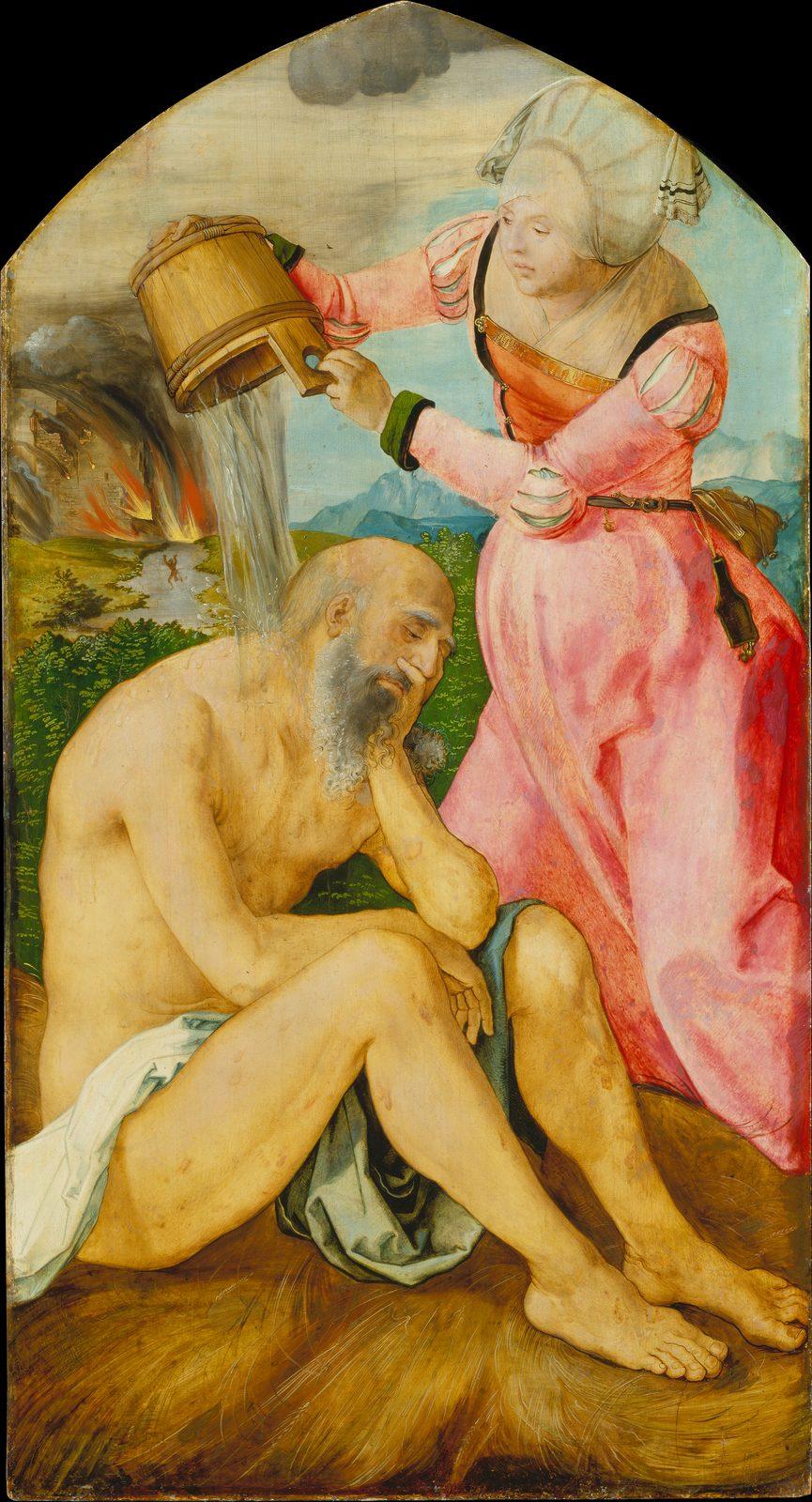
Albrecht Dürer, Job on the Dungheap, about 1505. Public domain.
Job 1 to 42 · Person · Featured Study
Job of Uz
Job was a man of the land of Uz who offered sacrifice for his own house before the law of Moses was given.
When Job went out to the gate of his city, the old men rose to their feet.
There was a man in the land of Uz whose name was Job. And this man was blameless and upright, fearing God and shunning evil.
There was a man in the land of Uz whose name was Job. And this man was blameless and upright, fearing God and shunning evil.
- The name means
- one persecuted, by Gesenius's reading in Barnes
- Family
- wife: not named in the text; daughter: Jemimah; daughter: Keziah; daughter: Keren-happuch
- First named
- Job 1:1 “…of Uz whose name was Job. And this…”
- Last named
- James 5:11 “…persevered. You have heard of Job’s perseverance and…”
Summary
Job tells his own life in two parts, the honour he had at the gate and the scorn he met in his trial. The commentators and the Talmud add his priesthood, his land and his age.
- The Septuagint gives Job 170 years after his trial and 240 years in all.
- Rabbi Yohanan taught that Scripture says more of Job than it says of Abraham.
- A Syrian tradition put Job's home in the Hauran, where a monastery near Damascus bore his name.
Where Job Stands in Scripture
His Hebrew name belongs to him alone.
The Hebrew name Iyyov stands 58 times in 52 verses, all of them in the book of Job and in Ezekiel.
“How I long for the months gone by, for the days when God watched over me,Job begins his own account of his life with a longing for the months gone by.
His Life in His Own Words
In Job 29 and 30 Job sets the days of his honour beside the days of his trial.
Job moved from the seat of honour at the gate to the scorn of the men of the wasteland.
- The friendship of God rested on his tentHis primeJob 29:4
- His children were around himHis primeJob 29:5
- The young men withdrew and the old men rose when he took his seatAt the city gateJob 29:8
- He rescued the poor and the fatherlessHis primeJob 29:12
- He served as eyes to the blind and feet to the lameHis primeJob 29:15
- He was a father to the needy and took up the stranger's caseHis primeJob 29:16
- Men younger than he mocked himHis trialJob 30:1
- He became a byword in their songsHis trialJob 30:9
- They did not hesitate to spit in his faceHis trialJob 30:10
- He became like dust and ashesHis trialJob 30:19
Six lines of his honour, then four of his trial, each with its verse.
Men younger than he mocked him, He became a byword in their songs, They did not hesitate to spit in his face, He became like dust and ashes
The Priest of His House
Commentators read Job 1:5 as a father's priesthood.
And when the days of feasting were over, Job would send for his children to purify them, rising early in the morning to offer burnt offerings for all of them. For Job thought, “Perhaps my children have sinned and cursed God in their hearts.” This was Job’s regular practice.It is the one act of worship the book records of Job before his trial.
Ellicott reads the verse as one of the passages that place Job outside the law of Moses. Jamieson, Fausset and Brown add that in the age of the patriarchs each father offered as priest for his household.
“Still he was the priest of the family, and at his altar they all attended, valuing their share in his prayers more than their share in his estate. Parents cannot give grace to their children (it is God that sanctifies), but they ought by seasonable admonitions and counsels to further their sanctification.”
Matthew Henry · Commentary on the Whole Bible · on Job 1:5Puritan
The Name Iyyov
Commentators read his name from two roots.
Albert Barnes, after Gesenius, takes the name from a Hebrew root meaning to be an enemy, to persecute or to hate. Jamieson, Fausset and Brown give a second reading, from an Arabic word meaning to return, that is, to repent.
The Cambridge Bible notes that the book makes no play on the name, and judges that it came down to the author with the story.
The House of Job
His wife, his kin, his children and four men who spoke with him stand around Job in the text.
Job's house reaches from his brothers and sisters to the children of his children.
| Person | Generation | Tie to Job |
|---|---|---|
| His brothers and sisters | 1 | His kin |
| His wife | 1 | His wife |
| Ten children of his first family | 2 | His sons and daughters |
| Ten children of his second family | 2 | His sons and daughters |
| His children's children | 3 and 4 | His descendants |
| Eliphaz, Bildad and Zophar | His three friends | |
| Elihu son of Barachel | The young man who answered him |
The Land of Uz
Scripture names the land of Uz and the lands around it, and commentators place it two ways.
Job's land lay toward Edom by one reading and toward the Euphrates by another.
| Place | What Scripture tells of it | Where the commentators place it |
|---|---|---|
| The land of Uz | The land where Job lived, named in the first verse of his book. | In Idumea, by Adam Clarke; north of Arabia Deserta toward the Euphrates, by Jamieson, Fausset and Brown. |
| Edom | Lamentations calls the daughter of Edom one who dwells in the land of Uz. | Clarke takes Uz for a very large district of Edom. |
| Teman | Eliphaz, the first of Job's friends, came from it. | Its people stand in the list of the kings of Edom in Genesis 36:34. |
Questions His Life Raises
The Talmud asks two questions about Job and answers each.
Did Job live at all?The Babylonian Talmud, Bava Batra 15a
A sage before Rabbi Shmuel bar Nahmani said that Job never existed and that his story was a parable. Rabbi Shmuel bar Nahmani answered from Job 1:1, and the Talmud asks why a parable would give a man's name and his city.
Was Job a Jew?The Babylonian Talmud, Bava Batra 15b
One teaching calls Job a pious man among the nations of the world. The Talmud answers that the sages who date him to the times of Israel all held him to be a Jew.
What the Text Leaves Unsaid
The book names no father and no tribe for Job.
The Septuagint, the old Greek translation of the Hebrew Bible, adds an ending that says more of him, and that ending is studied on its own page.
A Righteous Man Outside Israel
Two fathers of the church read Job's goodness from his land and from the lack of any law.
Gregory the Great held that the book names Uz, a land of the Gentiles, to show that Job was good among bad men. John Chrysostom asked what fear, what courts and what laws had made Job as he was.
Voices on Job
Clement of Rome quoted Job to the church at Corinth.
Clement of Rome (died 99)
Clement's First Letter to the Corinthians, Chapter 17
He set Job beside Abraham and Moses as men honoured by God who still spoke humbly of themselves. Abraham called himself dust and ashes, Job accused himself, and Moses called himself a man of feeble voice, and Clement calls the church to imitate such men.
“Let us be imitators also of those who in goat-skins and sheep-skins went about proclaiming the coming of Christ; I mean Elijah, Elisha, and Ezekiel among the prophets, with those others to whom a like testimony is borne [in Scripture]. Abraham was specially honoured, and was called the friend of God; yet he, earnestly regarding the glory of God, humbly declared, ‘I am but dust and ashes.’ Moreover, it is thus written of Job, ‘Job was a righteous man, and blameless, truthful, God-fearing, and one that kept himself from all evil.’ But bringing an accusation against himself, he said, ‘No man is free from defilement, even if his life be but of one day.’ Moses was called faithful in all God's house; and through his instrumentality, God punished Egypt with plagues and tortures. Yet he, though thus greatly honoured, did not adopt lofty language, but said, when the divine oracle came to him out of the bush, ‘Who am I, that Thou sendest me? I am a man of a feeble voice and a slow tongue.’ And again he said, ‘I am but as the smoke of a pot.’”
on Job 1:1Patristic
When Did Job Live?
Commentators and the sages of the Talmud place Job in three ages.
Before Moses, in the age of the patriarchsJamieson, Fausset and Brown, after Eusebius
Jamieson, Fausset and Brown report that Eusebius set Job two ages before Moses, about the time of Isaac. They add that his long life fits the patriarchs, and that he names only the worship of the sun and moon (Job 31:26 to 28).
The objection: the Rabbis of the Talmud read the Chaldeans of Job 1:17 as the kingdom of Nebuchadnezzar.
In the time of MosesRabbi Levi bar Lahma; Rava; the baraita of Bava Batra 14b
Rabbi Levi bar Lahma placed Job in the time of Moses, from a rare Hebrew word that Job 19:23 shares with Exodus 33:16. Rava placed him at the time of the spies, and a teaching of the Talmud says that Moses wrote the book of Job.
The objection: the Talmud itself answers that the same word stands in verses about Isaac, Jacob and Joseph.
After the exileRabbi Yohanan and Rabbi Elazar, Bava Batra 15a
Rabbi Yohanan and Rabbi Elazar held that Job was among those who came up from the exile, and that his house of study was in Tiberias.
The objection: a teaching quoted against them says that Job's days ran from Israel's entry into Egypt to the exodus.
Sources
Scripture is the Berean Standard Bible.
- Strong's Hebrew lexicon, h347, with the index of every use.
- Albert Barnes, Notes (1832 to 1869); Jamieson, Fausset and Brown, Commentary (1871), with its introduction to Job; the Cambridge Bible for Schools and Colleges; Adam Clarke, Commentary (1832); Franz Delitzsch's volume on Job in the commentary of Keil and Delitzsch, each on Job 1:1.
- Ellicott's Commentary for English Readers; Jamieson, Fausset and Brown, each on Job 1:5.
- Matthew Henry, Commentary on the Whole Bible (1710), on Job 1:5.
- The Babylonian Talmud, Bava Batra 14b, 15a and 15b, the William Davidson translation.
- The Septuagint in English, translated by Sir Lancelot Brenton, Job 42:16 to 17e.
- Gregory the Great, Morals on the Book of Job, Book I, on Job 1:1; John Chrysostom, Commentary on Job, on Job 1:1.
- Clement of Rome, 1 Clement 17.
Keep Studying
Studies8
People and groups1
Go further6
Trials of life1