
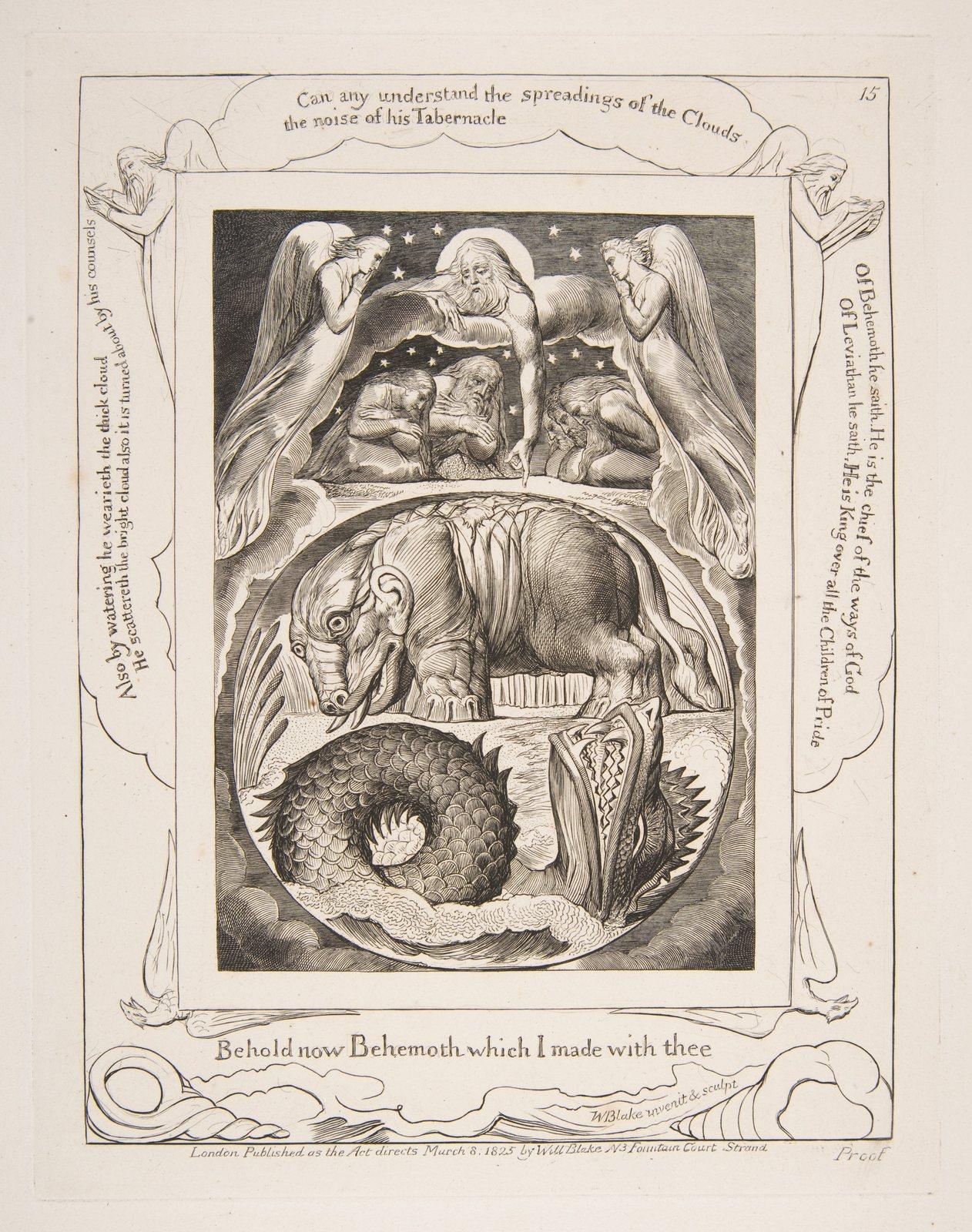
William Blake, Behemoth and Leviathan, 1825. CC0.
Job 40 to 41 · Symbol · Featured Study
Leviathan, Behemoth and Rahab
Scripture names three great beasts of the waters, and the LORD shows two of them to Job.
One of Scripture's names for Egypt is the name of a monster of the sea.
Who has given to Me that I should repay him? Everything under heaven is Mine.
- The word
- לִוְיָתָן (livyathan), H3882
- First appears
- Job 3:8 “…the day—those prepared to rouse Leviathan.”
Summary
Job names Leviathan and Rahab when he complains. The LORD answers him with Behemoth and Leviathan. The Psalms and Isaiah use the same names for Egypt at the Red Sea and for a dragon God will kill. Some read the beasts as real animals. Some read them as Egypt or as the devil.
- Benson notes that the Septuagint, the Greek translation of the Old Testament, renders Leviathan dragon wherever it occurs.
- Strong's lexicon also reads Leviathan as the constellation of the dragon and as a symbol of Babylon.
- Blake engraved Behemoth and Leviathan in one circle under the hand of God.
Three Names for Great Beasts
James Strong glosses each name, and one English name covers two Hebrew words.
Which creatures does God name to Job, and why does Rahab stand among them? James Strong glosses Leviathan (H3882) as a wreathed animal, a serpent, especially the crocodile or some other large sea monster. He glosses Behemoth (H930) as a water ox, the hippopotamus, and Rahab (H7294) as a boaster, a name for Egypt. A second number, H7293, carries the same Hebrew letters in Psalm 87:4 and Isaiah 30:7. The woman Rahab of Jericho bears another name, Rachab (H7343), spelled with a different letter.
Surely hope of overcoming him is false. Is not the sight of him overwhelming? No one is so fierce as to rouse Leviathan. Then who is able to stand against Me?The LORD turns from the beast no one dares rouse to Himself.
Where Each Name Stands
Five of the verses stand in Job, three in Job's speeches and two in the LORD's.
Leviathan stands in five verses, Rahab in six and Behemoth in one.
| Name | Where it stands and who speaks | Strong's number |
|---|---|---|
| Leviathan | In Job 3:8, Job curses his birthday. | H3882 |
| Rahab | In Job 9:13, Job answers Bildad's first speech. | H7294 |
| Rahab | In Job 26:12, Job answers Bildad again. | H7294 |
| Behemoth | In Job 40:15, the LORD speaks from the whirlwind. | H930 |
| Leviathan | In Job 41:1, the LORD speaks on. | H3882 |
| Leviathan | Psalm 74:14 stands in a lament. | H3882 |
| Rahab | Psalm 87:4 stands in a song of Zion. | H7293 |
| Rahab | Psalm 89:10 stands in a song of God's faithfulness. | H7294 |
| Leviathan | Psalm 104:26 stands in a song of creation. | H3882 |
| Leviathan | In Isaiah 27:1, the prophet speaks of that day. | H3882 |
| Rahab | Isaiah 30:7 closes a woe on the rebellious children. | H7293 |
| Rahab | In Isaiah 51:9, the prophet calls on the LORD. | H7294 |
Rahab, Leviathan
Scripture sets the beast of the sea at six points, from creation to the new creation.
- CreationThe great sea creatures are made and called goodGenesis 1:21
- The exodusThe heads of the dragons of the sea are smashedPsalm 74:13
- The exileThe prophet recalls the cutting of RahabIsaiah 51:9
- That dayA judgment is set for LeviathanIsaiah 27:1
- The endThe great dragon is thrown downRevelation 12:9
- The new creationThe sea is goneRevelation 21:1
Each step names a sea creature, a dragon or the sea; Jamieson, Fausset and Brown join Isaiah 27:1 to Revelation 12.
Behemoth and Leviathan in the LORD's Answer
The LORD ends His second speech with two beasts that Job cannot master.
Look at Behemoth, which I made along with you. He feeds on grass like an ox.The LORD sets the beast beside Job as a fellow creature.
Ellicott notes that Behemoth is the natural plural of behemah, the word for domestic cattle. The Cambridge Bible takes it as an Egyptian name for the river ox, made Hebrew.
“Can you pull in Leviathan with a hook or tie down his tongue with a rope?The second speech turns from the land to the water.
The Pulpit Commentary derives the name Leviathan from words for twisting and for a monster, and calls it a descriptive epithet more than a name.
Rahab and the Sea
Rahab names a proud power God crushed.
You crushed Rahab like a carcass; You scattered Your enemies with Your mighty arm.The psalm looks back to the exodus to ask God for help now.
Barnes and Benson read Rahab in Psalm 89:10 and Isaiah 51:9 as Egypt, broken at the exodus. In Isaiah 30:7 the prophet calls Egypt Rahab Who Sits Still, and Psalm 87:4 names Rahab with Babylon among those who know the LORD.
In Job the reading is less sure. Ellicott on Job 9:13 holds it impossible to say whether Rahab is Egypt or a poetic name for the lost archangel. The Pulpit Commentary reads Rahab in Job 9:13 and Job 26:12 as a great power of evil, and compares the serpent of Egyptian myth pierced by Horus.
Matthew Henry notes on Job 26:12 that Rahab is often put for Egypt, and Adam Clarke hears in the verse the passage through the Red Sea.
The Dragon in That Day
Isaiah sets Leviathan's end in the day the LORD judges the earth.
In that day the LORD will take His sharp, great, and mighty sword, and bring judgment on Leviathan the fleeing serpent—Leviathan the coiling serpent—and He will slay the dragon of the sea.Isaiah moves the monster from the past to a day still to come.
The Cambridge Bible reads the three monsters as hostile powers of the world, and the dragon in the sea as almost certainly Egypt. The Pulpit Commentary lists the kingdoms others have named, among them Assyria, Babylon and Egypt, and holds that so many answers show the doubt.
Jamieson, Fausset and Brown read rulers hostile to Israel first, and Satan as the one intended in the end, citing Revelation 20:10. Revelation 12:9 names the great dragon that ancient serpent, the devil.
A Voice on Leviathan
Matthew Henry wrote on the LORD's sword in Isaiah's prophecy.
Matthew Henry (1662 to 1714)
Commentary on the Whole Bible
His note turns on the three words that describe the sword.
“It is emphatically expressed in the original: The Lord with his sword, that cruel one, and that great one, and that strong one, shall punish this unwieldy, this unruly criminal; and it shall be capital punishment: He shall slay the dragon that is in the sea; for the wages of his sin is death.”
on Isaiah 27:1Puritan
What Are the Beasts?
Each answer has its holders and its objection.
The hippopotamus and the crocodileThe Cambridge Bible; John Wesley
The Cambridge Bible reads Behemoth as the hippopotamus, and John Wesley reads Leviathan as the crocodile. Barnes reports that the hippopotamus has been the common reading of Behemoth since Bochart.
The objection: Ellicott notes that the description of Behemoth scarcely seems to answer to one and the same animal.
The elephant and the whaleThomas Aquinas; the King James margin, as Barnes reports it
Thomas Aquinas reads Behemoth under the likeness of an elephant, the largest land animal, and Leviathan as a whale. Barnes reports the margin's note that some think Behemoth the elephant.
The objection: Jamieson, Fausset and Brown hold that the reeds and marsh of Job 40:21 to 22 fit the river horse.
Figures of the devilGregory the Great; Jerome, on Isaiah 27:1
Gregory the Great, in his Morals on the Book of Job, asks whom the LORD suggests under the name Behemoth except the ancient enemy. Jerome reports that the Hebrews understand the devil by the serpent of Isaiah 27:1.
The objection: Barnes holds that the whole description of Job 41 is of an animal that lived in the water.
Formed to Frolic
The psalm that names Leviathan last among the Psalms calls it a creature at play.
There the ships pass, and Leviathan, which You formed to frolic there.The name Isaiah gives to God's enemy stands here in a song of praise.
Sources
Scripture is the Berean Standard Bible.
- James Strong, Exhaustive Concordance of the Bible, entries H3882, H930, H7294, H7293, H7343 and H8577, with every verse that carries each word.
- On Job 40:15: Ellicott's Commentary for English Readers; Albert Barnes, Notes on the Bible; the Cambridge Bible for Schools and Colleges; the Pulpit Commentary.
- On Job 41:1: the Benson Commentary; Albert Barnes, Notes on the Bible; the Pulpit Commentary.
- On Job 9:13: Ellicott's Commentary for English Readers; the Pulpit Commentary.
- On Psalm 89:10 and Isaiah 51:9: Albert Barnes and the Benson Commentary; on Isaiah 27:1: the Cambridge Bible for Schools and Colleges and the Pulpit Commentary.
- Matthew Henry (1710) on Job 26:12; Adam Clarke (1832) on Job 26:12; John Wesley (1765) on Job 40:15 and 41:1; Jamieson, Fausset and Brown (1871) on Job 40:15; Gregory the Great, Morals on the Book of Job, book 32, on Job 40:15; Thomas Aquinas, Commentary on Job, on Job 41:1.
- Jamieson, Fausset and Brown (1871) on Isaiah 27:1.
- Jerome, Commentary on Isaiah, on Isaiah 27:1.
- Matthew Henry, Commentary on the Whole Bible (1710), on Isaiah 27:1.
Keep Studying
Read it5
People and groups1
Go further8