
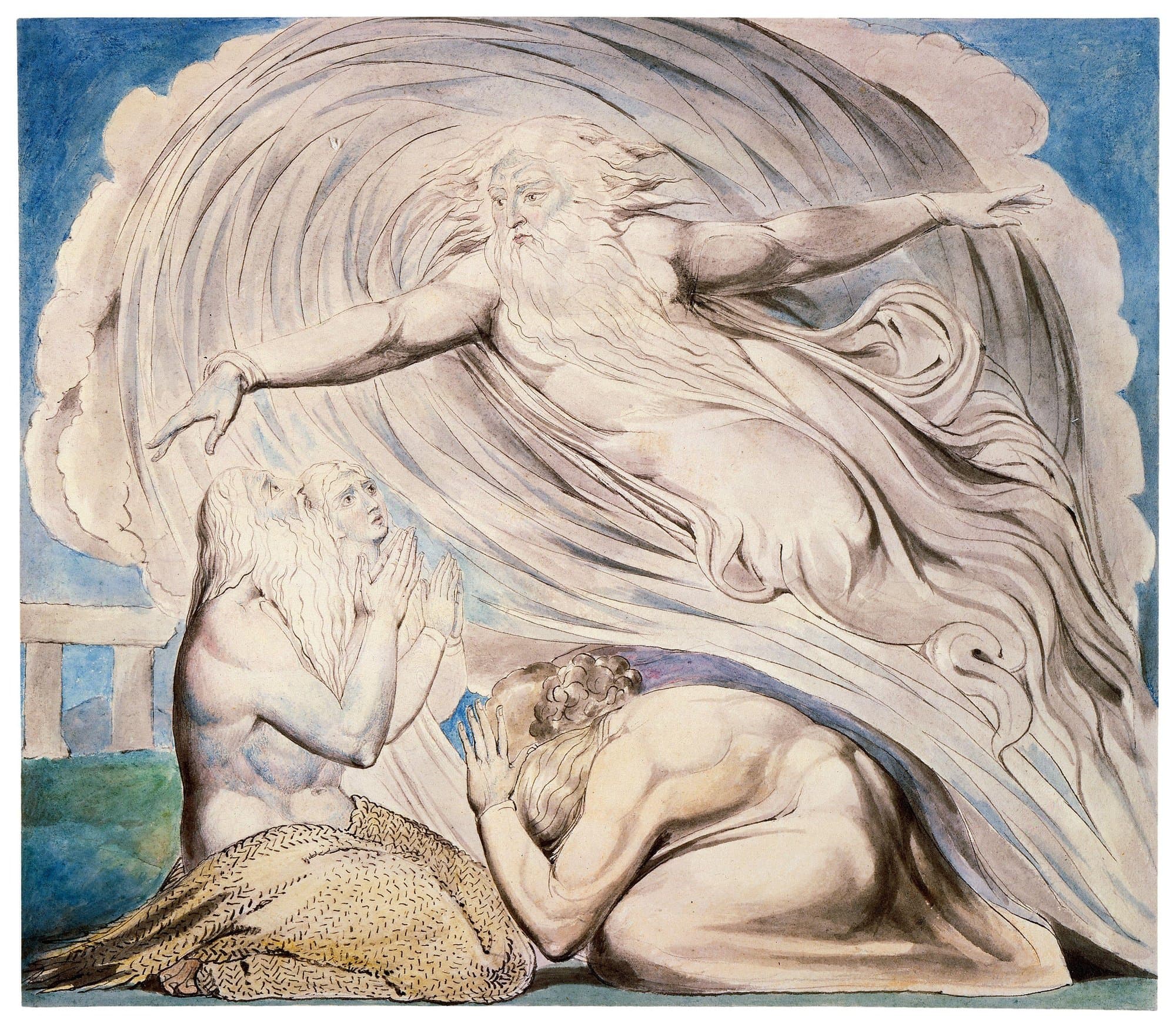
Job 38 · Debate · Suffering
Why Does God Allow Suffering?
Christians have answered the problem of suffering with free will, with the growth of souls, and with God's reply to Job.
In a survey George Barna ran for Lee Strobel, the question people most wanted to ask God was why there is pain and suffering in the world.
Then the LORD answered Job out of the whirlwind and said:
- The question
- Why does a good and all-powerful God allow suffering?
- The texts
- Job 38:1 to 7, Job 42:5, Romans 5:3 to 4
Summary
No single answer explains every suffering, and the church has held three together, each with its own holders across the centuries. Each rests on a text of Scripture, and each meets an objection it cannot fully remove. The objection itself was given its classic modern forms by David Hume and William Rowe.
- Augustine and Alvin Plantinga hold the free-will answer, and Irenaeus and John Hick the soul-making answer.
- God answered Job from the whirlwind with questions and gave him no reason for his losses.
- The strongest objections press suffering that no free choice caused and suffering that no one grows by.
The Question and Its Two Forms
Philosophers distinguish a form of the objection that claims a contradiction from a form that weighs the evidence.
Anyone who believes in a good and almighty God meets this question, often in the hour of his own grief. It belongs to the trial of suffering because every sufferer who prays is asking it in some form. The answers Christians give shape how they pray, how they comfort and how they wait.
The question this study answers is why a God who is good and all-powerful allows suffering. It states the skeptic's case first and then the three answers the church has given, each with the Scripture it reads.
David Hume, in his Dialogues concerning Natural Religion (1779), part 10, gave the logical form in the words of Epicurus: "Is he willing to prevent evil, but not able? then is he impotent. Is he able, but not willing? then is he malevolent. Is he both able and willing? whence then is evil?"
The evidential form, which William Rowe argued in 1979, grants that God and evil can both exist and asks whether the suffering we see makes God unlikely. Rowe's example was a fawn trapped in a forest fire that "lies in terrible agony for several days before death relieves its suffering".
The problem as it bears on the goodness of God has its own study, with the doctrine of evil as the lack of a good.
Three Answers Side by Side
Each answer reads a different text of Scripture.
Natural disaster, unseen pain and unexplained loss are the hardest cases for the three answers.
| The answer | Held by | The work | The text it rests on | The strongest objection |
|---|---|---|---|---|
| Free will | Augustine; Alvin Plantinga | Augustine, Enchiridion, chapters 11 and 27; Plantinga, God, Freedom, and Evil (Eerdmans, 1977) | sin entered the world through one man, and death through sin (Romans 5:12) | Cancer, earthquakes and famines come about without any creature choosing them. |
| Soul-making | Irenaeus; Gregory the Great; John Hick | Irenaeus, Against Heresies, book 4, chapters 37 to 39; Hick, Evil and the God of Love (1966) | suffering produces perseverance; perseverance, character; and character, hope (Romans 5:3 to 4) | Much suffering, like the fawn in the fire, is seen by no one and builds no one's character. |
| God's answer to Job | G. K. Chesterton | Chesterton, Introduction to The Book of Job (1916) | My ears had heard of You, but now my eyes have seen You. (Job 42:5) | God gives Job no reason for his suffering, so the speeches can sound like power in place of an answer. |
Each Answer Stated
Augustine, Plantinga, Irenaeus, Gregory, Hick and Chesterton state the answers in their own words.
The free-will answerAugustine, Alvin Plantinga
Augustine, in his Enchiridion, wrote that God "would never permit the existence of anything evil among His works, if He were not so omnipotent and good that He can bring good even out of evil". He traced the misery of mankind to Adam, "who by an evil use of his free-will broke away from his wholesome bondage to the Creator's laws". Of God's choice he wrote, "He judged it better to bring good out of evil, than not to permit any evil to exist".
Alvin Plantinga, in God, Freedom, and Evil, argued that a world of persons with free will able to love and do good is of great value. He held that God could not remove much of the evil without removing that good. The Internet Encyclopedia of Philosophy calls his reply the most famous philosophical response to the question in modern times.
The soul-making answerIrenaeus, Gregory the Great, John Hick
Irenaeus, in Against Heresies, book 4, chapters 37 to 39, held that created things are young and could not be perfect from the beginning. He described "man making progress day by day, and ascending towards the perfect", and asked, "How, then, shall he be a God, who has not as yet been made a man?"
John Hick, in Evil and the God of Love (1966), built on Irenaeus and called the world a "vale of soul-making", in which people grow in character and love by facing real hardship.
Gregory the Great, in his Morals on the Book of Job, read Job 42:5 as a measure of Job's growth. He wrote of "the progress also he had made through suffering", as far above his former state as sight is above hearing.
God's answer to JobJob 38 to 42, G. K. Chesterton
Where were you when I laid the foundations of the earth? Tell Me, if you have understanding.This question about the founding of the earth sets the course of God's reply to Job.
“I know that You can do all things and that no plan of Yours can be thwarted.Job's reply shows that the speeches answered him.
G. K. Chesterton wrote of the speeches from the whirlwind in the essay that opens an edition of Job. He wrote that Job "has been told nothing, but he feels the terrible and tingling atmosphere of something which is too good to be told". He went on, "The riddles of God are more satisfying than the solutions of man."
Where Suffering Came From
Genesis 3 is where Scripture places the entry of pain and death, and the book of Job is its longest treatment of a righteous man's suffering.
Genesis 3 puts the curse on the ground after the first sin, "cursed is the ground because of you; through toil you will eat of it all the days of your life" (Genesis 3:17). The free-will answer reads natural evil from this curse.
The book of Job sets the question in a story, from the losses of Job 1 and 2 through the friends' speeches to the whirlwind.
Every answer works within God's rule over what happens, which Scripture teaches most plainly in Joseph's words to his brothers.
What Scripture Adds to Every Answer
First Peter and Revelation add the Son's suffering and the end of all suffering.
Therefore, since Christ suffered in His body, arm yourselves with the same resolve, because anyone who has suffered in his body is done with sin.Peter speaks of Christ suffering in His body, so the God of whom the question is asked has entered suffering in the person of the Son.
The cross shows the sufferer the One who has suffered for him. Scripture also promises a day when "there will be no more death or mourning or crying or pain" (Revelation 21:4).
Books to Read Next
These five works state the answers and the objection in the words of the men who gave them.
Enchiridion
Augustine · before 430
Augustine's handbook on faith, hope and love sets out what Christians believe, and its eleventh chapter calls evil the absence of good.
READ IT FREE →Against Heresies, book 4
Irenaeus · before 202
Its fourth book asks, in chapter 38, why God did not make man perfect from the beginning.
READ IT FREE →Dialogues concerning Natural Religion
David Hume · 1779
Hume's dialogue among Cleanthes, Philo and Demea weighs what the order of nature shows of God.
READ IT FREE →God, Freedom, and Evil
Alvin Plantinga · Eerdmans edition, 1977
Plantinga's short book is the work the modern debate cites for the free-will defense.
In print: find it wherever books are sold.
Evil and the God of Love
John Hick · 1966
Hick's book is the classic modern statement of the theodicy of soul-making.
In print: find it wherever books are sold.
Things Too Wonderful
Job's reply to the whirlwind begins with God's power and turns to his own lack of understanding.
You asked, ‘Who is this who conceals My counsel without knowledge?’ Surely I spoke of things I did not understand, things too wonderful for me to know.Job's confession warns every answer against speaking beyond what God has made known.
Sources
Scripture is the Berean Standard Bible.
- David Hume, Dialogues concerning Natural Religion (1779), part 10.
- Augustine, Enchiridion on Faith, Hope and Love, chapters 11 and 27, translated by J. F. Shaw, Nicene and Post-Nicene Fathers, first series, volume 3.
- Irenaeus, Against Heresies, book 4, chapters 37 to 39, Ante-Nicene Fathers, volume 1.
- Wikipedia, Dialogues Concerning Natural Religion, the infobox (publication date 1779), the page Project Gutenberg #4583 links.
- G. K. Chesterton, Introduction to The Book of Job (London: Cecil Palmer & Hayward, 1916)
- Lee Strobel, The Case for Faith (2000), p. 29, reporting the survey George Barna ran for him, as the Internet Encyclopedia of Philosophy cites it.
- James R. Beebe, "The Logical Problem of Evil", Internet Encyclopedia of Philosophy, section 4 on Plantinga's Free Will Defense and the objection from natural evil.
- Nick Trakakis, "The Evidential Problem of Evil", Internet Encyclopedia of Philosophy, on Rowe (1979) and Hick (1966)
- Gregory the Great, Morals on the Book of Job, book 35, on Job 42:5.
Keep Studying
Studies4
People and groups6
Trials of life1