
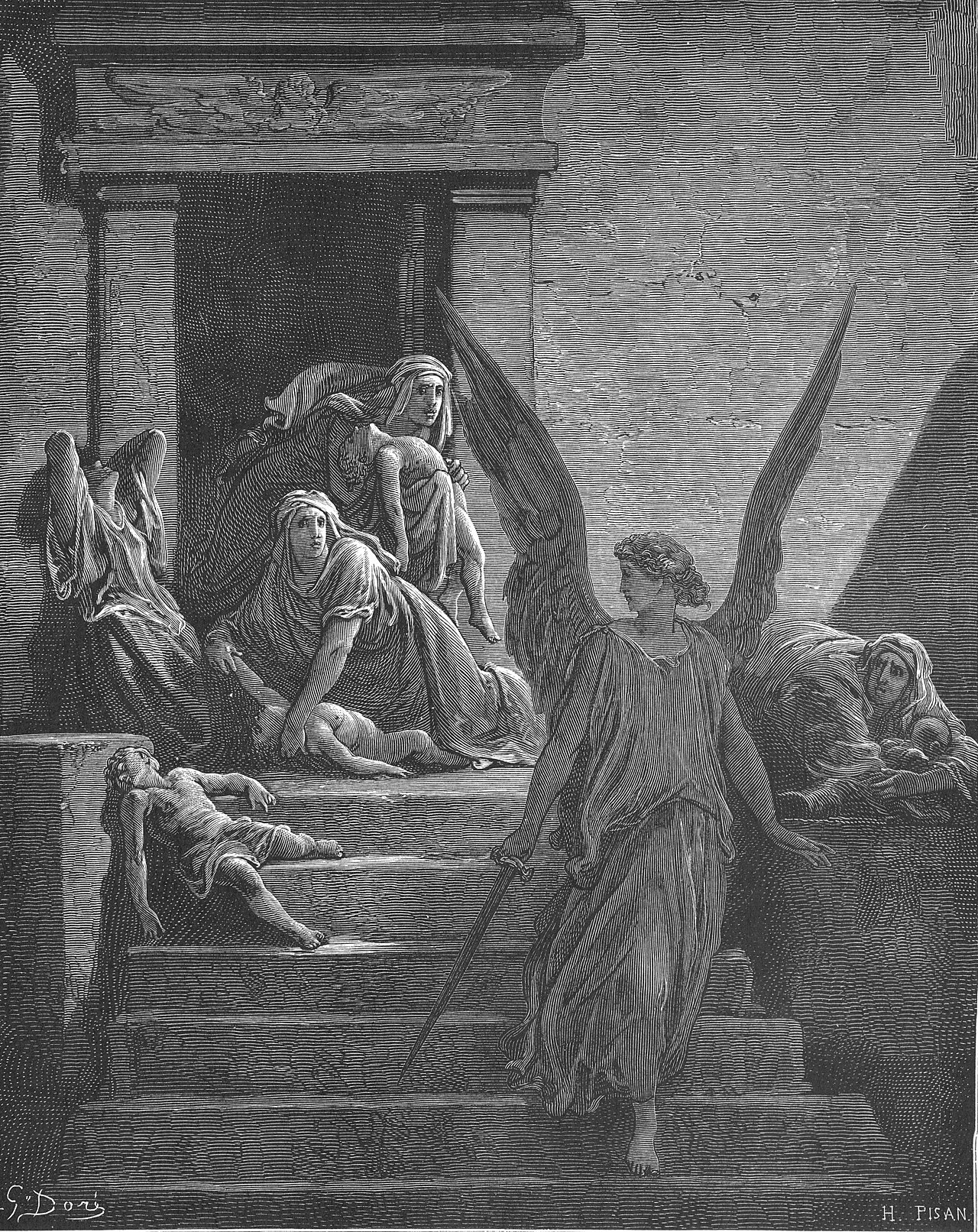
Exoduschapter 12
51 verses · Moses, by tradition · 15th or 13th century BC · The Law
In Jewish life
The reading
Weekly portion 15 of 54
בֹּא Bo, Exodus 10:1 to 13:16
Read with it: Jeremiah 46:13 to 46:28.
The verse numbers here are the ones a Hebrew Bible carries, which differ from an English Bible by a verse or two in several places. The Sephardi reading is named only where this site records a difference; communities vary beyond what is listed. What these books are, and how a Christian reader meets them →
What is done
Passover, in Hebrew Pesach, is kept from this chapter, and this site's own note on it describes the evening as Jewish families keep it now. The meal is called the seder, which is the Hebrew word for order. It carries unleavened bread, bitter herbs, cups of wine and the retelling of this chapter's story, with the children asking the questions. The lamb stood at the centre of the feast while the Temple stood. The seder as it is now practised took its shape after the Temple fell in AD 70, and its oldest written outline is the Mishnah at Pesachim 10. The month this chapter sets first is the month the festival year is counted from. Rashi reads verse 2 as a lesson given by sight. God showed Moses the moon in its renewal and said that this is how the beginning of a month is known (Rashi on Exodus 12:2:1). From Passover the counting runs on toward Weeks, and this site's own note on the firstfruits describes the sheaf brought during the festival week.
How it is read
Rashi reads this chapter through the Mekhilta and the tractate Pesachim, so the law and the story come together in almost every line. At verse 6 he holds that the four days between taking the lamb and killing it were for examining it against blemish. He carries Rabbi Mathia ben Cheresh on why those days were given (Rashi on Exodus 12:6:1). At verse 13 he reads the blood as a private mark. It is "a sign, and not to others for a sign", and from that he concludes that the blood was placed inside the houses (Rashi on Exodus 12:13:1). At verse 17 he carries Rabbi Josiah's reading of the unleavened bread as a rule about time. Just as dough must not be left to rise, "so we may not let the commandment become leavened by waiting too long before we perform it" (Rashi on Exodus 12:17:1). At verse 23 he gives two senses for the verb the feast is named from, holding that it signifies sparing, and also that it can be read as leaping over (Rashi on Exodus 12:23:1). The text is the Rosenbaum and Silbermann Rashi of 1929 to 1934, in the public domain.
What the rabbis say
The rabbis take up the lamb of verse 3 at Bekhorot 12a:2 and the company that eats it at Chagigah 7b:10. On the lamb without blemish they taught at Arakhin 31b:10, and on its keeping until the fourteenth day at Arakhin 13b:2. On the eating of it they taught at Berakhot 38b:13 and Bava Metzia 115b:2, and on what is left until morning at Berakhot 9a:18. The Jerusalem Talmud carries the child's question of verses 26 and 27 at Pesachim 10:4:2 and 10:7:5.
The text, verse by verse
Each word shows the Hebrew, the English under it, how it sounds and its Strong’s number. A rule between verses marks where the Hebrew manuscripts end a paragraph.
A Lamb for Each Household
Ibn Ezra on Exodus 12:1
Scripture now mentions the first of the commandments given via Moses and Aaron, as they alone were prophets of the law.
Read it in full at Sefaria · Ibn Ezra's commentary on the Pentateuch, tran. and annot. by H. Norman Strickman and Arthur M. Silver. Menorah Pub., 1988-2004
Ibn Ezra on Exodus 12:10
BUT THAT WHICH REMAINETH OF IT…BURN WITH FIRE. If one was unable to eat one’s portion due to circumstances beyond one’s control.
Read it in full at Sefaria · Ibn Ezra's commentary on the Pentateuch, tran. and annot. by H. Norman Strickman and Arthur M. Silver. Menorah Pub., 1988-2004
Onkelos Exodus 12:10
You must not leave any of it over until morning. Any of it left over until morning must be burned in fire.
Read it in full at Sefaria · Metsudah Chumash, Metsudah Publications, 2009 [with Onkelos translation]
Ibn Ezra on Exodus 12:11
The reference is only to the paschal lamb eaten in Egypt. However, those in Argalon. The reference is unclear.
Read it in full at Sefaria · Ibn Ezra's commentary on the Pentateuch, tran. and annot. by H. Norman Strickman and Arthur M. Silver. Menorah Pub., 1988-2004
Ramban on Exodus 12:12
The idol of wood rotted, and the one of metal melted. 183 This is the language of Rashi. The Mechilta here has it: “the metal idols corroded.” Now Scripture did not elucidate the nature of these judgments because the vanities by which they are instructed are but timber.
Read it in full at Sefaria · Commentary on the Torah by Ramban (Nachmanides). Translated and annotated by Charles B. Chavel. New York, Shilo Pub. House, 1971-1976
Seven Days of Unleavened Bread
Blood on the Doorposts
At Midnight, a Great Cry
Out of Egypt by Night
Who May Eat the Passover
Hebrew words in this chapter
The 40 most used Hebrew words of the chapter, counted by lemma. The article, the object marker, the negatives and the common prepositions are left out.
| Word | Sense here | Uses | Strong’s |
|---|---|---|---|
| מִצְרַיִםMitsrayim | Egypt | 22 | H4714 |
| יְהֹוָהYᵉhôvâh | yahweh | 19 | H3068 |
| אָכַלʼâkal | to eat | 18 | H398 |
| בַּיִתbayith | for a household of | 16 | H1004 |
| יִשְׂרָאֵלYisrâʼêl | Israel | 15 | H3478 |
| יוֹםyôwm | day | 15 | H3117 |
| אֶרֶץʼerets | land | 13 | H776 |
| בֵּןbên | son | 13 | H1121 |
| עָשָׂהʻâsâh | I will do | 12 | H6213 |
| אָמַרʼâmar | to say | 9 | H559 |
| יָצָאyâtsâʼ | to come out | 8 | H3318 |
| מֹשֶׁהMôsheh | Moses | 7 | H4872 |
| חֹדֶשׁchôdesh | month | 7 | H2320 |
| לָקַחlâqach | to take | 7 | H3947 |
| לַיִלlayil | night | 7 | H3915 |
| שָׁנֶהshâneh | year | 6 | H8141 |
| דָּםdâm | blood | 6 | H1818 |
| מַצָּהmatstsâh | unleavened bread | 6 | H4682 |
| אַהֲרוֹןʼAhărôwn | Aaron | 5 | H175 |
| רִאשׁוֹןriʼshôwn | first | 5 | H7223 |
| Word | Sense here | Uses | Strong’s |
|---|---|---|---|
| שֶׂהseh | a lamb | 5 | H7716 |
| פֶּסַחpeçach | Passover | 5 | H6453 |
| בְּכוֹרbᵉkôwr | firstborn | 5 | H1060 |
| עַםʻam | people | 5 | H5971 |
| דָבַרdâbar | to speak | 4 | H1696 |
| עֵדָהʻêdâh | congregation | 4 | H5712 |
| אִישׁʼîysh | everyone | 4 | H376 |
| נֶפֶשׁnephesh | people | 4 | H5315 |
| אַרְבַּעʼarbaʻ | four | 4 | H702 |
| נָתַןnâthan | to give | 4 | H5414 |
| שָׁמַרshâmar | to keep | 4 | H8104 |
| עֶצֶםʻetsem | bone | 4 | H6106 |
| חָמֵץchâmêts | to leaven | 4 | H2556 |
| עֶרֶבʻereb | evening | 3 | H6153 |
| שְׁנַיִםshᵉnayim | two | 3 | H8147 |
| מְזוּזָהmᵉzûwzâh | doorpost | 3 | H4201 |
| מַשְׁקוֹףmashqôwph | lintel | 3 | H4947 |
| אֵשׁʼêsh | fire | 3 | H784 |
| בֹּקֶרbôqer | morning | 3 | H1242 |
| נָכָהnâkâh | and I will strike | 3 | H5221 |
Keep studying
Studies12
Words12
Trails1
Subjects3
Sources for this chapter
The Hebrew text
STEP Bible, the tagged Hebrew text and its English glosses and James Strong, Strong's Exhaustive Concordance.
In Jewish life
Rashi, Rashi on Exodus 12:2:1, 12:6:1, 12:13:1, 12:17:1 and 12:23:1, Pentateuch with Rashi's commentary by M. Rosenbaum and A. M. Silbermann, 1929 to 1934 (public domain); This site's Hebraic note on Exodus 12, src/lib/hebraic/feasts.ts, the entry titled The night Israel still keeps, and the firstfruits entry in the same file; The Babylonian Talmud, Bekhorot 12a:2, Chagigah 7b:10, Arakhin 31b:10 and 13b:2, Berakhot 38b:13 and 9a:18, and Bava Metzia 115b:2, cited by ref and The Jerusalem Talmud, Jerusalem Talmud Pesachim 10:4:2 and 10:7:5, cited by ref.
The rabbinic texts
Ramban, Commentary on the Torah by Ramban (Nachmanides). Translated and annotated by Charles B. Chavel. New York, Shilo Pub. House, 1971-1976; Ibn Ezra, Ibn Ezra's commentary on the Pentateuch, tran. and annot. by H. Norman Strickman and Arthur M. Silver. Menorah Pub., 1988-2004; Targum, Metsudah Chumash, Metsudah Publications, 2009 [with Onkelos translation] and Sefaria, texts and citation data.