
Luke 22:17
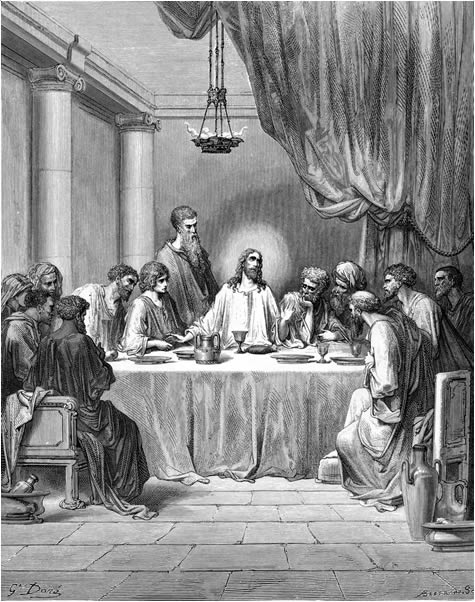
in Luke 22After taking the cup, He gave thanks and said, “Take this and divide it among yourselves.
BSB
The same verse in ASV and KJV ▾
ASV
And he received a cup, and when he had given thanks, he said, Take this, and divide it among yourselves:
KJV
And he took the cup, and gave thanks, and said, Take this, and divide it among yourselves:
⋯
This verse in Luke 22
Commentary
14 notes on this verseWhen he came to his passion, he wanted to declare to Abraham and those with him the good news of the opening of the inheritance. After he gave thanks while holding the cup and then drank from it … he promised that he would again drink of the produce of the vine with his disciples. Christ thus showed the inheritance of the earth, in which the new produce of the vine is drunk, and the physical resurrection of his disciples.
This site's exposition
divide it among yourselves
on Luke 22:17-18
He took the cup, and gave thanks, and said, take this, and divide it among yourselves, one of several cups in the traditional Passover sequence, taken here before the bread that follows in verse 19. For I say unto you, I will not drink of the fruit of the vine, until the kingdom of God shall come, the same forward-looking vow as verse 16 now attached to the cup, Jesus abstaining from what he offers them as a pledge of a shared future meal in the coming kingdom. The bench reads the two vows together as framing the whole institution that follows, present sharing bound to a promised consummation.
The record, by era
The Church Fathers1 voice
Christ is also within us in another way by means of our partaking in the sacrifice of bloodless offerings, which we celebrate in the churches. We received from him the saving pattern of the rite, as the blessed Evangelist plainly shows us in the passage that has just been read. He tells us that Jesus took a cup, gave thanks and said, "Take this, and divide it with one another." His giving thanks meant his speaking to God the Father in the manner of prayer. Christ signified to us that he, so to speak, shares and takes part in the Father's good pleasure in granting us the life-giving blessing that was given to us then. Every grace and every perfect gift comes to us from the Father by the Son in the Holy Spirit. This act, then, was a useful pattern for us of the prayer that should be offered whenever the grace of the mystical and life-giving sacrifice is about to be spread before him by us. Accordingly, we are accustomed to do this. First, offering up our thanksgivings and joining in our praises to God the Father, Son and the Holy Spirit, we come near to the holy tables. We believe that we receive life and blessing spiritually and physically. We receive in us the Word of the Father, who for our sakes became man and who is life and the giver of life.
The Medieval Church4 voices
But it is far more natural, that as before of the typical lamb, so now also of the drink of the Passover, He should say that He would no more taste, until the glory of the kingdom of God being made manifest, the faith of the whole world should appear; that so by means of the spiritual changing of the two greatest commands of the law, namely, the eating and drinking of the Passover, you might learn that all the Sacraments of the law were to be transferred to a spiritual observance.
And having taken the cup, He gave thanks and said: Take it and divide it among yourselves. And this cup pertains to that old Passover, of which He desired to put an end. Having taken it, He gave thanks, for this reason indeed, because the …
Third, as regards the termination of the figurative drink, it is added: And having taken the cup, he gave thanks and said: Take and divide it among you. Now this is said of the drink pertaining to the old passover; whence the Gloss: "This cup …
Thus then was our Lord the approver of the legal Passover; and as He taught that it related to the figure of His own dispensation, He forbids it henceforth to be represented in the flesh. Therefore He adds, For I say unto you, I will not any more eat thereof, until it be fulfilled in the kingdom of God. That is, I will no more celebrate the Mosaic Passover, until, being spiritually understood, it is fulfilled in the Church. For the Church is the kingdom of God; as in Luke, The kingdom of God is within you. (Luke 17:21.) Again, the ancient Passover, which He desired to bring to an end, is also alluded to in what follows; And he took the cup, and gave thanks, and said, Take ye, &c. For this gave He thanks, that the old things were about to pass away, and all things to become new.
7 more voices on this verse
The Puritans and the Awakening3 voices
In the great day you shall sit on thrones, as assessors with Christ, to approve of and applaud his judgment of the twelve tribes of Israel. " If the saints shall judge the world ( 1 Cor. vi.
quarantine:debris (2026-07-29) — unbalanced-parens+odd-straight-quotes
For I will not eat thereof any more - That is, it will be the last I shall eat with you before I die. The kingdom of God did not properly commence till his resurrection. Then was fulfilled what was typified by the passover.
And he took the cup and gave thanks,....
The Nineteenth Century4 voices
A commentator
Albert Barnes1798–1870
Notes, Explanatory and Practical, on the Old and New Testaments (1832-1869)
And he took the cup and gave thanks - This was not the “sacramental” cup, for that was taken “after” supper, Luk 22:20. This was one of the cups which were usually taken during the celebration of the Passover, and pertained to that observance. “After” he had kept this in the usual manner, he instituted the supper which bears his name, using the bread and wine which had been prepared for the Passover, and thus ingrafted the Lord’s Supper on the Passover, or superseded the Passover by another ordinance, which was intended to be perpetual.
A commentator
J.C. Ryle1816–1900
Expository Thoughts on the Gospels: Luke (lightly modernized text, Grace Gems edition) (1858)
proposed
These verses contain Luke's account of the institution of the Lord's supper. It is a passage which every true Christian will always read with deep interest. How astonishing it seems that an ordinance, so beautifully simple at its first appointment, should have been obscured and mystified by man's inventions! What a painful proof it is of human corruption — that some of the bitterest controversies which have disturbed the Church, have been concerning the table of the Lord. Great indeed is the ingenuity of man, in perverting God's gifts!
A commentator
J.C. Ryle1816–1900
Expository Thoughts on the Gospels: Luke (lightly modernized text, Grace Gems edition) (1858)
proposed
These verses contain Luke's account of the institution of the Lord's supper. It is a passage which every true Christian will always read with deep interest. How astonishing it seems that an ordinance, so beautifully simple at its first appointment, should have been obscured and mystified by man's inventions! What a painful proof it is of human corruption — that some of the bitterest controversies which have disturbed the Church, have been concerning the table of the Lord. Great indeed is the ingenuity of man, in perverting God's gifts! The ordinance that should have been for his wealth — is too often made an occasion of stumbling. We should notice, for one thing in these verses — that the principal object of the Lord's supper was to remind Christians of Christ's death for sinners. In appointing the Lord's supper, Jesus distinctly tells His disciples that they were to do what they did, "in remembrance of Me." In one word, the Lord's supper is not a sacrifice. It is eminently a commemorative ordinance. The bread that the believer eats at the Lord's table, is intended to remind him of Christ's body given to death on the cross for his sins. The wine that he drinks, is intended to remind him of Christ's blood shed to make atonement for his transgressions. The whole ordinance was meant to keep fresh in his memory — the sacrifice of Christ on the cross, and the satisfaction which that sacrifice made for the sin of the world. The two elements of bread and wine were intended to preach Christ crucified as our substitute under lively emblems. They were to be a visible sermon, appealing to the believer's senses, and teaching the old foundation-truth of the Gospel — that Christ's death on the cross, is the life of man's soul. We shall do well to keep this simple view of the Lord's supper steadily in view.
He took the cup - This was not the sacramental cup, for that was taken after supper, Luk 22:20, but was the cup which was ordinarily taken before supper. Divide it among yourselves - Pass the cup from one to another; thus the cup which Christ gave to the first person on his right hand continued to be handed from one to another, till it came to the last person on his left.
How the passage was read
On Luke 22:1-23On Luke 22:1-23
The cups on the table
Luke alone records TWO cups (22:17, 22:20), and the detail is at home in the feast: the Passover meal was ordered around four cups of wine, a structure already fixed in the Mishnah, the first written code of Jewish oral law (Pesachim 10:1). Passover (Pesach) is the spring feast remembering the exodus; its meal, the seder (“order”), moved through blessing, story, and psalm with a cup at each station. Jesus takes the feast's own furniture, and at the cup after supper says the words that made it new: “this cup... is the new covenant in my blood.”
The seder as Jewish families keep it today descends from the same order, reshaped after the Temple fell in AD 70; the lamb on the table then is matzah and remembrance now.
This section is reception history: how the passage was read and kept in the Jewish tradition. Where a reading parts from an essential of the Christian faith, the section says so at that point.
Sources: Mishnah Pesachim 10:1 (the four cups) · The Lord's Supper (this site's study)
The words behind it
11 Greek wordsEvery Greek word of this verse in the order it stands, with what it means and the door to its own study. The last column counts the times a word stands in the whole Bible: the rarer the word, the more the places it appears belong together.
| Greek | Sound | Meaning | Word study | In the Bible |
|---|---|---|---|---|
| καὶ | kai | And | G2532 → | 9120 times |
| δεξάμενος | dexamenos | having received | G1209 → | 56 times |
| ποτήριον | poterion | [the] cup | G4221 → | 31 times |
| εὐχαριστήσας | eucharistesas | having given thanks | G2168 → | 38 times |
| εἶπεν· | eipen | He said; | G2036 → | 925 times |
| λάβετε | labete | do take | G2983 → | 257 times |
| τοῦτο | touto | this | G3778 → | 1381 times |
| καὶ | kai | and | G2532 → | 9120 times |
| διαμερίσατε | diamerisate | do divide [it] | G1266 → | 11 times |
| εἰς | eis | among | G1519 → | 1755 times |
| ἑαυτούς· | he'autous | yourselves; | G1438 → | 322 times |
καὶAnd
kaiG2532 →9120 times
δεξάμενοςhaving received
dexamenosG1209 →56 times
ποτήριον[the] cup
poterionG4221 →31 times
εὐχαριστήσαςhaving given thanks
eucharistesasG2168 →38 times
εἶπεν·He said;
eipenG2036 →925 times
λάβετεdo take
labeteG2983 →257 times
τοῦτοthis
toutoG3778 →1381 times
καὶand
kaiG2532 →9120 times
διαμερίσατεdo divide [it]
diamerisateG1266 →11 times
εἰςamong
eisG1519 →1755 times
ἑαυτούς·yourselves;
he'autousG1438 →322 times
A shaded row is a word that stands 400 times or fewer in the Bible.
The walk
8 stopsEach card is a verse this one points to, and under it the verses that one points to in turn. Where several paths arrive at the same place, that place is listed first: the text keeps returning to it.
Through
Luke 22:19And He took the bread, gave thanks and broke it, and gave it to them, saying, “This is My body, given for you; do this in remembrance of Me.”
it leads to
- 1 Corinthians 11:23–29
For I received from the Lord what I also passed on to you: The Lord Jesus, on the night He was betrayed, took bread,
- 1 Corinthians 10:16
Is not the cup of blessing that we bless a participation in the blood of Christ? And is not the bread that we break a participation in the body of Christ?
- Mark 14:22–24
While they were eating, Jesus took bread, spoke a blessing and broke it, and gave it to the disciples, saying, “Take it; this is My body.”
- Luke 22:20
In the same way, after supper He took the cup, saying, “This cup is the new covenant in My blood, which is poured out for you.
- Matthew 26:26–28
While they were eating, Jesus took bread, spoke a blessing and broke it, and gave it to the disciples, saying, “Take and eat; this is My body.”
- 1 Corinthians 11:23–29
Through
Deuteronomy 8:10When you eat and are satisfied, you are to bless the LORD your God for the good land that He has given you.
it leads to
- 1 Timothy 4:4–5
For every creation of God is good, and nothing that is received with thanksgiving should be rejected,
Reached by 2 separate paths from here.
- Psalms 103:2
Bless the LORD, O my soul, and do not forget all His kind deeds—
- 1 Timothy 4:4–5
Through
Psalms 116:13I will lift the cup of salvation and call on the name of the LORD.
it leads to
- Psalms 16:5
The LORD is my chosen portion and my cup; You have made my lot secure.
- Psalms 16:5
Where this verse is studied
On this page
Studies12
On this verse
About Luke
This page draws on 12 works. Open the list of works
This page draws on Adam Clarke, Commentary on the Bible; Albert Barnes, Notes, Explanatory and Practical, on the Gospels; Albert Barnes, Notes, Explanatory and Practical, on the Old and New Testaments (1832-1869); Bede, Catena Aurea by Aquinas; Bede, On the Gospel of Luke; Bonaventure, Commentary on Luke, Chapter 22; Cyril of Alexandria, COMMENTARY ON LUKE, HOMILY 142; Irenaeus, AGAINST HERESIES 5.33.1; J.C. Ryle, Expository Thoughts on the Gospels: Luke (lightly modernized text, Grace Gems edition); John Gill, Exposition of the New Testament (1746-1748); John Wesley, Explanatory Notes upon the New Testament and Matthew Henry, Commentary on the Whole Bible.