
On this page, 7 sections
The one drawing
Across the canon
11 passages
Where Scripture speaks
The passages this subject stands on, in canon order.
God said to Moses, “I AM WHO I AM. This is what you are to say to the Israelites: ‘I AM has sent me to you.’”The blood on the houses where you are staying will distinguish them; when I see the blood, I will pass over you. No plague will fall on you to destroy you when I strike the land of Egypt.Then Pharaoh summoned Moses and Aaron by night and said, “Get up, leave my people, both you and the Israelites! Go, worship the LORD as you have requested.and the Israelites went through the sea on dry ground, with walls of water on their right and on their left.Then Moses and the Israelites sang this song to the LORD: “I will sing to the LORD, for He is highly exalted. The horse and rider He has thrown into the sea.Then the LORD said to Moses, “Behold, I will rain down bread from heaven for you. Each day the people are to go out and gather enough for that day. In this way I will test whether or not they will follow My instructions.Now if you will indeed obey My voice and keep My covenant, you will be My treasured possession out of all the nations—for the whole earth is Mine.“I am the LORD your God, who brought you out of the land of Egypt, out of the house of slavery.So Moses took the blood, sprinkled it on the people, and said, “This is the blood of the covenant that the LORD has made with you in accordance with all these words.”And the LORD answered, “My Presence will go with you, and I will give you rest.”Then the cloud covered the Tent of Meeting, and the glory of the LORD filled the tabernacle.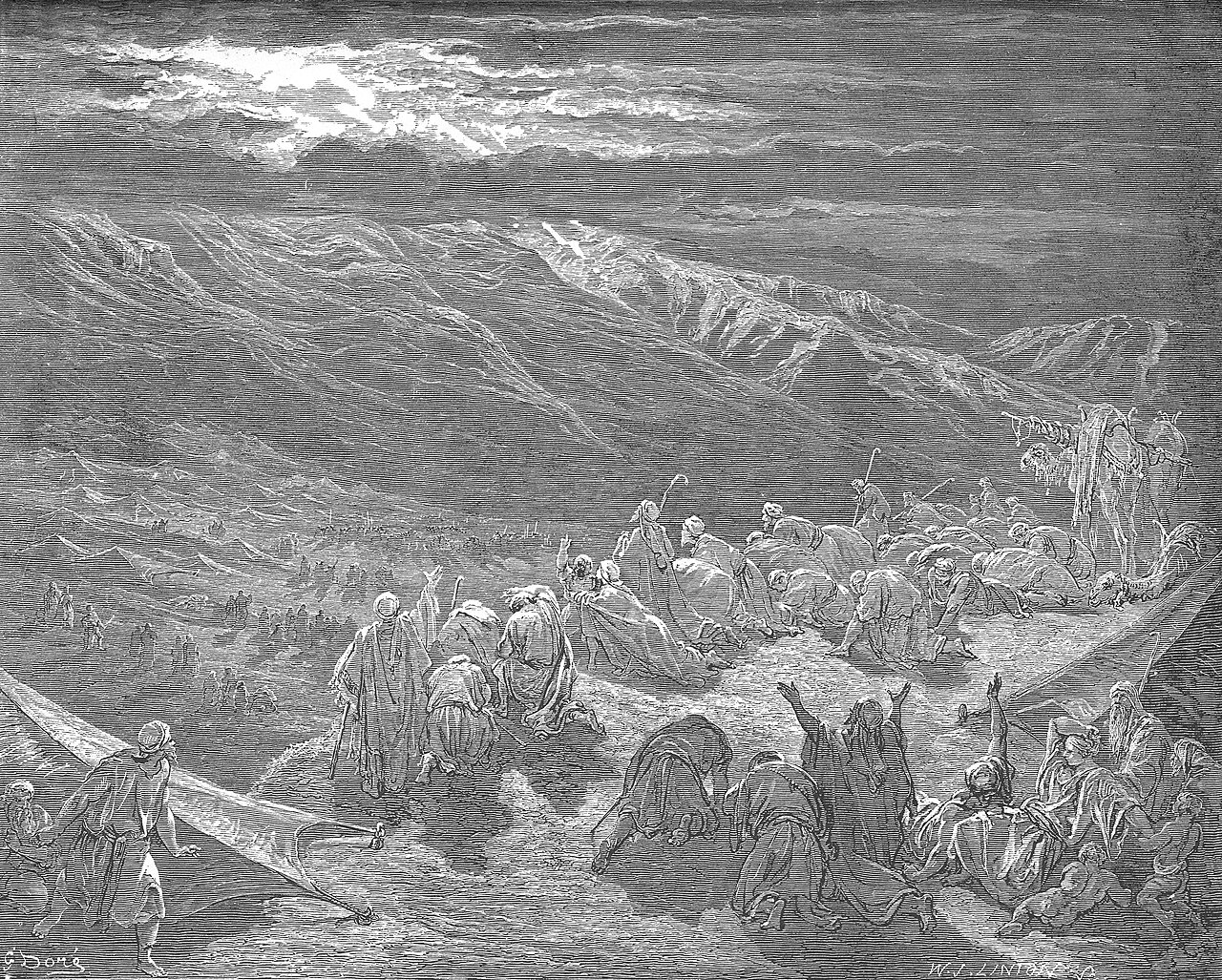
The Exodus in Scripture, in full
The exodus is the defining rescue of the Old Testament, the story Israel told itself again and again to remember who God was and what he had done. It begins in slavery. The Israelites had multiplied in Egypt until a new Pharaoh, who did not know Joseph, grew afraid of their numbers and worked them ruthlessly (Exodus 1:8). Into that suffering, God spoke from a burning bush and revealed his name to Moses: I AM THAT I AM, the God who simply is, unchanging and dependable (Exodus 3:14).
What followed was a direct confrontation between the living God and the gods of Egypt. Through nine plagues, Pharaoh refused to let Israel go, hardening his heart again and again. The tenth plague brought a different kind of deliverance. God instructed each household to kill a lamb and mark their doorposts with its blood, promising that when he saw the blood, he would pass over that house and the firstborn inside would live (Exodus 12:13).
That night the blood on the door, not the goodness of the people behind it, was what kept judgment away. It is impossible to read the New Testament's language about Christ as the Passover Lamb without hearing this scene behind it.
Pharaoh finally let Israel go, but he did not stay convinced for long. His army pursued the fleeing Israelites to the edge of the Red Sea, where the people found themselves trapped between the water and the enemy. Moses stretched out his hand, and the Lord drove the sea back, so that the Israelites walked through on dry ground (Exodus 14:22). When the Egyptian army tried to follow, the sea returned and swallowed them. On the far shore, Moses and the people sang, "I will sing unto the Lord, for he hath triumphed gloriously" (Exodus 15:1). It remains one of Scripture's clearest pictures of complete, undeserved deliverance.
The journey did not end at the sea. God fed the freed slaves with bread from heaven in the wilderness, teaching them daily dependence (Exodus 16:4), and led them finally to Mount Sinai. There he made Israel an offer: if they would obey his voice and keep his covenant, they would be his own treasured possession among all the peoples of the earth (Exodus 19:5).
At Sinai, Moses took the blood of the covenant and sprinkled it on the people, sealing the relationship God had rescued them into (Exodus 24:8). The exodus was never only an escape from Egypt. It was a journey toward covenant, toward a God who wanted to dwell among his people, which he finally did when his glory filled the completed tabernacle (Exodus 40:34).
Every later generation in Scripture looked back on the exodus as proof of who God is. He introduces the Ten Commandments not with abstract law but with memory: I am the Lord thy God, which have brought thee out of the land of Egypt, out of the house of bondage (Exodus 20:2). Deliverance came first; obedience followed as response, not payment.
The New Testament reads the whole exodus as a shadow of a greater rescue still to come. Jesus is the true Passover Lamb, whose blood turns aside judgment for everyone who trusts him. His death and resurrection are the greater Red Sea crossing, carrying believers out of slavery to sin and toward a promised inheritance that does not fade. What happened once at the edge of Egypt happens now, in Christ, for anyone who will trust the blood on the door.
4 voices
What teachers have said
The Egyptians thought they could walk through the sea as well as the Israelites; they tried, and were drowned; while the former passed in perfect safety. The one walked by faith, the other by sight; one perished, the other was saved.
Adam Clarke · Commentary on the Bible
Written before 1832.
"And overthrew Pharaoh and his power in the Red Sea" [Psalm 136:15]. He quickly destroys both the sin of His people and the guilt thereof by baptism.
Augustine of Hippo · Exposition on Psalm 136
Written before 430.
The Hebrews tell a story of this kind: In the exodus of the Israelites from Egypt, when on one side there was a mountain, on the other the Red Sea, and Pharaoh's army surrounded them, and the trapped people were held, the other tribes despairing of salvation and either wishing to return to Egypt or wanting to fight, only Judah faithfully entered the sea.
Jerome · Commentary on Hosea 11:12
Written before 420.
They do not enter the Red Sea, since entering it once was enough. Now they camp next to the sea, so that they look at the sea and regard its waves but in no way fear its motions and assaults.
Origen of Alexandria · Homilies on Numbers 27:11
Written before 253.
Where it leads
Everything the site holds on the exodus
The words underneath
Each card is one Hebrew or Greek word behind the exodus. It gives the sense, the count across the canon, and the number in Strong's 1890 concordance.
erythros: Red (Sea)
Greek · G2063Strong's entry: red, i.e. (with ) the Red Sea
the Greek word for the Red Sea in Hebrews' faith chapter
2 times in the New Testament · erythros, in full →
Suph: Suph
Hebrew · H5489Strong's entry: the Reed (Sea)
Çûwph — the Reed Sea, traditionally the Red Sea Israel crossed on dry ground
1 times in the Old Testament · Suph, in full →
Paroh: Pharaoh
Hebrew · H6547Strong's entry: Paroh, a general title of Egyptian kings
Parʻôh — Pharaoh, the title of every Egyptian king who resisted the Lord
274 times in the Old Testament · Paroh, in full →
Mitsrayim: Egypt
Hebrew · H4714Strong's entry: Mitsrajim, i.e. Upper and Lower Egypt
the house of bondage Israel left
641 times in the Old Testament · Mitsrayim, in full →
Where in the story
The subjects beside it
On this page