
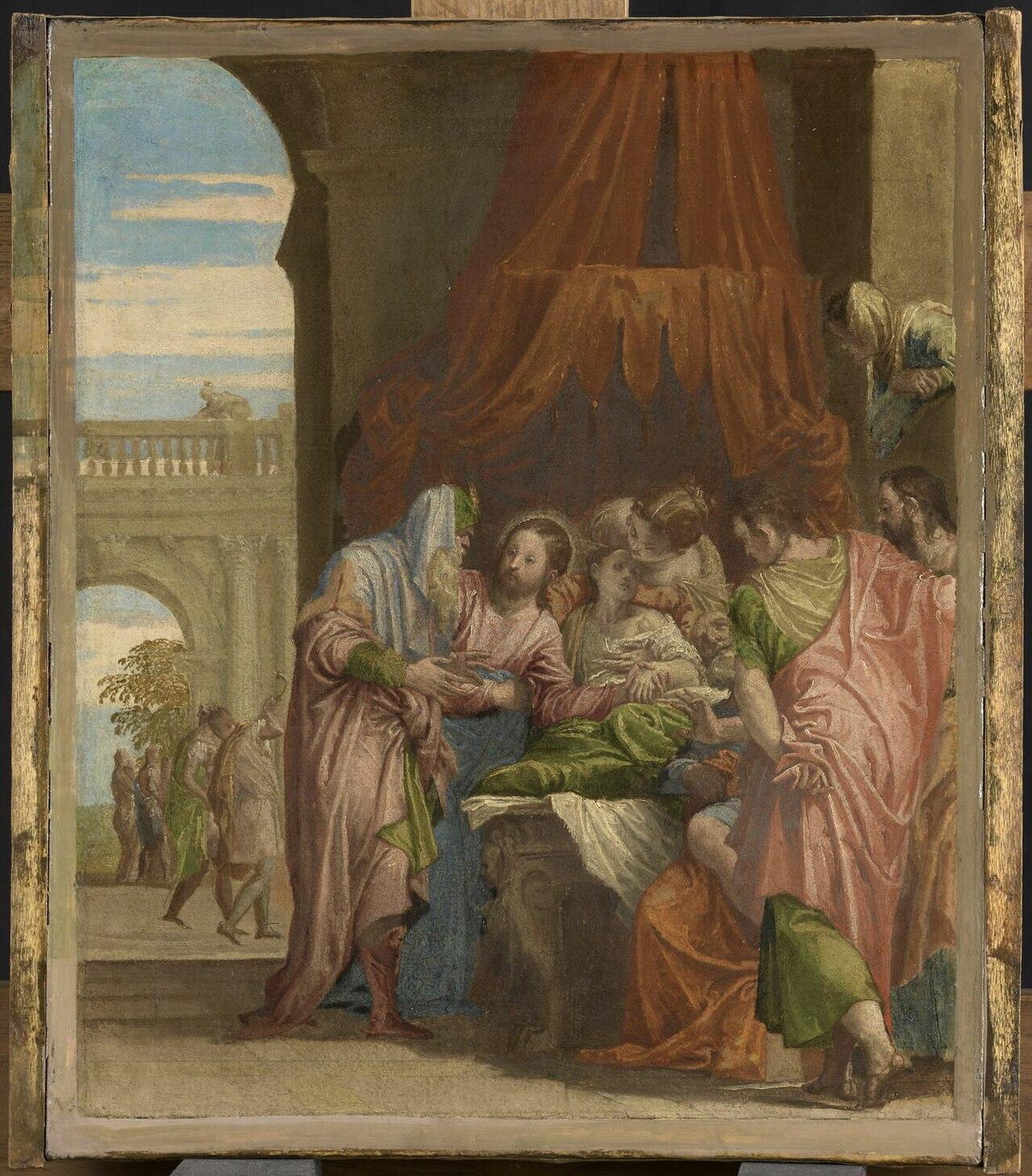
Paolo Veronese, The Raising of Jairus' Daughter, 1540s. Public domain.
Mark 5:21 to 43 · Subject · Featured Study
Mark's Framed Stories
Mark sets one story inside another at least six times in his Gospel.
A father begs Jesus to come at once, and Jesus stops on the road to find a woman who touched His cloak.
Taking her by the hand, Jesus said, “Talitha koum!” which means, “Little girl, I say to you, get up!”
Summary
Readers have called the device a frame or a sandwich. The best known frame is the healing of a woman on the way to the house of Jairus.
- The woman had been ill for twelve years, and Jairus's daughter was twelve years old.
- The woman was healed on the road, and the girl was raised in her father's house.
- Peter is questioned in the courtyard below while Jesus is questioned by the high priest.
One Story Inside Another
Jairus's plea opens the outer story, and his daughter's raising closes it.
A synagogue leader named Jairus arrived, and seeing Jesus, he fell at His feet and pleaded with Him urgently, “My little daughter is near death. Please come and place Your hands on her, so that she will be healed and live.”Jairus asks Jesus to come before his daughter dies, so every delay on the road matters.
Theophylact of Ohrid saw the second healing happen on the road to the first.
“Meanwhile, on the Lord's way, the woman with the flow of blood is also healed. This woman had great faith, because she hoped to be healed by the Lord's garment alone; and for this she received healing.”
Theophylact of Ohrid · Commentary on Mark · on Mark 5:25Patristic
While He was still speaking, messengers from the house of Jairus arrived and said, “Your daughter is dead; why bother the Teacher anymore?”The delay for the woman costs Jairus the time he begged for.
Jesus had just called the woman daughter and praised her faith (Mark 5:34).
But Jesus overheard their conversation and said to Jairus, “Do not be afraid; just believe.”Jairus is now asked for the faith the woman has just shown.
Six Frames in Mark
Mark's frames run in order from Mark 3 to Mark 14.
Three frames fall in Galilee and three in the last week at Jerusalem and Bethany.
In frames 2 and 6 the two stories happen in the same hour, and in frame 3 the inner story happened earlier.
What the Galilee Frames Teach
The frames of Mark 3 and Mark 6 each set a conflict inside another story.
The family and the scribesMark 3:20 to 35
When His family heard about this, they went out to take custody of Him, saying, “He is out of His mind.” And the scribes who had come down from Jerusalem were saying, “He is possessed by Beelzebul,” and, “By the prince of the demons He drives out demons.”Two groups judge Jesus in one scene, His own relatives and the teachers from Jerusalem.
Jerome joined the two charges in a letter, the family's and that of His opponents.
“In the gospel we read that even his kinsfolk desired to bind him as one of weak mind. His opponents also reviled him saying, ‘You are a Samaritan and have a devil.’”
Jerome · Letter 108, to Eustochium · on Mark 3:21Patristic
For whoever does the will of God is My brother and sister and mother.”Jesus names a new family when His mother and brothers stand outside.
The Twelve and John the BaptistMark 6:7 to 30
So they set out and preached that the people should repent. They also drove out many demons and healed many of the sick, anointing them with oil.The Twelve preach repentance, as John had done in the wilderness (Mark 1:4).
Herod heard of the work and said that John, whom he had beheaded, had risen (Mark 6:14 to 16).
Meanwhile, the apostles gathered around Jesus and brought Him news of all they had done and taught.The apostles return in the next verse after John's disciples bury him.
The Frames of the Last Week
Three more frames stand in the days before the cross, from the fig tree to the courtyard.
The fig tree and the templeMark 11:12 to 25
Seeing in the distance a fig tree in leaf, He went to see if there was any fruit on it. But when He reached it, He found nothing on it except leaves, since it was not the season for figs.Jesus finds leaves and no fruit on the tree on the morning He clears the temple courts.
Gregory the Dialogist, the pope known as Gregory the Great, read the barren tree as a sign about the synagogue.
“For, as to what you have said about the fig-tree, Augustine speaks aptly in the same sense; for, when the evangelist subjoined, For the time of figs was not yet, it is plainly shown that the figs which the Lord had sought were fruit in the synagogue, which had the leaves of the Law, but not the fruit of works. For the Creator of all things could not be ignorant that the fig-tree had no fruit; which was a thing that all might know, since it was not the time of figs.”
Gregory the Dialogist · Register of Epistles, Book 10, Epistle 39 · on Mark 11:13Patristic
The plot and the perfumeMark 14:1 to 11
While Jesus was in Bethany reclining at the table in the home of Simon the Leper, a woman came with an alabaster jar of expensive perfume, made of pure nard. She broke open the jar and poured it on Jesus’ head.The costly gift of the woman stands between the plot of the priests and the bargain of Judas.
Some at the table said the perfume could have been sold for over three hundred denarii and given to the poor (Mark 14:4 to 5).
The trial and the courtyardMark 14:53 to 72
Then some of them began to spit on Him. They blindfolded Him, struck Him with their fists, and said to Him, “Prophesy!” And the officers received Him with slaps in His face.The guards mock Jesus as a prophet in the same hour that Peter fails below.
In the courtyard below, a servant girl of the high priest was the first to question Peter (Mark 14:66 to 68).
Why Did Mark Frame His Stories?
Readers from the fourth century to the twentieth gave three answers.
The events came in that orderAlexander Maclaren, Expositions of Holy Scripture, on Mark 5
Alexander Maclaren held that the Gospel writers wanted readers to feel the calm power of Jesus, who had time to heal on the way.
The objection: John was already dead when Herod heard of Jesus (Mark 6:16 to 17). That frame breaks the order of events.
A gap in time filled with a storyAugustine of Hippo, Harmony of the Gospels, Book 2, chapter 45; H. A. W. Meyer, Handbook to Mark, on Mark 6:30
Augustine placed the report of the apostles after the death of John, so in his reading Mark tells first what came last. H. A. W. Meyer held that Mark filled the time the Twelve were away with the story of John.
The objection: a gap in time explains the frame of Mark 6, and the frame of Mark 5 happens on one short walk.
Each frame placed for its meaningJames R. Edwards, Markan Sandwiches, Novum Testamentum 31 (1989), pages 193 to 216
James R. Edwards wrote on the significance of the stories Mark sets inside others, as the title of his article names it. The opening of the article counts some nine such frames in the Gospel.
The objection: Matthew and Luke also set the woman inside the story of Jairus (Matthew 9:18 to 26; Luke 8:40 to 56). The frame may come from the order of the events.
Reading the Pairs Together
Mark sets a larger frame around the road to Jerusalem.
Two healings of blind men stand at the two ends of that road (Mark 8:22 to 26 and Mark 10:46 to 52). Three predictions of the cross stand between them.
Sources
Scripture is the Berean Standard Bible.
- Theophylact of Ohrid, Commentary on Mark, on Mark 5:25.
- Jerome, Letter 108, to Eustochium.
- Gregory the Dialogist (Gregory the Great), Register of Epistles, Book 10, Epistle 39, on Mark 11:13.
- Augustine of Hippo, Harmony of the Gospels, Book 2, chapter 45, in Thomas Aquinas, Catena Aurea, on Mark 6:30.
- Alexander Maclaren, Expositions of Holy Scripture: Mark, The Power of Feeble Faith, on Mark 5:25 to 28.
- H. A. W. Meyer, Critical and Exegetical Handbook to the Gospels of Mark and Luke, on Mark 6:30 to 44.
- James R. Edwards, Markan Sandwiches: The Significance of Interpolations in Markan Narratives, Novum Testamentum 31, no. 3 (1989), pages 193 to 216.
Keep Studying
Read it6
People and groups6