
Matthew 3:1
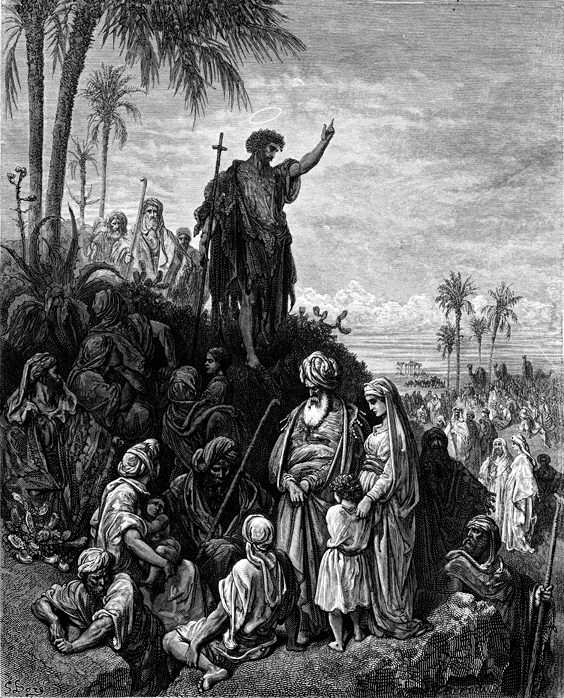
in Matthew 3In those days John the Baptist came, preaching in the wilderness of Judea
BSB
The same verse in ASV and KJV ▾
ASV
And in those days cometh John the Baptist, preaching in the wilderness of Judæa, saying,
KJV
In those days came John the Baptist, preaching in the wilderness of Judea,
⋯
This verse in Matthew 3
Commentary
25 notes on this verseA commentator
Albert Barnes1798–1870
Notes, Explanatory and Practical, on the Old and New Testaments (1832-1869)
In those days - The days here referred to cannot be those mentioned in the preceding chapter, for John was but six months older than Christ.
This site's exposition
preaching in the wilderness of Judea
on Matthew 3:1-3
John's ministry opens in those days, some three decades after chapter 2 with no exact date given, and his location itself preaches, since Israel's story keeps beginning in a wilderness, from the exodus onward. His message reduces to two words, repent, metanoia in the Greek, a change of mind and direction rather than mere regret, for the kingdom of heaven is at hand, the first sounding of Matthew's own distinctive phrase against Mark and Luke's kingdom of God. Verse 3 supplies the chapter's first Old Testament citation, Isaiah 40:3's herald crying in the wilderness, read across the church as pointing directly to this man preparing the way of the Lord.
The record, by era
The Church Fathers5 voices
(De Con. Evan. ii. 6.) Luke describes the time by the reigning sovereigns. (Luke 3:1.) But Matthew must be understood to speak of a wider space of time by the phrase 'those days,' than the fifteenth year of Tiberius. Having related Christ's return from Egypt, which must be placed in early boyhood or even infancy, to make it agree with what Luke has told of His being in the temple at twelve years old, he adds directly, In those days, not intending thereby only the days of His childhood, but all the days from His birth to the preaching of John.
(Hom. in Joan. Bap. nat. 1.) Where neither a noisy mob would interrupt his preaching, and whither no unbelieving hearer would retire; but those only would hear, who sought to his preaching from motives of divine worship.
Or, he came to Judæa, desert by the absence of God, not of population, that the place of preaching might witness the few to whom the preaching was sent.
In these words (ver. 1.) we have not only time, place, and person, respecting St. John, but also his office and employment. First the time, generally; In those days. The man is mentioned in the words came John, that is, showed himself, having abode so long in obscurity. (ap. Anselm.) His office; the Baptist; in this he prepared the way of the Lord, for had not men been used to be baptized, they would have shunned Christ's baptism. His employment; Preaching; The place; the desert of Judæa.
John holds not his peace, saying, "Enter upon repentance, for now shall salvation approach the nations" -the Lord, that is, bringing salvation according to God's promise.
18 more voices on this verse
The Church Fathers5 voices
(Chapter III - Verse 1) Repent, for the kingdom of heaven is near. John the Baptist proclaims the kingdom of heaven, honoring the Lord as its precursor with this privilege.
The Sun as he approaches the horizon, and before he is yet visible, sends out his rays and makes the eastern sky to glow with light, that Aurora going before may herald the coming day. Thus the Lord at His birth in this earth, and before He shows Himself, enlightens John by the rays of His Spirit's teaching, that he might go before and announce the Saviour that was to come. Therefore after having related the birth of Christ, before proceeding to His teaching and baptism, (wherein he received such testimony,) he first premises somewhat of the Baptist and forerunner of the Lord. In those days, &c.
And in those days came John the Baptist preaching in the wilderness of Judaea and saying, Repent, for the kingdom of heaven is at hand; as if he said, the mansion in the heavens is now ready to be revealed, as the Christ is now …
(non occ.) But why must John thus go before Christ with a witness of deeds preaching Him? First; that we might hence learn Christ's dignity, that He also, as the Father has, has prophets, in the words of Zacharias, And thou, Child, shalt be called the Prophet of the Highest. (Luke 1:76.) Secondly; That the Jews might have no cause for offence; as He declared, John came neither eating nor drinking, and they say, He hath a devil. The Son of Man came eating and drinking, and they say, Behold a gluttonous man. (Luke 7:33.) It needeth moreover that the things concerning Christ should be told by some other first, and not by Himself; or what would the Jews have said, who after the witness of John made complaint, Thou bearest witness of thyself, thy witness is not true. (John 8:13.)
A commentator
John ChrysostomHomily on the Gospel of Matthew 10 · Written in the 5th century.
proposed
How "in those days"? For not then, surely, when He was a child, and came to Nazareth, but thirty years after, John cometh; as Luke also testifies. How then is it said, "in those days"? The Scripture is always wont to use this manner of speech, not only when it is mentioning what occurs in the time immediately after, but also of things which are to come to pass many years later. Thus also, for example, when His disciples came unto Him as He sat on the Mount of Olives, and sought to learn about His coming, and the taking of Jerusalem: and yet ye know how great is the interval between those several periods. I mean, that having spoken of the subversion of the mother city, and completed His discourse on that subject, and being about to pass to that on the consummation, he inserted, "Then shall these things also come to pass;" not bringing together the times by the word then, but indicating that time only in which these things were to happen. And this sort of thing he doth now also, saying, "In those days." For this is not put to signify the days that come immediately after, but those in which these things were to take place, which he was preparing to relate. "But why was it after thirty years," it may be said, "that Jesus came unto His baptism"? After this baptism He was thenceforth to do away with the law: wherefore even until this age, which admits of all sins, He continues fulfilling it all; that no one might say, that because He Himself could not fulfill it, He did it away. For neither do all passions assail us at all times; but while in the first age of life there is much thoughtlessness and timidity, in that which comes after it, pleasure is more vehement, and after this again the desire of wealth. […]
The Medieval Church5 voices
Preaching in the wilderness of Judea, and saying, Repent ye. The Jews were arrogant, and so he urges them to repent. For the kingdom of heaven is at hand. The kingdom of heaven means the first and second comings of Christ, and also the virtuous …
For because Christ was to preach, as soon as it seemed the fit time, that is, about thirty years of age, he began by his preaching to make ready the way for the Lord.
(ap. Anselm.) The desert typically means a life removed from the temptations of the world, such as befits the penitent.
The evangelist dealt above with Christ's entry into the world; now he deals with the spread of his teaching, for he came for this purpose (Jn 18:37). In regard to his teaching two things are considered: first, the preparation for teaching is mentioned: secondly, the …
In those days. Not when the Lord was a child and was living in Nazareth, but rather the evangelist makes this simple statement, "at that time, before the present generation." Came John the Baptist. John was sent by God to reprove the Jews and to …
The Puritans and the Awakening4 voices
In those days, in the time appointed of the Father for the beginning of the gospel, when the fulness of time was come, which was often thus spoken of in the Old Testament, In those days. Now the last of Daniel's weeks began, or rather, the latter half of the week, when the Messiah was to confirm the covenant with many, Dan. ix. Christ's appearances are all in their season.
); for by the foolishness of preaching, Christ's kingdom must be set up. The doctrine he preached was that of repentance (
quarantine:debris (2026-07-29) — leading-punctuation
In those days - that is, while Jesus dwelt there. In the wilderness of Judea - This was a wilderness properly so called, a wild, barren, desolate place as was that also where our Lord was tempted.
In those days came John the Baptist,....
The Nineteenth Century4 voices
These verses describe the ministry of John the Baptist, the forerunner of our Lord Jesus Christ: it is a ministry that deserves close attention. Few preachers ever produced such effects as John the Baptist: “There went out to him Jerusalem and all Judea and all the region round about Jordan.”None ever received such praise from the great head of the church: Jesus called him “a burning and a shining light” ( John 5:35 ); the great Bishop of souls Himself declared, that “among them that are born of women there hath not risen a greater than John the Baptist.”
A commentator
Jamieson, Fausset & Brown1802–1910
Commentary Critical and Explanatory on the Whole Bible (1871)
In those days--of Christ's secluded life at Nazareth, where the last chapter left Him. came John the Baptist, preaching--about six months before his Master. in the wilderness of Judea--the desert valley of the Jordan, thinly peopled and bare in pasture, a little north of Jerusalem.
These verses describe the ministry of John the Baptist, the forerunner of our Lord Jesus Christ: it is a ministry that deserves close attention. Few preachers ever produced such effects as John the Baptist: “There went out to him Jerusalem and all Judea and all the region round about Jordan.”None ever received such praise from the great head of the church: Jesus called him “a burning and a shining light” ( John 5:35 ); the great Bishop of souls Himself declared, that “among them that are born of women there hath not risen a greater than John the Baptist.” Let us then study the leading features of his ministry. John the Baptist spoke plainly about sin . He taught the absolute necessity of repentance before anyone can be saved; he preached that repentance must be proved by its “fruits”he warned men not to rest on outward privileges, or outward union with the church. This is just the teaching that we all need. We are naturally dead, and blind, and asleep in spiritual things; we are ready to content ourselves with a mere formal religion and to flatter ourselves that if we go to church we shall be saved: we need to be told that, except we “repent and are converted” we shall all perish. John the Baptist spoke plainly about our Lord Jesus Christ . He taught people that one “mightier than himself” was coming among them. He was nothing more than a servant: the coming one was the King. He himself could only baptize with water: the coming one could “baptize with the Holy Ghost,” take away sins, and would one day judge the world. This again is the very teaching that human nature requires. We need to be sent direct to Christ: we are all ready to stop short of this; we want to rest in our union with the church, our regular use of the sacraments, and our diligent attendance on an established ministry. We need to be told the absolute necessity of union with Christ himself by faith.
John the Baptist - John, surnamed The Baptist, because he required those to be baptized who professed to be contrite because of their sins, was the son of a priest named Zacharias, and his wife Elisabeth, and was born about A. M. 3999, and about six months before our blessed Lord. Of his almost miraculous conception and birth, we have a circumstantial account in the Gospel of Luke, chap. 1: to which, and the notes there, the reader is requested to refer. For his fidelity in reproving Herod for his incest with his brother Philip’s wife, he was cast into prison, no doubt at the suggestion of Herodias, the profligate woman in question. He was at last beheaded at her instigation, and his head given as a present to Salome, her daughter, who, by her elegant dancing, had highly gratified Herod, the paramour of her incestuous mother. His ministry was short; for he appears to have been put to death in the 27th or 28th year of the Christian era. Came - preaching - Κηρυσσων, proclaiming, as a herald, a matter of great and solemn importance to men; the subject not his own, nor of himself, but from that God from whom alone he had received his commission. See on the nature and importance of the herald’s office, at the end of this chapter. Κηρυσσειν, says Rosenmuller, de iis dicitur, qui in Plateis, in Campis, in Aere aperto, ut a multis audiantur, vocem tollunt, etc. “The verb κηρυσσειν is applied to those who, in the streets, fields, and open air, lift up their voice, that they may be heard by many, and proclaim what has been committed to them by regal or public authority; as the Kerukes among the Greeks, and the Precones among the Romans.” The wilderness of Judea - That is, the country parts, as distinguished from the city; for in this sense the word wilderness, מדבר midbar or מדבריות midbarioth, is used among the rabbins. […]
The words behind it
15 Greek wordsEvery Greek word of this verse in the order it stands, with what it means and the door to its own study. The last column counts the times a word stands in the whole Bible: the rarer the word, the more the places it appears belong together.
| Greek | Sound | Meaning | Word study | In the Bible |
|---|---|---|---|---|
| Ἐν | en | In | G1722 → | 2738 times |
| δὲ | de | then | G1161 → | 2765 times |
| ταῖς | tais | the | G3588 → | 19766 times |
| ἡμέραις | hemerais | days | G2250 → | 389 times |
| ἐκείναις | ekeinais | those | G1565 → | 260 times |
| παραγίνεται | paraginetai | comes | G3854 → | 36 times |
| Ἰωάννης | ioannes | John | G2491 → | 134 times |
| ὁ | ho | the | G3588 → | 19766 times |
| βαπτιστὴς | baptistes | Baptist | G910 → | 12 times |
| κηρύσσων | kerusson | preaching | G2784 → | 59 times |
| ἐν | en | in | G1722 → | 2738 times |
| τῇ | tea | the | G3588 → | 19766 times |
| ἐρήμῳ | eremo | wilderness | G2048 → | 48 times |
| τῆς | tes | <the> | G3588 → | 19766 times |
| Ἰουδαίας | ioudaias | of Judea | G2449 → | 44 times |
ἘνIn
enG1722 →2738 times
δὲthen
deG1161 →2765 times
ταῖςthe
taisG3588 →19766 times
ἡμέραιςdays
hemeraisG2250 →389 times
ἐκείναιςthose
ekeinaisG1565 →260 times
παραγίνεταιcomes
paraginetaiG3854 →36 times
ἸωάννηςJohn
ioannesG2491 →134 times
ὁthe
hoG3588 →19766 times
βαπτιστὴςBaptist
baptistesG910 →12 times
κηρύσσωνpreaching
kerussonG2784 →59 times
ἐνin
enG1722 →2738 times
τῇthe
teaG3588 →19766 times
ἐρήμῳwilderness
eremoG2048 →48 times
τῆς<the>
tesG3588 →19766 times
Ἰουδαίαςof Judea
ioudaiasG2449 →44 times
A shaded row is a word that stands 400 times or fewer in the Bible.
The walk
8 stopsEach card is a verse this one points to, and under it the verses that one points to in turn. Where several paths arrive at the same place, that place is listed first: the text keeps returning to it.
Through
Luke 1:76And you, child, will be called a prophet of the Most High; for you will go on before the Lord to prepare the way for Him,
it leads to
- Malachi 3:1
“Behold, I will send My messenger, who will prepare the way before Me. Then the Lord whom you seek will suddenly come to His temple—the Messenger of the covenant, in whom you delight—see, He…
- Isaiah 40:3–5
A voice of one calling: “Prepare the way for the LORD in the wilderness; make a straight highway for our God in the desert.
- Mark 1:2–3
As it is written in Isaiah the prophet: “Behold, I will send My messenger ahead of You, who will prepare Your way.”
- Malachi 3:1
Through
Matthew 11:11Truly I tell you, among those born of women there has risen no one greater than John the Baptist. Yet even the least in the kingdom of heaven is greater than he.
it leads to
- Luke 7:28
I tell you, among those born of women there is no one greater than John, yet even the least in the kingdom of God is greater than he.”
- Ephesians 3:8
Though I am less than the least of all the saints, this grace was given me: to preach to the Gentiles the unsearchable riches of Christ,
- John 1:15
John testified concerning Him. He cried out, saying, “This is He of whom I said, ‘He who comes after me has surpassed me because He was before me.’”
- Matthew 3:11
I baptize you with water for repentance, but after me will come One more powerful than I, whose sandals I am not worthy to carry. He will baptize you with the Holy Spirit and…
- Matthew 5:19
So then, whoever breaks one of the least of these commandments and teaches others to do likewise will be called least in the kingdom of heaven; but whoever practices and teaches them will be…
- Luke 7:28
Where this verse is studied
About Matthew
This page draws on 21 works. Open the list of works
This page draws on Adam Clarke, Commentary on the Bible; Albert Barnes, Notes, Explanatory and Practical, on the Old and New Testaments (1832-1869); Augustine of Hippo, Catena Aurea by Aquinas; Cosmas Indicopleustes, The Christian Topography, Book 5; Glossa Ordinaria, Catena Aurea by Aquinas; Hilary of Poitiers, Catena Aurea by Aquinas; J.C. Ryle, Expository Thoughts on the Gospels: Matthew; Jamieson, Fausset & Brown, Commentary Critical and Explanatory on the Whole Bible; Jerome, Commentary on Matthew; John Chrysostom, Catena Aurea by Aquinas; John Chrysostom, Homily on the Gospel of Matthew 10; John Gill, Exposition of the New Testament (1746-1748); John Wesley, Explanatory Notes upon the New Testament; Matthew Henry, Commentary on the Whole Bible; Maximus of Turin, Catena Aurea by Aquinas; Pseudo-Chrysostom, Catena Aurea by Aquinas; Rabanus Maurus, Catena Aurea by Aquinas; Remigius of Rheims, Catena Aurea by Aquinas; Tertullian, On Repentance; Theophylact of Ohrid, Commentary on Matthew and Thomas Aquinas, Commentary on Matthew.