
Matthew 3:4
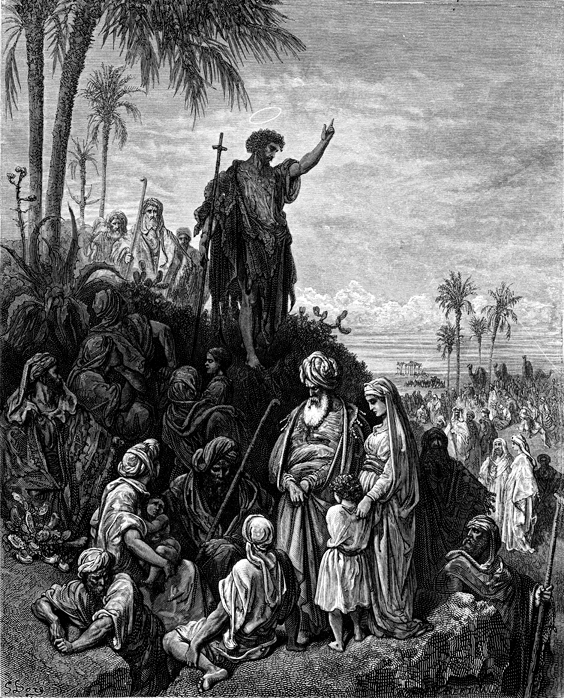
in Matthew 3John wore a garment of camel’s hair, with a leather belt around his waist. His food was locusts and wild honey.
BSB
The same verse in ASV and KJV ▾
ASV
Now John himself had his raiment of camel’s hair, and a leathern girdle about his loins; and his food was locusts and wild honey.
KJV
And the same John had his raiment of camel’s hair, and a leathern girdle about his loins; and his meat was locusts and wild honey.
⋯
This verse in Matthew 3
Commentary
28 notes on this verse(Verse 4.) Now John himself had a garment made of camel's hair and a leather belt around his waist. He said, 'It is made of hair, not wool.' The type of clothing indicates austerity, not luxury. The leather belt that he wore, just like Elijah, is a symbol of mortification (IV Kings 1). Furthermore, what follows is... But his food was locusts and wild honey. It is fitting for a dweller of solitude to fulfill not the delights of food, but the necessity of human flesh.
This site's exposition
a garment of camel’s hair
John's "garment of camel’s hair, with a leather belt around his waist" presents him as the Elijah of Malachi 4:5-6. Locusts are permitted food under Leviticus 11:22. With wild honey they make the diet of a man who owns nothing and lives on what the wilderness provides.
The record, by era
The Church Fathers5 voices
He could have made use of goat's hair, but there was no need for it. Rather, he wore a garment of camel's hair with nothing refined about it, nothing graceful, nothing comely. By nature it was intended for hard work and heavy burdens and consigned …
Locusts intended for sinners worthy of chastisement are rightly considered to be food for repentance, so that bounding from the place of sin to the place of repentance the sinner may fly to heaven on the wings of forgiveness. The prophet was aware of this …
John ate locusts, suggesting that the people of God were being nourished by a word that traveled high aloft in the air and had not yet passed over the earth. In the second place John ate honey, which is not obtained by people through their own efforts. The honey produced under the law and the prophets was not accessible to those who were inquiring only superficially about the meaning of the Scriptures and not searching their deeper intention.
Indeed, when Christ's forerunner wore a coarse camel-hair garment, what else does it signify but that the coming Christ would be vested in the garb of a human body, thick with the coarseness of sinners, and that, girded with the skins of a most unclean …
As for the leather belt, what else does it demonstrate but this fragile flesh of ours, trapped in the grip of vice before the coming of Christ and which, after his coming, was restrained by virtue? Before his coming this flesh was fat through dissipation. …
21 more voices on this verse
The Church Fathers8 voices
For the preaching of John no place more suitable, no clothing more useful, no food more fitted. The preacher of Christ is clad in the skins of unclean beasts, to which the Gentiles are compared, and so by the Prophets' dress is sanctified whatever in them was useless or unclean. The girdle is a thing of much efficacy to every good work, that we may be girt for every ministry of Christ. For his food are chosen locusts, which fly the face of man, and escape from every approach, signifying ourselves who were borne away from every word or speech of good by a spontaneous motion of the body, weak in will, barren in works, fretful in speech, foreign in abode, are now become the food of the Saints, chosen to fill the Prophets' desire, furnishing our most sweet food not from the hives of the law, but from the trunks of wild trees.
A garment woven with camel's hair designates the peculiar clothing of this prophetic preacher. He is covered with the skins of an unclean animal. Whatever had been useless or shabby in us becomes sanctified by the prophet's clothes.
First, the heavenly life and glorious humility of John are demonstrated in his way of living. He who held the world in low regard did not seek costly attire. He who had no use for worldly delights did not have any desire for succulent foods. …
In this clothing and this poor food, he shows that he sorrows for the sins of the whole human race. In John (which name is interpreted 'the grace of God,') is figured Christ who brought grace into the world; in his clothing, the Gentile Church.
His raiment of camel's hair, not of wool—the one the mark of austerity in dress, the other of a delicate luxury. Food moreover suited to a dweller in the desert, no choice viands, but such as satisfied the necessities of the body. His girdle of skin, which Elias also bare, is the mark of mortification.
Having said that he is the voice of one crying in the desert, the Evangelist well adds, John had his clothing of camel's hair; thus showing what his life was; for he indeed testified of Christ, but his life testified of himself. No one is fit to be another's witness till he has first been his own. It becomes the servants of God to use a dress not for elegant appearance, or for cherishing of the body, but for a covering of the nakedness. Thus John wears a garment not soft and delicate, but hairy, heavy, rough, rather wounding the skin than cherishing it, that even the very clothing of his body told of the virtue of his mind. It was the custom of the Jews to wear girdles of wool; so he desiring something less indulgent wore one of skin.
"And the same John had his raiment of camel's hair, and a leathern girdle about his loins." Observe, how the prophets foretold some things, others they left to the evangelists. Wherefore also Matthew both sets down the guided by what they then beheld, to the memory of that blessed man; or rather, even to a greater astonishment. For the one indeed was brought up in cities and in houses, the other dwelt entirely in the wilderness from his very swaddling clothes. For it be away all the ancient ills, the labor, for example, the curse, the sorrow, the sweat; himself also to have certain tokens of such a gift, and to come at once to be above that condemnation. Thus he neither ploughed land, nor opened furrow, he ate not his bread by the sweat of his face, but his table was hastily supplied, and his clothing more easily furnished than his table, and his lodging yet less troublesome than his clothing. For he needed neither roof, nor bed, nor table, nor any other of these things, but a kind of angel's life in this our flesh did he exhibit. For this cause his very garment was of hair, that by his dress he might instruct men to separate themselves from all things human, and to have nothing in common with the earth, but to hasten back to their earlier nobleness, wherein Adam was before he wanted garments or robe. Thus that garb bore tokens of nothing less than a kingdom, and of repentance. And do not say to me, "Whence had he a garment of hair and a girdle, dwelling as he did in the wilderness?" For if thou art to make a difficulty of this, thou wilt also inquire into more things besides; how in the winters, and how in the heats of summer, he continued in the wilderness, and this with a delicate body, and at an immature age? […]
A commentator
Philoxenus of Mabbug13 Ascetic Discourses, Discourse 11 -- On Abstinence · Written before 523.
proposed
And remember how the Holy Book recounteth unto thee concerning his abstinent rule of life, which was new and different from that of all the other children of men, for his clothing was of camel's hair, and skin girded his loins, like the prophets, and …
The Medieval Church5 voices
And there are some who do not think that the wearing of fine and costly garments is a sin. But if indeed it were not a fault, the Word of God would never so carefully express that the rich man who is tormented in hell had been clothed in fine linen and purple. For no one seeks exceptional garments except for vainglory, that is, to appear more honorable than others. For the thing itself testifies that more costly clothing is sought only for empty glory, because no one wishes to be clothed in precious garments where he cannot be seen by others. We can better understand this fault also from the opposite: for if the lowliness of cheap clothing were not a virtue, the evangelist would not carefully say of John: "He was clothed with camel's hair."
Then he shows how John bore witness to Christ by his life: "Now John wore..." But who bore witness concerning John, who bore witness to Christ? The answer is that his own life did, because, as Chrysostom says, no one is a worthy witness of …
Content with poor fare; to wit, small insects and honey gathered from the trunks of trees. In the sayings of Arnulphusa, Bishop of Gaul, we find that there was a very small kind of locust in the deserts of Judæa, with bodies about the thickness of a finger and short; they are easily taken among the grass, and when cooked in oil form a poor kind of food. He also relates, that in the same desert there is a kind of tree, with a large round leaf, of the colour of milk and taste of honey, so friable as to rub to powder in the hand, and this is what is intended by wild honey. His dress and diet express the quality of his inward conversation. His garment was of an austere quality, because he rebuked the sinner's life. He ate locusts and honey, because his preaching was sweet to the multitude, but was of short continuance; and honey has sweetness, locusts a swift flight but soon fall to the ground.
(interlin.) Or, faith is the way by which the word reaches the heart; when the life is amended the paths are made straight.
Now this John wore a garment of camel's hair. Even by his appearance John called them to repentance, for he wore the garb of mourning. It is said that the camel is somewhere between a clean and unclean animal: it is clean in that it …
The Puritans and the Awakening3 voices
John had his raiment of camel's hair - Coarse and rough, suiting his character and doctrine. A leathern girdle - Like Elijah, in whose spirit and power he came. His food was locusts and wild honey - Locusts are ranked among clean meats, Lev. xi, 22.
The same John had his raiment,....
John Baptist thus showed the deep sense he had of the badness of the time and place he lived in, which made the preaching of repentance needful; every day was a fast-day with him. (2.) This agreed with his office as Christ's forerunner; by this practice he showed that he knew what the kingdom of heaven was, and had experienced the powers of it.
The Nineteenth Century5 voices
His raiment of camel’s hair - A sort of coarse or rough covering, which, it appears, was common to the prophets, Zec 13:4. In such a garment we find Elijah clothed, 2Ki 1:8. And as John had been designed under the name of this prophet, Mal 4:5, whose spirit and qualifications he was to possess, Luk 1:17, he took the same habit and lived in the same state of self-denial.
These verses describe the ministry of John the Baptist, the forerunner of our Lord Jesus Christ: it is a ministry that deserves close attention. Few preachers ever produced such effects as John the Baptist: “There went out to him Jerusalem and all Judea and all the region round about Jordan.”None ever received such praise from the great head of the church: Jesus called him “a burning and a shining light” ( John 5:35 ); the great Bishop of souls Himself declared, that “among them that are born of women there hath not risen a greater than John the Baptist.”
A commentator
Jamieson, Fausset & Brown1802–1910
Commentary Critical and Explanatory on the Whole Bible (1871)
And the same John had his raiment of camel's hair--woven of it. and a leathern girdle about his loins--the prophetic dress of Elijah (2Ki 1:8; and see Zec 13:4). and his meat was locusts--the great, well-known Eastern locust, a food of the poor (Le 11:22). and wild honey--made by wild bees (1Sa 14:25, 26).
These verses describe the ministry of John the Baptist, the forerunner of our Lord Jesus Christ: it is a ministry that deserves close attention. Few preachers ever produced such effects as John the Baptist: “There went out to him Jerusalem and all Judea and all the region round about Jordan.”None ever received such praise from the great head of the church: Jesus called him “a burning and a shining light” ( John 5:35 ); the great Bishop of souls Himself declared, that “among them that are born of women there hath not risen a greater than John the Baptist.” Let us then study the leading features of his ministry. John the Baptist spoke plainly about sin . He taught the absolute necessity of repentance before anyone can be saved; he preached that repentance must be proved by its “fruits”he warned men not to rest on outward privileges, or outward union with the church. This is just the teaching that we all need. We are naturally dead, and blind, and asleep in spiritual things; we are ready to content ourselves with a mere formal religion and to flatter ourselves that if we go to church we shall be saved: we need to be told that, except we “repent and are converted” we shall all perish. John the Baptist spoke plainly about our Lord Jesus Christ . He taught people that one “mightier than himself” was coming among them. He was nothing more than a servant: the coming one was the King. He himself could only baptize with water: the coming one could “baptize with the Holy Ghost,” take away sins, and would one day judge the world. This again is the very teaching that human nature requires. We need to be sent direct to Christ: we are all ready to stop short of this; we want to rest in our union with the church, our regular use of the sacraments, and our diligent attendance on an established ministry. We need to be told the absolute necessity of union with Christ himself by faith.
A commentator
Albert Barnes1798–1870
Notes, Explanatory and Practical, on the Old and New Testaments (1832-1869)
proposed
His raiment of camel’s hair - His clothing. This is not the fine hair of the camel from which our elegant cloth is made called camlet, nor the more elegant stuff brought from the East Indies under the name of “camel’s hair,” but the long shaggy hair of the camel, from which a coarse cheap cloth is made, still worn by the poorer classes in the East, and by monks. This dress of the camel’s hair, and a leather belt, it seems, was the common dress of the prophets, 2Ki 1:8; Zec 13:4. His meat was locusts - His food. These constituted the food of the common people. Among the Greeks the vilest of the people used to eat them; and the fact that John made his food of them is significant of his great poverty and humble life. The Jews were allowed to eat them, Lev 11:22. Locusts are flying insects, and are of various kinds. The green locusts are about 2 inches in length and about the thickness of a man’s finger. The common brown locust is about 3 inches long. The general form and appearance of the locust is not unlike the grasshopper. They were one of the plagues of Egypt Exo. 10. In Eastern countries they are very numerous. They appear in such quantities as to darken the sky, and devour in a short time every green thing. The whole earth is sometimes covered with them for many leagues, Joe 1:4; Isa 33:4-5. “Some species of the locust are eaten until this day in Eastern countries, and are even esteemed as a delicacy when properly cooked. After tearing off the legs and wings, and taking out the entrails, they stick them in long rows upon wooden spits, roast them at the fire, and then proceed to devour them with great zest. There are also other ways of preparing them. For example: they cook them and dress them in oil; or, having dried them, they pulverize them, and, when other food is scarce, make bread of the meal. […]
The words behind it
27 Greek wordsEvery Greek word of this verse in the order it stands, with what it means and the door to its own study. The last column counts the times a word stands in the whole Bible: the rarer the word, the more the places it appears belong together.
| Greek | Sound | Meaning | Word study | In the Bible |
|---|---|---|---|---|
| Αὐτὸς | autos | Himself | G846 → | 5565 times |
| δὲ | de | now | G1161 → | 2765 times |
| ὁ | ho | <the> | G3588 → | 19766 times |
| Ἰωάννης | ioannes | John | G2491 → | 134 times |
| εἶχεν | eichen | was having | G2192 → | 707 times |
| τὸ | to | the | G3588 → | 19766 times |
| ἔνδυμα | enduma | garment | G1742 → | 8 times |
| αὐτοῦ | autou | of him | G846 → | 5565 times |
| ἀπὸ | apo | of | G575 → | 640 times |
| τριχῶν | trichon | hair | G2359 → | 15 times |
| καμήλου | kamelou | of a camel | G2574 → | 6 times |
| καὶ | kai | and | G2532 → | 9120 times |
| ζώνην | zonen | a belt | G2223 → | |
| δερματίνην | dermatinen | of leather | G1193 → | |
| περὶ | peri | around | G4012 → | 332 times |
| τὴν | ten | the | G3588 → | 19766 times |
| ὀσφὺν | osphun | waist | G3751 → | |
| αὐτοῦ· | autou | of him; | G846 → | 5565 times |
| ἡ | he | <the> | G3588 → | 19766 times |
| δὲ | de | and | G1161 → | 2765 times |
| τροφὴ | trophe | [the] food | G5160 → | 16 times |
| ἦν | en | was | G1510 → | 2333 times |
| αὐτοῦ | autou | of him | G846 → | 5565 times |
| ἀκρίδες | akrides | locusts | G200 → | |
| καὶ | kai | and | G2532 → | 9120 times |
| μέλι | meli | honey | G3192 → | |
| ἄγριον.¶ | agrion | wild. | G66 → |
ΑὐτὸςHimself
autosG846 →5565 times
δὲnow
deG1161 →2765 times
ὁ<the>
hoG3588 →19766 times
ἸωάννηςJohn
ioannesG2491 →134 times
εἶχενwas having
eichenG2192 →707 times
τὸthe
toG3588 →19766 times
ἔνδυμαgarment
endumaG1742 →8 times
αὐτοῦof him
autouG846 →5565 times
ἀπὸof
apoG575 →640 times
τριχῶνhair
trichonG2359 →15 times
καμήλουof a camel
kamelouG2574 →6 times
καὶand
kaiG2532 →9120 times
ζώνηνa belt
zonenG2223 →
δερματίνηνof leather
dermatinenG1193 →
περὶaround
periG4012 →332 times
τὴνthe
tenG3588 →19766 times
ὀσφὺνwaist
osphunG3751 →
αὐτοῦ·of him;
autouG846 →5565 times
ἡ<the>
heG3588 →19766 times
δὲand
deG1161 →2765 times
τροφὴ[the] food
tropheG5160 →16 times
ἦνwas
enG1510 →2333 times
αὐτοῦof him
autouG846 →5565 times
ἀκρίδεςlocusts
akridesG200 →
καὶand
kaiG2532 →9120 times
μέλιhoney
meliG3192 →
ἄγριον.¶wild.
agrionG66 →
A shaded row is a word that stands 400 times or fewer in the Bible.
The walk
8 stopsEach card is a verse this one points to, and under it the verses that one points to in turn. Where several paths arrive at the same place, that place is listed first: the text keeps returning to it.
Through
Mark 1:6John was clothed in camel’s hair, with a leather belt around his waist. His food was locusts and wild honey.
it leads to
- 2 Kings 1:8
“He was a hairy man,” they answered, “with a leather belt around his waist.” “It was Elijah the Tishbite,” said the king.
Reached by 3 separate paths from here.
- Zechariah 13:4
And on that day every prophet who prophesies will be ashamed of his vision, and he will not put on a hairy cloak in order to deceive.
Reached by 3 separate paths from here.
- Leviticus 11:22
Of these you may eat any kind of locust, katydid, cricket, or grasshopper.
- 2 Kings 1:8
Through
Zechariah 13:4And on that day every prophet who prophesies will be ashamed of his vision, and he will not put on a hairy cloak in order to deceive.
it leads to
- Isaiah 20:2
the LORD had already spoken through Isaiah son of Amoz, saying, “Go, remove the sackcloth from your waist and the sandals from your feet.” And Isaiah did so, walking around naked and barefoot.
Reached by 3 separate paths from here.
- Micah 3:6–7
Therefore night will come over you without visions, and darkness without divination. The sun will set on these prophets, and the daylight will turn black over them.
- Revelation 11:3
And I will empower my two witnesses, and they will prophesy for 1,260 days, clothed in sackcloth.”
- Isaiah 20:2
Through
Leviticus 11:22Of these you may eat any kind of locust, katydid, cricket, or grasshopper.
it leads to
- Mark 1:6
John was clothed in camel’s hair, with a leather belt around his waist. His food was locusts and wild honey.
Reached by 2 separate paths from here.
- Exodus 10:4–5
But if you refuse to let My people go, I will bring locusts into your territory tomorrow.
- Mark 1:6
Where this verse is studied
On this page
About Matthew
This page draws on 26 works. Open the list of works
This page draws on Adam Clarke, Commentary on the Bible; Albert Barnes, Notes, Explanatory and Practical, on the Old and New Testaments (1832-1869); Chromatius of Aquileia, TRACTATE ON MATTHEW 9.1; Glossa Ordinaria, Catena Aurea by Aquinas; Gregory the Dialogist, Forty Gospel Homilies, Homily 40; Hilary of Poitiers, Catena Aurea by Aquinas; Hilary of Poitiers, Commentary on Matthew 2.2; J.C. Ryle, Expository Thoughts on the Gospels: Matthew; Jamieson, Fausset & Brown, Commentary Critical and Explanatory on the Whole Bible; Jerome, Commentary on Matthew; Jerome, Catena Aurea by Aquinas; John Chrysostom, Homily on the Gospel of Matthew 10; John Gill, Exposition of the New Testament; John Gill, Exposition of the New Testament (1746-1748); John Wesley, Explanatory Notes upon the New Testament; Matthew Henry, Commentary on the Whole Bible; Maximus of Turin, SERMONS 88.3; Origen of Alexandria, FRAGMENT 41; Peter Chrysologus, SERMONS 167.8; Peter Chrysologus, SERMONS 167.9.25; Philoxenus of Mabbug, 13 Ascetic Discourses, Discourse 11 -- On Abstinence; Pseudo-Chrysostom, Catena Aurea by Aquinas; Rabanus Maurus, Catena Aurea by Aquinas; Remigius of Rheims, Catena Aurea by Aquinas; Theophylact of Ohrid, Commentary on Matthew and Thomas Aquinas, Commentary on Matthew.