
John 20:30 to 31 · Subject · Doubt
The Reasons a Doubter Can Weigh
Luke, John, Paul and Peter each name in their own words the grounds a reader can weigh before believing.
Luke wrote to a man named Theophilus so that he would know the certainty of the things he had been taught.
But these are written so that you may believe that Jesus is the Christ, the Son of God, and that by believing you may have life in His name.
- Books
- John, 1 Corinthians, Acts
- Hold in memory
- 1 Peter 3:15, John 20:29, 2 Peter 1:19
Summary
The writers of the New Testament wrote for readers who had not seen Jesus themselves. They point those readers to eyewitnesses who saw the risen Jesus over many days, to accounts drawn from what those witnesses handed down, and to Scriptures any reader can examine. They expect believers to answer anyone who asks why they hope.
- Peter told the crowd at Pentecost that God had raised Jesus to life and that the apostles were all witnesses of it (Acts 2:32).
- The apostles themselves at first dismissed the women's report of the empty tomb as nonsense (Luke 24:11).
- Paul wrote that if Christ has not been raised, faith is futile and believers are still in their sins (1 Corinthians 15:17).
What Scripture Sets Before a Doubter
The apostles and evangelists named their grounds for belief in their own writings.
The Reasons a Doubter Can Weigh gathers what the New Testament itself sets before a person who is unsure whether its message is true. Doubt is one of the trials of the Christian life, and a doubter who wants to believe honestly needs to know what grounds the apostles offered.
The question it answers is what reasons Scripture gives a doubter to weigh. Its answer comes from the writers' own words about what they saw, heard and checked, and each ground leads on to a fuller treatment in the Evidence Room. The last sections set sight and proof in their place within a life of trust.
Eight Grounds to Weigh
Each ground stands in a text of the New Testament, and each has a question in the Evidence Room that weighs it.
The New Testament gives a doubter eight grounds to weigh, from written signs to a reason for hope.
| The ground | Its text in the Berean words | Weighed in the Evidence Room under |
|---|---|---|
| The signs John wrote down | "Jesus performed many other signs in the presence of His disciples, which are not written in this book." (John 20:30) | Faith and evidence |
| The witnesses of the risen Christ | "He appeared to more than five hundred brothers at once, most of whom are still living" (1 Corinthians 15:6) | The resurrection |
| Luke's inquiry | "having carefully investigated everything from the beginning" (Luke 1:3) | Faith and evidence |
| The forty days | "He presented Himself to them with many convincing proofs that He was alive." (Acts 1:3) | The resurrection |
| What the apostles touched | "which we have seen with our own eyes, which we have gazed upon and touched with our own hands" (1 John 1:1) | The resurrection |
| Eyewitnesses of His majesty | "For we did not follow cleverly devised fables when we made known to you the power and coming of our Lord Jesus Christ, but we were eyewitnesses of His majesty." (2 Peter 1:16) | Faith and evidence |
| The Scriptures examined | "examined the Scriptures every day to see if these teachings were true" (Acts 17:11) | Prophecy |
| A reason for the hope | "Always be prepared to give a defense to everyone who asks you the reason for the hope that is in you." (1 Peter 3:15) | The existence of God |
The Scriptures examined, A reason for the hope
Each Ground in Its Setting
Every ground has its own setting in the chapter where it stands.
A selection of the signsJohn 20:30 to 31
John says that Jesus did many more things than his book holds, and he names his purpose for the rest in the closing verse of the chapter.
Paul's list of appearances1 Corinthians 15:3 to 8
Paul passes on what he received as of first importance, that Christ died, was buried and was raised, and he names those who saw Him, from Cephas to Paul himself.
Jamieson, Fausset and Brown read Paul's note on the living witnesses as an open offer, since such witnesses "may be sifted thoroughly to ascertain the trustworthiness of their testimony."
Luke's sourcesLuke 1:1 to 4
Luke names his sources as the initial eyewitnesses and servants of the word, and he says that many others had already written accounts of the same events.
Appearances over many daysActs 1:3
Luke adds that the appearances ran over forty days and that Jesus taught the apostles about the kingdom of God. John Chrysostom read the length of that time as part of the proof.
“For this He then remained forty days on earth, furnishing in this length of time the sure evidence of their seeing Him in His own proper Person, that they might not suppose that what they saw was a phantom. And not content with this, He added also the evidence of eating with them at their board: as to signify this, the writer adds, ‘And being at table with them, He commanded.’ And this circumstance the Apostles themselves always put forth as an infallible token of the Resurrection; as where they say, ‘Who did eat and drink with Him.’ And what did He, when appearing unto them those forty days? Why, He conversed with them, says the writer, ‘concerning the kingdom of God.’ For, since the disciples both had been distressed and troubled at the things which already had taken place, and were about to go forth to encounter great difficulties, He recovered them by His discourses concerning the future.”
John Chrysostom · Homily on Acts 1 · on Acts 1:3Patristic
A fellowship of witnesses1 John 1:1 to 3
John says that he proclaims what he has seen and heard so that his readers may share the fellowship he has with the Father and with His Son.
The voice on the holy mountain2 Peter 1:16 to 18
Peter names the moment he means, when the voice came to Jesus from the Majestic Glory and called Him the Father's beloved Son (2 Peter 1:17 to 18).
What the Bereans foundActs 17:11 to 12
Luke records that many of the Bereans believed after their search (Acts 17:12). Matthew Henry drew from their example that "The doctrine of Christ does not fear a scrutiny."
Gentleness in the answer1 Peter 3:15
Peter asks that the answer be given with gentleness and respect, and John Wesley gave the reason in his note on the verse: "For anger would hurt your cause as well as your soul."
When John the Baptist sent from prison to ask whether Jesus was the One who was to come, Jesus pointed his disciples to the works they could see and hear (Matthew 11:4 to 5).
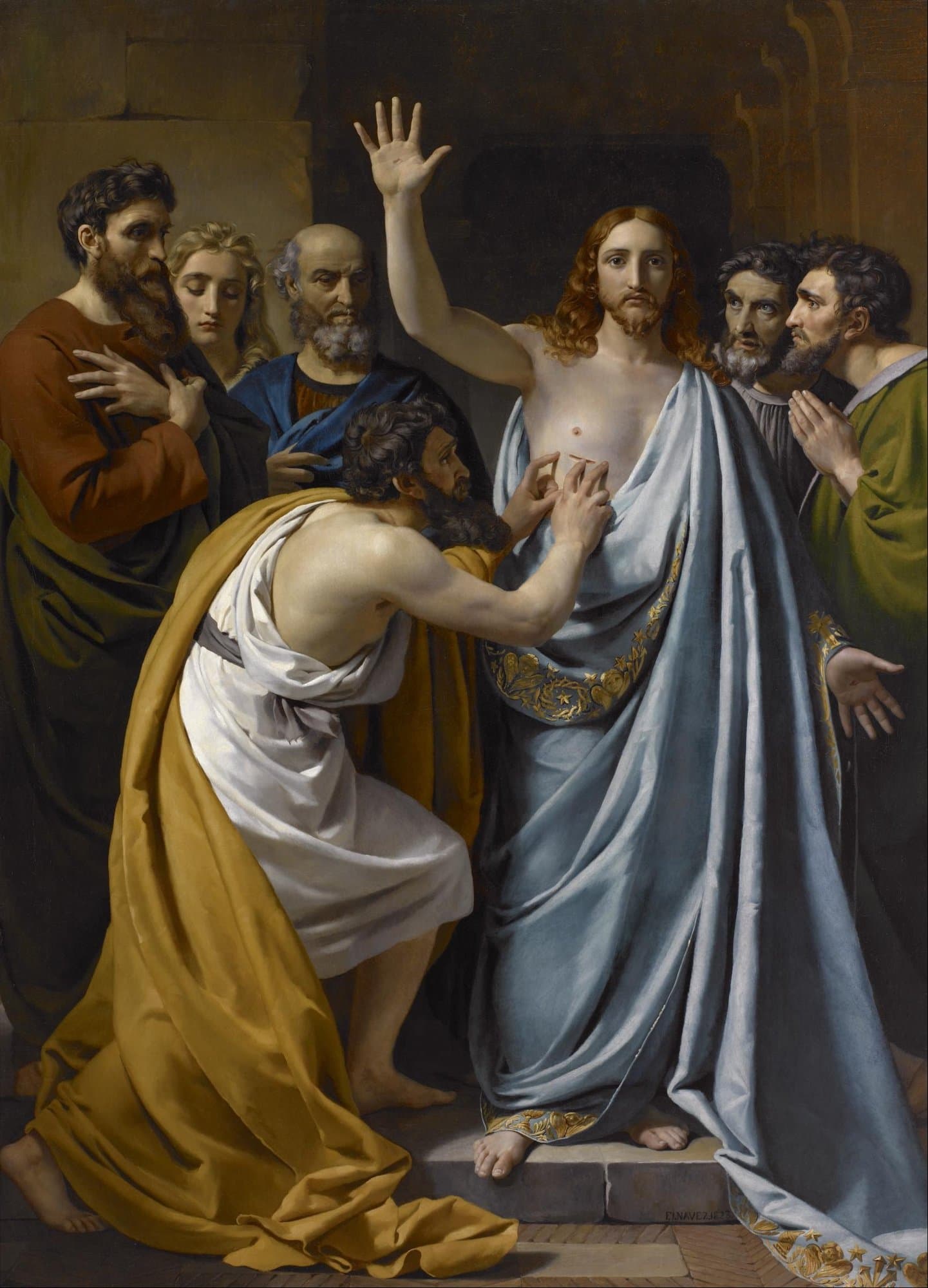
When Thomas would not believe without touching, Jesus offered him His hands and His side (John 20:27).
Evidence Beside Faith
Two texts mark where evidence stands in a life of faith.
Scripture sets evidence beside faith as a help and never in its place.
Jesus said to him, “Because you have seen Me, you have believed; blessed are those who have not seen and yet have believed.”Jesus spoke this blessing after Thomas had seen, so it reaches every later believer who trusts without seeing.
Now faith is the assurance of what we hope for and the certainty of what we do not see.Hebrews places the object of faith beyond sight, which marks the limit of what evidence can show.
Albert Barnes found evidence in the doubt of some disciples at Matthew 28:17. He held that the record of their doubting shows "that they were convinced only by the strength of the evidence."
Weighing and Trusting
Peter closes his account of what he saw with the word of the prophets.
The one who weighs these grounds is asked in the end to trust Jesus, whom the witnesses saw and touched.
Where doubt comes with depression or with intrusive, obsessive fears, a physician or a counsellor belongs beside prayer and study and never in their place.
We also have the word of the prophets as confirmed beyond doubt. And you will do well to pay attention to it, as to a lamp shining in a dark place, until the day dawns and the morning star rises in your hearts.The verse turns the reader from the apostles' witness to the Scriptures that stay open to every reader.
Sources
Scripture is the Berean Standard Bible.
- John Chrysostom, Homilies on the Acts of the Apostles, Homily 1, on Acts 1:3, translated by J. Walker, J. Sheppard and H. Browne, revised by George B. Stevens, Nicene and Post-Nicene Fathers, first series, volume 11.
- Jamieson, Fausset and Brown, Commentary Critical and Explanatory on the Whole Bible (1871), on 1 Corinthians 15:6.
- Matthew Henry, Commentary on the Whole Bible (1710), on Acts 17:11.
- John Wesley, Explanatory Notes upon the New Testament (1755), on 1 Peter 3:15.
- Albert Barnes, Notes, Explanatory and Practical, on the Old and New Testaments (1832 to 1869), on Matthew 28:17.
Keep Studying
In this trial5
People and groups10