
Luke 8:1-3 and the Passion Witnesses · Women of Scripture · An Iconic Story
The Women Who Followed
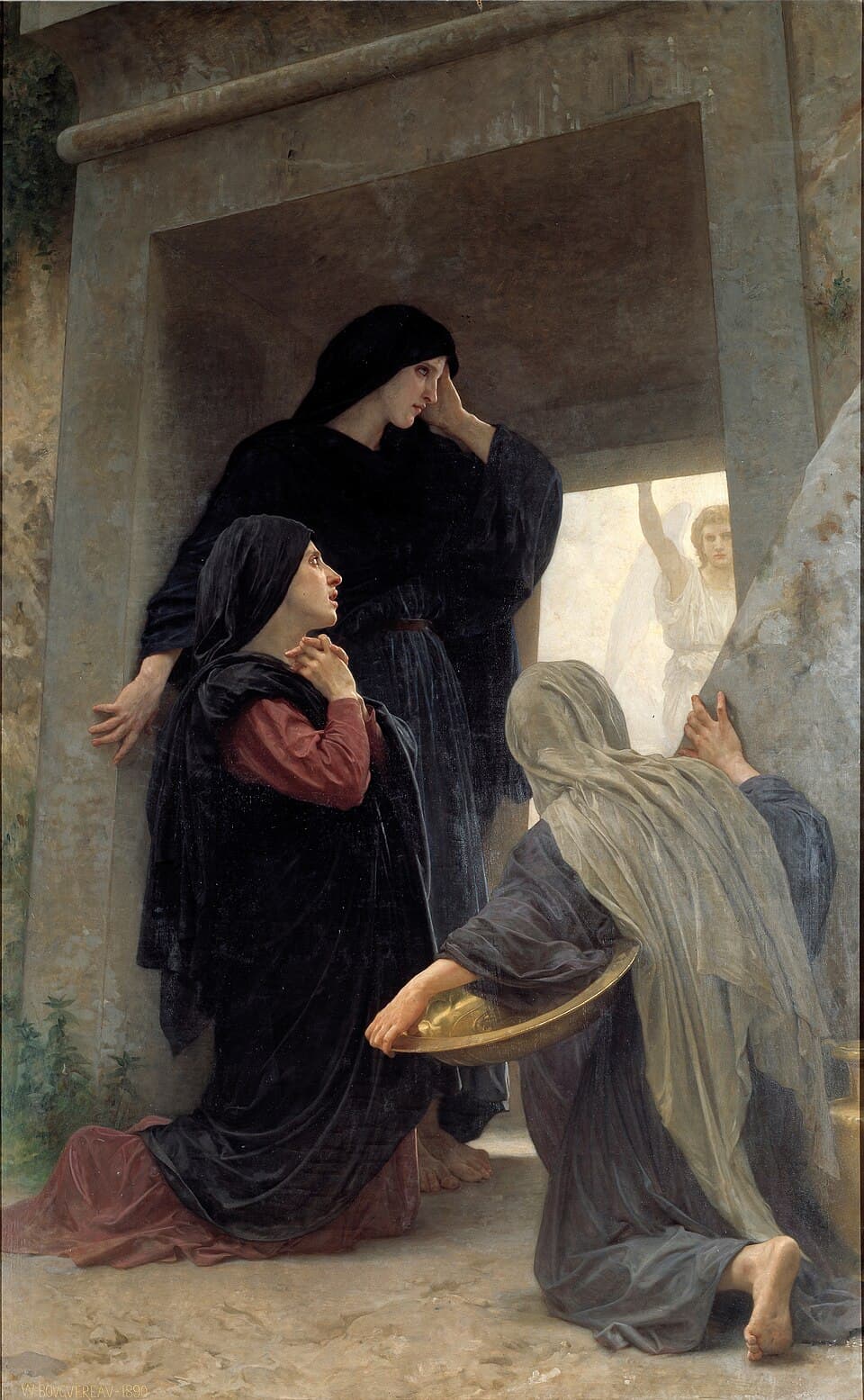
William-Adolphe Bouguereau, The Holy Women at the Tomb, 1890. Public domain.
They funded His ministry, stood at the cross when the eleven scattered, and were first at the empty tomb, and first to preach the resurrection to the very apostles who did not believe them.
Summary
Luke 8:1-3 names Mary Magdalene, Joanna the wife of Herod's steward, Susanna, and many others as women who traveled with Jesus and funded His ministry from their own means. The same women appear again at the cross when the eleven scattered, again at the burial, and again first at the empty tomb, where they become the first to preach the resurrection to the apostles who at first refused to believe them.
- These women "ministered unto him of their substance": they funded Jesus' itinerant ministry from their own independent means.
- Joanna's husband managed Herod Antipas' own household, meaning the gospel had a hearing inside the court of the man who executed John the Baptist.
- The same phrase, "the women which came with him from Galilee," names this group at the cross, at the burial, and at the tomb: one continuous line, not three separate groups.
- The apostles' first response to the women's report of the resurrection was disbelief, called "idle tales" in the text itself.
- In first-century practice a woman's testimony carried little legal standing; an invented account would not have made women its first witnesses, a widely made observation in New Testament scholarship.
Women Who Funded a Ministry
Luke 8:1-3, told plainly
As Jesus traveled from town to town preaching the kingdom, a group of women traveled with him alongside the Twelve, named and unnamed, funding the ministry from their own resources.
Soon afterward, Jesus traveled from one town and village to another, preaching and proclaiming the good news of the kingdom of God. The Twelve were with Him,Preaching the kingdom from town to town, with the Twelve, and with this group of women, all in the same sentence.
as well as some women who had been healed of evil spirits and infirmities: Mary called Magdalene, from whom seven demons had gone out,Mary Magdalene is named first. Her own fuller story and healing are told in full on her own page.
“Mary Magdalene--that is, probably, of Magdala... It is a great wrong to this honored woman to identify her with the once profligate woman of Lu 7:37, and to call all such penitents Magdalenes.”
Jamieson, Fausset & Brown · Commentary Critical and Explanatory on the Whole Bible (1871), on Luke 8:2
Joanna is named next, and the detail Luke gives about her husband is not incidental.
Joanna the wife of Herod’s household manager Chuza, Susanna, and many others. These women were ministering to them out of their own means.Joanna's husband managed Herod Antipas' own household. Susanna is named once, here only. "Many others" ministered from their own means.
“Herod's steward - Herod Antipas, who reigned in Galilee. He was a son of Herod the Great. The word ‘steward’ means one who has charge of the domestic affairs of a family, to provide for it. This office was generally held by a ‘slave’ who was esteemed the most faithful, and was often conferred as a reward of fidelity.”
Albert Barnes · Notes, Explanatory and Practical (1832-1869), on Luke 8:3
“She had been his wife (so some), but was now a widow, and left in good circumstances. If she was now his wife, we have reason to think that her husband, though preferred in Herod's court, had received the gospel, and was very willing that his wife should be both a hearer of Christ and a contributor to him.”
Matthew Henry · Commentary on the Whole Bible (1710), on Luke 8:3
A steward ran a great household’s affairs and was “often conferred as a reward of fidelity,” a position of trust, not a minor servant’s job. Joanna’s presence among Jesus’ followers means his ministry had a hearing, at minimum, inside the court of the very man who would later have John the Baptist executed and stand Jesus before him at his own trial.
The Same Women, When the Eleven Scattered
Luke 23:49, 55-56: the through-line the Gospel draws itself
Luke does not introduce a new group at the cross. The same phrase, “the women which came with him from Galilee,” names the same followers Luke 8 already introduced, now watching the crucifixion when the male disciples had fled.
But all those who knew Jesus, including the women who had followed Him from Galilee, stood at a distance watching these things."The women who had followed him from Galilee": the same group named in Luke 8, still present, at a distance, at the cross.
The women who had come with Jesus from Galilee followed, and they saw the tomb and how His body was placed. Then they returned to prepare spices and perfumes. And they rested on the Sabbath, according to the commandment.They watch where the body is laid, then prepare spices, then wait through the Sabbath. Nothing about their presence is accidental.
One continuous line runs through the ministry, the cross, the burial, and what comes next: the same women, named and unnamed, present at every point the Gospel records.
First at the Tomb, First to Preach
Luke 24:1-11, the resurrection reported to the very men who would preach it
On the first day of the week, very early in the morning, the women came to the tomb, bringing the spices they had prepared.Very early in the morning, on the first day of the week: the women arrive first, before any of the men.
As the women bowed their faces to the ground in terror, the two men asked them, “Why do you look for the living among the dead? He is not here; He has risen! Remember how He told you while He was still in Galilee:"Why seek ye the living among the dead?": the angels' question assumes the resurrection as already accomplished fact.
“Why, &c.--Astonishing question! not ‘the risen,’ but ‘the Living One’... and the surprise expressed in it implies an incongruity in His being there at all, as if, though He might submit to it, ‘it was impossible He should be holden of it’ (Ac 2:24).”
Jamieson, Fausset & Brown · Commentary Critical and Explanatory on the Whole Bible (1871), on Luke 24:5
The women return and report everything to the apostles, the first proclamation of the resurrection in the New Testament, delivered by women to the men who would carry that same message to the world.
And when they returned from the tomb, they reported all these things to the Eleven and to all the others.They return and tell "all these things" to the eleven and to everyone else present.
It was Mary Magdalene, Joanna, Mary the mother of James, and the other women with them who told this to the apostles.Luke names them: Mary Magdalene, Joanna, Mary the mother of James, and the other women with them.
“Now the women, when they had received the sayings of the Angels, hastened to tell them to the disciples... For woman who was once the minister of death, is now the first to receive and tell the awful mystery of the resurrection. The female race has obtained therefore both deliverance from reproach, and the withdrawal of the curse.”
Cyril of Alexandria · Commentary on Luke (5th century), on Luke 24:8
The apostles’ own first reaction is on the record, and the Gospel does not soften it.
But their words seemed like nonsense to them, and they did not believe the women."Idle tales": the apostles' own word for the first report of the resurrection, spoken by the women who had just seen the empty tomb.
“And their words seemed to them as idle tales,.... As fabulous things, as mere whims, and the fancies of their brains: ‘as a dream’, according to the Persic version; or, ‘as a jest’, as the Arabic version renders it.”
John Gill · Exposition of the New Testament (1746-1748), on Luke 24:11
Why This Detail Argues for Itself
the historical honesty note, held plainly
In the legal practice of first-century Jewish courts, a woman’s testimony carried little or no standing as a witness, a rule the Jewish historian Josephus states directly for his own era (Antiquities 4.219). Roman practice was not much different. A resurrection account invented in order to be believed would not have chosen women as its first witnesses, and it certainly would not have recorded the very apostles doubting them.
Furthermore, some of our women astounded us. They were at the tomb early this morning, but they did not find His body. They came and told us they had seen a vision of angels, who said that Jesus was alive. Then some of our companions went to the tomb and found it just as the women had described. But Him they did not see.”Even on the road to Emmaus, the disciples describe the women's report with lingering astonishment rather than settled confidence.
“The disciples also mention the report of the resurrection which was brought by the women; adding, Yea, and certain women also of our company made us astonished, &c. They say this indeed as if they did not believe it; wherefore they speak of themselves as frightened or astonished.”
Ancient Greek Expositor · Catena Aurea, compiled by Thomas Aquinas (1264), on Luke 24:22
The Gospel writers had every cultural incentive to put the resurrection report in male mouths if they were shaping the story for credibility. They did not. The detail argues for itself: this is what happened, recorded honestly, disbelief included.
What the Text Doesn't Say
the silences are not gaps to be filled
Who exactly were the "many others"?not named
Luke 8:3 closes the list with “and many others,” without naming them. How many, or who beyond the three named women, is never stated, and this page does not guess a number or a list on Scripture’s behalf.
What became of Joanna and Susanna afterward?the text does not say
Joanna is named again at the tomb (Luke 24:10) and then disappears from the biblical record. Susanna is named once, in Luke 8:3, and nowhere else in Scripture. Their later lives are simply not recorded.
How the Voices Read These Women
the roster's relevance gate: a voice earns its place with a real, citable, on-subject work
No roster entry surfaced a confirmed, citable, treatment specific to this group of women this session: the site does not add a voice to a page on the strength of a topic-tier score alone. The public-domain floor below is quoted verbatim throughout this page.
Read the Great Books
the works that have carried this teaching: go further than this page
Commentary on Luke
Cyril of Alexandria · 5th century
The single sharpest theological line on the resurrection witness: “woman who was once the minister of death, is now the first to receive and tell the awful mystery of the resurrection.”
Commentary Critical and Explanatory on the Whole Bible
Jamieson, Fausset & Brown · 1871
Corrects the common wrong done to Mary Magdalene’s name, and names the angels’ own astonishing question at the tomb plainly.
Notes, Explanatory and Practical, on the Old and New Testaments
Albert Barnes · 1832-1869
States plainly what “Herod’s steward” means, the detail that puts Jesus’ ministry inside the reach of Herod’s own court.
Present at Every Point the Gospel Records
They funded the ministry, stayed at the cross when the men who walked with him fled, watched where his body was laid, and were the first to find the tomb empty. Then they preached the resurrection to the apostles who would carry it to the world, and were not believed, at first, by the very men history would remember as its first witnesses. Luke records both halves honestly: what they did, and how they were received for it.
Notable art
— click a piece to enlargeSources
Built from MannaFest's research brief on the women who followed Jesus, drawn from the site's own commentary pool (Jamieson-Fausset-Brown, Albert Barnes, Matthew Henry, Cyril of Alexandria, John Gill, the Catena Aurea), quoted verbatim, all public domain. Scripture BSB, fetched from the floor.
Keep Studying
On this page