
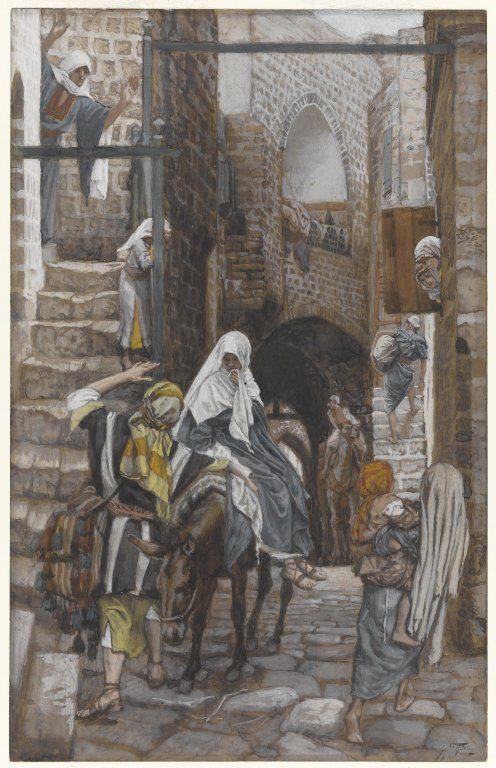
James Tissot, Saint Joseph Seeks a Lodging in Bethlehem, 1886 to 1894. Public domain.
Luke 2:1 to 7 · Subject · Featured Study
Hard Questions in the New Testament
The decree of Augustus brought Joseph and Mary to Bethlehem, and the governor Luke names beside it has been hard to date.
In 1898 William Ramsay wrote that most critics of his day called Luke's Quirinius a demonstrated blunder.
This was the first census to take place while Quirinius was governor of Syria.
This was the first census to take place while Quirinius was governor of Syria.
- Books
- Luke, Acts
- Hold in memory
- Luke 2:1
Summary
Luke ties the birth of Jesus to a Roman census. Commentators place the census of Quirinius in Judea about ten years after the birth.
- Matthew says Jesus was born while Herod was king.
- Barnes, Clarke and Jamieson, Fausset and Brown all found Quirinius hard to fit to Herod's reign.
- Lardner, Gill and Ramsay each read Luke 2:2 so that it fits the reign of Herod.
The Census of Luke 2
An order from Rome sent a household of Galilee to the town of David.
Now in those days a decree went out from Caesar Augustus that a census should be taken of the whole empire.The decree of the emperor sets the birth of Jesus inside the history of Rome.
And everyone went to his own town to register. So Joseph also went up from Nazareth in Galilee to Judea, to the city of David called Bethlehem, since he was from the house and line of David. He went there to register with Mary, who was pledged to him in marriage and was expecting a child.The census explains why a family from Nazareth was in Bethlehem when the child was born.
Luke sets the priest Zechariah, father of John the Baptist, in the time of Herod king of Judea (Luke 1:5).
From Herod to Judas the Galilean
Matthew, Barnes, Ramsay and Acts each place one of these events.
The events run from the reign of Herod to the rising of Judas the Galilean.
- Herod king of JudeaJesus is born in Bethlehem during Herod's reign.Matthew 2:1
- 8 to 7 BC, in Ramsay's reckoningThe province of Syria is counted.
- After HerodHis son Archelaus reigns eight or nine years, as Barnes reports from Josephus.
- AD 6, in Ramsay's reckoningJudea is joined to Syria, and Quirinius takes the census.
- In the days of the censusJudas the Galilean rises in the days of the census.Acts 5:37
Herod's reign stands first and the census of Judea last.
Luke Dates Events by Their Rulers
Luke's habit of dating events by their rulers shows again at the start of John's preaching.
In the fifteenth year of the reign of Tiberius Caesar, while Pontius Pilate was governor of Judea, Herod tetrarch of Galilee, his brother Philip tetrarch of Ituraea and Trachonitis, and Lysanias tetrarch of Abilene, during the high priesthood of Annas and Caiaphas, the word of God came to John son of Zechariah in the wilderness.The verse fixes one event in time by naming seven rulers at once.
Why Luke Names the Governor
The early teachers read the census as a mark of the time and as a sign of a greater enrolment.
Ambrose of Milan joined the date to its meaning.
“He has rightly added the name of the governor, to mark the course of time. For if the names of the Consuls are affixed to the tables of prices, how much more ought the time to be noted down, of that event which was the redemption of all men? There is described a secular registration, implied a spiritual, to be laid before the King not of earth but of Heaven; a registering of faith: a census of souls. For the old census of the Synagogue was abolished, a new census of the Church was preparing.”
Ambrose of Milan · Catena Aurea by Aquinas · on Luke 2:1 to 2Patristic
Cyril of Alexandria read the decree as proof that Judea now stood under Caesar, with no king of its own from David's tribe. He tied it to Jacob's word that the sceptre would not depart from Judah until the One came (Genesis 49:10).
Why Luke 2:2 Is Hard
Albert Barnes laid out the problem from the record of Josephus.
Albert Barnes called Luke 2:2 a verse that has caused as much perplexity as any in the New Testament. He wrote that Varus governed Syria at the birth of Jesus, and that Quirinius came as governor only after Archelaus was removed.
The Greek Words of Luke 2:1 to 5
Three Greek words carry the census of Luke 2: the census, the registering and first.
ἀπογραφή apographē, census
2 uses in the canon
An enrolment or registration, the noun Luke uses for both of the censuses he names.
πρῶτος prōtos, first
152 uses in the canon
First in time, place or rank, the word whose sense decides each reading of the verse.
ἀπογράφω apographō, to register
4 uses in the canon
To enter in a list, the verb for the registering of Luke 2:1, Luke 2:3 and Luke 2:5.
Registered in Bethlehem
Jamieson, Fausset and Brown and Adam Clarke each asked why Mary went to Bethlehem with Joseph.
Tertullian (died 220)
Jamieson, Fausset and Brown noted that Joseph registered in the city of his descent, by Jewish custom. Roman practice registered a man where he lived.
Adam Clarke wrote that Joseph alone could have met the census. In his reading God ordered that both should go, so that Jesus was born in the city of David (Micah 5:2).
Tertullian cited the Roman record of the census for the line of Mary.
“For He was from the native soil of Bethlehem, and from the house of David; as, among the Romans, Mary is described in the census, of whom is born Christ.”
Tertullian · An Answer to the Jews · on Luke 2:1Patristic
Three Readings of Luke 2:2
Each reading comes with its holder and the objection raised against it.
A census named by his later titleNathaniel Lardner, as reported by Albert Barnes, Notes, on Luke 2:2
Barnes took up the reading of Nathaniel Lardner as the most satisfactory. Augustus sent Quirinius, then a senator, to take the census, and Luke calls him by the title he held later.
The objection, from Clarke: Quirinius was not governor of Syria until ten or twelve years after the birth.
The first of two enrolments in JudeaJohn Gill, Exposition of the New Testament (1746 to 1748), on Luke 2:2
John Gill read the verse as the first enrolment in the Jewish nation, since another followed when Judas the Galilean arose.
The objection, from Jamieson, Fausset and Brown: the taxing under Quirinius is the one that led to the rising of Judas.
An enrolment begun under Herod, Quirinius twice in officeW. M. Ramsay, Was Christ Born at Bethlehem? (1898), chapters 8 and 9
Ramsay judged that the enrolment in Herod's kingdom was probably delayed beyond the count of the province. He held that Quirinius governed Syria twice.
The objection, from Ramsay himself: he wrote that his inscription leaves uncertain whether the Apamean numbering fell in the first or the second administration of Quirinius.
Josephus, the Inscriptions and the Commentaries
Ramsay drew on an inscription, and Gill and Lardner on the words of Luke.
Sources
Scripture is the Berean Standard Bible.
- Strong's lexicon entries g582, g583 and g4413, with their counts of uses.
- Albert Barnes, Notes, Explanatory and Practical (1832 to 1869), on Luke 2:2, reporting Nathaniel Lardner and Josephus, Antiquities 17.
- Adam Clarke, Commentary on the Bible (1832), on Luke 2:2 and Luke 2:5.
- Jamieson, Fausset and Brown, Commentary Critical and Explanatory on the Whole Bible (1871), on Luke 2:2 and Luke 2:3.
- John Gill, Exposition of the New Testament (1746 to 1748), on Luke 2:2.
- W. M. Ramsay, Was Christ Born at Bethlehem? A Study on the Credibility of St. Luke (1898), chapters 2, 8 and 9.
- Ambrose of Milan, on Luke 2:1 to 2, in Thomas Aquinas, Catena Aurea.
- Cyril of Alexandria, Commentary on the Gospel of Luke (444), on Luke 2:1.
- Tertullian, An Answer to the Jews.
Keep Studying
Doctrines1