
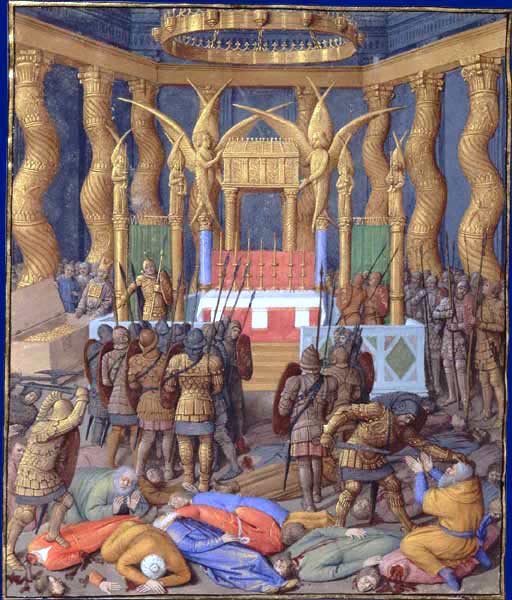
Jean Fouquet, Pompey in the Temple of Jerusalem, about 1470. Public domain.
Luke 3:1 · Book · Featured Study
Josephus and His Histories
Flavius Josephus, a priest of Jerusalem, wrote the Jewish War and the Antiquities of the Jews in the first century.
The governors, high priests and rebels of Luke's pages walk through these histories as well.
In the fifteenth year of the reign of Tiberius Caesar, while Pontius Pilate was governor of Judea, Herod tetrarch of Galilee, his brother Philip tetrarch of Ituraea and Trachonitis, and Lysanias tetrarch of Abilene,
- Date
- The Jewish War after AD 70; the Antiquities finished in the thirteenth year of Domitian
- Written by
- Flavius Josephus
- Occasion
- Josephus told the war of his people with Rome, then the history of the Jews before it.
- Edition
- The English translation of William Whiston, 1737
Summary
Josephus was a priest in Jerusalem who led Jewish troops in Galilee against Rome. He gave himself up to Vespasian, and Titus took him to Rome.
- He records the deaths of John the Baptist and of James, the brother of Jesus.
- His Theudas comes later than the Theudas of Acts 5, and readers explain the gap in two ways.
- Readers hold three views of his passage on Jesus, from wholly his own to wholly added.
Where He Meets the Gospels
Four men of the Gospels and Acts stand in the Antiquities: a prophet, a high priest, a governor and an apostle.
But when he rebuked Herod the tetrarch regarding his brother’s wife Herodias and all the evils he had done, Herod added this to them all: He locked John up in prison.This is the Gospel's side of an imprisonment that Josephus also records.
Josephus calls John a good man who taught the Jews to practice virtue. He writes that Herod sent John a prisoner to the fortress of Macherus and put him to death there (Antiquities 18.5.2).
Josephus records that Gratus made Caiaphas high priest and that Vitellius later removed him (Antiquities 18.2.2 and 18.4.3). He also tells how Pilate brought Caesar's images on the standards into Jerusalem and built an aqueduct with the temple's money (Antiquities 18.3.1 to 2).
But I saw none of the other apostles except James, the Lord’s brother.Paul names James as the Lord's brother, the same tie Josephus gives him.
Josephus tells how the high priest Ananus, while Festus was dead and Albinus still on the road, brought James before the Sanhedrin. He names James as the brother of Jesus who was called Christ, and Ananus had him stoned (Antiquities 20.9.1).
His Four Works
The four works run from the war of his own day back to the Creation.
Josephus wrote two long histories, a life of himself and a reply to his critics.
- The Jewish WarSeven booksIt tells the revolt against Rome and the fall of Jerusalem.
- The Antiquities of the JewsTwenty booksIt tells the history of the Jews from the Creation to the outbreak of the revolt in AD 66.
- The LifeOne workIt tells his family, his command in Galilee and his years in Rome.
- Against ApionA replyIt defends his people against their critics and tells how he wrote the War.
The Antiquities runs to twenty books, nearly three times the length of the War.
From Priest to Historian
Josephus tells his own life in the Life and in book 3 of the War.
Josephus was born to Matthias in the first year of the emperor Gaius, in 37 or 38. He came from the first of the twenty-four courses of priests, and his mother's family descended from the Hasmonean kings (Life 1).
At sixteen he tried the three sects of his people, the Pharisees, the Sadducees and the Essenes. He spent three years with a desert teacher named Banus, and at nineteen he began to live by the rules of the Pharisees (Life 2).
When the revolt against Rome broke out, the leaders in Jerusalem sent him with two other priests to Galilee (Life 7). Vespasian besieged him in the town of Jotapata until the town fell.
Brought before Vespasian, he told the general that he and his son would be Caesar and emperor (War 3.8.9). Vespasian later gave him a room in his own house, Roman citizenship and a yearly pension (Life 76).
Josephus wrote the War at Rome with helpers for his Greek. He gave the books first to Vespasian and Titus (Against Apion 1.9).
How Far He Can Be Trusted
Three events of Acts stand in Josephus as well, and set side by side they agree in part.
On the appointed day, Herod donned his royal robes, sat on his throne, and addressed the people. And they began to shout, “This is the voice of a god, not a man!” Immediately, because Herod did not give glory to God, an angel of the Lord struck him down, and he was eaten by worms and died.Acts and Josephus tell this death apart from each other, so the two accounts can be laid side by side.
Josephus tells the same death of Agrippa at Caesarea. The king wore a robe of silver, his flatterers hailed him as a god, he did not rebuke them, and he died after five days of pain (Antiquities 19.8.2).
Some time ago Theudas rose up, claiming to be somebody, and about four hundred men joined him. He was killed, all his followers were dispersed, and it all came to nothing.Gamaliel names Theudas before Judas of the census, so Luke's Theudas rose before the census revolt.
Josephus places his Theudas under the governor Fadus, who beheaded him (Antiquities 20.5.1). Adam Clarke counted that rising at least ten years after the council of Acts 5.
Clarke and Albert Barnes held that Luke and Josephus speak of two men, and Barnes argued that Josephus does not profess to record every revolt. Clarke also reported Lightfoot's view that Josephus slipped in his dates.
“Aren’t you the Egyptian who incited a rebellion some time ago and led four thousand members of the ‘Assassins’ into the wilderness?”The commander mistakes Paul for an Egyptian rebel whom Josephus also describes.
In the War, Josephus gives the Egyptian thirty thousand followers on the Mount of Olives (War 2.13.5). In the Antiquities he writes that Felix slew four hundred and took two hundred alive (Antiquities 20.8.6).
The Census Under Quirinius
Luke and Josephus both name Quirinius and a census of Judea, and readers weigh whether they speak of one census or two.
This was the first census to take place while Quirinius was governor of Syria.Luke ties the birth of Jesus to a governor whom Josephus also names.
Josephus writes that Caesar sent Cyrenius, a former consul, to take account of Syria and to sell the estate of Archelaus (Antiquities 17.13.5). Cyrenius then came into Judea to take an account of the people's property, and Judas the Gaulonite called the tax the start of slavery (Antiquities 18.1.1).
Eusebius read Luke and Josephus as speaking of one census.
“It was the forty second year of the reign of Augustus and twenty-eight years after the oppression of Egypt and the death of Antony and Cleopatra when Jesus was born in Bethlehem according to the prophecies concerning him. Flavius Josephus mentions this census in the time of Quirinius, adding another account about the sect of Galileans that arose at about the same time. Luke, among our writers, mentions this sect in Acts, saying, ‘After him Judas the Galilean arose in the days of the census and drew some people after him. He also perished, and all who followed him were scattered.’”
Eusebius of Caesarea · Ecclesiastical History 1.5 · on Luke 2:1 to 2Patristic
Albert Barnes found the verse hard, since by Josephus's account Cyrenius came to Syria only after Archelaus, Herod's successor, was removed. Barnes followed Lardner in reading Luke's census as the first that Cyrenius took, called by the title he held later.
The Testimony About Jesus
Readers have weighed for more than two centuries who wrote the passage on Jesus in Antiquities 18.3.3.
In the passage as it stands, Josephus calls Jesus a wise man and a doer of wonderful works. It says that He was the Christ, that Pilate condemned Him to the cross, and that He appeared alive again on the third day.
Eusebius quotes the whole passage in his Church History 1.11. The Jewish Encyclopedia held that the passage cannot have come from Josephus in its present form.
Written whole by JosephusWilliam Whiston, Dissertation I, 1737
William Whiston held the passage genuine. He argued that a writer who honored John and named James as the brother of Jesus could not have passed over Jesus himself, and that its style is Josephus's own.
Added whole by a Christian handEdward Gibbon, The Decline and Fall, chapter 16, note 36
Edward Gibbon held that the passage was inserted between the time of Origen and that of Eusebius. He pointed to a Jew who acknowledges the Messiah and hesitates to call him a man.
A shorter passage, enlarged by a copyistHeinichen, as Milman reports him; the Catholic Encyclopedia, 1910
Henry Hart Milman reported that Heinichen, the editor of Eusebius, held the passage to be partly genuine, with many clauses added. The Catholic Encyclopedia judged that the passage seems to suffer from repeated interpolations.
Each reading meets an objection. Origen says twice that Josephus did not believe Jesus to be the Christ (Against Celsus 1.47; Commentary on Matthew 10.17), which weighs against the first. Josephus's notices of John and of James weigh against the second, and Gibbon's charge of forgery against the third.
Books to Read Next
Three works give Josephus and the oldest readers of his testimony.
The Works of Flavius Josephus
Flavius Josephus, translated by William Whiston · 1737
Whiston's translation holds all four works, with his own dissertations.
Read it free at CCELChurch History
Eusebius of Caesarea · fourth century
Eusebius gives the passage on Jesus in his first book and the passage on James in his second.
Read it free at New AdventAgainst Celsus
Origen · third century
Book 1, chapter 47 holds Origen's remark on what Josephus believed of Jesus.
Read it free at New AdventAn Orderly Account
Luke and Josephus wrote of the same land in the same century, one for Theophilus and one under Roman patrons.
Therefore, having carefully investigated everything from the beginning, it seemed good also to me to write an orderly account for you, most excellent Theophilus,Luke's claim to careful research is one a reader can test against Josephus.
Josephus counts ninety-seven thousand captives in the whole war and eleven hundred thousand dead in the siege of Jerusalem (War 6.9.3). Adam Clarke set those counts beside Jesus' warning in Luke 21:24.
Sources
Scripture is the Berean Standard Bible.
- Flavius Josephus, The Life, sections 1, 2, 7 and 76, translated by William Whiston (1737)
- Flavius Josephus, The Wars of the Jews, preface 12, 2.13.5, 3.8.7 to 9 and 6.4 to 6.9, translated by William Whiston.
- Flavius Josephus, The Antiquities of the Jews, 4.8.15, 17.13.5, 18.1.1, 18.2.2, 18.3.1 to 3, 18.4.3, 18.5.2, 19.8.2, 20.5.1, 20.8.6, 20.9.1 and 20.11.3, translated by William Whiston.
- Flavius Josephus, Against Apion 1.9, translated by William Whiston.
- The Jewish Encyclopedia, Josephus, Flavius (signed G. S. Kr.)
- Karl Hoeber, Flavius Josephus, in The Catholic Encyclopedia, volume 8 (1910)
- Eusebius, Church History 1.11 and 2.23, translated by A. C. McGiffert (1890)
- Origen, Against Celsus 1.47 (ANF, 1885) and Commentary on Matthew 10.17 (ANF, 1896)
- William Whiston, Dissertation I, in The Works of Flavius Josephus (Philadelphia, 1859)
- Edward Gibbon, The History of the Decline and Fall of the Roman Empire, chapter 16, note 36, with the notes of Henry Hart Milman.
- Adam Clarke, Commentary on the Bible (1832), on Acts 5:36 and Luke 21:24.
- Albert Barnes, Notes on Acts 5:36.
- Eusebius, Ecclesiastical History 1.5 on Luke 2:1 to 2.
- Albert Barnes, Notes on Luke 2:2; Bede on Luke 2:2.
Keep Studying
Read it4
Studies4
People and groups9