
Also called: trust, belief, believing God, confidence in God, taking God at His word
This subject covers trusting God enough to act on what He said before the outcome is visible. The questions that come while a person trusts belong to Doubt. What God does in answer, and at what cost, belongs to Salvation.
What Faith covers, and where it stops
This subject covers trusting God enough to act on what He said before the outcome is visible. The questions that come while a person trusts belong to Doubt. What God does in answer, and at what cost, belongs to Salvation.
On this page, 8 sections
The one drawing
Across the canon
Old Testament
New Testament
The other 47 books of the canon carry none.
12 passages
Where Scripture speaks
The passages this subject stands on, in canon order.
Abram believed the LORD, and it was credited to him as righteousness.Abraham answered, “God Himself will provide the lamb for the burnt offering, my son.” And the two walked on together.When Israel saw the great power that the LORD had exercised over the Egyptians, the people feared the LORD and believed in Him and in His servant Moses.He is the Rock, His work is perfect; all His ways are just. A God of faithfulness without injustice, righteous and upright is He.Still I am certain to see the goodness of the LORD in the land of the living.The head of Ephraim is Samaria, and the head of Samaria is the son of Remaliah. If you do not stand firm in your faith, then you will not stand at all.’”Look at the proud one; his soul is not upright—but the righteous will live by faith—When Jesus heard this, He marveled and said to those following Him, “Truly I tell you, I have not found anyone in Israel with such great faith.Jesus turned and saw her. “Take courage, daughter,” He said, “your faith has healed you.” And the woman was cured from that very hour.“Because you have so little faith,” He answered. “For truly I tell you, if you have faith the size of a mustard seed, you can say to this mountain, ‘Move from here to there,’ and it will move. Nothing will be impossible for you.”Immediately the boy’s father cried out, “I do believe; help my unbelief!”The apostles said to the Lord, “Increase our faith!”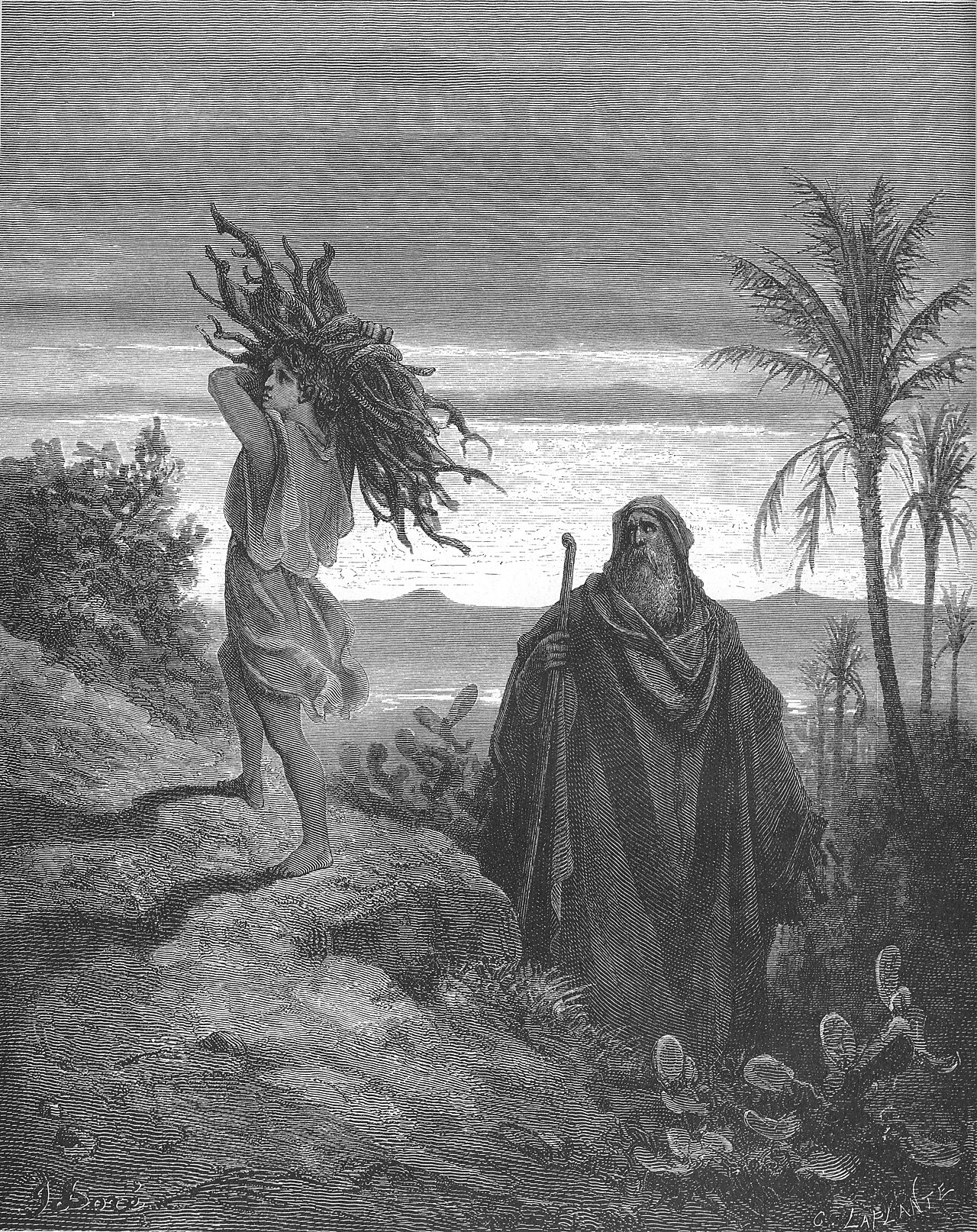
Faith in Scripture, in full
Faith across the canon is less a feeling than a transaction: a person trusts what God has said and acts on it before the outcome is visible. The Old Testament rarely uses an abstract noun for "faith" the way the New Testament does; its vocabulary runs through the Hebrew root 'aman (the same root behind "amen"), carrying senses of firmness, steadiness, and reliability.
Genesis 15:6 sets the pattern early: Abraham "believed in Jehovah; and he reckoned it to him for righteousness," years before circumcision (Genesis 17) or any law existed to obey.
Habakkuk 2:4, written centuries later into a book about an evil empire's imminent violence, distills the same posture into five words ("the righteous shall live by his faith") and becomes one of the New Testament's most-quoted Old Testament lines on the subject, taken up three separate times (Romans 1:17, Galatians 3:11, Hebrews 10:38) across three letters making three related but distinct arguments: alongside Genesis 15:6, which the New Testament cites at least as often.
In the Gospels, faith moves from a general covenant posture to something aimed directly at Jesus. The sick and desperate reach for him specifically: the woman with the twelve-year hemorrhage (Matthew 9:22), a Gentile centurion whose trust surprises even Jesus (Matthew 8:10), a father caught between belief and doubt in the same breath (Mark 9:24).
None of these accounts measure faith by its intensity; Jesus' own teaching on mustard-seed faith (Matthew 17:20) makes the point that a small amount of trust in an infinite God outperforms a large amount of confidence in anything smaller. The apostles themselves, closest to him for years, still ask him to "increase our faith" (Luke 17:5): a tell that faith in the Gospels is treated as something Christ supplies as much as something a disciple works up on his own.
Paul systematizes the Old Testament material into the doctrine of justification: a sinner is declared righteous by faith, not by law-keeping, and Abraham is Exhibit A (Romans 4, Galatians 3). Faith here is carefully kept as the instrument that receives a righteousness that is not the believer's own (the empty hand, not the payment) while the ground remains Christ's atoning death, never the quality or quantity of anyone's belief.
Ephesians 2:8-9 states the same architecture in miniature: salvation by grace, through faith, and "that not of yourselves... the gift of God"; readers have long divided over whether the gift named is the faith specifically or the whole salvation, but on either reading Paul's point stands, that nothing in the arrangement is the believer's own contribution or a substitute merit.
Hebrews 11 then walks faith backward through the whole Old Testament (Abel, Noah, Abraham, Moses, Rahab), showing that in every case faith was not a private feeling but issued in a visible act: an offering brought, an ark built, a land left, a wall approached. The chapter's most sobering note is verse 39: every one of them "obtained a good report through faith," yet none "received the promise" in their lifetime; faith, in Hebrews, includes waiting without seeing the end.
The honest tension sits between Paul and James. Paul insists a person "is justified by faith apart from the works of the law" (Romans 3:28); James insists "by works a man is justified, and not only by faith" (James 2:24); read side by side, the two verses look flatly contradictory.
The standard resolution, held here without flattening the difficulty: Paul is answering how a sinner is declared righteous before God (a legal question, settled once, by an instrument that receives Christ's finished work); James is answering how professed faith is shown to be genuine before other people (an evidential question, proven over time, in works a merely verbal "faith" the demons also hold cannot produce, James 2:19).
It is not two gospels but two questions aimed at two different courts. A second honest tension worth naming: Habakkuk 2:4's Hebrew ('emunah), carries a strong sense of "faithfulness, steadfastness" alongside "faith, trust," and serious readers disagree on how much of Paul's use rides on the Greek Septuagint's rendering (pistis) versus the Hebrew word's own native weight.
Both readings converge on the same practical demand (a life staked on God's word, held under pressure) which is one reason the verse survives three distinct New Testament applications without contradicting itself.
Taken as a whole, the canon's picture of faith is concrete rather than sentimental: it has a specific object (God's revealed word, and finally Christ himself), a specific origin ("cometh by hearing," Romans 10:17, not self-generated), a specific proof (James's works, Hebrews' acts, 1 Peter's gold refined by fire), and a specific question left open at the end rather than answered for the reader: Jesus' own words, "when the Son of man cometh, shall he find faith on the earth?" (Luke 18:8).
4 voices
What teachers have said
Man is to believe God's ways are right, because they are His, not because we fully see they are so
Jamieson, Fausset & Brown · Commentary Critical and Explanatory on the Whole Bible, 1871
this unbelief was a foil to his faith, and bespeaks it a believing against hope.
Matthew Henry · Commentary on the Whole Bible, 1710
He was not unbelieving, but fearful; and therefore came by night to the light, wishing to be enlightened, but afraid of being known to go.
Augustine of Hippo · Catena Aurea by Aquinas
Written before 430.
"Thy faith," He would say, "hath saved thee; " and, "Thy sins shall be remitted thee," on thy believing, of course, albeit thou be not yet baptized.
Tertullian · On Baptism
Written before 220.
Where it leads
Everything the site holds on faith
On this page
The words underneath
Each card is one Hebrew or Greek word behind faith. It gives the sense, the count across the canon, and the number in Strong's 1890 concordance.
pisteuo: to trust (in)
Greek · G4100Strong's entry: to have faith (in, upon, or with respect to, a person or thing), i.e. credit; by implication, to entrust (especially one's spiritual well-being to Christ)
the verb behind every "whosoever believeth" in John
237 times in the New Testament · pisteuo, in full →
pistos: faithful
Greek · G4103Strong's entry: objectively, trustworthy; subjectively, trustful
what God is named as the ground for ours
67 times in the New Testament · pistos, in full →
pistis: faith: faithfulness
Greek · G4102Strong's entry: persuasion, i.e. credence; moral conviction (of religious truth, or the truthfulness of God or a religious teacher), especially reliance upon Christ for salvation; abstractly, constancy in such profession; by extension, the system of religious (Gospel) truth itself
the persuasion and reliance the whole New Testament calls saving
242 times in the New Testament · pistis, in full →
emunah: faithfulness
Hebrew · H530Strong's entry: literally firmness; figuratively security; morally fidelity
the word behind "the just shall live by his faith"
49 times in the Old Testament · emunah, in full →
22 verses
The complete list
This subject carries 34 curated verses. 12 of them are quoted above, and the other 22 stand here, book by book. Open a book to read the references with a clause of each verse.
John2
Acts1
Romans4
- Romans 1:17For the gospel reveals the righteousness of God that comes by faith from start to finish, just...
- Romans 4:3For what does the Scripture say? “Abraham believed God, and it was credited to him as...
- Romans 5:1Therefore, since we have been justified through faith, we have peace with God through our Lord...
- Romans 10:17Consequently, faith comes by hearing, and hearing by the word of Christ.
2 Corinthians1
Galatians2
Ephesians2
Hebrews4
- Hebrews 10:38But My righteous one will live by faith; and if he shrinks back, I will take no pleasure in...
- Hebrews 11:1Now faith is the assurance of what we hope for and the certainty of what we do not see.
- Hebrews 11:6And without faith it is impossible to please God, because anyone who approaches Him must...
- Hebrews 12:2Let us fix our eyes on Jesus, the author and perfecter of our faith, who for the joy set before...
James3
Character
The subjects beside it
On this page
Subjects28