
Mark 4:40
in Mark 4“Why are you so afraid?” He asked. “Do you still have no faith?”
BSB
The same verse in ASV and KJV ▾
ASV
And he said unto them, Why are ye fearful? have ye not yet faith?
KJV
And he said unto them, Why are ye so fearful? how is it that ye have no faith?
⋯
This verse in Mark 4
Commentary
17 notes on this verseAnd he said to them: Why are you afraid? Do you still have no faith? They are rightly reproached, who were afraid with Christ present, since certainly whoever adheres to him cannot perish. This is similar to when, after the sleep of death, he appeared …
This site's exposition
Why are you so afraid
on Mark 4:40-41
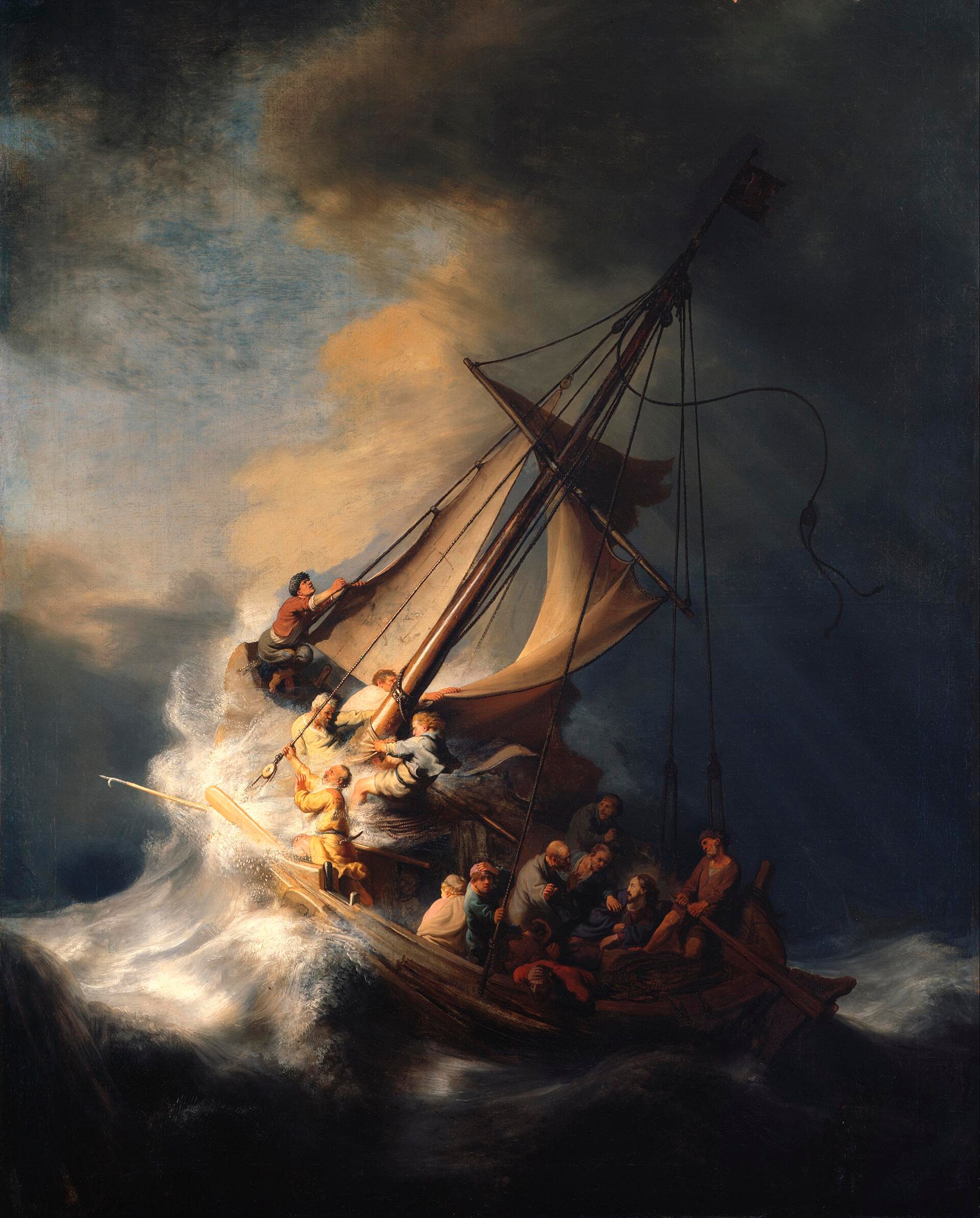
Jesus turns to the disciples and sets their fear against their faith, asking Why are you so afraid and Do you still have no faith. Overwhelmed with fear, they asked one another, Who is this, that even the wind and the sea obey Him, the question the whole Gospel is written to answer. Their fear grows after the calm, and the question comes from them in the boat.
The record, by era
The Medieval Church4 voices
(ubi sup.) Or else the ship into which He embarked, is taken to mean the tree of His passion, by which the faithful attain to the security of the safe shore. The other ships which are said to have been with the Lord, signify those, who are imbued with faith in the cross of Christ, and are not beaten about by the whirlwind of tribulation; or who, after the storms of temptation, are enjoying the serenity of peace.
After His teaching, they come from that place to the sea, and are tossed by the waves. Wherefore it is said, And the same day, when the even was come, &c. Mystically, however, the hinder part of the ship is the beginning of the Church, in which the Lord sleeps in the body only, for He never sleepeth who keepeth Israel; for the ship with its skins of dead animals keeps in the living, and keeps out the waves, and is bound together by wood, that is, by the cross and the death of the Lord the Church is saved. The pillow is the body of the Lord, on which His Divinity, which is as His head, has come down. But the wind and the sea are devils and persecutors, to whom He says Peace, when He restrains the edicts of impious kings, as He will. The great calm is the peace of the Church after oppression, or a contemplative after an active life.
He also rebukes the disciples for not having faith. For if they had had faith, they would have believed that even while sleeping He could preserve them unharmed.
He rebuked His disciples, for not having faith; for it goes on, And he said unto them, Why are ye so fearful? How is it that ye have not faith? For if they had had faith, they would have believed that even when sleeping, He could preserve them safe.
The Reformation1 voice
And, lo, there was a great swell in the sea, so that the ship was covered with the billows: and he was asleep. And his disiples approached and awoke him, saying, Lord, save us, we perish. And he saith to them, Why are you timid, O men of little faith?
10 more voices on this verse
The Puritans and the Awakening2 voices
11 And he said unto them, Unto you it is given to know the mystery of the kingdom of God: but unto them that are without, all these things are done in parables: 12 That seeing they may see, and not perceive; and hearing they may hear, and not understand; lest at any time they should be converted, and their sins should be forgiven them.
quarantine:scripture (2026-07-29) — verbatim-scripture
And he said unto them,.... His disciples, why are ye so fearful? since he was with them in person, whose power to keep and preserve them, they had no room to question, when they reflected on the miracles they had so lately seen performed by him: how is it that ye have no faith?
The Nineteenth Century8 voices
A commentator
J.C. Ryle1816–1900
Expository Thoughts on the Gospels: Mark (lightly modernized text, Grace Gems edition) (1857)
These verses describe a storm on the sea of Galilee, when our Lord and His disciples were crossing it, and a miracle performed by our Lord in calming the storm in a moment. Few miracles recorded in the Gospel were so likely to strike the minds of the apostles as this. Four of them at least were fishermen. Peter, Andrew, James, and John, had probably known the sea of Galilee, and its storms, from their youth. Few events in our Lord's journeyings to and fro upon earth, contain more rich instruction than the one related in this passage.
A commentator
Jamieson, Fausset & Brown1802–1910
Commentary Critical and Explanatory on the Whole Bible (1871)
In Matthew (Mt 8:26) it is, "Why are ye fearful, O ye of little faith?" Faith they had, for they applied to Christ for relief: but little, for they were afraid, though Christ was in the ship.
LAST Lord's-Day morning our music was pitched upon a high key. We sought after great faith in the Master's name [Sermon #1963, Volume 33—The Search for Faith.] It struck me that I might, perhaps, have discouraged some of the feebler sort and that, therefore, it would be right, this morning, to follow up that sermon by endeavoring to encourage those of weak faith to exercise it until it becomes stronger—and also to invite those who, as yet have no faith, to venture in the direction of childlike trust. With this brief introduction, let us come at once to our subject.
A commentator
J.C. Ryle1816–1900
Expository Thoughts on the Gospels: Mark (lightly modernized text, Grace Gems edition) (1857)
proposed
These verses describe a storm on the sea of Galilee, when our Lord and His disciples were crossing it, and a miracle performed by our Lord in calming the storm in a moment. Few miracles recorded in the Gospel were so likely to strike the minds of the apostles as this. Four of them at least were fishermen. Peter, Andrew, James, and John, had probably known the sea of Galilee, and its storms, from their youth. Few events in our Lord's journeyings to and fro upon earth, contain more rich instruction than the one related in this passage. Let us learn, in the first place, that Christ's service does not exempt His servants from storms . Here were the twelve disciples in the path of duty. They were obediently following Jesus, wherever He went. They were daily attending on His ministry, and hearkening to His word. They were daily testifying to the world, that, whatever Scribes and Pharisees might think, they believed on Jesus, loved Jesus, and were not ashamed to give up all for His sake. Yet here we see these men in trouble, tossed up and down by a tempest, and in danger of being drowned. Let us mark well this lesson. If we are true Christians, we must not expect everything smooth in our journey to heaven. We must count it no strange thing, if we have to endure sicknesses, losses, bereavements, and disappointments, just like other men. Free pardon and full forgiveness, grace along the way, and glory at the end — all this our Savior has promised to give. But He has never promised that we shall have no affliction. He loves us too well to promise that. By affliction He teaches us many precious lessons, which without it we should never learn. By affliction He shows us our emptiness and weakness, draws us to the throne of grace, purifies our affections, weans us from the world, makes us long for heaven.
LAST Lord's-Day morning our music was pitched upon a high key. We sought after great faith in the Master's name [Sermon #1963, Volume 33—The Search for Faith.] It struck me that I might, perhaps, have discouraged some of the feebler sort and that, therefore, it would be right, this morning, to follow up that sermon by endeavoring to encourage those of weak faith to exercise it until it becomes stronger—and also to invite those who, as yet have no faith, to venture in the direction of childlike trust. With this brief introduction, let us come at once to our subject. I should not wonder if the disciples considered that they had much faith in Jesus, their Master and Lord. They had been with Him all day, listening to His teaching, believing it even when they did not understand it. They had afterwards gathered about Him in private to listen to His fuller explanations and they were thankful to be favored with those expositions in which their Lord became their private Tutor. I do not question that they, each one of them, esteemed himself a firm believer in Jesus. How could he tolerate a doubt? But, my Brothers and Sisters, we have, none of us, any idea how scanty our faith really is. When trial comes, the heap from the threshing floor becomes very small beneath the influence of the winnowing fan. After a day of calm service with Jesus, a storm came on and that storm tested their faith and left so little of it that Jesus said to them, "Why are you so fearful? How is it that you have no faith?" Remember that we have no more faith at any time than we have in the hour of trial. All that which will not bear to be tested is mere carnal confidence. Fair-weather faith is no faith—the only real faith in Jesus Christ is that which can trust Him when it cannot trace Him—and believe Him when it cannot see Him.
A commentator
Charles Spurgeon1834–1892
The Metropolitan Tabernacle Pulpit, Sermon No. 3241: “A Painful and Puzzling Question” (lightly modernized text, CCEL edition) · Written before 1892.
proposed
This question may be very properly put to those who have no faith at all—and we intend to so put it in the second part of our discourse. But it was originally put to men who had some faith, men who had faith enough to make them disciples of Christ, faith which brought them to sail in the same vessel with Him. Even when they reproached Him and said, "Care you not that we perish?" they had faith enough to make them call Him, "Master."
A commentator
Charles Spurgeon1834–1892
The Metropolitan Tabernacle Pulpit, Sermon No. 3241: “A Painful and Puzzling Question” (lightly modernized text, CCEL edition) · Written before 1892.
proposed
This question may be very properly put to those who have no faith at all—and we intend to so put it in the second part of our discourse. But it was originally put to men who had some faith, men who had faith enough to make them disciples of Christ, faith which brought them to sail in the same vessel with Him. Even when they reproached Him and said, "Care you not that we perish?" they had faith enough to make them call Him, "Master." Yet, in comparison with the faith which they ought to have had, Christ calls their faith no faith at all! They were so wavering, so tossed about with unbelief, that though they were His hearty, honest and sincere followers, He yet speaks to them as if they were unbelievers and says to them, "How is it that you have no faith?" I shall address this question, then, first of all, to God's people. And in the next place, to the unconverted. I. First, LET US SPEAK TO GOD'S PEOPLE. Let me say to begin with, that this is a question which must have been peculiarly painful to Him who asked it. The faith in which they were lacking was faith in Him—their Master, their Lord who had loved them from before the foundation of the world and who intended to shed His precious blood for them—and to make them His companions in Glory, world without end! Yet they had no faith in Him! Let the Lord Jesus come to you, my Brothers and Sisters, and I think you will detect much sorrow in the tone of His voice when He asks, "How is it that you have no faith, or so little faith in Me? I have loved you. I have loved you to the death—remember Gethsemane and Golgotha—remember all that I did and am still doing for you. How is it that you doubt Me?" Beloved, if we doubt our fellow men, it is not strange, for Judas is one of a large family.
Why are ye so fearful? - Having me with you. How is it that ye have no faith? - Having already had such proofs of my unlimited power and goodness.
The words behind it
9 Greek wordsEvery Greek word of this verse in the order it stands, with what it means and the door to its own study. The last column counts the times a word stands in the whole Bible: the rarer the word, the more the places it appears belong together.
| Greek | Sound | Meaning | Word study | In the Bible |
|---|---|---|---|---|
| Καὶ | kai | And | G2532 → | 9120 times |
| εἶπεν | eipen | He said | G2036 → | 925 times |
| αὐτοῖς· | autois | to them; | G846 → | 5565 times |
| τί | ti | Why | G5101 → | 563 times |
| δειλοί | deiloi | fearful | G1169 → | |
| ἐστε; | este | are you? | G1510 → | 2333 times |
| οὔπω | oupo | Still not | G3768 → | 26 times |
| ἔχετε | echete | have you | G2192 → | 707 times |
| πίστιν; | pistin | faith? | G4102 → | 242 times |
ΚαὶAnd
kaiG2532 →9120 times
εἶπενHe said
eipenG2036 →925 times
αὐτοῖς·to them;
autoisG846 →5565 times
τίWhy
tiG5101 →563 times
δειλοίfearful
deiloiG1169 →
ἐστε;are you?
esteG1510 →2333 times
οὔπωStill not
oupoG3768 →26 times
ἔχετεhave you
echeteG2192 →707 times
πίστιν;faith?
pistinG4102 →242 times
A shaded row is a word that stands 400 times or fewer in the Bible.
The walk
8 stopsEach card is a verse this one points to, and under it the verses that one points to in turn. Where several paths arrive at the same place, that place is listed first: the text keeps returning to it.
Through
Isaiah 43:2When you pass through the waters, I will be with you; and when you go through the rivers, they will not overwhelm you. When you walk through the fire, you will not be scorched;…
it leads to
- Isaiah 41:10
Do not fear, for I am with you; do not be afraid, for I am your God. I will strengthen you; I will surely help you; I will uphold you with My right hand…
- Joshua 1:9
Have I not commanded you to be strong and courageous? Do not be afraid; do not be discouraged, for the LORD your God is with you wherever you go.”
- Psalms 66:12
You let men ride over our heads; we went through fire and water, but You brought us into abundance.
- Psalms 23:4
Even though I walk through the valley of the shadow of death, I will fear no evil, for You are with me; Your rod and Your staff, they comfort me.
- Daniel 3:25–27
“Look!” he exclaimed. “I see four men, unbound and unharmed, walking around in the fire—and the fourth looks like a son of the gods!”
- Isaiah 41:10
Through
Luke 8:25“Where is your faith?” He asked. Frightened and amazed, they asked one another, “Who is this? He commands even the winds and the water, and they obey Him!”
it leads to
- Matthew 8:26
“You of little faith,” Jesus replied, “why are you so afraid?” Then He got up and rebuked the winds and the sea, and it was perfectly calm.
Reached by 3 separate paths from here.
- Matthew 8:26
Through
Matthew 8:26“You of little faith,” Jesus replied, “why are you so afraid?” Then He got up and rebuked the winds and the sea, and it was perfectly calm.
it leads to
- Matthew 6:30
If that is how God clothes the grass of the field, which is here today and tomorrow is thrown into the furnace, will He not much more clothe you, O you of little faith?
Reached by 2 separate paths from here.
- Isaiah 41:10–14
Do not fear, for I am with you; do not be afraid, for I am your God. I will strengthen you; I will surely help you; I will uphold you with My right hand…
- Matthew 6:30
Where this verse is studied
About Mark
This page draws on 14 works. Open the list of works
This page draws on Adam Clarke, Commentary on the Bible; Bede, On the Gospel of Mark; Bede, Catena Aurea by Aquinas; Charles Spurgeon, The Metropolitan Tabernacle Pulpit, Sermon No. 1964: “Why Is Faith So Feeble?” (lightly modernized text, CCEL edition); Charles Spurgeon, The Metropolitan Tabernacle Pulpit, Sermon No. 3241: “A Painful and Puzzling Question” (lightly modernized text, CCEL edition); J. C. Ryle, Expository Thoughts on the Gospels, Mark; J.C. Ryle, Expository Thoughts on the Gospels: Mark (lightly modernized text, Grace Gems edition); Jamieson, Fausset & Brown, Commentary Critical and Explanatory on the Whole Bible; John Calvin, Commentaries; John Gill, Exposition of the New Testament (1746-1748); Matthew Henry, Commentary on the Whole Bible; Pseudo-Jerome, Catena Aurea by Aquinas; Theophylact of Ohrid, Commentary on Mark and Theophylact of Ohrid, Catena Aurea by Aquinas.