
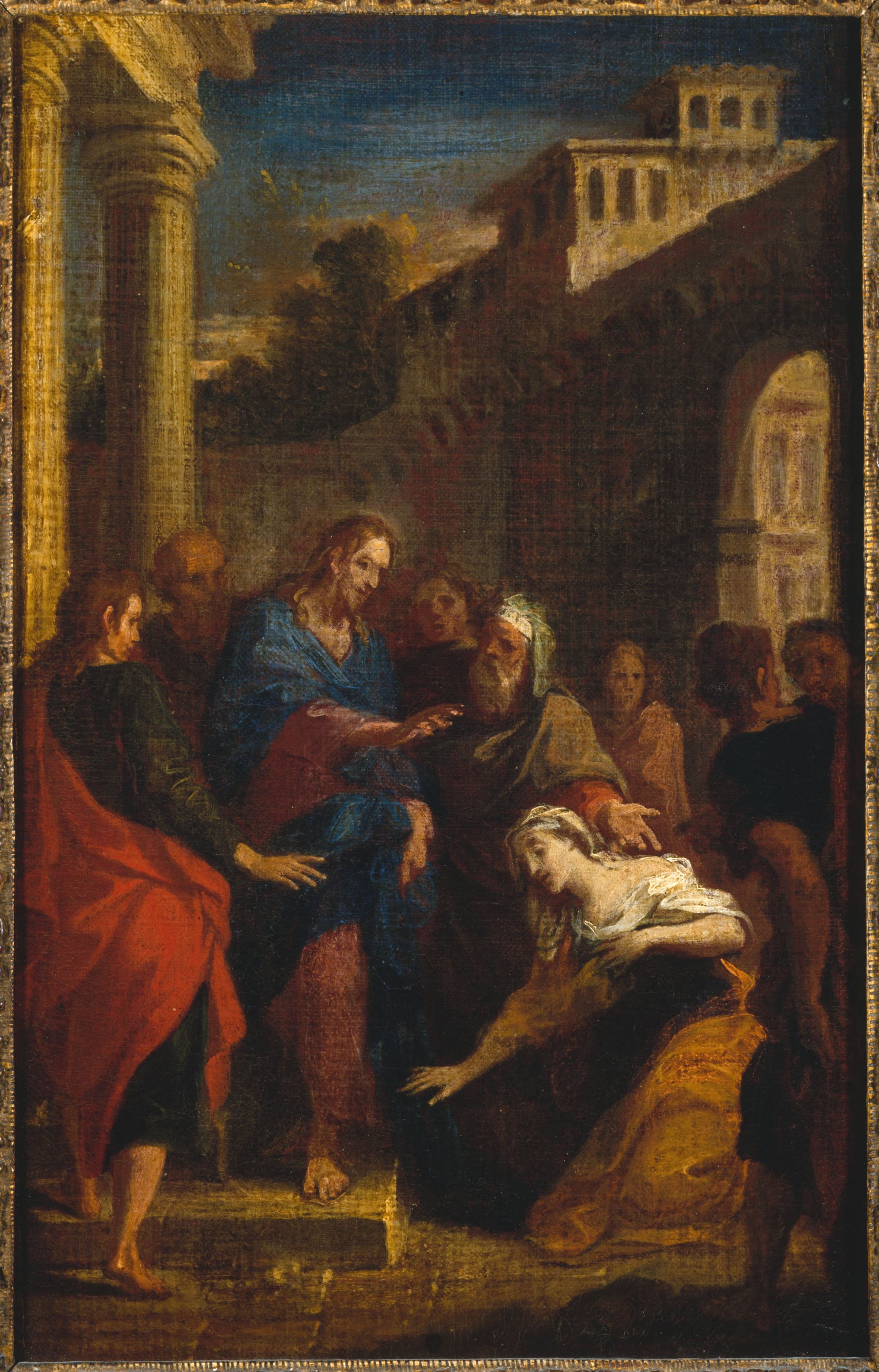
Mark 5:25 to 34 · Story · Illness and Pain
The Woman Who Touched His Cloak
Mark 5:25 to 34 stands inside the story of Jairus, between his plea for his dying daughter and her raising.
Mark's word for the woman's affliction, mastix, is the word the New Testament also uses for the scourge, the Roman whip.
“Daughter,” said Jesus, “your faith has healed you. Go in peace and be free of your affliction.”
- Who
- Jesus of Nazareth, Peter
- When
- On the way to the house of Jairus, after Jesus crossed back over the sea (Mark 5:21 to 24)
Summary
A woman who had bled for twelve years reached out in a crowd and touched the cloak of Jesus. She was healed at once, and Jesus stopped and looked for the one who had touched Him. When she came forward He called her Daughter and gave her healing to her faith.
- Under Leviticus 15 a flow of blood outside the monthly period made a woman unclean for as long as it lasted.
- Mark says the physicians left her worse and her money spent, and Luke says only that no one could heal her.
- The Greek verb of her healing, sozo, also means to save, and Mark uses it for the woman and for Jairus' daughter alike.
- Luke and Matthew tell the story in fewer words, and in Matthew the synagogue leader speaks of his daughter as already dead.
A Woman in the Crowd
Mark describes her sickness and her years under the physicians in one long sentence.
The Woman Who Touched His Cloak is a story of the trial of illness and pain. It tells of a sickness that cost a woman her health, her money and her place among the clean, and of what one touch in a crowd did for her.
The question it answers is what happened when she touched Jesus and why He made her come forward. It gives the events in order, the law of uncleanness behind her touch and the Greek of her healing. It also sets out what Luke and Matthew add and the traditions that later grew up around her.
And a woman was there who had suffered from bleeding for twelve years. She had borne much agony under the care of many physicians and had spent all she had, but to no avail. Instead, her condition had only grown worse.Mark gives the length of her sickness and the cost of her treatment before she ever reaches Jesus, so the reader knows how much the touch will undo.
Mark's word for her condition is rhysis, a flux of blood, which stands in only two other verses, both in Luke's account (Luke 8:43 to 44). His Greek sets out her years as a chain of participles, having suffered much, having spent all she had, gaining nothing and coming to worse.
John Gill, in his Exposition of the New Testament, wrote that “She took many a nauseous medicine, and had gone through courses of physic with different physicians”. He listed remedies the Talmud prescribes for such a flow, among them “gum of Alexandria, alum, saffron”.
From the Crossing to the Raising of the Girl
Jairus' errand frames the woman's healing from its start to its end.
The woman is healed on the road between Jairus' plea and the raising of his daughter.
- Jesus crosses back by boat and a crowd gathers by the seaJesusMark 5:21
- Jairus falls at His feet and pleads for his dying daughterJairusMark 5:22 to 23
- A large crowd follows and presses around Jesusthe crowdMark 5:24
- The woman comes up behind Him and touches His cloakthe womanMark 5:25 to 28
- Her bleeding stops at once and she feels the healingthe womanMark 5:29
- Jesus asks who touched His garments and looks aroundJesusMark 5:30 to 32
- She falls before Him and tells the whole truththe womanMark 5:33
- Jesus calls her Daughter and sends her away in peaceJesusMark 5:34
- Messengers bring word that the girl has diedthe messengersMark 5:35 to 36
- Jesus takes the girl by the hand and raises herJesusMark 5:37 to 43
A timeline of ten steps in Mark 5:21 to 43, each with the one who acts and its verse.
She falls before Him and tells the whole truth, Jesus calls her Daughter and sends her away in peace, Messengers bring word that the girl has died, Jesus takes the girl by the hand and raises her
From Behind Him to Before Him
She meant to be healed unseen, and Jesus brought her face to face with Him.
When the woman heard about Jesus, she came up through the crowd behind Him and touched His cloak. For she kept saying, “If only I touch His garments, I will be healed.”The two verses give the woman's act and the thought behind it, so her faith is shown before Jesus names it.
Mark's verb for her saying is elegen, an imperfect, she kept saying, and her words end with sothesomai, I will be healed, from the verb sozo.
The healing came at once. “Immediately her bleeding stopped, and she sensed in her body that she was healed of her affliction” (Mark 5:29). Mark's Greek says the spring of her blood was dried up.
At once Jesus was aware that power had gone out from Him. Turning to the crowd, He asked, “Who touched My garments?”Jesus' question turns a hidden healing into a meeting in front of the crowd.
The disciples pointed to the crowd pressing on Him (Mark 5:31), and Jesus kept looking around to see who had done it (Mark 5:32). The woman then “fell down before Him trembling in fear, and she told Him the whole truth” (Mark 5:33).
Daughter, Your Faith Has Healed You
The teachers have weighed what Jesus' answer means for the cloak she touched.
Jesus answers her with thygater, Daughter, and with sesoken, the perfect of sozo, has healed or has saved. Mark uses that verb three times in the chapter, for Jairus' plea that his daughter “will be healed and live” (Mark 5:23), for the woman's own words (Mark 5:28) and for Jesus' answer to her.
John Chrysostom spoke to it in a homily on Matthew, which the Catena Aurea of Thomas Aquinas prints. “It was not however the hem of the garment, but her frame of mind that made her whole.”
Twelve Years Unclean
The Law of Moses set a woman with a long flow of blood apart, with everything she lay or sat on.
When a woman has a discharge of her blood for many days at a time other than her menstrual period, or if it continues beyond her period, she will be unclean all the days of her unclean discharge, just as she is during the days of her menstruation.The law shows why the woman's touch in the crowd crossed a rule of uncleanness.
Her bed and any furniture she sat on became unclean, and anyone who touched them had to wash his clothes, bathe and stay “unclean until evening” (Leviticus 15:26 to 27). For twelve years every chair and bed she used fell under that law.
She came up behind Jesus in a pressing crowd and touched only His clothing. Mark records no rebuke from Jesus for the touch, and the healing ended the flow that made her unclean.
How Luke and Matthew Tell It
Luke and Matthew name the edge of the cloak she touched.
She came up behind Jesus and touched the fringe of His cloak, and immediately her bleeding stopped.Luke's shorter account gives the Greek word for the edge of the cloak.
Luke and Matthew both call what she touched the kraspedon, a fringe or tassel. The word stands in five verses, among them the Pharisees' long tassels (Matthew 23:5) and the sick who begged “just to let them touch the fringe of His cloak” (Mark 6:56). The Law told Israel to make “tassels for the corners of their garments” (Numbers 15:38).
Luke says of the physicians, “She had spent all her money on physicians, but no one was able to heal her” (Luke 8:43). In Luke it is Peter who answers for the disciples (Luke 8:45), and the woman tells her story “In the presence of all the people” (Luke 8:47).
Matthew tells the story in three verses. Matthew's synagogue leader says, “My daughter has just died” (Matthew 9:18), where Mark's Jairus says she “is near death” (Mark 5:23). Jesus tells the woman, “Take courage, daughter”, and Matthew adds that “the woman was cured from that very hour” (Matthew 9:22).
Her Name and Home in Later Tradition
The Gospels leave the woman unnamed, and later writers gave her a name and a town.
Eusebius and the statue at Caesarea PhilippiTradition, as Eusebius reports it
Eusebius of Caesarea reported the story in his Church History (book 7, chapter 18). “They say that the woman with an issue of blood” came from Caesarea Philippi, he wrote, “and that her house is shown in the city”. He described “a brazen image of a woman kneeling, with her hands stretched out, as if she were praying”. He added, “It has remained to our day, so that we ourselves also saw it when we were staying in the city.”
Veronica in the Acts of PilateTradition; the Acts of Pilate, Latin form, chapter 7
The Acts of Pilate is a writing outside the canon. Its Latin form names a witness at the trial of Jesus, “a certain woman, Veronica by name”. She says, “I was flowing with blood for twelve years; and I touched the fringe of his garment”. The Greek form of the same chapter gives her testimony without a name.
Two Daughters
Mark binds the woman's healing to the raising of a girl of twelve.
Taking her by the hand, Jesus said, “Talitha koum!” which means, “Little girl, I say to you, get up!” Immediately the girl got up and began to walk around. She was twelve years old, and at once they were utterly astounded.The raising of the girl completes the errand the woman interrupted and gives her age, the same number as the years of the woman's sickness.
Jairus had called his child thygatrion, “My little daughter” (Mark 5:23), and Jesus called the woman Daughter on the road to her.
The chapter follows the calming of the storm (Mark 4:35 to 41) and the freeing of a man among the Gerasenes (Mark 5:1 to 20).
How the Story Has Been Taught
Matthew Henry on the woman's faith and Jerome on her coming before Jesus.
died 420 · Jerome
Jerome traced the order of her healing and her coming forward.
The reading1 paragraph
Jerome, in his Homily 77, on Mark, wrote, “Note the separate stages; mark the progress. As long as she was hemorrhaging, she could not come into his presence. She was healed by faith and then came before him”.
1662 to 1714 · Matthew Henry
Matthew Henry read her touch as faith in the Son of God.
The reading1 paragraph
Matthew Henry wrote on Mark 5:28 in his Commentary on the Whole Bible (1710). “She believed that he cured, not as a prophet, by virtue derived from God, but as the Son of God, by a virtue inherent in himself”.
Healed and Named
Jesus sent her home with more than her health.
A sickness that had cost her everything ended with a word of kinship and peace, spoken where the whole crowd could hear it.
Sources
Scripture is the Berean Standard Bible.
- STEP Bible, Translators Amalgamated Greek New Testament (Tyndale House, Cambridge), CC BY 4.0.
- STEP Bible brief lexicons of Extended Strongs for Greek (Tyndale House, Cambridge), CC BY 4.0, with the Strong's glosses.
- John Gill, Exposition of the New Testament (1746 to 1748), on Mark 5:26.
- Thomas Aquinas, Catena Aurea on the Gospel of Matthew, chapter 9, printing John Chrysostom, Homily 31 on Matthew.
- Eusebius of Caesarea, Church History, book 7, chapter 18, trans. Arthur Cushman McGiffert, Nicene and Post-Nicene Fathers, Second Series, vol. 1 (Buffalo: Christian Literature Publishing Co., 1890)
- The Gospel of Nicodemus, or Acts of Pilate, Part I, Latin form and first Greek form, chapter 7, trans. Alexander Walker, Ante-Nicene Fathers, vol. 8 (Buffalo: Christian Literature Publishing Co., 1886)
- Matthew Henry, Commentary on the Whole Bible (1710), on Mark 5:28.
- Jerome, Homily 77, on Mark.
Keep Studying
Studies1
People and groups9
Show the next 3 titles
Symbols1
Doctrines1
In this trial5
Values1