
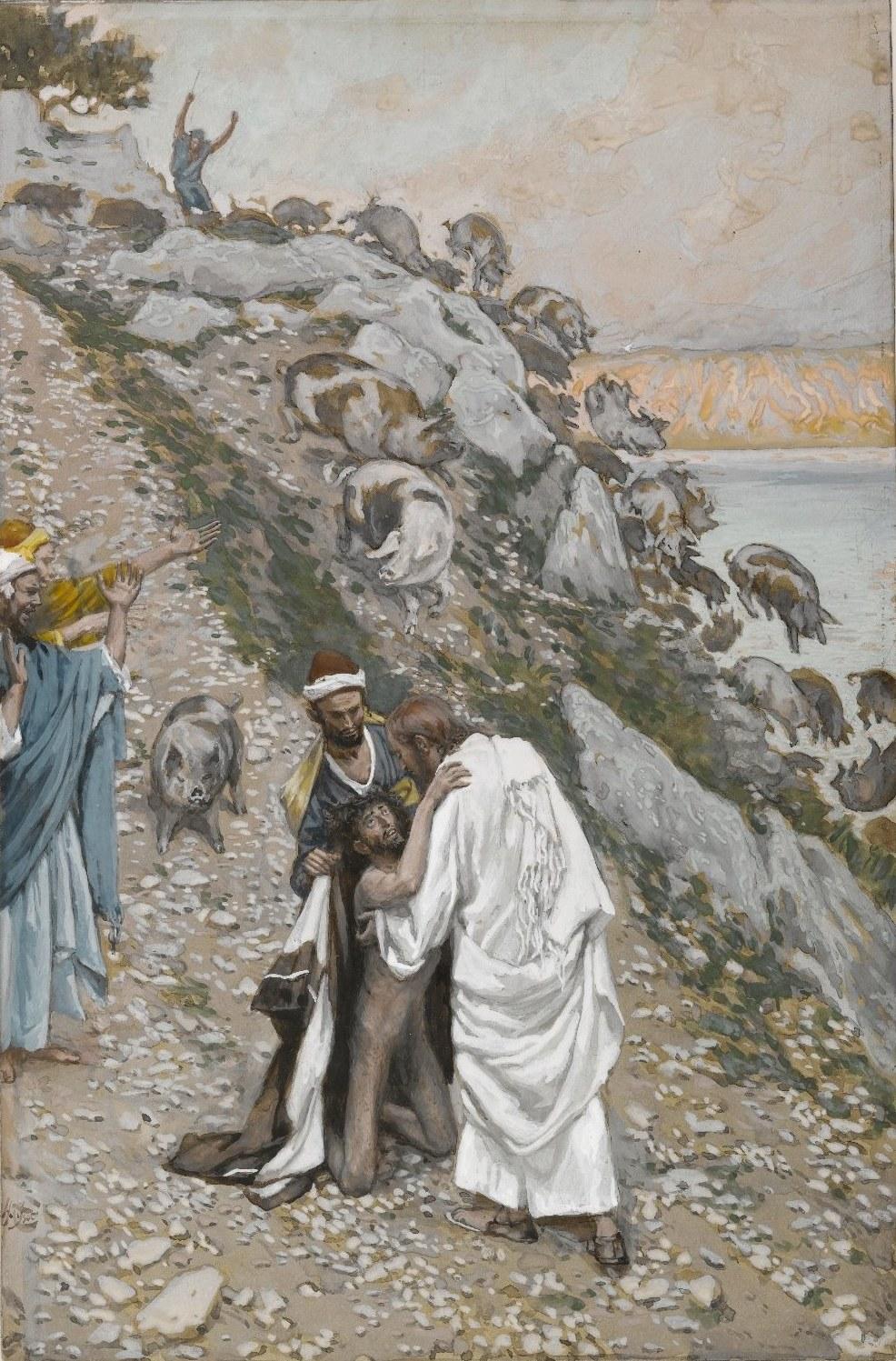
James Tissot, The Swine Driven into the Sea, 1886 to 1896. Public domain.
Mark 1:21 to 28 · Subject · Featured Study
Jesus and the Unclean Spirits
Jesus casts out unclean spirits with a word in Mark, from Capernaum in chapter 1 to the boy below the mountain in chapter 9.
The first miracle Mark records happens in a synagogue on the Sabbath.
All the people were amazed and began to ask one another, “What is this? A new teaching with authority! He commands even the unclean spirits, and they obey Him!”
All the people were amazed and began to ask one another, “What is this? A new teaching with authority! He commands even the unclean spirits, and they obey Him!”
Summary
An unclean spirit is Mark's usual name for a demon. Jesus drove such spirits out with a word, and they obeyed Him. Mark uses these meetings to show who Jesus is.
- The spirits named Jesus as the Holy One of God and the Son of God, and He told them to be silent.
- Jesus answered the charge that He worked by Beelzebul with a parable of a strong man.
- Readers differ over whether the sign of Mark 16:17 still belongs to believers today.
Eight Scenes in Mark's Order
Mark tells of spirits driven out in Galilee, on the far shore of the sea, and in the region of Tyre.
Mark sets eight scenes of unclean spirits, from the synagogue to the house at Capernaum.
- The synagogue at CapernaumA spirit cries out, and Jesus silences it and drives it out.Mark 1:23 to 27
- Capernaum at evening and GalileeAt sunset the sick and the possessed are brought to the door.Mark 1:32 to 39
- Beside the seaThe spirits fall before Him and call Him the Son of God.Mark 3:11 to 12
- The region of the GerasenesLegion leaves a man who lived among the tombs.Mark 5:1 to 20
- The villages of GalileeThe Twelve, sent two by two, drive out many demons.Mark 6:7 to 13
- The region of TyreA Greek woman's daughter is freed at a distance.Mark 7:24 to 30
- Below the mountainA mute spirit leaves a boy the disciples could not help.Mark 9:14 to 29
- The house at CapernaumJohn reports a stranger using the name of Jesus, and Jesus says not to stop him.Mark 9:38 to 40
In five of the scenes Jesus Himself drives the spirits out by His word.
Below the mountain, The house at Capernaum
What the Spirits Knew
The spirits spoke the truth about Jesus, and He would not take their witness.
And when the unclean spirits saw Him, they fell down before Him and cried out, “You are the Son of God!” But He warned them sternly not to make Him known.Mark gives the title Son of God to the spirits here, and no disciple in Mark ever uses it.
Legion later called Him the Son of the Most High God (Mark 5:7). At evening in Capernaum Jesus would not let the demons speak, because they knew who He was (Mark 1:34).
Athanasius explained why Jesus refused a witness that told the truth.
“And again, when He put a curb in the mouths of the demons that cried after Him from the tombs. For although what they said was true, and they lied not then, saying, 'Thou art the Son of God,' and 'the Holy One of Gods;' yet He would not that the truth should proceed from an unclean mouth, and especially from such as them, lest under pretence thereof they should mingle with it their own malicious devices, and sow these also while men slept.”
Athanasius of Alexandria · To the Bishops of Egypt 1.3 · on Mark 1:25Patristic
Three Cases From Mark 5, 7 and 9
Each case brings others into the story beside the sufferer: a town, a mother and a father.
Legion among the tombsMark 5:1 to 20
The man lived among the tombs and had broken every chain put on him (Mark 5:3 to 4). When Jesus asked his name, he answered Legion, for they were many. The spirits went into a herd of about two thousand pigs, and the herd rushed into the sea.
When they came to Jesus, they saw the man who had been possessed by the legion of demons sitting there, clothed and in his right mind; and they were afraid.The calm of the healed man frightens the town that had once tried to chain him.
Theophylact read the question about the name as a question asked for the hearers' sake.
“The Lord indeed asks, not that He Himself required to know, but that the rest might know that there was a multitude of devils dwelling in him. Also that by fighting with us, they may make us more expert.”
Theophylact of Ohrid · Catena Aurea by Aquinas · on Mark 5:9Patristic
Jesus sent the man home to tell what the Lord had done for him, and he spread the news through the Decapolis (Mark 5:19 to 20).
The Greek woman's daughterMark 7:24 to 30
Then Jesus told her, “Because of this answer, you may go. The demon has left your daughter.”Mark ends the exchange with the cure, so the mother's answer is the last word before it.
Matthew Henry set out how far outside Israel the woman stood.
“The application made to him by a poor woman in distress and trouble. She was a Gentile, a Greek, a stranger to the commonwealth of Israel, an alien to the covenant of promise; she was by extraction a Syrophenician, and not in any degree proselyted to the Jewish religion; she had a daughter, a young daughter, that was possessed with the devil.”
Matthew Henry · Commentary on the Whole Bible · on Mark 7:25Puritan
The boy the disciples could not helpMark 9:14 to 29
A father brought his son, who had a spirit that made him mute and threw him into fire and water. The disciples had failed to drive it out (Mark 9:17 to 22). The boy lay like a corpse after the spirit left, until Jesus lifted him by the hand (Mark 9:26 to 27).
After Jesus had gone into the house, His disciples asked Him privately, “Why couldn’t we drive it out?” Jesus answered, “This kind cannot come out, except by prayer.”The answer turns the disciples from their own failure to prayer.
The Charge of Beelzebul and the Strong Man
The accusation of the scribes and the answer of Jesus explain every exorcism in Mark.
The scribes who came down from Jerusalem said that Jesus was possessed by Beelzebul (Mark 3:22). Jesus answered in parables: a kingdom or a house divided against itself cannot stand, and Satan cannot drive out Satan.
Indeed, no one can enter a strong man’s house to steal his possessions unless he first ties up the strong man. Then he can plunder his house.Jesus pictures each exorcism as the plundering of a house whose master is already tied up.
Augustine named the strong man and the goods Christ came to take from him.
“The ‘strong man’ in this passage means the devil who was able to hold the human race in bondage. By his ‘goods,’ which Christ was coming to plunder, the devil was keeping for himself those who would in time become faithful, but had remained in the clutches of ungodliness and various sins. It was for the purpose of binding up this strong man that John, in the Apocalypse, saw ‘an angel coming down from heaven, having the key of the abyss and a great chain in his hand. And he laid hold on the dragon, the ancient serpent, who is the devil and Satan, and bound him for a thousand years.’ The angel checked and repressed his power to seduce and possess those destined to be set free.”
Augustine of Hippo · City of God 20.7 · on Mark 3:27Patristic
Mark adds that Jesus spoke of the sin that is never forgiven because they were saying He had an unclean spirit (Mark 3:29 to 30).
The Words for the Spirits
Four Greek words name the spirits, the state of the possessed, and the act of driving out.
ἀκάθαρτος akathartos, unclean
32 uses in the canon
Impure, the word Mark joins to spirit; eleven of its verses stand in Mark.
δαιμόνιον daimonion, demon
61 uses in the canon
A demonic being, the word Mark uses beside unclean spirit.
δαιμονίζομαι daimonizomai, to be demonized
13 uses in the canon
To be under the power of a demon, said of the man from the tombs.
ἐκβάλλω ekballō, to drive out
79 uses in the canon
To throw out or expel, the verb for casting demons out.
Possession Read as Real
Adam Clarke and John Charles Ryle held that Mark describes real possession by spirits.
Adam Clarke (1762 to 1832)
Adam Clarke, in his Commentary on Mark 9:25, answered those who read the boy's case as epilepsy. He asked whether Jesus could fitly have commanded a mere disease as a deaf and mute spirit.
Ryle, in his Expository Thoughts on Mark, wrote of the man from the tombs that possession by the devil was a real and true thing in the days of Christ's ministry. He named as a painful fact that some professing Christians explain such miracles by natural causes.
Does the Sign of Mark 16:17 Continue?
Mark 16:17 promises that believers will drive out demons in the name of Jesus, and readers differ over how long.
And these signs will accompany those who believe: In My name they will drive out demons; they will speak in new tongues;The promise stands in the longer ending of Mark, whose place in the text is itself disputed.
Signs given for a timeJohn Gill, Exposition of the New Testament, 1746 to 1748, on Mark 16:17
John Gill held that the signs would follow some believers and not all, and only for a time. In his reading they served to confirm the gospel and to establish the church in the world, and they were given chiefly to its ministers.
The objection, in the words of the verse itself: the signs go with those who believe (Mark 16:17).
Signs that go with the gospelDerek Prince, With Accompanying Signs, a daily devotional
“In these verses Jesus specifies five supernatural signs ordained by God to accompany the preaching of the gospel message and to bear divine testimony to its truth.”
Derek Prince · With Accompanying Signs, Daily Devotional: Foundations, day 240 (WD-B052-240) · on Mark 16:17 to 18Pentecostal-Charismatic
The objection: the verse stands in Mark 16:9 to 20, which Codex Sinaiticus and Codex Vaticanus, the two earliest complete manuscripts of Mark, do not contain.
Spirits That Obey His Word
The crowd at Capernaum marveled that He commands even the unclean spirits, and Mark ends with a soldier's confession.
At the end of the Gospel a Roman centurion called Jesus the Son of God at the cross, the title the spirits had cried out by the sea (Mark 3:11; Mark 15:39).
Sources
Scripture is the Berean Standard Bible.
- Tertullian, Against Praxeas.
- Theophylact of Ohrid, on Mark 5:9, in Thomas Aquinas, Catena Aurea.
- Athanasius of Alexandria, To the Bishops of Egypt 1.3.
- Augustine of Hippo, City of God 20.7.
- Matthew Henry, Commentary on the Whole Bible (1710), on Mark 7:25.
- Adam Clarke, Commentary on the Bible (1832), on Mark 9:25.
- J.C. Ryle, Expository Thoughts on the Gospels: Mark (1857), on Mark 5:1 to 17.
- John Gill, Exposition of the New Testament (1746 to 1748), on Mark 16:17.
- Codex Sinaiticus and Codex Vaticanus, the two earliest complete manuscripts of Mark, which end the Gospel of Mark at Mark 16:8.
- Derek Prince, With Accompanying Signs, Daily Devotional: Foundations, day 240.
Keep Studying
Read it5
People and groups1
Places3
Doctrines9
Go further9
Values1