
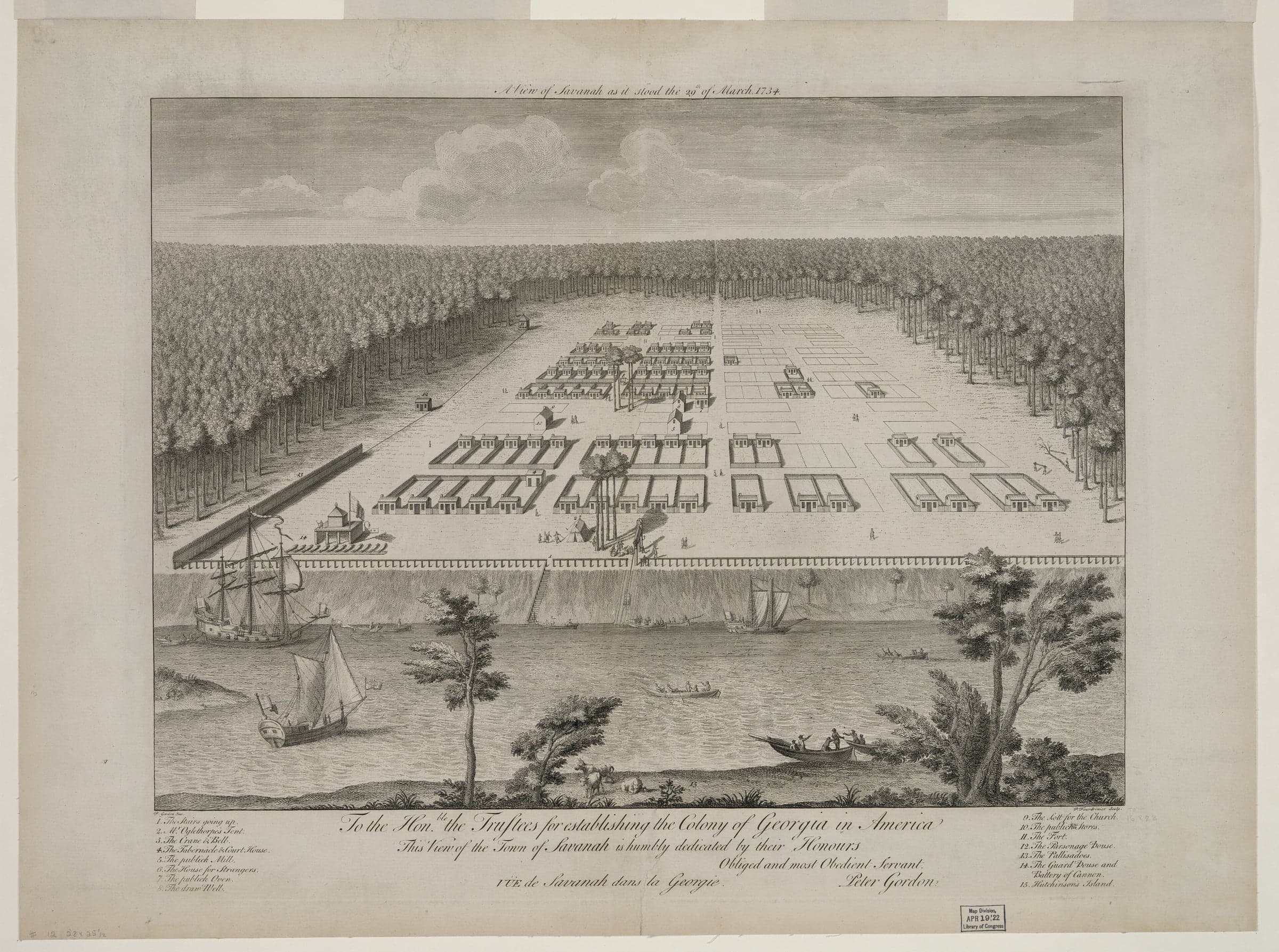
Peter Gordon, a view of Savannah, 1734. Public domain.
AD 1735 to 1738 · Story · Featured Study
The Moravians on the Simmonds
The ship that took John Wesley to Georgia carried the second company of Moravian settlers bound for the colony.
- When
- 14 October 1735 to 5 March 1738
A Moravian diary of the voyage says the preacher Wesley cried out to the English in the storm, “Now man can see who has a God, and who has none.”
“Why are you so afraid?” He asked. “Do you still have no faith?”
Summary
The Simmonds carried John and Charles Wesley and a company of Moravian Brethren from Gravesend to the Savannah river between October 1735 and February 1736.
- Wesley counted about eighty English passengers on board.
- Benjamin Ingham wrote that the Brethren were more like the Primitive Christians than any other church now in the world.
- The Moravians wrote, as Fries prints it, that the whole company going to Georgia numbered one hundred and fifty.
The Verses of the Storms
Wesley's Journal and a Moravian diary each tie a storm to Scripture.
Wesley put Christ's question in Mark 4:40 to himself in the storm of 23 January, and Nitschmann's diary gives the psalm the Brethren were given for the third storm.
May the LORD give you increase, both you and your children.It was the Brethren's text for the day of the great storm, 25 January.
How Many Brethren Sailed
Five writers give four counts of the Germans on board.
The two Englishmen on board counted twenty-six, and the Herrnhut papers name twenty-five.
| Writer | Count | How he counts |
|---|---|---|
| John Wesley, Journal | 26 | The Germans on board, counted in October 1735 |
| Benjamin Ingham, his journal | 26 | The Moravians in his ship |
| Adelaide Fries, The Moravians in Georgia | 25 | A list of names from the Herrnhut papers, one of them a volunteer |
| J. E. Hutton (1909) | 24 | Nitschmann and twenty-three other Brethren |
| Luke Tyerman (1872) | About 30 | No method given |
The Voyage From Gravesend to Savannah
Three storms in January 1736 tried every passenger on board.
On 14 October 1735 John and Charles Wesley, Benjamin Ingham and Charles Delamotte went on board the Simmonds off Gravesend.
Wesley began to learn German to talk with the Brethren, and their bishop, David Nitschmann, began to learn English. At seven each evening Wesley joined the Germans in their public service.
In the storm of 17 January he lay down much ashamed of his unwillingness to die, and his diary for that night reads, Afraid to die. On 23 January a sea broke over him as he stood, and he wrote that he was vaulted over with water.
“You of little faith,” Jesus replied, “why are you so afraid?” Then He got up and rebuked the winds and the sea, and it was perfectly calm.Wesley closes his entry for the storm of 17 January with these words.
The third storm began at noon on Sunday 25 January. That day a child was received into the church on board.
Wesley had watched the Brethren do servile work for the other passengers that none of the English would take on, for no pay. In the evening, in the midst of the psalm that opened their service, the sea broke over the ship and split the mainsail. The English screamed, and the Germans went on singing.
So I bought the field in Anathoth from my cousin Hanamel, and I weighed out seventeen shekels of silver.The child received in the storm put Wesley in mind of Jeremiah's buying of the field, which this verse records.
On 5 February the ship came into the Savannah river, and the next morning Wesley first set foot on American ground.
for they all saw Him and were terrified. But Jesus spoke up at once: “Take courage! It is I. Do not be afraid.”It stood in the day's second lesson when Wesley first came ashore.
August Gottlieb Spangenberg, who came out to the ship at Tybee, asked Wesley whether he had the witness within himself, and whether he knew Jesus Christ. Wesley answered that he knew Christ was the Saviour of the world, and wrote that he feared they were vain words.
The New York printing of the Journal places the talk on 7 February, and Curnock's edition, from Ingham's copy and Wesley's diary, on Sunday 8 February.
The Spirit Himself testifies with our spirit that we are God’s children.Spangenberg's first question rests on this verse.
Wesley left Georgia in December 1737. On the voyage home he wrote that in a storm he still asked himself whether the Gospel might not be true.
On 7 February 1738, a day he marked as much to be remembered, he met Peter Böhler in London, and on 5 March Böhler left him clearly convinced of unbelief.
For to me, to live is Christ, and to die is gain.Wesley wrote on 24 January 1738 that he could not yet say this.
Mark 6:50, Romans 8:16, Philippians 1:21
The People of the Voyage
Each person of the voyage stands with the record that names him.
Four Englishmen and the Brethren's bishop sailed together under Captain Cornish.
| Person | His part | The record |
|---|---|---|
| John Wesley | He sailed for Georgia and kept the Journal of the voyage. | Wesley's Journal |
| Charles Wesley | He sailed with his brother, and his own journal begins in Georgia. | Wesley's Journal; Charles Wesley's Journal |
| Benjamin Ingham | He sailed with the Wesleys and kept a journal of his own. | Tyerman (1873) |
| Charles Delamotte | He went on board with the Wesleys at Gravesend. | Wesley's Journal |
| David Nitschmann | He led the Brethren on board, and Wesley calls him Bishop of the Germans. | Wesley's Journal; Fries (1905) |
| Joseph Cornish | He was the master of the Simmonds. | Curnock (1909) |
| August Gottlieb Spangenberg | He met Wesley in Georgia and wrote of him in his diary. | Fries (1905) |
Who Tells the Story
Wesley, Ingham and the Brethren's own diaries each tell the voyage.
Wesley's Journal of the voyage was written up for his friends at home, as Curnock notes. Ingham's journal survives in the pages Tyerman printed in 1873.
The Brethren's side stands in the diaries of Nitschmann and John Andrew Dober, kept in the archives at Herrnhut. Fries gives them in English, and they are the movement's own account.
What the Record Leaves Unsaid
The record of the storm has two gaps.
No source names the psalm the Brethren were singing; Curnock's text says only that it was one mentioning the power of God. Ingham's entry for 25 January says nothing of the Brethren and records that he himself was under some fear for a little while.
In Their Own Words
Four voices from the ship and from Georgia speak in their own words.
John Wesley (1703 to 1791)
Journal, 25 January 1736, page 17
Our women and children
“I asked one of them afterward, ‘Was you not afraid?’ He answered, ‘I thank God, no.’ I asked, ‘But were not your women and children afraid?’ He replied mildly, ‘No; our women and children are not afraid to die.’”
Evangelical
About this saying1 paragraph
Wesley recorded this exchange in 1736, after the sea had split the mainsail.
August Gottlieb Spangenberg (1704 to 1792)
Diary, February 1736, in Adelaide L. Fries, The Moravians in Georgia, 1735-1740, page 123
True grace
“He told me how it was with him, and I saw that true Grace dwelt in and governed him.”
Moravian
About this saying1 paragraph
Spangenberg judged Wesley's state for himself in 1736.
Benjamin Ingham
Journal of the voyage to Georgia, 17 October 1735, printed in Luke Tyerman, The Oxford Methodists, page 68
Singing twice a day
“almost the only time that you could know they were in the ship, was when they were harmoniously singing the praises of the Great Creator, which they constantly do in public twice a day, wherever they are.”
Church of England
About this saying1 paragraph
Ingham saw the Brethren's daily worship in the first week of the voyage, in 1735.
David Nitschmann
Diary of the voyage to Georgia, 5 February 1736 in the new style, in Adelaide L. Fries, The Moravians in Georgia, 1735-1740, page 116
The Lord helped us
“I was content, for our lives are in God’s hands, and He does what He will; among us there was no fear, for the Lord helped us.”
Moravian
About this saying1 paragraph
The Brethren's own diarist saw the storm of 1736 from among the singers.
Benjamin Ingham, David Nitschmann
Where Historians Disagree
Two questions of the voyage divide its historians.
What did the storm show Wesley?2 paragraphs
Wesley wrote in May 1738 that God gave him twenty-six of the Moravian brethren for companions to show him a better way, and that he did not understand it at first. Curnock wrote that the storm may be said to have made Ingham a Moravian.
Against Wesley's own reading of the voyage as a failure, J. H. Overton wrote in 1891 that Wesley seems most unjustly to lay the blame upon himself, and that the Moravians had not been afraid of facing death, but he had been.
Was Wesley unconverted before Böhler?2 paragraphs
Landing at Deal on 1 February 1738, Wesley wrote that he who went to America to convert others was never himself converted to God. Hutton, the Moravian historian, reads him as wanting assurance until 1738.
Against that reading, Wesley's own later notes say, I am not sure of this, and that he had even then the faith of a servant, though not that of a son. Curnock says the notes first appear in Thomas Jackson's edition, from Wesley's corrected copy.
Books to Read Next
Three free books carry the story, the first of them Wesley's own Journal.
The Journal of the Rev. John Wesley, vol. 1
John Wesley, edited by Nehemiah Curnock · 1909
It prints the Journal of the voyage with Wesley's diary beside it.
Read it free onlineThe Moravians in Georgia, 1735-1740
Adelaide L. Fries · 1905
It gives the Brethren's own diaries of the voyage in English.
Read it free onlineThe Oxford Methodists
Luke Tyerman · 1873
It prints Benjamin Ingham's journal of the voyage.
Read it free onlineWhat the Voyage Left
The voyage left the record that Wesley, Ingham and the Brethren each kept of the same storm.
Sources
Scripture is the Berean Standard Bible.
- The Holy Bible, Berean Standard Bible (read 2026)
- John Wesley, Journal, from 14 October 1735, in The Works of the Rev. John Wesley, vol. III (New York: B. Waugh and T. Mason, 1832), pages 13 to 62.
- John Wesley, The Journal of the Rev. John Wesley, edited by Nehemiah Curnock, Standard Edition, vol. 1 (London: Robert Culley, 1909), pages 110 to 152 and 422.
- Adelaide L. Fries, The Moravians in Georgia, 1735-1740 (Raleigh: Edwards and Broughton, 1905), pages 91 to 123 and 185, with the diaries of Nitschmann, Dober and Spangenberg in her English.
- Benjamin Ingham, journal of the voyage, in Luke Tyerman, The Oxford Methodists (New York: Harper and Brothers, 1873), pages 67 to 75.
- J. E. Hutton, A History of the Moravian Church (1909), book two, chapter IX.
- Luke Tyerman, The Life and Times of the Rev. John Wesley, vol. 1 (New York: Harper, 1872), pages 122 to 123.
- J. H. Overton, John Wesley (London: Methuen, 1891), pages 48 to 59.
- Charles Wesley, The Journal of the Rev. Charles Wesley, edited by Thomas Jackson, vol. 1 (London: John Mason, 1849)
Keep Studying
Studies5
People and groups7
Trials of life1
Values1