
Mark 9:24
in Mark 9Immediately the boy’s father cried out, “I do believe; help my unbelief!”
BSB
The same verse in ASV and KJV ▾
ASV
Straightway the father of the child cried out, and said, I believe; help thou mine unbelief.
KJV
And straightway the father of the child cried out, and said with tears, Lord, I believe; help thou mine unbelief.
⋯
This verse in Mark 9
Commentary
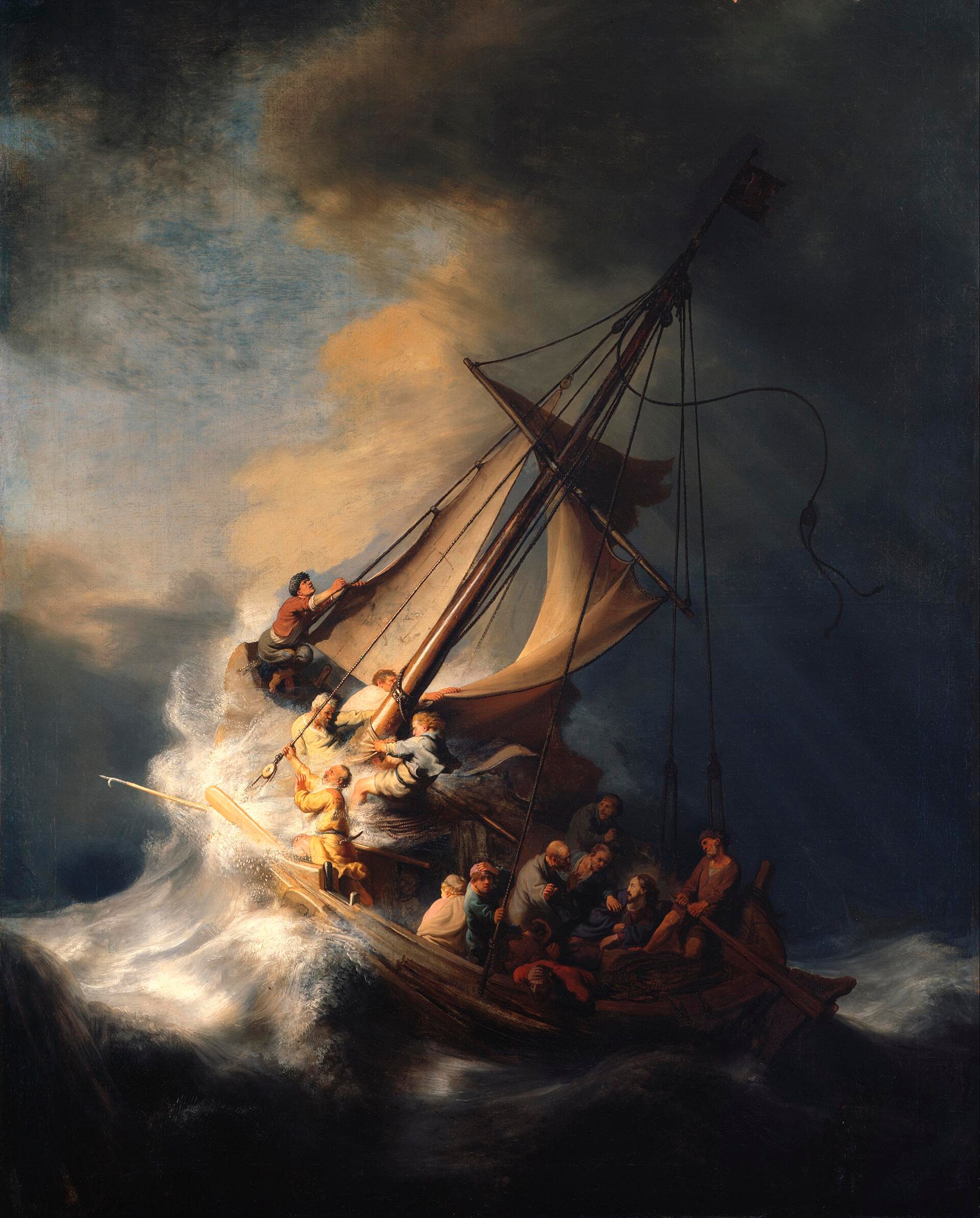
19 notes on this verseSeeing that his faith was being driven by the waves of unbelief on the rocks which would cause a fearful shipwreck, he asks of the Lord an aid to his faith, saying "Lord, help me in my unbelief." So thoroughly did the apostles and those who live in the gospel realize that everything which is good is brought to completion by the aid of the Lord, and not imagine that they could preserve their faith unharmed by their own strength or free will, that they prayed that it might be helped and granted to them by the Lord.
This site's exposition
wallowed foaming
on Mark 9:20-24
Wallowed foaming is the violence Jesus meets the instant the boy is brought before him, straightway the spirit tare him, and the father's plea when asked how long is it ago since this came unto him, of a child, reveals a lifetime spent watching it try to destroy his son in fire and in water. If thou canst believe answers the father's own if thou canst do any thing with a correction, turning the doubt back where it belongs, and the cry that follows, Lord, I believe, help thou mine unbelief, is the bench's favored honest prayer in the Gospels, faith and its lack confessed together in the same breath. The father asks for compassion; Jesus answers by relocating the whole question of possibility onto faith rather than onto the severity of the case.
The record, by era
The Church Fathers4 voices
So great is the virtue of faith that even those who refuse to keep it still presume to praise it. Truly deservedly is faith extolled, for without it no good work is ever begun or completed.
(Vict. Ant. e Cat. in Marc. sed v. Chrys. ubi sup.) His meaning is; such a plenitude of virtue is there in Me, that not only can I do this, but I will make others to have that power; where fore if thou canst believe as thou oughtest to do, thou shalt be able to cure not only him, but many more. In this way then, He endeavoured to bring back to the faith, the man who as yet speaks unfaithfully. There follows, And straightway the father of the child cried out, and said with tears, Lord, I believe; help thou mine unbelief. But if he had already believed, saying, I believe, how is it that he adds, help thou mine unbelief? We must say then that faith is manifold, that one sort of faith is elementary, another perfect; but this man, being but a beginner in believing, prayed the Saviour to add to his virtue what was wanting.
A commentator
Augustine of HippoSERMONS ON NEW TESTAMENT LESSONS 65 · Written in the 5th century.
proposed
In saying, "When the Son of Man shall come, shall he find faith upon the earth?" our Lord spoke of that faith which is fully matured, which is so seldom found on earth. The church's faith is full, for who would come here if there were no fullness of faith? And whose faith when fully matured would not move mountains? Look at the apostles themselves, who would not have left all they had, trodden under foot this world's hope, and followed the Lord, if they had not had proportionally great faith. And yet if they had already experienced a completely matured faith, they would have not said to the Lord, "Increase our faith." Rather we find here an emerging faith, which is not yet full faith, in that father who when he had presented to the Lord his son to be cured of an evil spirit and was asked whether he believed, answered, "Lord, I believe, help me in my unbelief." "Lord," says he, "I believe." "I believe": therefore there was faith; but "help me in my unbelief": therefore there was not full faith.
A commentator
Augustine of HippoSERMONS ON NEW TESTAMENT LESSONS 65.1 · Written in the 5th century.
proposed
Where faith fails, prayer perishes. For who prays for that in which he does not believe?… So then in order that we may pray, let us believe, and let us pray that this same faith by which we pray may not falter.
The Medieval Church1 voice
And immediately the father of the child cried out with tears, saying: I believe, Lord; help my unbelief. No one becomes supreme suddenly: but in good conduct, everyone begins from the smallest things, so as to reach the great. For the beginnings of virtue are …
12 more voices on this verse
The Medieval Church1 voice
(ubi sup.) For no man at once reaches to the highest point, but in holy living a man begins with the least things that he may reach the great; for the beginning of virtue is different, from the progress and the perfection of it. Because then faith mounts up through the secret inspiration of grace, by the steps of its own meritsh, he who had not yet believed perfectly was at once a believer and an unbeliever.
The Puritans and the Awakening2 voices
Those that complain of unbelief, must look up to Christ for grace to help them against it, and his grace shall be sufficient for them. "Help mine unbelief, help me to a pardon for it, help me with power against it; help out what is wanting in my faith with thy grace, the strength of which is perfected in our weakness." VIII.
And straightway the father of the child cried out,....
The Nineteenth Century8 voices
Lord, I believe - The word Lord is omitted by ABCDL, both the Syriac, both the Arabic later Persic, Ethiopic, Gothic, and three copies of the Itala. Griesbach leaves it out. The omission, I think, is proper, because it is evident the man did not know our Lord, and therefore could not be expected to accost him with a title expressive of that authority which he doubted whether he possessed, unless we grant that he used the word κυριε after the Roman custom, for Sir. Help thou mine unbelief - That is, assist me against it.
A commentator
J.C. Ryle1816–1900
Expository Thoughts on the Gospels: Mark (lightly modernized text, Grace Gems edition) (1857)
The contrast between these verses and those which precede them in the chapter is very striking. We pass from the mount of transfiguration to a melancholy history of the work of the devil. We come down from the vision of glory — to a conflict with Satanic possession. We change the blessed company of Moses and Elijah — for crude interaction with unbelieving Scribes.
A commentator
Charles Spurgeon1834–1892
The Metropolitan Tabernacle Pulpit, Sermon No. 2881: “Feeble Faith Appealing to a Strong Savior” (lightly modernized text, CCEL edition) · Written before 1892.
THIS is the case of a man who knew well enough what he wanted and who was full of anxiety to obtain it. Indeed, he was so anxious to obtain it that he prayed most earnestly and most importunately for it. He prayed to the right Person, too, for, after having failed with the disciples, he resorted to their Master, Himself. Yet, not withstanding all this, at the time recorded in our text, he had not obtained the blessing that he sought.
A commentator
Jamieson, Fausset & Brown1802–1910
Commentary Critical and Explanatory on the Whole Bible (1871)
Second, His appeal to Christ for help against his felt unbelief--a feature in the case quite unparalleled, and showing, more than all protestations could have done, the insight he had attained into the existence of a power in Christ more glorious them any he had besought for his poor child.
'And straightway the father of the child cried out, and said with tears, Lord, I believe; help thou mine unbelief.''Mark 9:24. LAST SABBATH MORNING we treated upon the way by which faith comes to the soul. 'Faith cometh by hearing.' It is our joyful persuasion that on the past Sabbath faith actually came to many, and they were enabled to rest themselves upon the Lord Jesus Christ to their soul's salvation.
'And straightway the father of the child cried out, and said with tears, Lord, I believe; help thou mine unbelief.''Mark 9:24. LAST SABBATH MORNING we treated upon the way by which faith comes to the soul. 'Faith cometh by hearing.' It is our joyful persuasion that on the past Sabbath faith actually came to many, and they were enabled to rest themselves upon the Lord Jesus Christ to their soul's salvation. Now, every good shepherd knows that he ought to look very carefully after the newborn lambs, and, therefore, it seemed to me that it would be most expedient this morning to search after those who have just believed in Christ, and to endeavor to strengthen and help them against the very serious trials which are incident to their present weak condition. When a man first lays hold upon Jesus he is very apt to be in distress, if his joy be not always at its full height; he is untrained in spiritual conflict, and easily dismayed; the tremor of his former conviction is upon him, and he is prone to relapse into it. The light which he has received fills him with intense delight, but it is not very clear and abiding; he sees men as trees walking, and is ready to conjure up a thousand fears. The weakness of newborn faith, therefore, calls for the compassion of all who love the souls of men. In addition to their own weakness they are liable to special dangers, for at such times Satan is frequently very active. No king will willingly lose his subjects, and the Prince of Darkness labors to bring back those who have just escaped over the confines of his dominion. If souls are never tried afterwards, they are pretty sure to be assailed on their outset from the City of Destruction to the Celestial City. Bunyan very wisely placed the Slough of Despond at the very commencement of the spiritual journey.
A commentator
Charles Spurgeon1834–1892
The Metropolitan Tabernacle Pulpit, Sermon No. 2881: “Feeble Faith Appealing to a Strong Savior” (lightly modernized text, CCEL edition) · Written before 1892.
proposed
THIS is the case of a man who knew well enough what he wanted and who was full of anxiety to obtain it. Indeed, he was so anxious to obtain it that he prayed most earnestly and most importunately for it. He prayed to the right Person, too, for, after having failed with the disciples, he resorted to their Master, Himself. Yet, not withstanding all this, at the time recorded in our text, he had not obtained the blessing that he sought. We probably know of many persons who have not yet been awakened to a sense of their need—and much labor has to be expended by the faithful minister in order to show them their danger and to make them realize their true condition in the sight of God. They have many spiritual needs, but they do not know what those needs really are. This man had gone further than that, for he did know what was the great need of himself and his son. Then there are others who have head knowledge as to their spiritual needs, but they do not seem to be anxious to have those needs supplied. They are stolid, careless, immovable. That was not the case with this man. He knew that he needed his son to be healed. He was intensely eager that he should be healed, and healed then and there. His heart was moved with compassion for his child and he was most anxious that the evil spirit should be cast out of him at once. There are some of our hearers who seem to have desire of a certain kind, but they do not use that desire in the right way. They go about seeking salvation where it is not to be found. They are, to an extent, earnest in their own fashion, but to them the Lord might say, as of old, "Why do you spend money for that which is not bread? And your labor for that which satisfies not?" This man had gone a stage beyond that. He was directing all his entreaties to Jesus—he was appealing to the great Lord, Himself, from whom alone deliverance could come.
A commentator
J.C. Ryle1816–1900
Expository Thoughts on the Gospels: Mark (lightly modernized text, Grace Gems edition) (1857)
proposed
The contrast between these verses and those which precede them in the chapter is very striking. We pass from the mount of transfiguration to a melancholy history of the work of the devil. We come down from the vision of glory — to a conflict with Satanic possession. We change the blessed company of Moses and Elijah — for crude interaction with unbelieving Scribes. We leave the foretaste of millennial glory, and the solemn voice of God the Father testifying to God the Son, and return once more to a scene of pain, weakness, and misery — a boy in agony of body, a father in deep distress, and a little band of feeble disciples restrained by Satan's power, and unable to give relief. The contrast, we must all feel, is very great. Yet it is but a faint emblem of the change of scene that Jesus voluntarily undertook to witness, when He first laid aside His glory and came into the world. And it is after all a vivid picture of the life of all true Christians. With them, as with their Master, work, conflict, and scenes of weakness and sorrow will always be the rule. With them too, visions of glory, foretastes of heaven, seasons on the mount, will always be the exception. Let us learn from these verses, how dependent Christ's disciples are on the company and help of their Master . We see this truth brought out in a striking manner in the scene which meets our Lord's eyes, when He came down from the mount. Like Moses, when he came down from Mount Sinai, He finds his little flock in confusion. He sees His nine apostles beset by a party of malicious Scribes, and baffled in an attempt to heal one who had been brought to them possessed with a devil. The very same disciples who a short time before had done many miracles and "cast out many devils," had now met with a case too hard for them. They were learning by humbling experience the great lesson, "without me you can do nothing."
Modern Voices1 voice
A commentator
Charles Capps1934–2014
Believing & Receiving Your Healing (Capps Ministries Monthly Teaching) · Written before 2014.
His knowledge of Christ's abilities limited his belief. You can't believe any further than you have knowledge.
The words behind it
12 Greek wordsEvery Greek word of this verse in the order it stands, with what it means and the door to its own study. The last column counts the times a word stands in the whole Bible: the rarer the word, the more the places it appears belong together.
| Greek | Sound | Meaning | Word study | In the Bible |
|---|---|---|---|---|
| εὐθὺς | euthus | Immediately | G2112 → | 87 times |
| κράξας | kraxas | having cried out | G2896 → | 55 times |
| ὁ | ho | the | G3588 → | 19766 times |
| πατὴρ | pater | father | G3962 → | 410 times |
| τοῦ | tou | of the | G3588 → | 19766 times |
| παιδίου | paidiou | child | G3813 → | 51 times |
| ἔλεγεν· | elegen | was saying; | G3004 → | 1325 times |
| πιστεύω | pisteuo | I believe | G4100 → | 237 times |
| βοήθει | boethei | do help | G997 → | |
| μου | mou | me | G3165 → | 1936 times |
| τῇ | tea | with the | G3588 → | 19766 times |
| ἀπιστίᾳ.¶ | apistia | unbelief! | G570 → |
εὐθὺςImmediately
euthusG2112 →87 times
κράξαςhaving cried out
kraxasG2896 →55 times
ὁthe
hoG3588 →19766 times
πατὴρfather
paterG3962 →410 times
τοῦof the
touG3588 →19766 times
παιδίουchild
paidiouG3813 →51 times
ἔλεγεν·was saying;
elegenG3004 →1325 times
πιστεύωI believe
pisteuoG4100 →237 times
βοήθειdo help
boetheiG997 →
μουme
mouG3165 →1936 times
τῇwith the
teaG3588 →19766 times
ἀπιστίᾳ.¶unbelief!
apistiaG570 →
A shaded row is a word that stands 400 times or fewer in the Bible.
The walk
8 stopsEach card is a verse this one points to, and under it the verses that one points to in turn. Where several paths arrive at the same place, that place is listed first: the text keeps returning to it.
Through
Ephesians 2:8For it is by grace you have been saved through faith, and this not from yourselves; it is the gift of God,
it leads to
- Romans 3:22–26
And this righteousness from God comes through faith in Jesus Christ to all who believe. There is no distinction,
- Ephesians 2:5
made us alive with Christ even when we were dead in our trespasses. It is by grace you have been saved!
- Romans 4:16
Therefore, the promise comes by faith, so that it may rest on grace and may be guaranteed to all Abraham’s offspring—not only to those who are of the law, but also to those who…
- John 1:12–13
But to all who did receive Him, to those who believed in His name, He gave the right to become children of God—
- Romans 10:17
Consequently, faith comes by hearing, and hearing by the word of Christ.
- Romans 3:22–26
Through
Hebrews 12:2Let us fix our eyes on Jesus, the author and perfecter of our faith, who for the joy set before Him endured the cross, scorning its shame, and sat down at the right hand…
it leads to
- Micah 7:7
But as for me, I will look to the LORD; I will wait for the God of my salvation. My God will hear me.
- 1 Peter 3:18
For Christ also suffered for sins once for all, the righteous for the unrighteous, to bring you to God. He was put to death in the body but made alive in the Spirit,
- 1 Peter 2:23–24
When they heaped abuse on Him, He did not retaliate; when He suffered, He made no threats, but entrusted Himself to Him who judges justly.
- Micah 7:7
Where this verse is studied
By subject
Faith34 verses
On this page
Studies5
On this verse
About Mark
This page draws on 16 works. Open the list of works
This page draws on Adam Clarke, Commentary on the Bible; Augustine of Hippo, SERMONS ON NEW TESTAMENT LESSONS 65; Augustine of Hippo, SERMONS ON NEW TESTAMENT LESSONS 65.1; Bede, On the Gospel of Mark; Bede, Catena Aurea by Aquinas; Caesarius of Arles, SERMONS 12; Charles Capps, Believing & Receiving Your Healing (Capps Ministries Monthly Teaching); Charles Spurgeon, The Metropolitan Tabernacle Pulpit, Sermon No. 2881: “Feeble Faith Appealing to a Strong Savior” (lightly modernized text, CCEL edition); Charles Spurgeon, The Metropolitan Tabernacle Pulpit, Sermon No. 1033: “Faith's Dawn and Its Clouds” (lightly modernized text, CCEL edition); J. C. Ryle, Expository Thoughts on the Gospels, Mark; J.C. Ryle, Expository Thoughts on the Gospels: Mark (lightly modernized text, Grace Gems edition); Jamieson, Fausset & Brown, Commentary Critical and Explanatory on the Whole Bible; John Cassian, CONFERENCE OF ABBOT PAPHNUTIUS 16; John Chrysostom, Catena Aurea by Aquinas; John Gill, Exposition of the New Testament (1746-1748) and Matthew Henry, Commentary on the Whole Bible.