
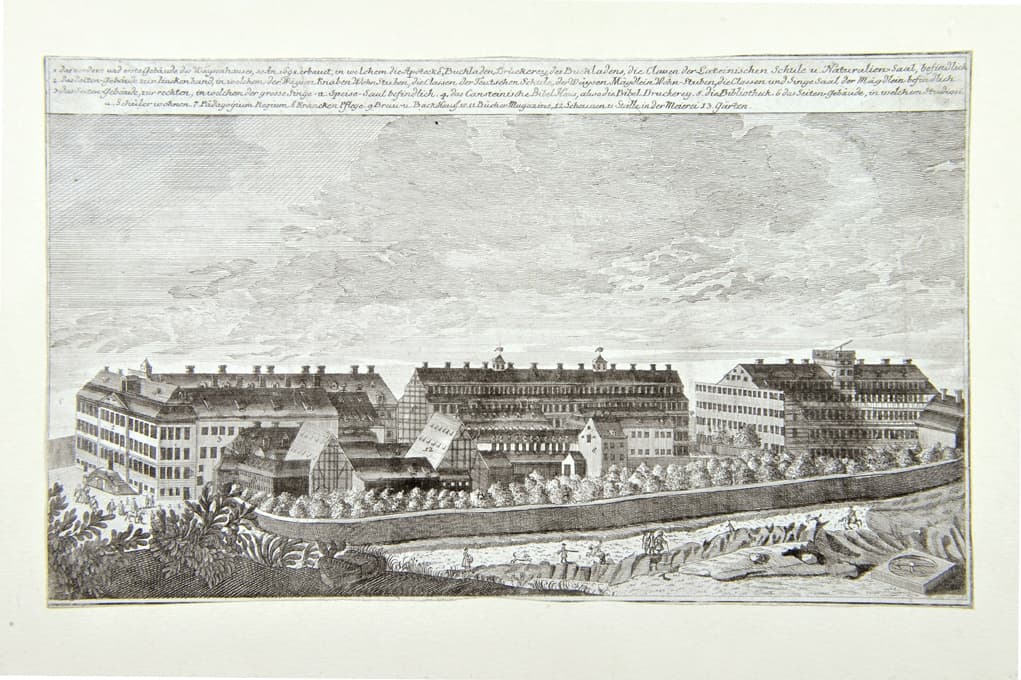
Gottfried August Gründler, The orphan house at Halle, 1734 to 1766. Public domain.
AD 1695 to 1727 · Story · Featured Study
Francke and the Halle Orphanage
An alms box of 1695 at Halle grew into an orphan house, schools, a press and a Bible institute, as Francke and his biographer record.
- When
- 1695 to 8 June 1727
George Müller wrote in 1851 that Francke “spoke to my soul in 1826, and he is speaking to my soul now.”
But seek first the kingdom of God and His righteousness, and all these things will be added unto you.
Summary
August Hermann Francke was a Lutheran pastor and professor at Halle. In July 1698 he laid the foundation of an orphan house there with no settled funds. He told its story in Pietas Hallensis.
- In his own account he wrote that he was obliged to begin again, as it were, to be a Christian.
- The inn first bought for the orphans cost 1,950 dollars.
- Each day's work on the building was begun with prayer, as Francke's own account tells it.
The Verse Over the Alms Box
Francke fixed an alms box in his parlour at the beginning of 1695.
The verse he set over it was a silent call to all who came in.
If anyone with earthly possessions sees his brother in need, but withholds his compassion from him, how can the love of God abide in him?It is the verse Francke chose to stand over his alms box.
The Counts of the House
Four counts across thirty years, each with the one who made it.
The house grew from a hundred orphans in 1698 to schools of more than two thousand children by 1727.
| When | What was counted | Who counted |
|---|---|---|
| 1698 | 100 orphans and 72 students | Guericke, in his life of Francke |
| 1705 | 673 boys and girls at the last examination, and above 700 in the house | The English editor of Pietas Hallensis |
| 1709 | 130 orphans, and about 1,300 children taught | Guericke |
| 1727 | 134 orphans, 2,207 children under 175 teachers, and 255 poor students fed | Guericke |
The Story From Lüneburg to the Orphan House
It moves from a sermon he could not write to a house built week by week.
Francke was born at Lübeck in March 1663. In 1686 at Leipzig he founded the collegium philobiblicum, a circle for reading the Bible.
His own account of his life begins in 1687. At Lüneburg, writing a sermon, he felt that he himself had not the faith it required.
He wrote that he “had knelt down in great distress and doubt, and rose up again with unspeakable joy and certainty.”
But these are written so that you may believe that Jesus is the Christ, the Son of God, and that by believing you may have life in His name.Francke's sermon at Lüneburg was to be on this verse.
Erfurt ordered him out within forty-eight hours, and he left on 27 September 1691.
He was appointed professor at Halle on 22 December 1691, arrived there on 7 January 1692, and took up the parish of Glaucha that February.
Pure and undefiled religion before our God and Father is this: to care for orphans and widows in their distress, and to keep oneself from being polluted by the world.This verse is MannaFest's choice for the work Francke took up at Halle.
An inn was bought for the orphans on 6 April 1698, and ground was broken for the new house on 5 July.
The house was roofed in July 1699. The orphans and students dined in it from Easter 1700, and every storey was in use by Easter 1701.
And God is able to make all grace abound to you, so that in all things, at all times, having all that you need, you will abound in every good work.Francke's own account tells how he lighted on this verse.
A dispensary grew from a medicine chest, and a Leipzig apothecary gave the first medicines free. A bookshop and a press grew up beside them.
After Canstein died in 1719, Francke ran Canstein's Bible institute, which printed 5,224,670 copies from 1712 to 1862 by its inspector's count.
Francke died on 8 June 1727, a quarter before ten in the evening.
Each one should give what he has decided in his heart to give, not out of regret or compulsion. For God loves a cheerful giver.This verse stood under the alms box, though Guericke's English prints it as chapter 9, verse 17.
2 Corinthians 9:8, 2 Corinthians 9:7
The People of the Story
Seven people, each with his part and the witness who records it.
Francke stands with those who helped him, his son, and the man his house later moved.
| Person | His part | The record |
|---|---|---|
| August Hermann Francke | He built the orphan house and wrote its story in Pietas Hallensis. | Pietas Hallensis; Guericke |
| Philipp Jakob Spener | He encouraged the Bible circle Francke founded at Leipzig. | The 1911 Britannica |
| Sandhagen | Francke lived with him at Lüneburg from Michaelmas 1687. | Guericke |
| Frederick, Elector of Brandenburg | He was the first King of Prussia, and he took a lively interest in Francke's institutions. | Guericke |
| Charles Hildebrand, baron of Canstein | A friend of Francke's and of the same age, he founded an institution to sell the Bible at a very low price. | Guericke |
| Francke's son | He read his father's own account aloud after his death. | Guericke |
| George Müller | He lived about two months in the orphan house, in free lodgings for poor students of divinity. | Müller's Narrative |
Who Tells the Story
Francke's own book and a life of him put into English in 1837 tell the story.
Pietas Hallensis is Francke's own account, printed in English at London in 1705 for readers who might give, and its numbers are its English editor's. It speaks for the house it asks money for.
H. E. F. Guericke wrote Francke's life in German, and Samuel Jackson put it into English in 1837.
What the Record Leaves Unsaid
The sources differ on his birthday and name no counter for the house in 1727.
The 1911 Britannica gives 22 March 1663 for his birth and Guericke the 23rd, and neither says why. Guericke gives the counts of the house at Francke's death and names no one who made them.
Where the House Led: George Müller
Müller's own words on the house that moved him.
On 20 November 1835 George Müller found a life of Francke at a sister's house, as he calls her. He wrote that he had long thought of labouring in a similar way, “not, to imitate Franke, but in reliance upon the Lord.”
His entries for 1851 were printed in the fourth part of his Narrative in 1856. There he wrote, “to his example I am greatly indebted in having been stirred up to care about poor children in general, and about poor Orphans in particular.”
“At the same time it appeared to me right, that henceforth I should ask no man, not even my beloved brethren and sisters, to help me […]”
George Müller · A Narrative of Some of the Lord's Dealings, first part, ninth edition (1865)Plymouth Brethren
In Their Own Words
Francke on the building of the house and on the night of his conversion.
August Hermann Francke (1663 to 1727)
Pietas Hallensis (1705), printed at London by J. Downing, section XXVIII, page 29
The foundation laid
“As the whole Affair was never Undertaken upon any settled Provision, but in singleness of Heart and entire Dependance upon God Almighty, so I had not as much now as would suffice to Erect a small House, much less a Large and Publick Hospital.”
Lutheran
About this saying1 paragraph
Francke tells how little he had in hand when the building began in 1698.
August Hermann Francke
Pietas Hallensis (1705), printed at London by J. Downing, the third instance, page 37
Lord look upon my necessity
“I closely adhered in my Mind to that saying: Seek first the Kingdom of God and his Righteousness, and all these things shall be added unto you; ... And when I was now laying out the last of the Money, I said in my Thoughts, Domine respice ad indigentiam meam; Lord look upon my Necessity.”
Lutheran
About this saying1 paragraph
Francke wrote this of February 1699, when the provision for the poor was spent.
August Hermann Francke
his own account of his life, in H. E. F. Guericke, The Life of Augustus Herman Franke, translated by Samuel Jackson (1837), printed at London by R. B. Seeley and W. Burnside, page 18
Awake from a dream
“It seemed to me as if I had spent all my life in a deep sleep; as if I had done every thing only as in a dream, and had now for the first time awoke from it.”
Lutheran
About this saying1 paragraph
Francke tells what his whole life had seemed to him before that night of prayer at Lüneburg in 1687.
Where Historians Disagree
Three questions of the house, with the writers who answer them.
Built on prayer and gifts alone?2 paragraphs
Francke's account tells of straits answered by gifts, and Müller wrote, “He trusted in God alone.”
Against that reading, Guericke records that Frederick, Elector of Brandenburg, gave a hundred thousand bricks, thirty thousand tiles, two gifts of a thousand dollars and “many privileges.”
On which day was the stone laid?1 paragraph
Francke's account gives 13 July 1698 for the laying of the foundation, and Guericke gives 24 July for the laying of the first stone.
What became of Halle?2 paragraphs
Mirbt wrote that Halle Pietism “was on the decline by 1730,” and Kurtz held that after its founders it grew narrow. Müller wrote that late in the eighteenth century and early in the nineteenth there was “little real vital godliness in these Institutions.”
Against a reading of mere decline, Kurtz also credited Pietism with a wholesome influence that lasted many years.
Books to Read Next
Three free books, the first of them his own.
Pietas Hallensis
August Hermann Francke · 1705
It is his own account of the school and the orphan house, in the English of 1705.
Read it free onlineThe Life of Augustus Herman Franke
H. E. F. Guericke, translated by Samuel Jackson · 1837
It carries his own account of his conversion and the counts of the house.
Read it free onlineA Narrative of Some of the Lord's Dealings with George Müller, fourth part
George Müller · 1856
Müller tells there what Francke's example meant to him.
Read it free onlineWhat the House Left
A pastor's alms box left what Müller called “the largest charitable establishment for poor children that, as far as I know, exists in the world.”
Sources
Scripture is the Berean Standard Bible.
- The Holy Bible, Berean Standard Bible (read 2026)
- August Hermann Francke, Pietas Hallensis (London: J. Downing, 1705), the English editor's preface, page vii, and pages 29 to 37.
- H. E. F. Guericke, The Life of Augustus Herman Franke, translated by Samuel Jackson (London: R. B. Seeley and W. Burnside, 1837), pages 7 to 37, 143 to 174, 198 and 213 to 220.
- The Encyclopaedia Britannica, eleventh edition (Cambridge, 1911), volume 11, Francke.
- George Müller, A Narrative of Some of the Lord's Dealings with George Müller, first part, ninth edition (London: J. Nisbet, 1865)
- George Müller, A Narrative of Some of the Lord's Dealings with George Müller, fourth part (London: J. Nisbet, 1856), pages 219 to 220, the entries of 1851.
- Oswald Bertram, Geschichte der Cansteinschen Bibelanstalt in Halle (Halle: Waisenhaus, 1863), the table near page 80.
- Carl Mirbt, Pietism, in The New Schaff-Herzog Encyclopedia of Religious Knowledge, volume 9 (New York: Funk and Wagnalls, 1911), section 13, page 65.
- J. H. Kurtz, Church History, volume 3, translated by John Macpherson (London: Hodder and Stoughton, 1890), section 167.
Keep Studying
People and groups5
Doctrines1
Values3
Subjects1
Church history2