
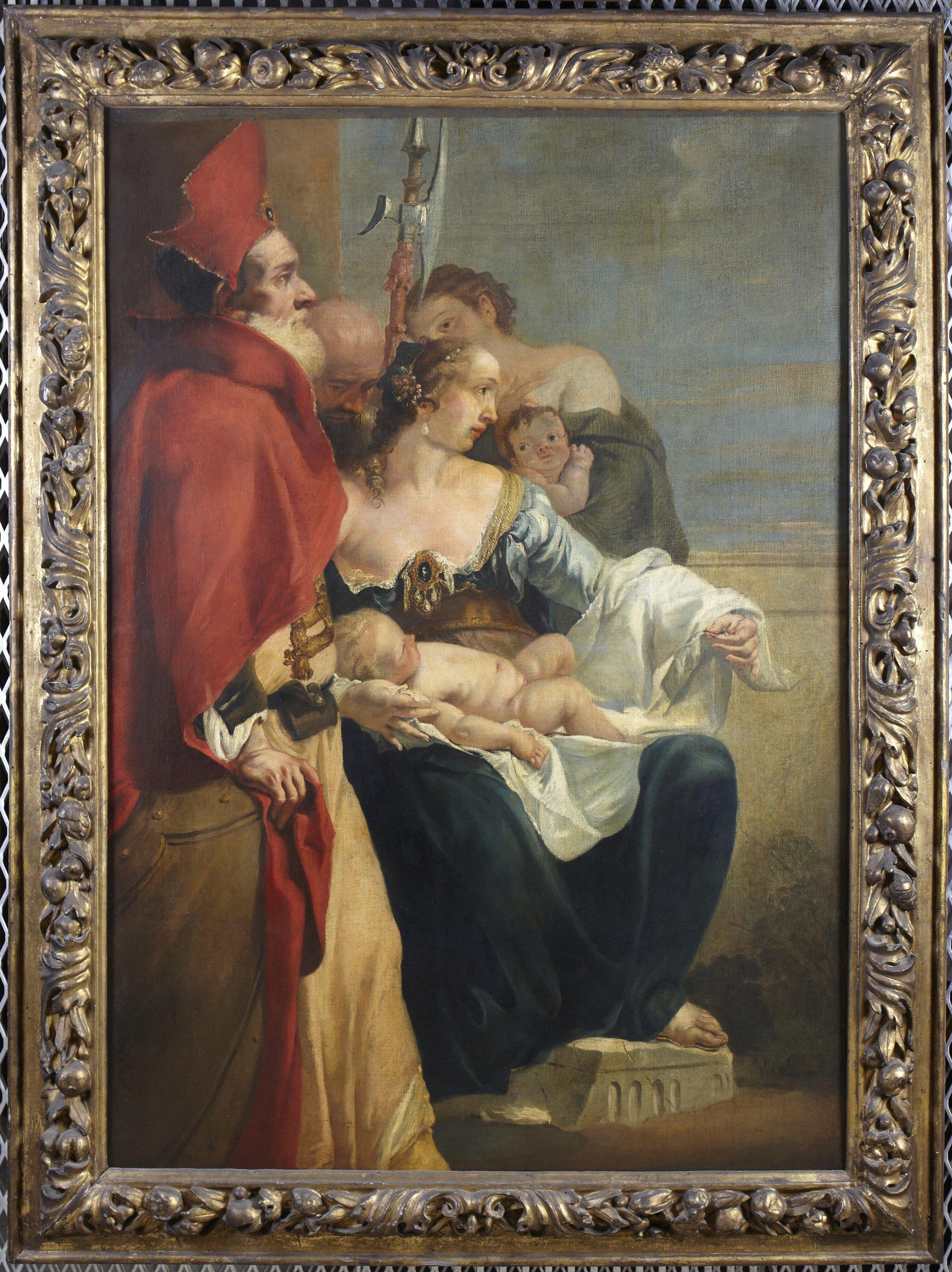
Francesco Fontebasso, Joash and Jehosheba. Public domain.
2 Kings 11 · Subject · Featured Study
The Chamber Above the Holy of Holies
Readers differ on what filled the space between Solomon's roof and the ceiling of the Most Holy Place.
A boy king grew up in hiding inside the temple, and one reading puts him over the Holy of Holies.
The house that King Solomon built for the LORD was sixty cubits long, twenty cubits wide, and thirty cubits high.
The house that King Solomon built for the LORD was sixty cubits long, twenty cubits wide, and thirty cubits high.
- Books
- 1 Kings, 2 Chronicles, 2 Kings
- Hold in memory
- Psalm 27:5, Hebrews 10:19
Summary
Chronicles names upper rooms in David's plans and covers them with gold.
- Josephus writes of a second building over the house, which made the temple a hundred and twenty cubits high.
- The Mishnah tells of trap doors through which workmen were let down into the Holy of Holies.
- Rashi reads the bedroom where Joash was hidden as a room above the inner sanctuary.
Two Heights and the Upper Rooms
Kings and Chronicles give the measures and the rooms, and 2 Kings hides a king in the house of the LORD.
The inner sanctuary was twenty cubits long, twenty cubits wide, and twenty cubits high. He overlaid the inside with pure gold, and he also overlaid the altar of cedar.This is the second of the two heights.
C. F. Keil reads the two numbers together. About ten cubits of height stood over the inner sanctuary, under the roof of the house.
Then David gave his son Solomon the plans for the portico of the temple, its buildings, storehouses, upper rooms, inner rooms, and the room for the mercy seat.David's plan held upper rooms before Solomon built.
Then he made the Most Holy Place; its length corresponded to the width of the temple—twenty cubits long and twenty cubits wide. And he overlaid the inside with six hundred talents of fine gold. The weight of the nails was fifty shekels of gold. He also overlaid the upper area with gold.Chronicles adds the upper area to the gold that Kings records.
But Jehosheba daughter of King Joram, the sister of Ahaziah, took Joash son of Ahaziah and stole him away from among the sons of the king who were being murdered. She put him and his nurse in a bedroom to hide him from Athaliah, and he was not killed. And Joash remained hidden with his nurse in the house of the LORD for six years while Athaliah ruled the land.Readers disagree over the room this verse names.
2 Chronicles 3:8 to 9, 2 Kings 11:2 to 3
The House in Section
The drawing gives the house of 1 Kings 6 from the side, to its measures.
The house stood thirty cubits high and the inner sanctuary twenty, which left ten cubits over the inner room.
10 cubits
- The house30 cubits high1 Kings 6:2
- The inner sanctuary20 cubits long, wide and high1 Kings 6:20
- The space abovethe 10 cubits between the two heights1 Kings 6:20
- The side roomseach storey 5 cubits high1 Kings 6:10
The side rooms stand on the north and south as well, out of this view.
Drawn to scale from the side, west to the left.
The Upper Chamber in Josephus and the Mishnah
Josephus writes of a building over Solomon's house, and the Mishnah describes the upper chamber of the later temple and its trap doors.
Josephus, in Antiquities 8.3.2, writes that another building stood over the house, equal to it in its measures. He gives the whole temple a height of a hundred and twenty cubits.
He adds that the side rooms rose only as high as the lower part of the house, and that the upper part had no buildings about it.
The Mishnah, in tractate Middot 4:5, describes an upper chamber over the sanctuary of the later temple. A winding walkway climbed to its door on the south side.
A row of stones in the upper chamber marked the line between the holy place and the Holy of Holies below. Trap doors opened from the chamber into the Holy of Holies, and workmen were let down through them in baskets so that they would not gaze on the room.
Middot 4:6 gives the upper chamber a height of forty cubits. The Babylonian Talmud, in Pesachim 26a, cites the same teaching about openings in the loft of the Holy of Holies.
The Hebrew of the Rooms
Three Hebrew words name the upper room, the inner sanctuary and the chamber where Joash was hidden.
aliyyah (Hebrew, H5944)
A room on the second storey or on the roof. It names the upper rooms of 1 Chronicles 28:11 and 2 Chronicles 3:9, Elisha's room in 2 Kings 4:10 and the upper chamber of Ahaz in 2 Kings 23:12.
debir (Hebrew, H1687)
The innermost part of the sanctuary. It stands in sixteen verses, from 1 Kings 6:5 to Psalm 28:2.
cheder (Hebrew, H2315)
An inner room or chamber. It is the bedroom of 2 Kings 11:2 and 2 Chronicles 22:11, and the inner rooms of David's plans in 1 Chronicles 28:11.
What the Text Leaves Unsaid
Scripture leaves three things about the chamber unsaid.
First Kings names no room over the inner sanctuary.
Keil writes that neither Kings nor Chronicles tells the nature or purpose of the upper rooms.
Neither Kings nor Chronicles says which room hid Joash.
Where Readers Differ
Readers differ on where the upper rooms stood, on what they held and on where Joash was hidden.
The upper rooms stood over the inner sanctuaryC. F. Keil
Keil places the upper rooms of 2 Chronicles 3:9 and 1 Chronicles 28:11 in the space the two heights leave.
The objection is Albert Barnes's caution. On 2 Chronicles 3:9 he calls their position uncertain and reports readers who place them over the entrance or in the side rooms.
The ceiling of the inner roomAdam Clarke
Adam Clarke, on 2 Chronicles 3:9, says the ceiling is probably meant.
The objection is 1 Chronicles 28:11, which counts the upper rooms among the parts of the plan.
The old tabernacle was kept thereC. F. Keil; Bishop Patrick, reported by Matthew Henry
Keil, on 1 Kings 8:4, writes that the tabernacle and its vessels were probably kept as a sacred relic in the rooms above the Most Holy Place.
“Bishop Patrick supposes that, among other things, the tabernacle which Moses reared and all the utensils of it, which there was now no further occasion for, were laid up here, signifying that in the fulness of time all the Mosaic economy, all the rites and ceremonies of that dispensation, should be respectfully laid aside, and something better come in their room.”
Matthew Henry · Commentary on the Whole Bible · on 1 Chronicles 28:11Puritan
The objection is 1 Kings 8:4, which brings the tent up to the house and names no room for it.
In an attic over the Holy of HoliesRashi
Rashi, on 2 Kings 11:2, reads the bedroom as the attic of the Holy of Holies. The note of the Metsudah translation adds that Jehosheba, as the wife of the chief priest, had access to the temple's rooms.
The objection is the Targum of Jonathan on 2 Kings 11:2. The commentary on Chronicles printed under Rashi's name reports, on 2 Chronicles 22:11, that this Targum renders the place the chamber of the beds, the room in the forecourt where the priests slept.
In the Holy of Holies itselfthe Targum on Chronicles, reported by Adam Clarke
Adam Clarke, on 2 Chronicles 22:12, cites the Targum's words for the place: in the holy of holies. He adds that Athaliah had no access there.
And the LORD said to Moses: “Tell your brother Aaron not to enter freely into the Most Holy Place behind the veil in front of the mercy seat on the ark, or else he will die, because I appear in the cloud above the mercy seat.The objection is the law, which kept even Aaron from entering that room at will.
In a priests' roomJohn Wesley; Jamieson, Fausset and Brown
John Wesley, on 2 Kings 11:2, takes the bedroom for one of the rooms beside the temple kept for the priests and Levites. Jamieson, Fausset and Brown, on 2 Chronicles 22:12, say all within the outer wall was often called the temple.
The objection is the Targum on Chronicles, which places the boy in the holy of holies.
In a closet for beddingJamieson, Fausset and Brown
“What is called, however, the bedchamber in the East is not the kind of apartment that we understand by the name, but a small closet, into which are flung during the day the mattresses and other bedding materials spread on the floors or divans of the sitting-rooms by day.”
Jamieson, Fausset & Brown · Commentary Critical and Explanatory on the Whole Bible · on 2 Kings 11:2Reformed
The objection is 2 Kings 11:3, which places the boy in the temple through all of Athaliah's reign.
Books to Read Next
Three works on the measures and the rooms of Solomon's house, each free to read.
Antiquities of the Jews
Flavius Josephus, translated by William Whiston · 1737
Josephus describes Solomon's house, its side rooms and the building over it in Book 8.
Read it at Project GutenbergBiblical Commentary on the Old Testament: The Books of the Kings
C. F. Keil, translated by James Martin · 1872
Keil works out the space above the Most Holy Place from the measures of 1 Kings 6.
Read it at the Internet ArchiveBiblical Commentary on the Old Testament: The Books of the Chronicles
C. F. Keil, translated by Andrew Harper · 1872
Keil follows the gold of the house from David's pattern to Solomon's building.
Read it at the Internet ArchiveA New and Living Way
Under the law even Aaron could not enter the Most Holy Place at will.
Therefore, brothers, since we have confidence to enter the Most Holy Place by the blood of Jesus, by the new and living way opened for us through the curtain of His body,The letter names the way that is now open.
The reader is asked to come to God by that way.
Sources
Scripture is the Berean Standard Bible.
- The Hebrew words aliyyah, debir and cheder, STEP Bible tagged text (CC BY 4.0), with Strong's lexicon.
- C. F. Keil, Biblical Commentary on the Old Testament: The Books of the Kings, translated by James Martin, T. and T. Clark, 1872, pages 68, 77 and 119.
- C. F. Keil, Biblical Commentary on the Old Testament: The Books of the Chronicles, translated by Andrew Harper, T. and T. Clark, 1872, pages 292 and 317.
- Flavius Josephus, Antiquities of the Jews 8.3.2, translated by William Whiston.
- Mishnah Middot 4:5 and 4:6, Mishnah Yomit by Dr. Joshua Kulp, CC-BY, via Sefaria.
- Babylonian Talmud, Pesachim 26a, William Davidson Edition, CC-BY-NC, via Sefaria.
- Rashi on 2 Kings 11:2, The Metsudah Tanach series, Lakewood, N.J.; Rashi on 2 Chronicles 22:11, The Judaica Press complete Tanach with Rashi, translated by A. J. Rosenberg; both CC-BY, via Sefaria.
- Albert Barnes, Notes, Explanatory and Practical, on the Old and New Testaments, 1832 to 1869.
- Adam Clarke, Commentary on the Bible, 1832.
- John Wesley, Explanatory Notes upon the Old Testament, 1765.
- Jamieson, Fausset and Brown, Commentary Critical and Explanatory on the Whole Bible, 1871.
- Matthew Henry, Commentary on the Whole Bible, 1710.