
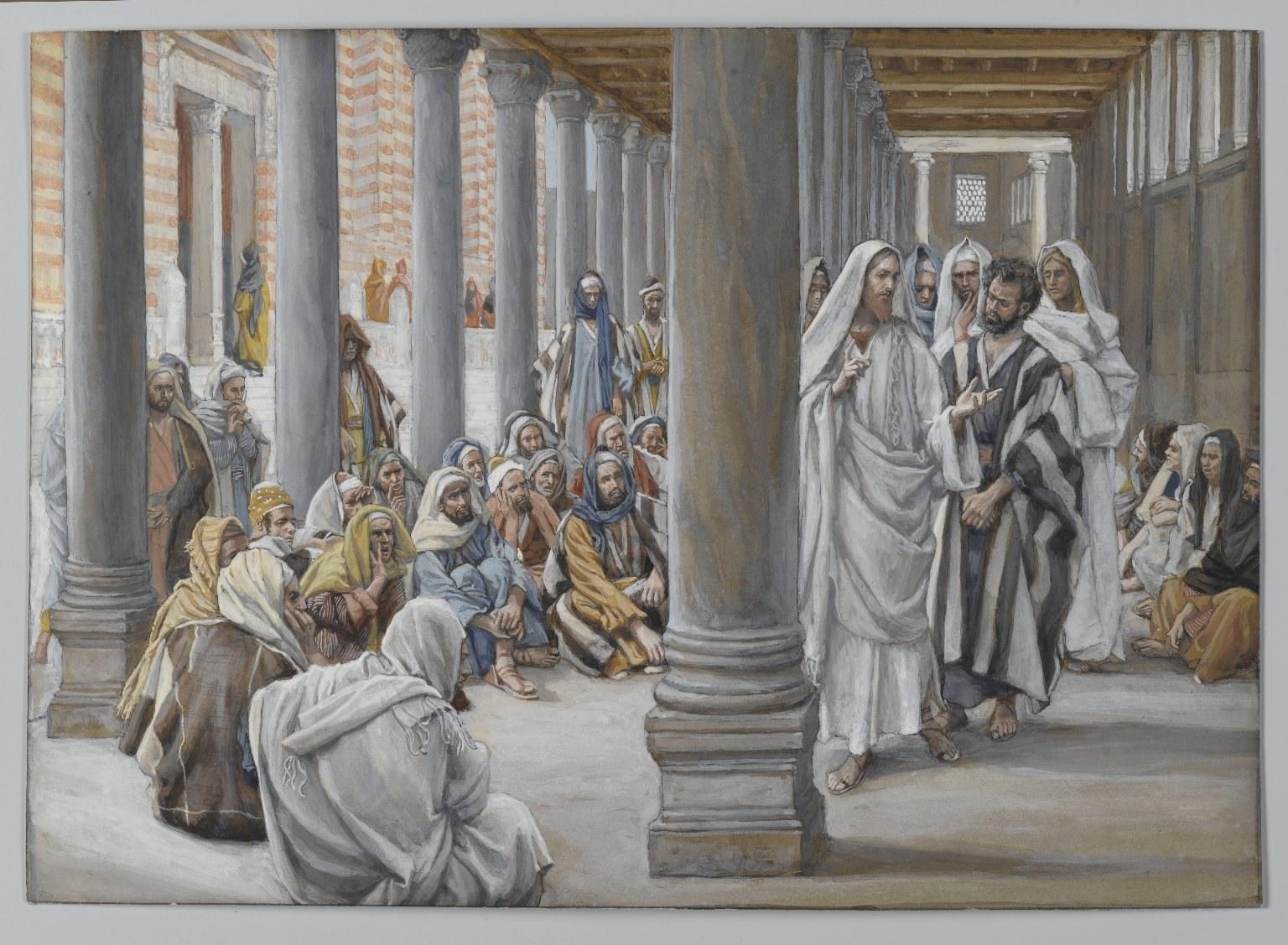
James Tissot, Jesus Walks in the Portico of Solomon, 1886 to 1894. Public domain.
Matthew 24:1 to 2 · Place · Featured Study
The Temple in Jesus' Day
Herod the Great rebuilt the temple in Jerusalem, and the Gospels set many of Jesus' days in its courts.
As Jesus was leaving the temple, one of His disciples said to Him, “Teacher, look at the magnificent stones and buildings!”
- Today
- The Temple Mount, Jerusalem
- Region
- Jerusalem
- First named
- Matthew 4:5 “…on the pinnacle of the temple.”
Jesus called the temple My Father's house.
Summary
The temple in Jerusalem was the house of God where Israel offered its sacrifices. Jesus came to it at the feasts, from His boyhood to His last week.
- Josephus dates the start of the work to the eighteenth year of Herod's reign.
- At His arrest Jesus said He had taught in the temple courts every day (Mark 14:49).
- Roman soldiers burned the temple in AD 70.
The House Herod Rebuilt
Josephus describes how Herod enlarged the house.
“This temple took forty-six years to build,” the Jews replied, “and You are going to raise it up in three days?”The Jews' reply to Jesus is the one verse of the Gospels that counts the temple's years, and its count is read two ways.
Josephus wrote in his Antiquities, Book 15, that Herod built the house larger in compass and raised it higher.
The Gospels use two Greek words for the temple.
hieron
70 uses in the canon
The whole sacred precinct with its courts and colonnades.
naos
45 uses in the canon
The sanctuary itself, the word Jesus uses when He speaks of His body.
The Courts and the Sanctuary
Middot measures each court and room in cubits.
The Mishnah sets the sanctuary, 100 cubits long, at the west end of the inner court, with the Court of the Women to the east.
50 cubits
- The Court of the Women135 cubits by 135
- The Court of Israel11 cubits deep, for the men of Israel
- The altar32 cubits square at its base
- Between the porch and the altar22 cubits
- The porch100 cubits across
- The Holy Place40 cubits long and 20 wide
- The veilBetween the Holy Place and the Holy of Holies
- The Holy of Holies20 cubits long and 20 wide
The sizes are the Mishnah's; the drawing sets the courts in a row from west to east with the sanctuary on the centre line, and leaves out the outer court of the Temple Mount, 500 cubits on each side, with its low wall (Middot 2:1 and Middot 2:3).
The numbers mark the parts Middot measures and the places the Gospels name.
The Mishnah was compiled early in the third century, after the temple had fallen. The whole inner court ran 187 cubits from east to west and 135 from north to south (Middot 5:1 to 2).
Scenes in the Temple Courts
The Gospels and Acts set their scenes in different parts of the temple.
The Gospels and Acts set eight scenes in five places within the temple.
- Zechariah burns incenseInside the sanctuary, while the people pray outsideLuke 1:9 to 10
- The boy Jesus among the teachersIn the temple courtsLuke 2:46
- The devil's testOn the pinnacle of the templeMatthew 4:5
- Jesus at the Feast of DedicationIn Solomon's ColonnadeJohn 10:23
- The money changers driven outIn the temple courtsMatthew 21:12
- The widow's two coinsOpposite the treasuryMark 12:41
- The veil tornInside the sanctuaryMatthew 27:51
- Peter and John and the healed manIn Solomon's ColonnadeActs 3:11
Each scene stands with the part of the temple its verse names.
The veil torn, Peter and John and the healed man
The Wall Gentiles Could Not Pass
Josephus and the book of Acts both tell of the limit set for Gentiles.
Josephus described a stone partition three cubits high around the inner courts in the Jewish War, Book 5. Pillars stood on it at equal distances, with the law of purity written in Greek and in Latin. They warned that no foreigner should go within the sanctuary.
crying out, “Men of Israel, help us! This is the man who teaches everywhere against our people and against our law and against this place. Furthermore, he has brought Greeks into the temple and defiled this holy place.”The crowd seized Paul on the charge that he had brought Greeks past this limit.
Paul later wrote to Gentile believers that Christ has torn down the dividing wall of hostility (Ephesians 2:14).
The Stones Thrown Down
Jesus foretold the fall of the temple as He walked away from it.
“Do you see all these things?” He replied. “Truly I tell you, not one stone here will be left on another; every one will be thrown down.”Jesus answered the disciples' pride in the buildings with the sentence on them.
Josephus recorded in the Jewish War, Book 6, that the house burned on the tenth day of the month Lous, or Ab. It was the same day on which the king of Babylon had burned the first house.
Rabanus Maurus counted the years from the passion to the fall.
“The historical sense is clear, that in the forty-second year after the Lord's passion, the city and temple were overthrown under the Roman Emperors Vespasian and Titus.”
Rabanus Maurus · Catena Aurea by Aquinas · on Matthew 24:1 to 2Patristic
Remigius of Rheims, in the Catena Aurea, held that God removed the temple and its ceremonies once grace was revealed, so that no one weak in faith would be drawn back to them.
Voices on the Temple
Teachers from the fourth century to the nineteenth read the temple's fall and the torn veil.
Hilary of Poitiers (died 367)
Hilary of Poitiers set the stones that fell beside an eternal temple of living people.
“The magnificent splendor of the temple's design was shown to Christ immediately after he had warned of Jerusalem's desolation, as though to move him. Yet he said that everything had to be destroyed and the scattered stones of its entire foundation demolished, for an eternal temple was being consecrated as a dwelling place of the Holy Spirit. This eternal temple is the man who is made worthy of becoming God's habitation through knowledge of the Son, confession of the Father and obedience to the commandments.”
Hilary of Poitiers · Commentary on Matthew 25.1 · on Matthew 24:2Patristic
John Chrysostom (died 407)
John Chrysostom heard the torn veil as a sign of what was coming to the house.
“This cry rent the veil, and opened the tombs, and made the house desolate. And He did this, not as offering insult to the temple (for how should He, who saith, ‘Make not my Father's house a house of merchandise,’ but declaring them to be unworthy even of His abiding there; like as also when He delivered it over to the Babylonians. But not for this only were these things done, but what took place was a prophecy of the coming desolation, and of the change into the greater and higher state; and a sign of His might.”
John Chrysostom · Homily on the Gospel of Matthew 88 · on Matthew 27:51Patristic
Jamieson, Fausset & Brown (1802 to 1910)
Jamieson, Fausset and Brown explained what the veil had closed off.
“Into this holiest of all none might enter, not even the high priest, save once a year, on the great day of atonement, and then only with the blood of atonement in his hands, which he sprinkled ‘upon and before the mercy seat seven times’ (Le 16:14) --to signify that access for sinners to a holy God is only through atoning blood.”
Jamieson, Fausset & Brown · Commentary Critical and Explanatory on the Whole Bible · on Matthew 27:51Reformed
The Forty-Six Years of John 2:20
Commentators from the ninth century to the nineteenth disagree over where the forty-six years begin.
The years of Herod's rebuildingJohn Wesley and Adam Clarke, on John 2:20
John Wesley counted the forty-six years from Herod's start on the work, which went on one part after another through his life and after it. Adam Clarke took the same start from Josephus, and held that the main work took nine and a half years while more building went on long after.
The objection is that the two works of Josephus give different years of the reign for the start.
The years of the building after the exileAlcuin of York, in the Catena Aurea; John Gill, on John 2:20
Alcuin of York counted the years of the house rebuilt under Zerubbabel.
“Note, that they allude here not to the first temple under Solomon, which was finished in seven years, but to the one rebuilt under Zorobabel. (Ezra 4:5) This was forty-six years building, in consequence of the hindrance raised by the enemies of the work.”
Alcuin of York · Catena Aurea by Aquinas · on John 2:20Patristic
John Gill also took it of the second temple built by Zerubbabel, and noted that the reckonings of learned men were many. The objection is that the speakers say this temple, the building standing before them, which Herod was then rebuilding.
The Temple of His Body
John tells which temple Jesus meant.
But Jesus was speaking about the temple of His body.John's comment answers the question the Jews raised in John 2:20.
But I saw no temple in the city, because the Lord God Almighty and the Lamb are its temple.John's vision closes the Bible's line of temples, from Solomon's house to Herod's.
Sources
Scripture is the Berean Standard Bible.
- Strong's numbers and counts for hieron (G2411) and naos (G3485)
- Flavius Josephus, Antiquities of the Jews 15.11.1, translated by William Whiston (1737)
- Flavius Josephus, The Jewish War 1.21.1, 5.5.2 and 6.4.5, translated by William Whiston (1737)
- Mishnah, tractate Middot 2:1, 2:3, 2:5, 3:1, 4:7 and 5:1 to 2, Mishnah Yomit, translated by Joshua Kulp.
- Rabanus Maurus, in the Catena Aurea of Thomas Aquinas, on Matthew 24:1 to 2.
- Hilary of Poitiers, Commentary on Matthew 25.1, on Matthew 24:2.
- Remigius of Rheims, in the Catena Aurea, on Matthew 24:1 to 2.
- John Chrysostom, Homily 88 on the Gospel of Matthew, on Matthew 27:51.
- Jamieson, Fausset and Brown, Commentary Critical and Explanatory on the Whole Bible (1871), on Matthew 27:51.
- John Wesley, Explanatory Notes upon the New Testament (1755), on John 2:20.
- Adam Clarke, Commentary on the Bible (1832), on John 2:20.
- Alcuin of York, in the Catena Aurea, on John 2:20.
- John Gill, Exposition of the New Testament (1746 to 1748), on John 2:20.
Keep Studying
People and groups2