
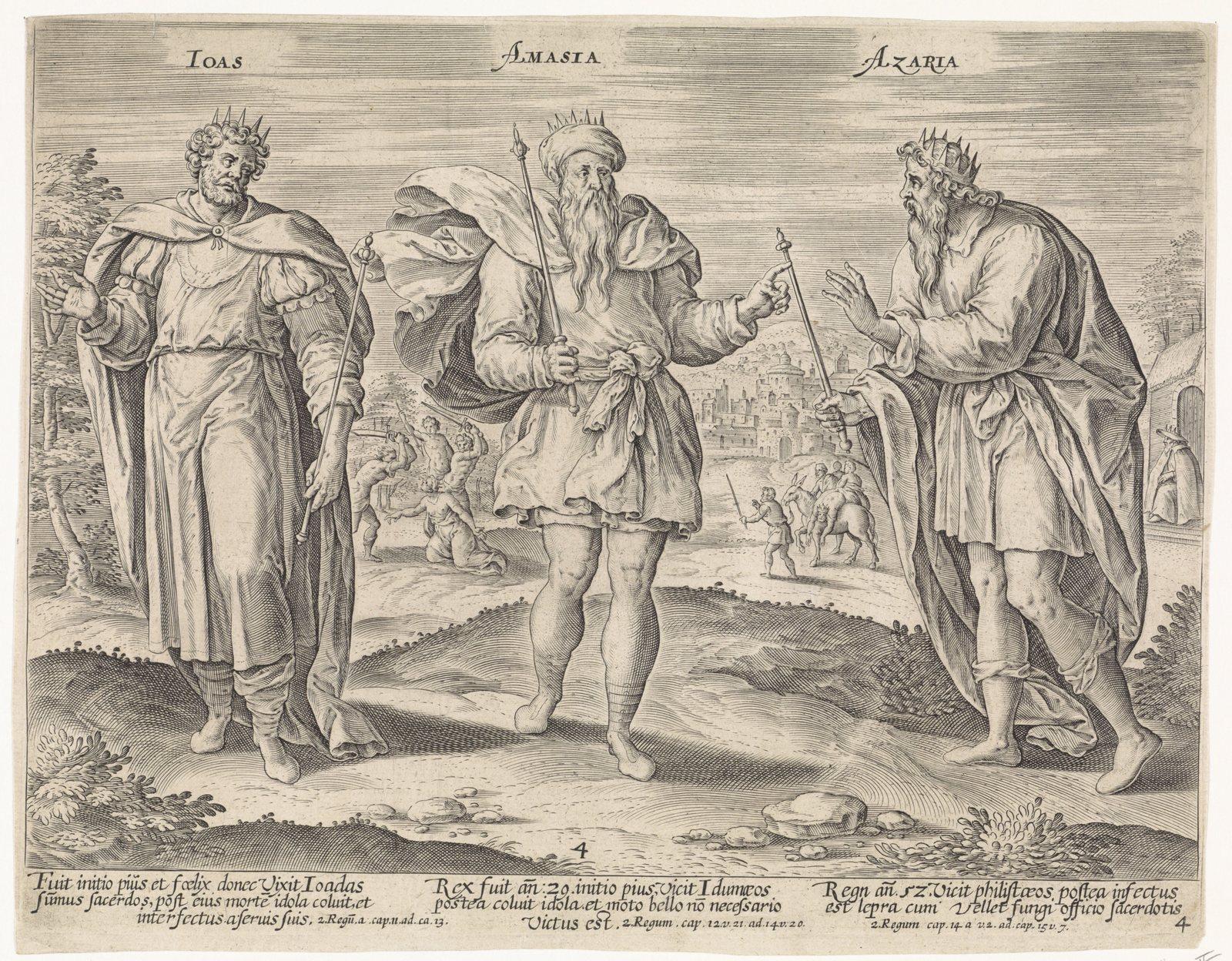
After Jan Snellinck the Elder, Joash, Amaziah and Azariah, 1643. Public domain.
2 Chronicles 24 and 2 Kings 12 · Subject · Featured Study
The Tax of Moses and the Temple Chest
2 Chronicles 24 and 2 Kings 12 tell how King Joash paid for the repair of the temple through a chest set at the house of the LORD.
So he gathered the priests and Levites and said, “Go out to the cities of Judah and collect the money due annually from all Israel, to repair the house of your God. Do it quickly.” The Levites, however, did not make haste.
- Books
- 2 Chronicles, 2 Kings
- Hold in memory
- 2 Chronicles 24:10, 2 Kings 12:15
Joash called the money by an old name, the tax of Moses.
Summary
The two books tell one repair and differ in the details of the chest.
- Joash reproached the high priest when the money was slow to come in.
- The people gave gladly, and the chest was emptied day after day.
- Kings and Chronicles disagree on where the chest stood and on what the surplus bought.
- Readers explain the disagreement in two ways.
The King and the Slow Levites
2 Chronicles 24:5 to 7 tells why Joash turned to a chest.
So the king called Jehoiada the high priest and said, “Why have you not required the Levites to bring from Judah and Jerusalem the tax imposed by Moses the servant of the LORD and by the assembly of Israel for the Tent of the Testimony?”Joash grounds his demand in the Law given in the wilderness.
For the sons of that wicked woman Athaliah had broken into the house of God and had even used the sacred objects of the house of the LORD for the Baals.The damage done under Athaliah is the reason the work was needed.
The Way of the Money
The steps of 2 Chronicles 24:8 to 14 run from the king's command to the articles of gold and silver.
The chest carried the people's gifts to the overseers of the work, and what was left became articles for the house.
- 1. The chest is made and set at the gateThe king's command2 Chronicles 24:8
- 2. The call goes outHeralds in Judah and Jerusalem2 Chronicles 24:9
- 3. The chest is filledThe officers and all the people2 Chronicles 24:10
- 4. The chest is emptied and returnedThe Levites and two officials2 Chronicles 24:11
- 5. The wages are paidThe king and Jehoiada, through the overseers2 Chronicles 24:12
- 6. The surplus is spentThe king and Jehoiada, on gold and silver articles2 Chronicles 24:14
A table of the steps in the order of 2 Chronicles 24, each with who acted and its verse.
Two Accounts of One Chest
2 Kings 12 and 2 Chronicles 24 tell the same repair, and the table sets their differences side by side.
Kings sets the chest beside the altar, and Chronicles sets it at the gate.
| What is told | 2 Kings 12 | 2 Chronicles 24 |
|---|---|---|
| Who collected first | The priests, each from his constituency | The priests and Levites, sent to the towns of Judah |
| When the king acted | The repair was still undone by the twenty-third year of Joash | Some time after the Levites failed to hurry |
| The chest | Jehoiada bored a hole in its lid and set it beside the altar | Made at the king's command and set outside at the gate |
| Who emptied it | The royal scribe and the high priest | The royal scribe and the officer of the high priest |
| The surplus | Nothing went to silver basins or other articles | The rest made articles of gold and silver |
Three Kinds of Temple Money
Rashi explains what the king's collectors gathered and how the chest was kept.
Rashi, on 2 Chronicles 24:5, names three kinds of temple money. The first is the yearly shekels of everyone counted in the census. The second is the money a person vowed as the value of his own life, and the third is the gifts given freely for the repair.
On 2 Chronicles 24:6 he takes the tax of Moses to mean the shekels laid on Israel in the desert. Of the chest itself he says its door stayed shut, so that no thief could take from it.
The chests of the Second TempleMishnah Shekalim 6:5
The Mishnah says the Second Temple had thirteen collection horns, each marked with its use. Two held new and old shekels, and six held free-will offerings for the community.
The Words of the Chest
Two Hebrew words of the chapter stand on the cards, and the bars count the uses of aron.
aron (Hebrew, H727)
A box; the same word names Joash's chest, Joseph's coffin and the ark of the covenant.
mas'et (Hebrew, H4864)
A raising, a gift or a tribute; it is the tax of Moses in 2 Chronicles 24:6 and 2 Chronicles 24:9.
The lexicon in full1 figure
Almost every use of aron names the ark of the covenant.
The three counts as a table
| What aron names | Uses | Verse |
|---|---|---|
| The ark | 195 | |
| Joash's chest, 2 Kings 12 and 2 Chronicles 24 | 6 | 2 Chronicles 24:11 |
| Joseph's coffin, Genesis 50:26 | 1 | Genesis 50:26 |
A bar chart of the Hebrew word aron by what it names, from the TAHOT word index of Tyndale House.
What the Text Leaves Unsaid
The two accounts leave these matters open.
Neither book gives the sum collected or the cost of the repair.
Neither gives the size of the chest or its material.
Chronicles leaves unsaid how long the collection ran before the work was done.
What the Chest Teaches
Two verses show what made the repair work.
No accounting was required from the men who received the money to pay the workmen, because they acted with integrity.Kings records the overseers' honesty as praise, and it is the reason no audit was asked.
Jesus called His disciples to Him and said, “Truly I tell you, this poor widow has put more than all the others into the treasury.At the treasury of a later temple Jesus judged a gift by what it cost the giver.
Two Voices on the Chest
Two commentators of the eighteenth and nineteenth centuries read the chest.
Matthew Henry (1662 to 1714)
Matthew Henry, in his Commentary on the Whole Bible of 1710, draws a warning from the honest overseers.
“Let all that are entrusted with public money, or public work, learn hence to deal faithfully, as those that know God will reckon with them, whether men do or no. Those that think it is no sin to cheat the government, cheat the country, or cheat the church, will be of another mind when God shall set their sins in order before them.”
Matthew Henry · Commentary on the Whole Bible · on 2 Kings 12:12Puritan
Albert Barnes (1798 to 1870)
Albert Barnes, in his Notes on the Old Testament, explains how the two books relate.
“This chapter is parallel with 2 Kings 12, but treats the matters common to both narratives in a different and, apparently, supplemental way.”
Albert Barnes · Notes, Explanatory and Practical, on the Old and New Testaments (1832-1869) · on 2 Chronicles 24:1Evangelical
Were Vessels Made From the Money?
Two readings answer the question, and each has its holders and an objection.
The two accounts tell two stages of the workKeil and Delitzsch; Josephus · Protestant commentary and Jewish history
Keil and Delitzsch see no contradiction. They read Kings as saying only that no money went to the vessels while the repair went on, and Chronicles as telling what followed. Josephus tells the same order, with the vessels made from the gold and silver left after the repair.
The objection is that 2 Kings 12:13 to 14 gives the money to the workmen and names no remainder.
The two accounts tell two collectionsThe Jerusalem Talmud, Shekalim 6:4 · Rabbinic Judaism
In the Jerusalem Talmud, Rabbi Samuel bar Nahman, in the name of Rabbi Jonathan, speaks of two free-will gifts. Heinrich Guggenheimer, in his notes to his translation, explains that the two verses then refer to two separate collections. He adds a second reading, that there were two chests, one inside and one outside. On that reading vessels were made only from money that never entered the sacred domain.
The objection is the Hebrew of 2 Chronicles 24:8, which speaks of one chest.
Books to Read Next
These works on the chest and the temple money are each free to read.
Commentary on the Whole Bible
Matthew Henry · 1710
Henry follows the repair of 2 Kings 12 from the priests' delay to the workmen's wages.
Read it at Bible HubBiblical Commentary on the Old Testament
Keil and Delitzsch · 1857 to 1878
The volume on Kings reads 2 Kings 12 verse by verse with the Hebrew.
Read it at Bible HubA House Restored by Gifts
The repair of Joash's reign was paid for by the people's free gifts and kept by men no one needed to audit.
Every gift to God's work still asks for a glad giver and an honest steward.
Sources
Scripture is the Berean Standard Bible.
- STEP Bible TBESH lexicon and TAHOT word index, Tyndale House, CC BY 4.0.
- Rashi on II Chronicles 24, The Judaica Press complete Tanach with Rashi, translated by A. J. Rosenberg, CC BY.
- Flavius Josephus, Antiquities of the Jews 9.8.2, translated by William Whiston.
- Mishnah Shekalim 6:5, William Davidson Edition, CC BY-NC.
- Jerusalem Talmud, Shekalim 6:4:7, translated with notes by Heinrich W. Guggenheimer, De Gruyter, 1999 to 2015, CC BY.
- C. F. Keil and F. Delitzsch, Biblical Commentary on the Old Testament, 1857 to 1878, on 2 Kings 12.
- Albert Barnes, Notes on the Old Testament, 1832 to 1869, on 2 Chronicles 24:1.
- Matthew Henry, Commentary on the Whole Bible, 1710, on 2 Kings 12:12.
Keep Studying
Places2
Doctrines1