
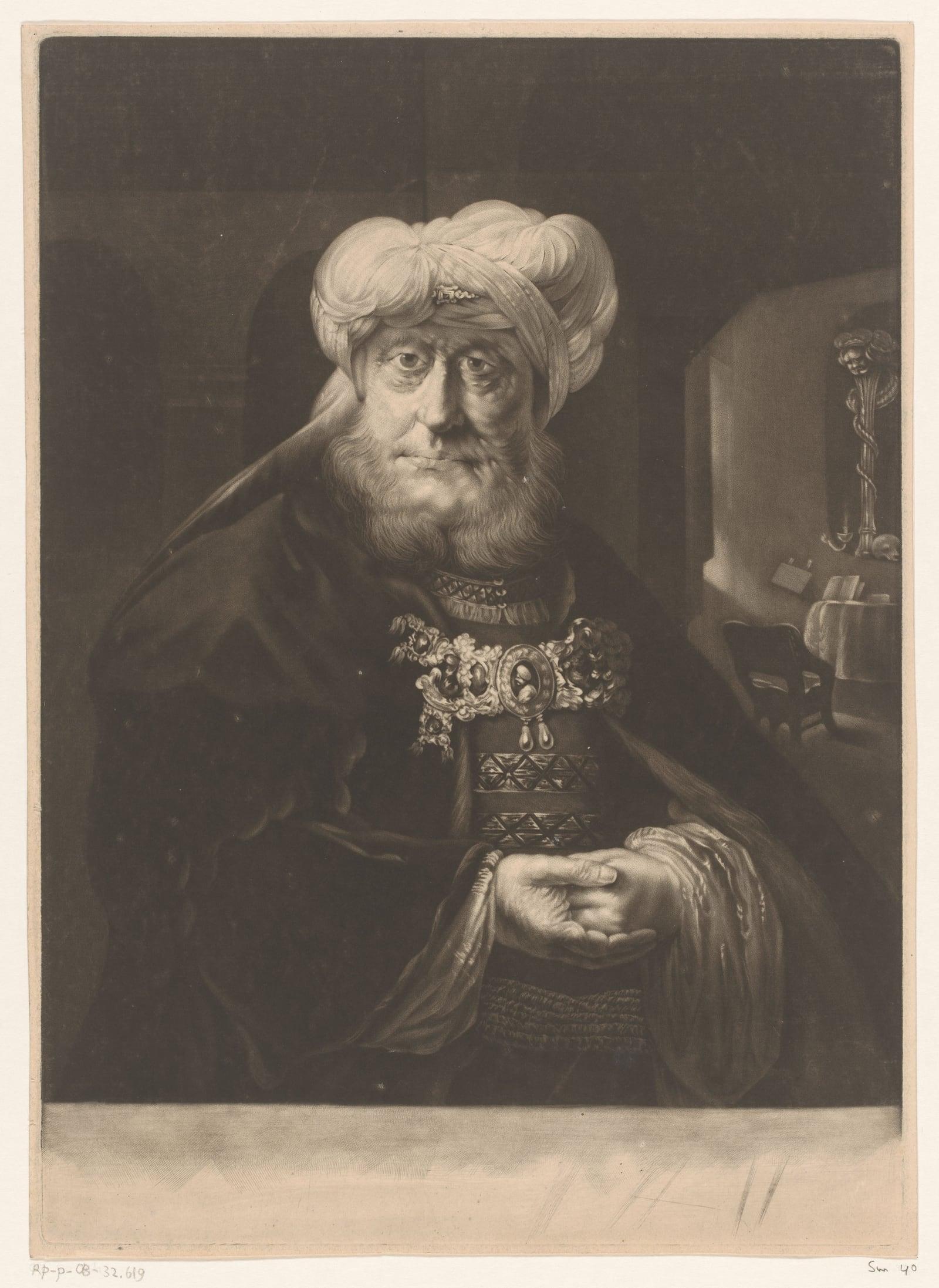
William Pether after Rembrandt, King Uzziah Stricken with Leprosy, 1741 to 1800. CC0.
2 Kings 15:1 to 7 · Person · Featured Study
Azariah, the King Who Lived Apart
A strong king of Judah was struck with leprosy when he took the priests' work for himself.
Eighty priests went in after him to stop him.
And the LORD afflicted the king with leprosy until the day he died, so that he lived in a separate house while his son Jotham had charge of the palace and governed the people of the land.
And the LORD afflicted the king with leprosy until the day he died, so that he lived in a separate house while his son Jotham had charge of the palace and governed the people of the land.
- The name means
- the Lord is my strength, for the name Uzziah in Easton's Bible Dictionary
- Family
- father: Amaziah; mother: Jecoliah of Jerusalem; son: Jotham; grandson: Ahaz
- Places
- Jerusalem
- First named
- 2 Kings 14:21 “…the people of Judah took Azariah, who was…”
- Last named
- Matthew 1:9 “Uzziah was the father of Jotham, Jotham the…”
Summary
Azariah son of Amaziah was made king of Judah at sixteen and reigned fifty-two years in Jerusalem. Amos, Hosea and Isaiah all began to prophesy in his reign.
- He loved the soil and kept farmers and vinedressers.
- Amos dated his visions two years before an earthquake in his reign.
- Zechariah 14:5 recalls that earthquake.
- Matthew 1:9 names him in the line of Jesus.
One King, Two Names
The two names belong to one son of Amaziah.
In the Hebrew text 2 Kings calls him Azariah in eight verses and Uzziah in four. Second Chronicles 26 names him Uzziah, as do Isaiah, Hosea, Amos and Zechariah, while 1 Chronicles 3:12 lists him as Azariah.
Then all the people of Judah took Azariah, who was sixteen years old, and made him king in place of his father Amaziah.John Wesley, in his Notes on 2 Kings 14:21, takes the two names as one meaning in substance, God's help and God's strength.
His Life, Turn by Turn
His life runs from the throne at sixteen to the house apart.
Kings gives him seven verses, and Chronicles adds the wars, the towers and the censer.
- Made king at sixteen in his father's placeJerusalem2 Kings 14:21
- Rebuilds Elath and restores it to JudahElath2 Kings 14:22
- Seeks God in the days of ZechariahJerusalem2 Chronicles 26:5
- Wars against the Philistines, the Arabs and the Meunitesthe land of the Philistines2 Chronicles 26:6 to 7
- Builds towers and digs cisternsJerusalem and the desert2 Chronicles 26:9 to 10
- Sets engines on the towers and cornersJerusalem2 Chronicles 26:15
- Enters the temple to burn incensethe temple2 Chronicles 26:16
- Struck with leprosy before the altar of incensethe temple2 Chronicles 26:19
- Lives as a leper until his deatha separate house2 Kings 15:5
- Buried in a field of burial of the kingsthe City of David2 Chronicles 26:23
The text dates no turn within his fifty-two years.
Enters the temple to burn incense, Struck with leprosy before the altar of incense, Lives as a leper until his death, Buried in a field of burial of the kings
From the Throne to the Censer
Three turns of his life, from his crowning to the censer.
Chronicles tells his reign as a rise while he sought God and a fall when he grew strong.
A king at sixteen2 Kings 14:19 to 22; 2 Kings 15:1 to 4
Conspirators had killed his father Amaziah at Lachish (2 Kings 14:19).
And he did what was right in the eyes of the LORD, just as his father Amaziah had done. Nevertheless, the high places were not taken away; the people continued sacrificing and burning incense there.The page on the high places counts his reign among those that left them standing.
Helped by God2 Chronicles 26:5 to 15; Matthew Henry
He sought God throughout the days of Zechariah, who instructed him in the fear of God. And as long as he sought the LORD, God gave him success.Matthew Henry describes the counsellor of these years.
“This Zechariah was one that had understanding in the visions of God, either the visions which he himself was favoured with or the visions of the preceding prophets. He was well versed in prophecy, and conversed much with the upper world, was an intelligent, devout, good man; and, it seems, had great influence with Uzziah.”
Matthew Henry · Commentary on the Whole Bible · on 2 Chronicles 26:5Puritan
Chronicles credits God's help for his wars and numbers his army at 307,500.
The censer2 Chronicles 26:16 to 20; Matthew Henry
But when Uzziah grew powerful, his arrogance led to his own destruction. He was unfaithful to the LORD his God, for he entered the temple of the LORD to burn incense on the altar of incense.C. F. Keil reads the act as a wish to be high priest of his kingdom, like the kings of Egypt.
Matthew Henry weighs the act against the law.
“None of all his predecessors, not the best, not the worst, attempted it. The law, he knew, was express against him, and there was no usage or precedent for him. He could not pretend any necessity, as there was for David's eating the show-bread.”
Matthew Henry · Commentary on the Whole Bible · on 2 Chronicles 26:16Puritan
The Priests' Work and the Leper's Dwelling
The law gave the incense to Aaron and set the diseased person outside the camp.
Numbers 18:7 kept the work of the altar for Aaron and his sons.
And Aaron is to burn fragrant incense on it every morning when he tends the lamps.Leviticus 13 set the rule for a person with a skin disease.
As long as he has the infection, he remains unclean. He must live alone in a place outside the camp.The Family of Azariah
His family runs from his father Amaziah to his great-grandson Hezekiah.
Three of his line after him were kings of Judah.
His parents
His own day
- AzariahThe king himself
- ZechariahHis counsellor in the early years
- Azariah the priestWho withstood him at the altar
- Isaiah son of AmozWho recorded the rest of his acts
Kings of Judah after him
His father and his son are each said to have done right in the eyes of the LORD.
The Places of His Life
Five places mark his life, from Elath to the temple.
His wars reached the Philistine cities, and his works reached the desert.
| Place | What Scripture tells of it | Book |
|---|---|---|
| Elath | He rebuilt it and restored it to Judah. | 2 Kings |
| Jerusalem | He built towers at its gates. | 2 Chronicles |
| The land of the Philistines | He built cities near Ashdod. | 2 Chronicles |
| The foothills and the plain | His herds grazed there. | 2 Chronicles |
| The temple of the LORD | He took a censer there and was struck. | 2 Chronicles |
Questions His Life Raises
Two questions are answered from the text and its commentators.
Why does his reign begin in Jeroboam's twenty-seventh year?2 Kings 14:23 and 2 Kings 15:1, with John Gill
Jeroboam came to the throne in Amaziah's fifteenth year, and Amaziah reigned twenty-nine years. John Gill, in his Exposition on 2 Kings 15:1, notes that Amaziah lived only to Jeroboam's fifteenth year, and that some readers mend the number to seventeen.
Where was he buried?2 Kings 15:7 and 2 Chronicles 26:23; Albert Barnes
And Uzziah rested with his fathers and was buried near them in a field of burial that belonged to the kings; for the people said, “He was a leper.” And his son Jotham reigned in his place.Kings says he was buried near his fathers in the City of David. Albert Barnes, in his Notes on 2 Chronicles 26:23, reads Chronicles as a separate tomb in the same ground, since the law kept the leper apart in life.
What the Text Leaves Unsaid
The text leaves two things about him untold.
Kings gives no reason for his leprosy, and Chronicles gives it in full.
Neither book says how many years he lived as a leper. C. F. Keil, reasoning from Jotham's age, put it within the last ten years of the reign in his Kings and at a year or two in his Chronicles.
The King and the Priest's Office
Chronicles keeps the altar apart from the throne.
M. G. Easton, in his entry on Uzziah, quotes Dr. Green's Kingdom of Israel. That book held that the grave apart would show coming generations that no king could interfere with God's order, an order that would reveal Christ, the true High Priest and King.
And he did what was right in the eyes of the LORD, just as his father Uzziah had done. In addition, he did not enter the temple of the LORD. But the people still behaved corruptly.Voices on Azariah
Cyprian and Matthew Henry wrote on the censer and the king's retreat.
Cyprian (died 258)
Treatise I. On the Unity of the Church 18
Cyprian of Carthage read the king's act as a warning to any who would seize a priest's office.
“When King Uzziah carried a censer and violently took on himself to sacrifice, against the law of God, and refused to submit or give place, despite the opposition of Azariah the priest, he was confounded by God's indignation and defiled with the markings of leprosy on his forehead, branded by the Lord's anger on that part of the body on which those who win the Lord's favor are sealed.”
on 2 Chronicles 26:16 to 19Patristic
Matthew Henry (1662 to 1714)
Commentary on the Whole Bible
Matthew Henry found a trace of fear even in the king's offence.
“If presumptuous men will not be made to see their error by the judgments of God's mouth, they shall be made to see it by the judgments of his hand. It evinced some religious fear of God in the heart of this king, even in the midst of his transgression, that, as soon as he found God was angry with him, he not only let fall his attempt, but retired with the utmost precipitation.”
on 2 Chronicles 26:19Puritan
What Was the Separate House?
The Hebrew word behind separate stands only in 2 Kings 15:5 and 2 Chronicles 26:21, and readers differ on its sense.
A house of freedomAlbert Barnes and C. F. Keil
Albert Barnes, in his Notes on 2 Kings 15:5, renders the words a house of liberation, or freedom.
C. F. Keil, in The Books of the Kings, holds that the Hebrew word means only free or set at liberty, and he takes Aquila's Greek, a house of freedom, as correct. He gives Kimchi's sense, a house for those released from the world and its duties.
The objection rests on the root: Winer and Gesenius derive the word from a verb meaning to be weak, Keil reports.
A house of sicknessWiner and Gesenius, as C. F. Keil reports them, and James Strong
Winer and Gesenius, as Keil reports them, read the words as an infirmary or lazar-house. Strong's dictionary glosses the word as prostration by sickness.
The objection is Keil's: no Hebrew use of the word carries that sense.
Books to Read Next
Both works are in the public domain, and each has a free copy to read.
The Books of the Kings
C. F. Keil, translated by James Martin · 1872
Keil explains the two names, the separate house and the burial in his notes on 2 Kings 15:1 to 7.
Read at the Internet ArchiveThe Books of the Chronicles
C. F. Keil · 1872
Keil weighs the length of the leprosy and the burial apart in his notes on 2 Chronicles 26.
Read at the Internet ArchiveA Priest on His Throne
Azariah reached for the priest's censer and lost the use of his throne.
Yes, He will build the temple of the LORD; He will be clothed in splendor and will sit on His throne and rule. And He will be a priest on His throne, and there will be peaceful counsel between the two.’Hebrews 7:26 speaks of a high priest holy, innocent and undefiled.
Sources
Scripture is the Berean Standard Bible.
- James Strong, Exhaustive Concordance of the Bible (1890), Hebrew dictionary, entries 2669, 5838 and 5818, and the verses that carry them.
- M. G. Easton, Illustrated Bible Dictionary (1897), entry Uzziah.
- C. F. Keil, The Books of the Kings, translated by James Martin, T. and T. Clark, 1872, pp. 384 and 388.
- C. F. Keil, The Books of the Chronicles, T. and T. Clark, 1872, pp. 429 to 430.
- John Wesley, Explanatory Notes upon the Old Testament (1765), on 2 Kings 14:21.
- Matthew Henry, Commentary on the Whole Bible (1710), on 2 Chronicles 26:5, 2 Chronicles 26:16 and 2 Chronicles 26:19.
- Albert Barnes, Notes, Explanatory and Practical, on the Old and New Testaments (1832 to 1869), on 2 Kings 15:5 and 2 Chronicles 26:23.
- John Gill, Exposition of the Old Testament (1748 to 1763), on 2 Kings 15:1.
- Cyprian of Carthage, Treatise I, On the Unity of the Church 18 (258)
Keep Studying
Studies4
People and groups7