
Exodus 14:27
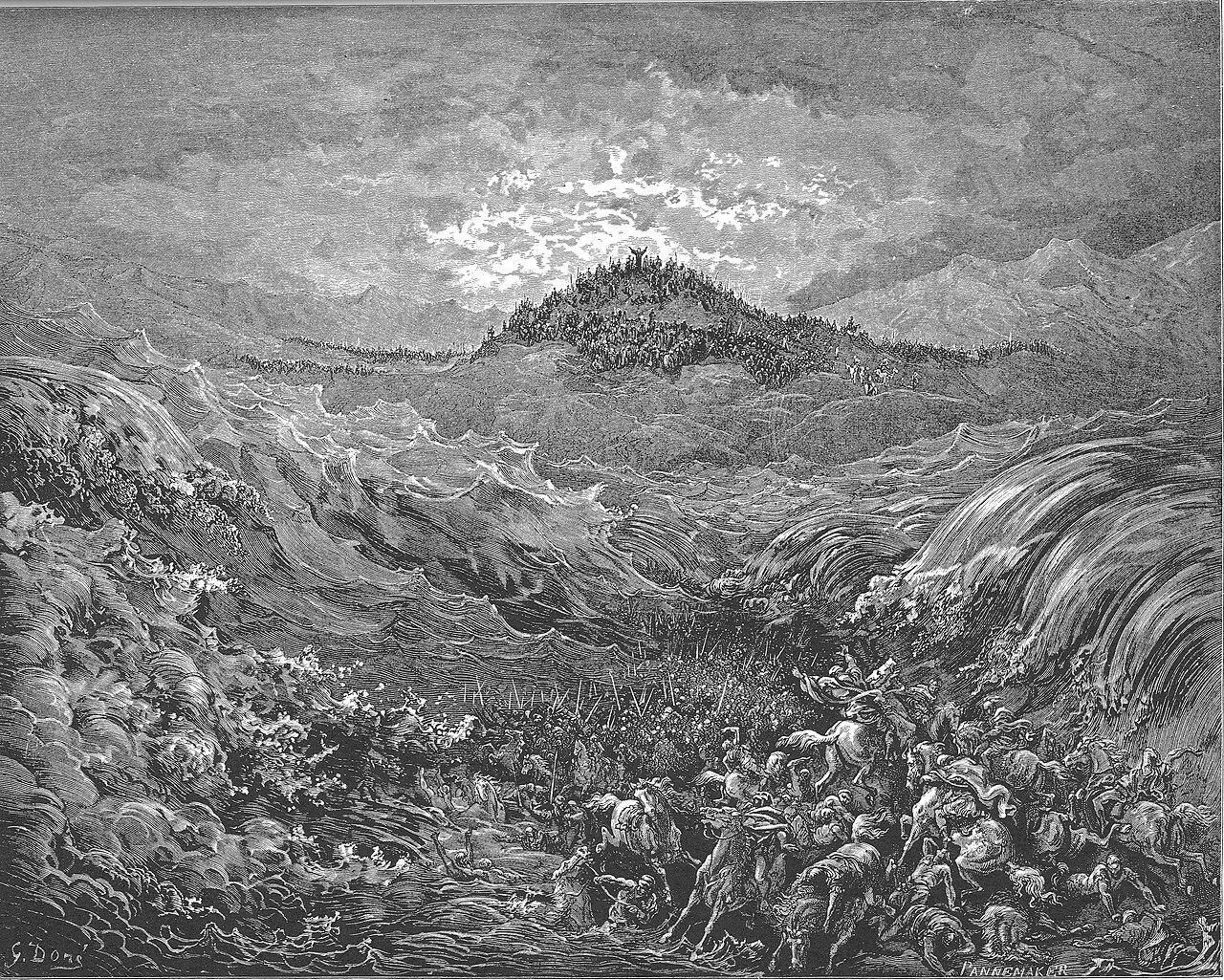
in Exodus 14So Moses stretched out his hand over the sea, and at daybreak the sea returned to its normal state. As the Egyptians were retreating, the LORD swept them into the sea.
BSB
The same verse in ASV and KJV ▾
ASV
And Moses stretched forth his hand over the sea, and the sea returned to its strength when the morning appeared; and the Egyptians fled against it; and Jehovah overthrew the Egyptians in the midst of the sea.
KJV
And Moses stretched forth his hand over the sea, and the sea returned to his strength when the morning appeared; and the Egyptians fled against it; and the Lord overthrew the Egyptians in the midst of the sea.
⋯
This verse in Exodus 14
Commentary
9 notes on this verseA commentator
Albert Barnes1798–1870
Notes, Explanatory and Practical, on the Old and New Testaments (1832-1869)
Overthrew the Egyptians - Better as in the margin, The Lord shook them off, hurled them from their chariots into the sea.
This site's exposition
Stretch out thine hand over the sea
on Exodus 14:26-28
The gesture that opened the sea closes it, and the water returns to his strength when the morning appeared. There remained not so much as one of them, which is the same absolute the text used of Egypt's houses at 12:30, where there was not a house where there was not one dead. Nehemiah 9:11 and Psalm 136:15 sing the event back as Israel's history, and Hebrews 11:29 says the Egyptians assaying to do the same were drowned.
This site's exposition
the LORD swept them into the sea
Albert Barnes renders the verb behind swept as shook off, the LORD hurling the riders from their chariots into the water. Matthew Henry reads the drowning of grown Egyptians as repayment for the newborn sons Egypt threw into the Nile at 1:22. He calls it the debt repaid double.
The record, by era
The Church Fathers2 voices
A commentator
Paulus OrosiusSEVEN BOOKS OF HISTORY AGAINST THE PAGANS 1.10 · Written before 420.
proposed
The Hebrews proceeded safely over the dry passage, and the masses of stationary water collapsed behind them. The entire Egyptian multitude with their king was overwhelmed and killed, and the entire province, which had previously been tortured by plagues, became empty by this last slaughter. …
A commentator
Gregory of NyssaTHE LIFE OF GREGORY THE WONDERWORKER 7.55 · Written before 395.
proposed
But after that the surface of the sea became one again, and the temporary gap was flooded over. So this remains a unique event which occurred in such a way that the marvel did not lose credibility because of the passage of time, since it continues to be testified to by visible traces. That is the way the affair of the marshy lake is both described and shown.
The Puritans and the Awakening3 voices
And now, (1.) God avenged upon the Egyptians the blood of the firstborn whom they had drowned: and the principal is repaid with interest, it is recompensed double, full-grown Egyptians for newborn Israelites; thus the Lord is righteous, and precious is his people's blood in his sight, Ps. lxxii.
And Moses stretched forth his hand over the sea,....
Note, It is very common, but very absurd and criminal, for people to repent of their good deeds; their justice and charity, and even their repentance, are repented of.
1 more voice on this verse
The Nineteenth Century1 voice
A commentator
Jamieson, Fausset & Brown1802–1910
Commentary Critical and Explanatory on the Whole Bible (1871)
Moses stretched forth his hand over the sea, &c.--What circumstances could more clearly demonstrate the miraculous character of this transaction than that at the waving of Moses' rod, the dividing waters left the channel dry, and on his making the same motion on the opposite side, they returned, commingling with instantaneous fury? Is such the character of any ebb tide?
The words behind it
20 Hebrew wordsEvery Hebrew word of this verse in the order it stands, with what it means and the door to its own study. The last column counts the times a word stands in the whole Bible: the rarer the word, the more the places it appears belong together.
| Hebrew | Sound | Meaning | Word study | In the Bible |
|---|---|---|---|---|
| וַיֵּט֩ | vaiyet | and he stretched out | H5186 → | 214 times |
| מֹשֶׁ֨ה | mosheh | Moses | H4872 → | 765 times |
| אֶת־ | ʾet- | <obj.> | H853 → | 10935 times |
| יָד֜וֹ | yado | hand his | H3027 → | 1618 times |
| עַל־ | ʾal- | over | H5921 → | 5755 times |
| הַיָּ֗ם | haiyam | the sea | H3220 → | 396 times |
| וַיָּ֨שָׁב | vaiyashov | and it returned | H7725 → | 1056 times |
| הַיָּ֜ם | haiyam | the sea | H3220 → | 396 times |
| לִפְנ֥וֹת | lifnot | to [the] turning of | H6437 → | 135 times |
| בֹּ֙קֶר֙ | boker | morning | H1242 → | 214 times |
| לְאֵ֣יתָנ֔וֹ | leeitano | to normal [state] its | H386 → | |
| וּמִצְרַ֖יִם | umitzrayim | and Egypt | H4714 → | 641 times |
| נָסִ֣ים | nasim | [were] fleeing | H5127 → | 159 times |
| לִקְרָאת֑וֹ | likrato | to meet it | H7122 → | 139 times |
| וַיְנַעֵ֧ר | vaynaer | and he shook off | H5287 → | |
| יְהוָ֛ה | yahweh | Yahweh | H3068 → | 6520 times |
| אֶת־ | ʾet- | <obj.> | H853 → | 10935 times |
| מִצְרַ֖יִם | mitzrayim | Egypt | H4714 → | 641 times |
| בְּת֥וֹךְ | betokh | in [the] middle of | H8432 → | 418 times |
| הַיָּֽם׃ | haiyam | the sea | H3220 → | 396 times |
וַיֵּט֩and he stretched out
vaiyetH5186 →214 times
מֹשֶׁ֨הMoses
moshehH4872 →765 times
אֶת־<obj.>
ʾet-H853 →10935 times
יָד֜וֹhand his
yadoH3027 →1618 times
עַל־over
ʾal-H5921 →5755 times
הַיָּ֗םthe sea
haiyamH3220 →396 times
וַיָּ֨שָׁבand it returned
vaiyashovH7725 →1056 times
הַיָּ֜םthe sea
haiyamH3220 →396 times
לִפְנ֥וֹתto [the] turning of
lifnotH6437 →135 times
בֹּ֙קֶר֙morning
bokerH1242 →214 times
לְאֵ֣יתָנ֔וֹto normal [state] its
leeitanoH386 →
וּמִצְרַ֖יִםand Egypt
umitzrayimH4714 →641 times
נָסִ֣ים[were] fleeing
nasimH5127 →159 times
לִקְרָאת֑וֹto meet it
likratoH7122 →139 times
וַיְנַעֵ֧רand he shook off
vaynaerH5287 →
יְהוָ֛הYahweh
yahwehH3068 →6520 times
אֶת־<obj.>
ʾet-H853 →10935 times
מִצְרַ֖יִםEgypt
mitzrayimH4714 →641 times
בְּת֥וֹךְin [the] middle of
betokhH8432 →418 times
הַיָּֽם׃the sea
haiyamH3220 →396 times
A shaded row is a word that stands 400 times or fewer in the Bible.
The walk
8 stopsEach card is a verse this one points to, and under it the verses that one points to in turn. Where several paths arrive at the same place, that place is listed first: the text keeps returning to it.
Through
Psalms 78:53He led them safely, so they did not fear, but the sea engulfed their enemies.
it leads to
- Exodus 14:19–20
And the angel of God, who had gone before the camp of Israel, withdrew and went behind them. The pillar of cloud also moved from before them and stood behind them,
- Exodus 15:10
But You blew with Your breath, and the sea covered them. They sank like lead in the mighty waters.
- Exodus 14:27–28
So Moses stretched out his hand over the sea, and at daybreak the sea returned to its normal state. As the Egyptians were retreating, the LORD swept them into the sea.
- Exodus 14:15
Then the LORD said to Moses, “Why are you crying out to Me? Tell the Israelites to go forward.
- Psalms 136:15
but swept Pharaoh and his army into the Red Sea. His loving devotion endures forever.
- Exodus 14:19–20
Through
Joshua 4:18When the priests carrying the ark of the covenant of the LORD came up out of the Jordan and their feet touched the dry land, the waters of the Jordan returned to their course…
it leads to
- Joshua 3:15
Now the Jordan overflows its banks throughout the harvest season. But as soon as the priests carrying the ark reached the Jordan and their feet touched the water’s edge,
- Joshua 3:15
Through
Hebrews 11:29By faith the people passed through the Red Sea as on dry land; but when the Egyptians tried to follow, they were drowned.
it leads to
- Psalms 106:9–11
He rebuked the Red Sea, and it dried up; He led them through the depths as through a desert.
- Psalms 78:13
He split the sea and brought them through; He set the waters upright like a wall.
- Psalms 106:9–11
Where this verse is studied
On this page
Studies4
About Exodus
Who and where
1 name in this verse with a page on the site.
This page draws on Albert Barnes, Notes, Explanatory and Practical, on the Old and New Testaments (1832-1869); Albert Barnes, Notes, Explanatory and Practical, on the Old and New Testaments; Gregory of Nyssa, THE LIFE OF GREGORY THE WONDERWORKER 7.55; Jamieson, Fausset & Brown, Commentary Critical and Explanatory on the Whole Bible; John Gill, Exposition of the Old Testament; John Gill, Exposition of the Old Testament (1748-1763); Matthew Henry, Commentary on the Whole Bible and Paulus Orosius, SEVEN BOOKS OF HISTORY AGAINST THE PAGANS 1.10.