
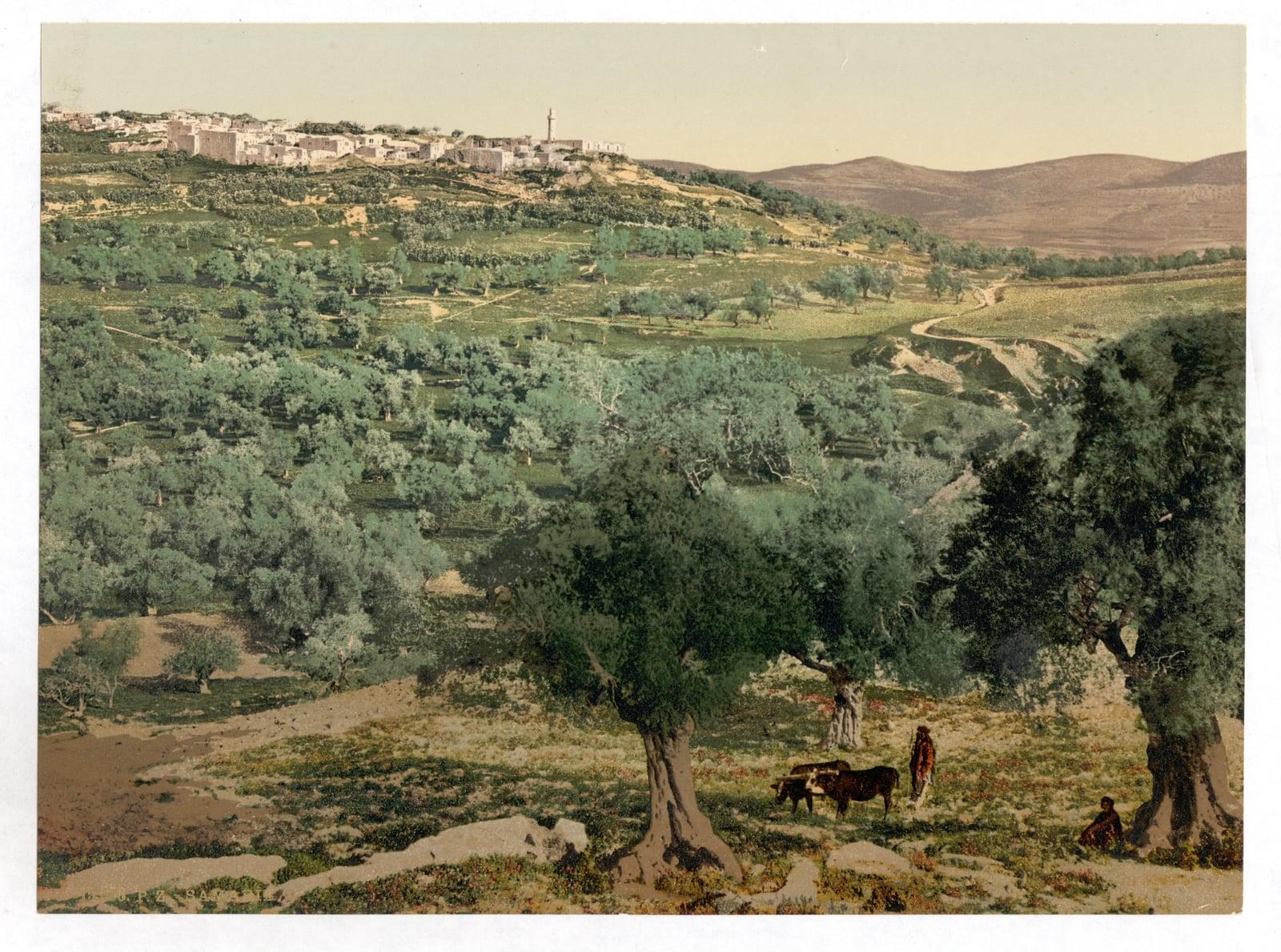
General View, Samaria, Holy Land, 1890 to 1900. Public domain.
2 Kings 14:23 to 29 · Person · Featured Study
Jeroboam the Second and the Word by Jonah
Israel's old border came back in his reign, as the LORD had said through the prophet Jonah.
This Jeroboam restored the boundary of Israel from Lebo-hamath to the Sea of the Arabah, according to the word that the LORD, the God of Israel, had spoken through His servant Jonah son of Amittai, the prophet from Gath-hepher.
- Family
- great-grandfather: Jehu; grandfather: Jehoahaz; father: Jehoash; son: Zechariah
- Places
- Samaria, Damascus, Bethel
- First named
- 2 Kings 13:13 “…rested with his fathers, and Jeroboam succeeded him…”
- Last named
- Amos 7:11 “…is what Amos has said: ‘Jeroboam will die…”
He did evil in the LORD's sight, and the LORD saved Israel by his hand.
Summary
Jeroboam son of Jehoash, the great-grandson of Jehu, reigned forty-one years in Samaria. He kept the calves of Jeroboam son of Nebat, and Hosea and Amos prophesied in his days.
- Second Kings tells his reign in seven verses.
- He bears the name of the first king of Israel.
- Amos spoke of ivory beds in Samaria in his reign.
- His son Zechariah was the last king of Jehu's line.
Where Jeroboam Stands in Scripture
He is the second king of Israel named Jeroboam.
Strong's dictionary gives the name Jeroboam to two kings of Israel. The second is the son of Jehoash and the great-grandson of Jehu, and the prophets Hosea and Amos date their words by his reign.
In the fifteenth year of the reign of Amaziah son of Joash over Judah, Jeroboam son of Jehoash became king of Israel, and he reigned in Samaria forty-one years.The page on Jeroboam son of Nebat teaches the first king of the name and the calves he set up.
The page Hosea and Gomer teaches the prophet who dated his word by this reign.
His Reign, Turn by Turn
His reign runs from his father's death to his own.
Six turns come from Kings, and four from Hosea, Amos and Chronicles.
- Succeeds his father JehoashSamaria2 Kings 14:16
- Begins a reign of forty-one yearsSamaria2 Kings 14:23
- Wins back Israel's old borderIsrael2 Kings 14:25
- Recovers Damascus and HamathAram2 Kings 14:28
- Azariah becomes king of Judah in his twenty-seventh yearJerusalem2 Kings 15:1
- Hosea receives the word of the LORDIsraelHosea 1:1
- Amos sees his visions two years before the earthquakeTekoaAmos 1:1
- Hears that Amos has conspired against himBethelAmos 7:10
- The families of Gad are reckoned in the genealogiesGilead1 Chronicles 5:17
- Dies, and his son Zechariah reignsSamaria2 Kings 14:29
The text dates his accession by Amaziah's fifteenth year and Azariah's by his own twenty-seventh.
Amos sees his visions two years before the earthquake, Hears that Amos has conspired against him, The families of Gad are reckoned in the genealogies, Dies, and his son Zechariah reigns
The Word Spoken Through Jonah
Four turns, from the oppression before his reign to Amos at Bethel.
Jeroboam came to a kingdom that Aram had pressed for two reigns, and he left it with its old border restored.
Israel under Aram2 Kings 13:3 to 25
So the anger of the LORD burned against Israel, and He delivered them continually into the hands of Hazael king of Aram and his son Ben-hadad.Albert Barnes reads the affliction of 2 Kings 14:26 as this oppression.
Jeroboam's father Jehoash defeated Ben-hadad three times and took back the cities his own father had lost.
The border restored2 Kings 14:25; Matthew Henry
Matthew Henry draws a lesson from the prophet's coming.
“It is a sign that God has not cast off his people if he continue faithful ministers among them; when Elisha, who strengthened the hands of Joash, was removed, Jonah was sent to encourage his son.”
Matthew Henry · Commentary on the Whole Bible · on 2 Kings 14:24Puritan
The page Jonah, the Man Who Ran follows the same prophet to Nineveh.
The LORD's two reasons2 Kings 14:26 to 27
For the LORD saw that the affliction of the Israelites, both slave and free, was very bitter. There was no one to help Israel, and since the LORD had said that He would not blot out the name of Israel from under heaven, He saved them by the hand of Jeroboam son of Jehoash.The narrator gives the LORD's reasons and names no merit in the king.
Amos at BethelAmos 7:10 to 11
Then Amaziah the priest of Bethel sent word to Jeroboam king of Israel, saying, “Amos has conspired against you in the midst of the house of Israel. The land cannot bear all his words, for this is what Amos has said: ‘Jeroboam will die by the sword, and Israel will surely go into exile, away from their homeland.’”The page Amos and the Courts at the Gate teaches the prophet's charge against Israel's courts.
Jehu's House at Its Height
Jeroboam was the third generation of Jehu's sons on the throne.
His son Zechariah, the fourth generation, was killed by Shallum.
So the word of the LORD spoken to Jehu was fulfilled: “Four generations of your sons will sit on the throne of Israel.”The Family of Jeroboam
His circle runs from his great-grandfather Jehu to his son Zechariah.
He was the fourth of the five kings of Jehu's house.
His fathers
His own day
- JeroboamThe king himself
- Amaziah of JudahKing of Judah when Jeroboam came to the throne
- Azariah of JudahCrowned in Jeroboam's twenty-seventh year
- Jonah son of AmittaiThe prophet of the restored border
After him
- ZechariahHis son, killed by Shallum after six months
Jehoahaz, Jehoash and Jeroboam each followed his father on the throne.
The Places of His Reign
Seven places mark his reign, from Gath-hepher to Bethel.
Two of the places mark the ends of his restored border.
| Place | What Scripture tells of it | Book |
|---|---|---|
| Samaria | He reigned there. | 2 Kings |
| Lebo-hamath | His restored border began there in the north. | 2 Kings |
| The Sea of the Arabah | His border reached it in the south. | 2 Kings |
| Gath-hepher | Jonah son of Amittai came from there. | 2 Kings |
| Damascus | He recovered it for Israel. | 2 Kings |
| Hamath | He recovered it as well. | 2 Kings |
| Bethel | The priest called it the king's sanctuary. | Amos |
Questions His Reign Raises
Two questions are answered from the text and its commentators.
Why was he named Jeroboam?Albert Barnes and Matthew Henry
Albert Barnes, in his Notes on 2 Kings 14:23, calls this the one case of a king's name used again in either kingdom. He judges that a father hoped his son would prove a second Jeroboam.
Matthew Henry reads the name the other way.
“Here is an account of the reign of Jeroboam the second. I doubt it is an indication of the affection and adherence of the house of Jehu to the sins of Jeroboam the son of Nebat, who made Israel to sin, that they called an heir-apparent to the crown by his name, thinking that an honourable name which in the book of God is infamous and stigmatized as much as any.”
Matthew Henry · Commentary on the Whole Bible · on 2 Kings 14:23Puritan
Did he die by the sword?Amos 7:9, Amos 7:11 and 2 Kings 14:29, with John Gill and C. F. Keil
The high places of Isaac will be deserted, and the sanctuaries of Israel will be laid waste; and I will rise up against the house of Jeroboam with My sword.”Amaziah reported Amos as saying that Jeroboam himself would die by the sword. John Gill, in his Exposition on Amos 7:11, notes that Amos spoke of the house of Jeroboam, and that Jeroboam's son Zechariah died by the sword while Jeroboam did not.
Then Shallum son of Jabesh conspired against Zechariah, struck him down and killed him in front of the people, and reigned in his place.C. F. Keil, in his commentary on Amos, reads it the other way. The head of the house is included in the house, so Amos had in substance said what the priest reported, and Keil sees no slander in it.
What the Text Leaves Unsaid
The text leaves two things about him untold.
Kings names no battle of his wars and gives no year for the recovery of Damascus and Hamath.
Amos 7 records the priest's message to the king and no reply from Jeroboam.
The Same Border, Turned
Amos marked the coming oppression with the bounds of Jeroboam's kingdom.
C. F. Keil, in The Books of the Kings, notes that Amos 6:14 marks Jeroboam's kingdom in the same way, naming the brook of the Arabah where Kings has the sea. He takes the brook for the wady between Moab and Edom, and so reads Moab as subject to Jeroboam.
For behold, I will raise up a nation against you, O house of Israel,” declares the LORD, the God of Hosts, “and they will oppress you from Lebo-hamath to the Brook of the Arabah.”Voices on Jeroboam
Matthew Henry and Albert Barnes wrote on the mercy of his reign and the ease of Samaria.
Matthew Henry (1662 to 1714)
Commentary on the Whole Bible
Matthew Henry looked past the ten tribes in 2 Kings 14:27.
“If this be understood of the dispersion of the ten tribes, he did say it and do it, for that name still remains under heaven in the gospel Israel, and will to the end of time; and because they, at present, bore that name which was to have this lasting honour, he showed them this favour, as well as for the sake of the ancient honour of that name, ch. xiii.”
on 2 Kings 14:27Puritan
Albert Barnes (1798 to 1870)
Notes, Explanatory and Practical, on the Old and New Testaments, on Amos 6:1
Albert Barnes read the prophet's charge against the rich.
“It is that luxury and ease, which sensualize the soul, and make it dull, stupid, hard-hearted. By one earnest, passing word, the prophet warns his own land, that present sinful ease ends in future woe.”
Presbyterian
Damascus and Hamath, From Judah?
Second Kings 14:28 says Jeroboam recovered Damascus and Hamath for Israel from Judah, and readers differ on what from Judah means.
As for the rest of the acts of Jeroboam, along with all his accomplishments and might, and how he waged war and recovered both Damascus and Hamath for Israel from Judah, are they not written in the Book of the Chronicles of the Kings of Israel?Cities Judah held under DavidAdam Clarke
Adam Clarke, in his Commentary on 2 Kings 14:28, holds that David had conquered Syria and set garrisons in Damascus (1 Chronicles 18). On his reading Jeroboam won back for Israel places that had once belonged to Judah by David's conquests.
The objection is Keil's: the city of Hamath never belonged to Israel and lay outside the border Moses set in Numbers 34:8, so Jeroboam could not have won it back.
The lands of the two kingdomsC. F. Keil
C. F. Keil, in The Books of the Kings, reads Damascus and Hamath as the two kingdoms, with the city of Damascus counted in its kingdom. Jeroboam recovered whatever in those kingdoms had belonged to Judah in the days of David and Solomon.
The objection is Clarke's: the places David garrisoned included the city of Damascus itself.
Books to Read Next
Both works are in the public domain, and each has a free copy to read.
The Books of the Kings
C. F. Keil, translated by James Martin · 1872
Keil explains the border of 2 Kings 14:25 and the reading of 2 Kings 14:28 in his notes on the reign.
Read at the Internet ArchiveThe Twelve Minor Prophets, volume 1
C. F. Keil · 1878
Keil weighs the priest's report of Amos 7:11 in his notes on Amos 7.
Read at the Internet ArchiveThe Arm That Saves
Israel's rescue in this reign came through a king who kept the calves. Isaiah promises a rescue the LORD carries out Himself.
He saw that there was no man; He was amazed that there was no one to intercede. So His own arm brought salvation, and His own righteousness sustained Him.Sources
Scripture is the Berean Standard Bible.
- James Strong, Exhaustive Concordance of the Bible (1890), Hebrew dictionary, entries 3379 and 3124, and the verses that carry them.
- C. F. Keil, The Books of the Kings, translated by James Martin, T. and T. Clark, 1872, pp. 385 to 386.
- C. F. Keil, The Twelve Minor Prophets, volume 1, translated by James Martin, T. and T. Clark, printing of 1878, pp. 311 to 312.
- Matthew Henry, Commentary on the Whole Bible (1710), on 2 Kings 14:23, 2 Kings 14:24 and 2 Kings 14:27.
- Albert Barnes, Notes, Explanatory and Practical, on the Old and New Testaments (1832 to 1869), on 2 Kings 14:23, 2 Kings 14:26 and Amos 6:1.
- Adam Clarke, Commentary on the Bible (1832), on 2 Kings 14:28.
- John Gill, Exposition of the Old Testament (1748 to 1763), on Amos 7:11.
Keep Studying
Read it4
Studies5
People and groups6
Symbols1
Doctrines1