
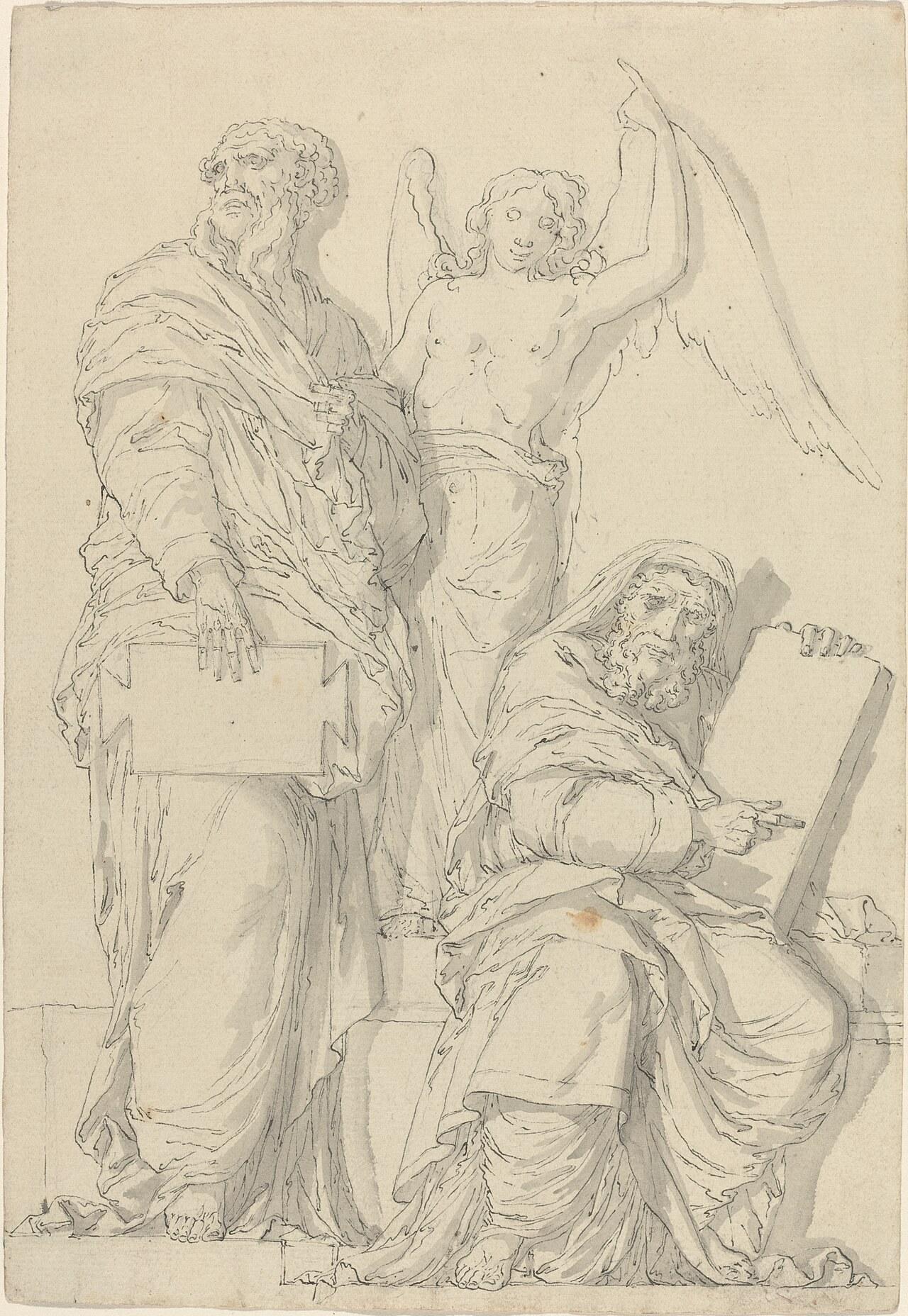
Louis-Félix de La Rue after Raphael, The Prophets Hosea and Jonah. CC0.
Hosea 1 to 3 and Hosea 14 · Person · Featured Study
Hosea, the Prophet to Israel
Hosea son of Beeri spoke for the LORD in the days of Jeroboam of Israel and four kings of Judah.
The LORD told Hosea to name his first son Jezreel, the town where Jehu had killed all who remained of the house of Ahab.
Return, O Israel, to the LORD your God, for you have stumbled by your iniquity.
Return, O Israel, to the LORD your God, for you have stumbled by your iniquity.
- The name means
- a saviour, the same name as Joshua, as John Gill gives it
- Family
- father: Beeri; wife: Gomer daughter of Diblaim; son: Jezreel; daughter: Lo-ruhamah; son: Lo-ammi
- Places
- Samaria, Jezreel, Bethel, Gilgal
- First named
- Hosea 1:1 “…the LORD that came to Hosea son of…”
- Last named
- Romans 9:25 “As He says in Hosea: “I will…”
Summary
Hosea was the prophet whose own marriage the LORD made into a message to Israel. At the LORD's command he married Gomer and later bought her back.
- Second Kings records that Samaria fell to Assyria in the ninth year of King Hoshea.
- Paul turns Hosea's question to death into a cry of victory in 1 Corinthians 15:55.
- Readers reckon his years of service from about sixty-six to about eighty.
The Word That Came to Hosea
The opening verses name his father and give the command about his marriage.
This is the word of the LORD that came to Hosea son of Beeri in the days of Uzziah, Jotham, Ahaz, and Hezekiah, kings of Judah, and of Jeroboam son of Jehoash, king of Israel.Every later word of the book is set in the reigns this line names.
When the LORD first spoke through Hosea, He told him, “Go, take a prostitute as your wife and have children of adultery, because this land is flagrantly prostituting itself by departing from the LORD.” So Hosea went and married Gomer daughter of Diblaim, and she conceived and bore him a son.Hosea's obedience to this command shapes the first three chapters of his book.
His Life in the Order of His Book
Chapters 1 to 3 tell of his household, and chapters 4 to 14 hold his preaching to Israel.
His call, his marriage and his children open his book, and a call to return closes it.
- The call to prophesyChapter 1Hosea 1:1
- The marriage to GomerChapter 1Hosea 1:3
- Three children are bornChapter 1Hosea 1:4 to 9
- Gomer is bought backChapter 3Hosea 3:2
- The LORD's case against IsraelChapter 4Hosea 4:1
- The call to returnChapter 14Hosea 14:1
Six turns, from chapter 1 to chapter 14.
The Last Years of Israel
Jeroboam's long reign opened Hosea's days, and Assyria's armies ended the kingdom.
In the fifteenth year of the reign of Amaziah son of Joash over Judah, Jeroboam son of Jehoash became king of Israel, and he reigned in Samaria forty-one years.Hosea 1:1 sets the prophet's work in this reign.
Jamieson, Fausset and Brown note that Jonah had promised Jeroboam success, and that the king restored Israel's coast from Hamath to the sea.
In the days of Pekah king of Israel, Tiglath-pileser king of Assyria came and captured Ijon, Abel-beth-maacah, Janoah, Kedesh, Hazor, Gilead, and Galilee, including all the land of Naphtali, and he took the people as captives to Assyria.Assyria's first deportation from Israel comes before the fall of Samaria in 2 Kings 17.
In the ninth year of Hoshea, the king of Assyria captured Samaria and carried away the Israelites to Assyria, where he settled them in Halah, in Gozan by the Habor River, and in the cities of the Medes.This is the end of the kingdom that Hosea warned in Hosea 13:16.
The Household of Hosea
The first chapter of his book names everyone in his house.
Beeri's son married Diblaim's daughter, and three children were born to them.
The marriage and the price Hosea paid are taught on one page, and the reversal of the children's names on another.
The Towns He Names
Hosea names towns from Jezreel and Gilead to Gibeah and Ramah in Benjamin.
Hosea's words fall on the shrines and the capital of the north and on the border towns of Benjamin.
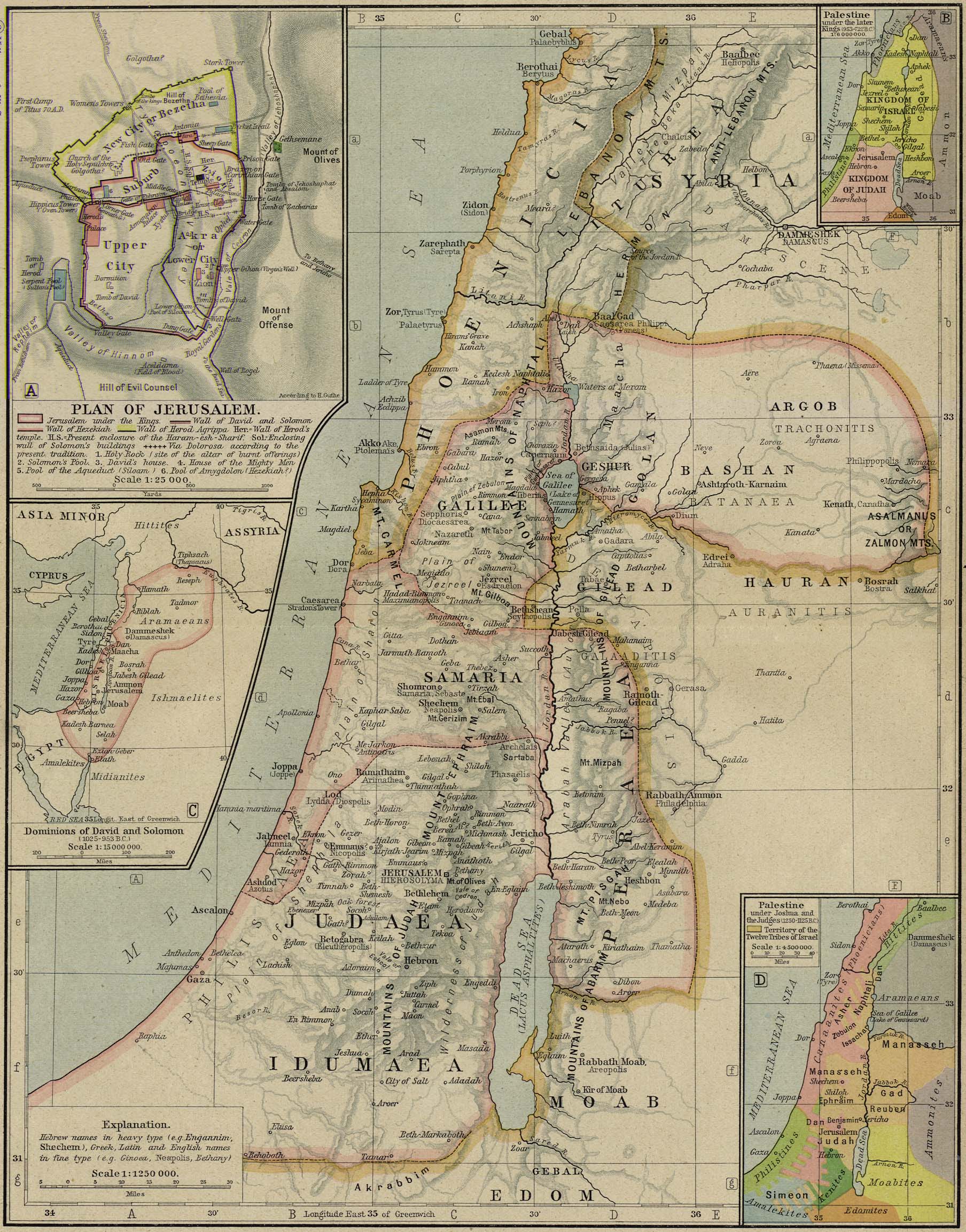
- Located: the site is known
- Identified: the point stands for an area, or is rounded
- 1Jezreel, The LORD will break the bow of Israel in its valley. Hosea 1:5
- 2Samaria, The city will bear her guilt and fall by the sword. Hosea 13:16
- 3Bethel, Its people will mourn for the calf taken into exile. Hosea 10:5
- 4Gilgal, Judah is told not to journey there. Hosea 4:15
- 5Gibeah, The ram's horn is to be blown there. Hosea 5:8
- 6Ramah, The trumpet is to sound there. Hosea 5:8
Base map: Reference map of ancient Palestine, Rand McNally reference map (1926), public domain. Each place stands at its place page's coordinates, set on the plate by Jerusalem and Damascus, as the plate prints them.
Six towns of his book.
Hosea calls Bethel by the name Beth-aven. John Wesley explains that Bethel, the house of God where Jacob lodged, became Beth-aven, the house of vanity, when Jeroboam made it the place of his calf worship.
After seeking advice, the king made two golden calves and said to the people, “Going up to Jerusalem is too much for you. Here, O Israel, are your gods, who brought you up out of the land of Egypt.” One calf he set up in Bethel, and the other in Dan.Jeroboam, the first king of the northern kingdom, set up the calf at Bethel that Wesley means.
Hosea also promises that the Valley of Achor will become a gateway of hope.
Hosea in the New Testament
Eight verses of the Gospels and of the letters of Paul and Peter take up words of Hosea.
where he stayed until the death of Herod. This fulfilled what the Lord had spoken through the prophet: “Out of Egypt I called My Son.”Matthew reads the words of Hosea 11:1 about Israel as fulfilled when Jesus came back from Egypt.
But go and learn what this means: ‘I desire mercy, not sacrifice.’ For I have not come to call the righteous, but sinners.”Jesus answers the Pharisees' complaint about the company He keeps with Hosea 6:6.
If only you had known the meaning of ‘I desire mercy, not sacrifice,’ you would not have condemned the innocent.Jesus uses Hosea 6:6 a second time when His disciples are accused of breaking the Sabbath.
Mercy and Sacrifice in Hosea 6:6
At that time ‘they will say to the mountains, “Fall on us!” and to the hills, “Cover us!”’On the road to the cross Jesus takes the cry of Hosea 10:8 for the days coming on Jerusalem.
As He says in Hosea: “I will call them ‘My People’ who are not My people, and I will call her ‘My Beloved’ who is not My beloved,” and, “It will happen that in the very place where it was said to them, ‘You are not My people,’ they will be called ‘sons of the living God.’”Paul quotes Hosea 2:23 and Hosea 1:10 for the people God has called from the Jews and from the Gentiles.
Once you were not a people, but now you are the people of God; once you had not received mercy, but now you have received mercy.Peter gives the reversal of the names Lo-ammi and Lo-ruhamah to the exiles he writes to.
“Where, O Death, is your victory? Where, O Death, is your sting?”Paul sets the words of Hosea 13:14 in his teaching on the resurrection of the dead.
Matthew 12:7, Luke 23:30, Romans 9:25 to 26, 1 Peter 2:10, 1 Corinthians 15:55
Voices on His Last Words
Two writers of the early church used Hosea's last verse in their own arguments.
Origen of Alexandria (died 253)
Whoever is wise, let him understand these things; whoever is discerning, let him know them. For the ways of the LORD are right, and the righteous walk in them but the rebellious stumble in them.Hosea sets his whole book before the reader as a test of wisdom.
Origen used the verse in his answer to a pagan critic of the church.
“And to such a degree does the gospel desire that there should be wise people among believers, that for the sake of exercising the understanding of its hearers, it has spoken certain truths in enigmas, others in what are called ‘dark’ sayings, others in parables, and others in problems. And one of the prophets—Hosea—says at the end of his prophecy, ‘Who is wise, and he will understand these things? Or prudent, and he shall know them?’”
Origen of Alexandria · Against Celsus 3:45 · on Hosea 14:9Patristic
Cyril of Alexandria (died 444)
Cyril of Alexandria made the verse a rule for reading the Old Testament.
“It is only by deeply considering the matters in the divinely inspired Scriptures that we shall find the hidden truth. It would be fitting for us when looking into the dark shadows of the law to say what one of the holy prophets rightly said, ‘Whoever will be wise will understand these things; and whoever will be prudent will know them.’ ‘For the law is but a shadow of the good things to come, and not the exact image of the objects,’ as it is written. Yet the shadows bring forth the truth, even if they do not contain the whole truth in themselves. Because of this, the divinely inspired Moses placed a veil upon his face and spoke thus to the children of Israel, all but shouting by this act that a person might behold the beauty of the utterances made through him, not in outwardly appearing figures but in meditations hidden within us.”
Cyril of Alexandria · LETTER 41:7 · on Hosea 14:9Patristic
How Long Did Hosea Prophesy?
Readers differ on how long Hosea worked and on what the opening verse of his book dates.
About sixty-six yearsBishop William Newcome, as Adam Clarke reports him
Some eighty yearsAlbert Barnes, Notes on Hosea 1:2
Barnes reasoned from that span that Hosea was in his early youth when the LORD first spoke through him.
Against this reading Newcome reckoned a shorter span from the same reigns.
A title for the reigns his words outlivedAdam Clarke, Commentary on Hosea 1:1
Clarke judged the first verse a title added by whoever gathered the prophecies, naming the reigns in which Hosea's predictions came true even after his death. On his reading the prophet's own work begins at Hosea 1:2.
Against this reading Jerome took the kings of the title as the rulers to whom the prophets spoke while they reigned. He read Hosea 1:2 to say that the LORD spoke through Hosea first among them.
Return, O Israel
In Hosea 14:4 the LORD answers that call with a promise to heal and to love.
Sources
Scripture is the Berean Standard Bible.
- Adam Clarke, Commentary on the Bible (1832), on Hosea 1:1, reporting Bishop William Newcome.
- Albert Barnes, Notes, Explanatory and Practical (1832 to 1869), on Hosea 1:2.
- Jerome (died 420), Commentary on Hosea, on Hosea 1:2.
- John Gill, Exposition of the Old Testament (1748 to 1763), on Hosea 1:1.
- Jamieson, Fausset and Brown, Commentary Critical and Explanatory on the Whole Bible (1871), on Hosea 1:1.
- John Wesley, Explanatory Notes upon the Old Testament (1765), on Hosea 4:15.
- Cyril of Alexandria (died 444), Letter 41:7, on Hosea 14:9.
- Origen of Alexandria (died 253), Against Celsus 3:45, on Hosea 14:9.
Keep Studying
Read it4
People and groups13
Places7
Symbols1
Subjects6
Go further8