
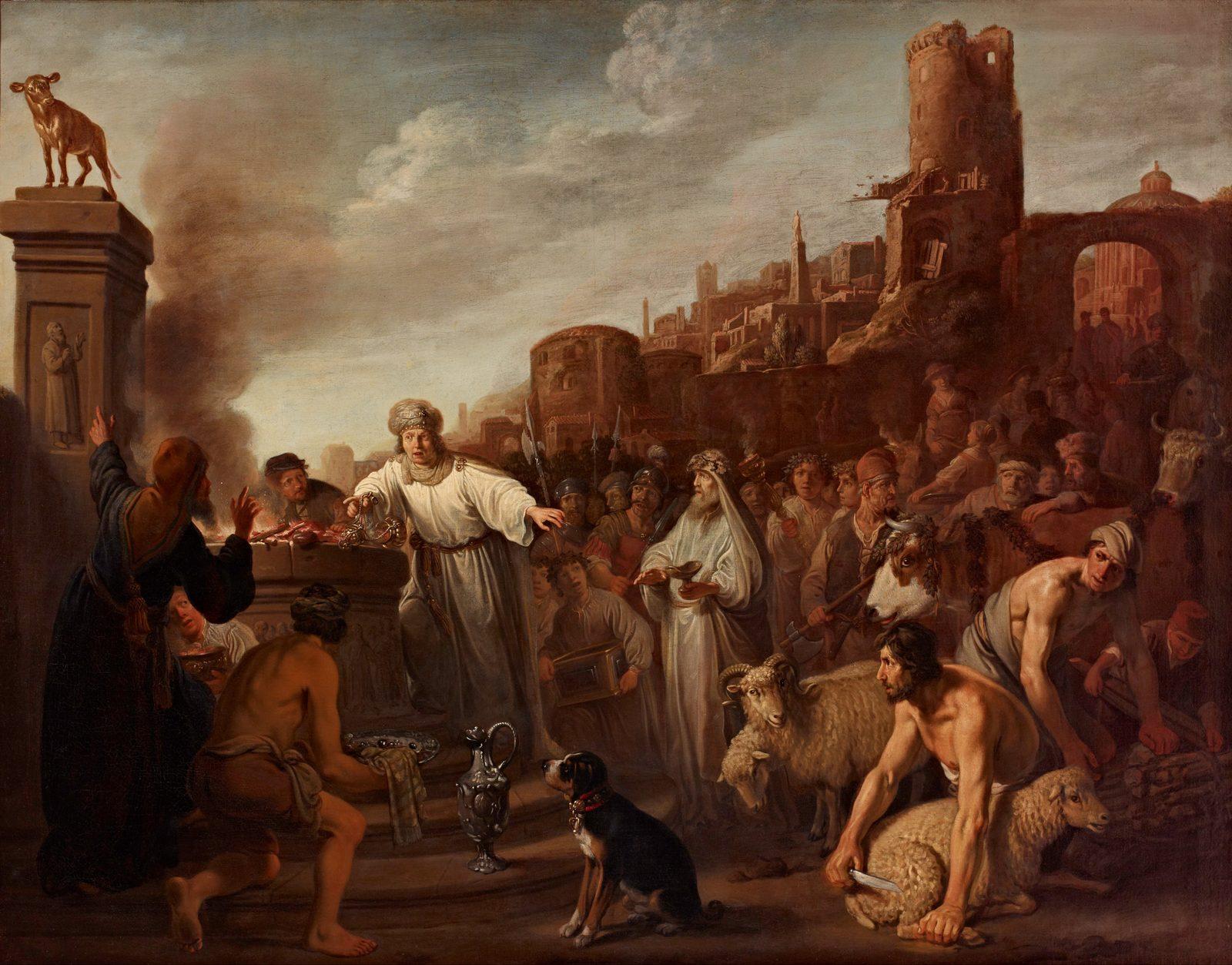
Claes Moeyaert, The Sacrifice of Jeroboam, 1641. Public domain.
1 Kings 12 · Subject · Featured Study
The Calves of Bethel and Dan
Jeroboam I set a golden calf at Bethel and another at Dan, and the northern kingdom worshipped before them until Assyria carried it away.
Jeroboam said in his heart, “Now the kingdom might revert to the house of David. If these people go up to offer sacrifices in the house of the LORD at Jerusalem, their hearts will return to their lord, Rehoboam king of Judah; then they will kill me and return to Rehoboam king of Judah.”
- Books
- 1 Kings, Exodus, Hosea
- Hold in memory
- Hosea 8:6, 1 John 5:21
Jeroboam feared that his people would go back to the house of David, so he gave them gods of their own.
Summary
Jeroboam I, the first king of the north, built a rival worship for his kingdom.
- Bethel was holy ground from Jacob's day, and Dan had kept an idol since the judges.
- Jehu wiped out Baal worship and kept the calves, and Hosea said Assyria would take the calf.
- The diggers at Tel Dan found a raised platform and an altar, and no calf.
- Readers differ on whether the calves stood for the LORD, held Him up, or were other gods.
Jeroboam's Two Calves
1 Kings 12 tells why the king made the calves and what he said over them.
The northern tribes had broken away from Solomon's son and crowned Jeroboam.
And Jeroboam ordained a feast on the fifteenth day of the eighth month, like the feast that was in Judah, and he offered sacrifices on the altar; he made this offering in Bethel to sacrifice to the calves he had set up, and he installed priests in Bethel for the high places he had set up. On the fifteenth day of the eighth month, a month of his own choosing, Jeroboam offered sacrifices on the altar he had set up in Bethel. So he ordained a feast for the Israelites, offered sacrifices on the altar, and burned incense.The new feast keeps the form of the LORD's feast and moves its date.
He took the gold from their hands, and with an engraving tool he fashioned it into a molten calf. And they said, “These, O Israel, are your gods, who brought you up out of the land of Egypt!” When Aaron saw this, he built an altar before the calf and proclaimed: “Tomorrow shall be a feast to the LORD.”At Sinai the priest led the people's worship of the image, as the king would lead it at Bethel.
After seeking advice, the king made two golden calves and said to the people, “Going up to Jerusalem is too much for you. Here, O Israel, are your gods, who brought you up out of the land of Egypt.”Jeroboam gives his calves the same words, almost to the letter.
The Shrines on the Map and Beside Sinai
A map of the two shrines, and Sinai set beside Bethel point by point.
Bethel lay near the border with Judah, and Dan at the northern edge of the kingdom.
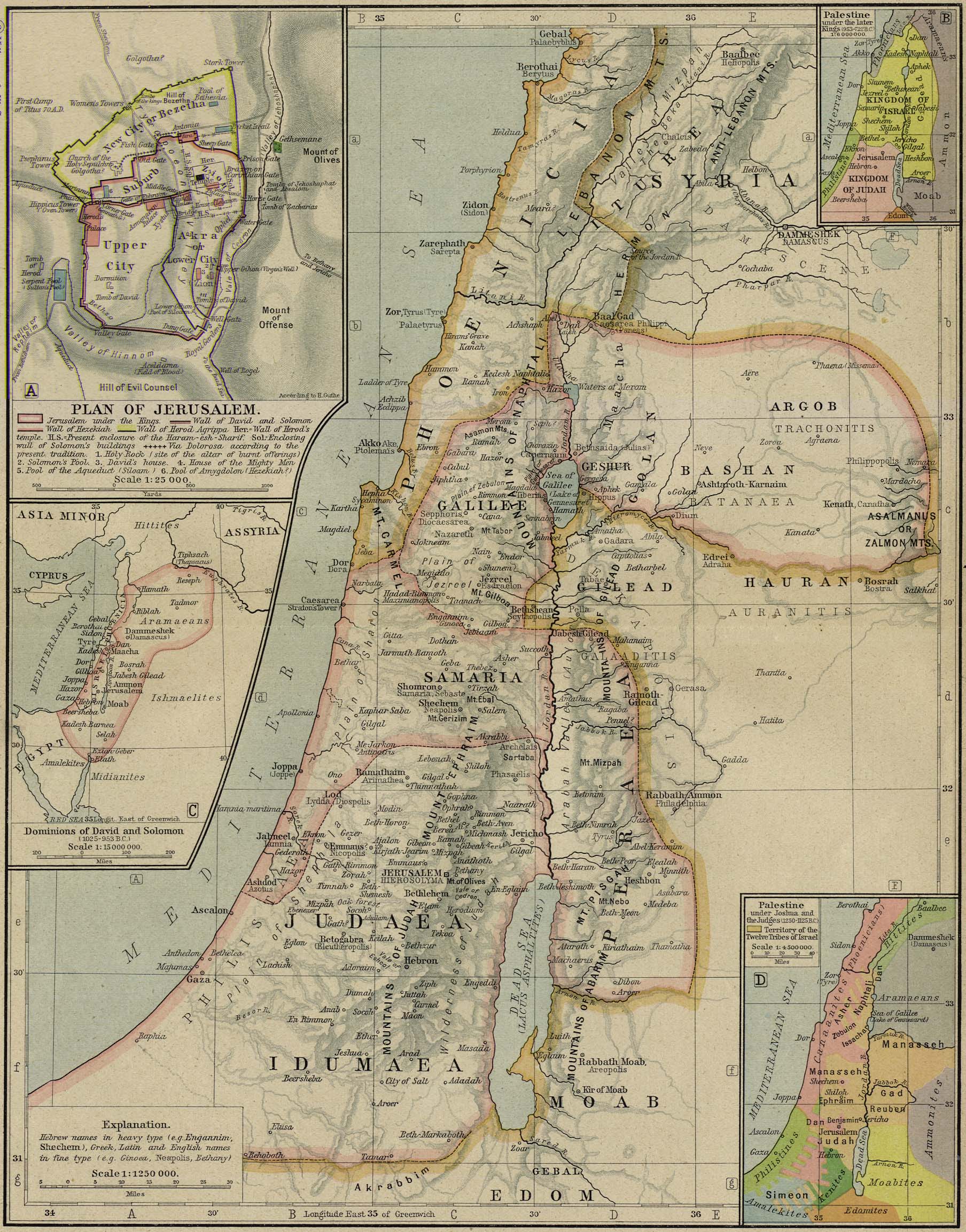
- 1Dan, The people walked as far as Dan to worship before one of the calves. 1 Kings 12:30
- 2Shechem, Jeroboam built Shechem in the hill country of Ephraim and lived there. 1 Kings 12:25
- 3Penuel, From Shechem Jeroboam went out and built Penuel. 1 Kings 12:25
- 4Bethel, Jeroboam set up the other calf here and offered sacrifices on his altar. 1 Kings 12:29 to 33
- 5Jerusalem, The house of the LORD, where Jeroboam feared his people would go up to sacrifice. 1 Kings 12:27
Base map: Reference map of ancient Palestine, Rand McNally reference map (1926), public domain. Each place stands at its place page's coordinates, set on the plate by Jerusalem and Damascus, as the plate prints them.
Five places of the story marked on the plate, each with its verse.
Jeroboam repeated the calf of Sinai in its words, its altar and its feast, with a king in Aaron's place.
| Point | Exodus 32 at Sinai | 1 Kings 12 at Bethel and Dan |
|---|---|---|
| Who makes it | Aaron the priest, at the people's demand | Jeroboam the king, after seeking advice |
| What is made | One molten calf of gold earrings | Two golden calves, at Bethel and at Dan |
| The altar and the feast | An altar before the calf and a feast to the LORD the next day | An altar at Bethel and a feast in the eighth month |
| The Levites | The Levites rally to Moses | Priests from any family, and the Levites leave for Judah |
| The end of the image | Burned, ground to powder and scattered on the water | Sent to Assyria as tribute, and the altar at Bethel later pulled down by Josiah |
The Calves After Jeroboam
The calves stood at Bethel until Assyria took Samaria.
Jehu keeps the calves2 Kings 10:28 to 29
Thus Jehu eradicated Baal from Israel, but he did not turn away from the sins that Jeroboam son of Nebat had caused Israel to commit—the worship of the golden calves at Bethel and Dan.Kings measures Jehu by the calves even after his purge, as it measures every king of Israel.
Albert Barnes judges how far Jehu's zeal reached.
“To abolish the calf-worship was a thought which had probably never occurred to Jehu. He had religious feeling enough, and patriotism enough, to detest the utterly debasing Astarte worship; but the pure worship of Yahweh was altogether beyond and above him.”
Albert Barnes · Notes, Explanatory and Practical, on the Old and New Testaments (1832-1869) · on 2 Kings 10:29Evangelical
Amaziah drives Amos out of BethelAmos 7:10 to 13
And Amaziah said to Amos, “Go away, you seer! Flee to the land of Judah; earn your bread there and do your prophesying there. But never prophesy at Bethel again, because it is the sanctuary of the king and the temple of the kingdom.”The priest of Bethel defends the shrine as the king's own, so it was still the royal sanctuary under Jeroboam II.
Matthew Henry sets out the two claims Amaziah made for Bethel.
“That Bethel was not a proper place for him to exercise his ministry in, for it was the king's chapel, or sanctuary, where he had his idols and their altars and priests; and it was the king's court, or the house of the kingdom, where the royal family resided and where were set the thrones of judgment; and therefore prophesy not any more here.”
Matthew Henry · Commentary on the Whole Bible · on Amos 7:12 to 13Puritan
Go to Bethel and transgressAmos 4:4
“Go to Bethel and transgress; rebel even more at Gilgal! Bring your sacrifices every morning, your tithes every three days.Bethel was still the north's place of pilgrimage in Amos's day.
They abandoned all the commandments of the LORD their God and made for themselves two cast idols of calves and an Asherah pole. They bowed down to all the host of heaven and served Baal.Kings counts the calves among the reasons the northern kingdom fell.
When the LORD had torn Israel away from the house of David, they made Jeroboam son of Nebat king, and Jeroboam led Israel away from following the LORD and caused them to commit a great sin. The Israelites persisted in all the sins that Jeroboam had committed and did not turn away from them.The writer traces the exile back to the first king of the north.
A priest of the calves teaches the settlers2 Kings 17:28
Thus one of the priests they had carried away came and lived in Bethel, and he began to teach them how they should worship the LORD.The priest the king of Assyria sent back settles at Bethel to teach the settlers how to worship the LORD.
Albert Barnes asks what kind of priest was sent.
“The priest sent to the colonists was not a true Yahweh-priest, but one of those who had been attached to the calf-worship, probably at Bethel. Hence, he would be willing to tolerate the mixed religion, which a true Yahweh-priest would have unsparingly condemned.”
Albert Barnes · Notes, Explanatory and Practical, on the Old and New Testaments (1832-1869) · on 2 Kings 17:28Evangelical
Bethel and Dan, in the Text and in the Ground
Each place held a sacred history before Jeroboam, and the shrine at Dan has been dug.
and he called that place Bethel, though previously the city had been named Luz.Jacob named the place after the LORD spoke to him there, so Bethel was holy ground in Israel's memory.
The Danites set up idols for themselves, and Jonathan son of Gershom, the son of Moses, and his sons were priests for the tribe of Dan until the day of the captivity of the land. So they set up for themselves Micah’s graven image, and it was there the whole time the house of God was in Shiloh.Dan had kept Micah's graven image and a line of priests from Moses' grandson since the days of the judges.
Matthew Henry gives a reason for Bethel that the text leaves unstated.
“He set up these two at Dan and Beth-el (one the utmost border of his country northward), the other southward, as if they were the guardians and protectors of the kingdom. Beth-el lay close to Judah. He set up one there, to tempt those of Rehoboam's subjects over to him who were inclined to image-worship, in lieu of those of his subjects that would continue to go to Jerusalem.”
Matthew Henry · Commentary on the Whole Bible · on 1 Kings 12:28Puritan
The ark of the covenant at BethelJudges 20:26 to 28
And the Israelites inquired of the LORD. (In those days the ark of the covenant of God was there, and Phinehas son of Eleazar, the son of Aaron, served before it.) The Israelites asked, “Should we again go out to battle against our brothers the Benjamites, or should we stop?” The LORD answered, “Fight, for tomorrow I will deliver them into your hand.”Bethel had held the ark once, which made it a place Israel remembered for worship.
Albert Barnes, on 1 Kings 12:29, held that two calves in two shrines spared the north a daily reminder that it had no ark. A pair standing together like the cherubim would have given that reminder.
Avraham Biran dug Tel Dan from 1966 until his retirement in 2003, for the Nelson Glueck School of Biblical Archaeology of Hebrew Union College. In the north of his Area T he found a platform of large blocks about 18 by 7 metres. He called it Bamah A and set it in Stratum IVA. Over it stood a later podium faced with dressed stone, which he called Bamah B.
Biran held that the golden calf of Jeroboam son of Nebat was set up in this precinct. Beside the platform lay a four-horned incense altar with heavy burn marks.
Jeroboam also built shrines on the high places and appointed from every class of people priests who were not Levites.The excavators named the platform after the bamah of this verse.
What the critics answerAndrew R. Davis, 2013; Eran Arie, 2008
Andrew R. Davis argues from a probe that Bamah A was only a foundation for the later podium. He writes that the dating of Stratum IVA to the reign of Jeroboam I is not yet certain while the Iron Age pottery is unpublished.
Eran Arie, in the journal Tel Aviv in 2008, dates Stratum IVA to the invasion of Hazael. He also proposes a gap in settlement at Dan from the middle of the tenth century BC to the middle of the ninth. Davis answers that any revision of Biran's dates is far from conclusive until Yifat Thareani publishes the whole corpus of pottery.
Was the calf on the podium?Davis, page 51
No calf has been found at Dan, and Davis judges that the evidence can neither support nor reject a calf on the podium.
The Hebrew Words of the Shrines
Five Hebrew words from the lexicon of James Strong name the calves and the places of their worship.
egel (Hebrew, H5695)
A male calf, especially one nearly grown; the word for Aaron's calf and for Jeroboam's two.
Beth-el (Hebrew, H1008)
The house of God, the name Jacob gave the place.
Beth-aven (Hebrew, H1007)
A place in Palestine; the name joins the words for house and for nothingness.
aven (Hebrew, H205)
Nothingness, trouble or wickedness, and in particular an idol; Hosea 10:8 calls the shrines the high places of Aven.
bamah (Hebrew, H1116)
An elevation, a raised place of worship.
What the Text Leaves Unsaid
Kings and Hosea leave two matters about the calves open.
The text does not tell the fate of Dan's calf. 2 Kings 15:29 records Tiglath-pileser taking all the land of Naphtali and names no calf.
Hosea does not name the Assyrian king who received the calf. Rashi takes him for Sennacherib. After the chronicle Seder Olam, Rashi says Pul carried off the golden calves of Bethel in the twelfth year of Ahaz.
Hosea's Word Against the Calf
Hosea calls the shrine Beth-aven, names the calf of Samaria and says the calf will go to Assyria.
For this thing is from Israel—a craftsman made it, and it is not God. It will be broken to pieces, that calf of Samaria.The prophet answers the calf with the fact that a workman made it.
The people of Samaria will fear for the calf of Beth-aven. Indeed, its people will mourn with its idolatrous priests— those who rejoiced in its glory— for it has been taken from them into exile. Yes, it will be carried to Assyria as tribute to the great king. Ephraim will be seized with shame; Israel will be ashamed of its wooden idols.The god that was to guard the kingdom is itself carried away, and its priests mourn for it.
Rashi, the Jewish commentator of Troyes (1040 to 1105), reads the calves of Beth-aven in Hosea 10:5 as the calves of Bethel, and points to Joshua 7:2 for the name.
Matthew Henry, on Hosea 8:6, asks why the prophet speaks of the calf of Samaria.
“The calf they worshipped is here called the calf of Samaria, because it is probable that when Samaria, in Ahab's time, became the metropolis of the kingdom, a calf was set up there to be near the court, besides those at Dan and Bethel, or perhaps one of those was removed thither; for those that are for new gods will still be for newer.”
Matthew Henry · Commentary on the Whole Bible · on Hosea 8:6Puritan
They kiss the calvesHosea 13:2
Now they sin more and more and make for themselves cast images, idols skillfully made from their silver, all of them the work of craftsmen. People say of them, “They offer human sacrifice and kiss the calves!”The kiss shows the calves still worshipped in Hosea's day, long after Jeroboam.
What the Calves Were Meant to Be
Three readings, each with its holders and the objection to it.
Images meant for the LORDMatthew Henry; John Wesley · Protestant commentators
Matthew Henry, on 1 Kings 12:28, holds that Jeroboam meant the calves to stand for the God of Israel. He says they stood for no false god such as Molech or Chemosh. John Wesley, on 1 Kings 12:30, writes that in the worship of the calves the people pretended to worship the true God.
The objection is the prophet's own word: Ahijah charged Jeroboam with making other gods and molten images (1 Kings 14:9).
Pedestals for the unseen GodW. F. Albright, after K. Th. Obbink · Twentieth-century archaeology
W. F. Albright wrote in 1946 that the gods of Canaan, Aram and the Hittites were nearly always shown standing on animals, and never as animals. He credits to Obbink, in 1929, the reading that the golden calf was the visible pedestal of the invisible God.
The objection is Hosea 13:2, where the people kiss the calves, and 2 Chronicles 13:8, where Abijah calls the calves gods. Both treat the image itself as the thing worshipped.
Other gods set up in the LORD's placePeter Chrysologus · The early church
Peter Chrysologus, in Sermon 27, says Jeroboam set up the calves as gods to keep the people from the living God and His true temple.
The objection is Jeroboam's own words, which name the calves as the God who brought Israel out of Egypt. His feast also copies the feast of the LORD in Judah.
Books to Read Next
Four works on the calves of Kings and Hosea, each free to read.
From the Stone Age to Christianity
William Foxwell Albright · 1946
Albright sets the calves beside the cherubim of Jerusalem and the animal bearers of the gods of Syria.
Read it at the Internet ArchiveCommentary on the Whole Bible
Matthew Henry · 1710
Henry follows the motives behind each step Jeroboam took at Bethel and Dan.
Read it at the Christian Classics Ethereal LibraryAntiquities of the Jews
Flavius Josephus, translated by William Whiston · 1737
Josephus retells Jeroboam's calves and his altar at Bethel in Book 8.
Read it at Project GutenbergTel Dan in Its Northern Cultic Context
Andrew R. Davis · 2013
Davis reads Biran's precinct stratum by stratum and weighs the claim that the calf stood there.
Read it at the Society of Biblical LiteratureFlee From Idolatry
Jeroboam kept the name of the God of the exodus and changed the place, the priests, the feast and the image.
The reader is asked to worship God as He has made Himself known.
Do not be idolaters, as some of them were. As it is written: “The people sat down to eat and to drink, and got up to indulge in revelry.”Paul sets the feast before Aaron's calf before the church at Corinth as a warning.
Little children, keep yourselves from idols.John closes his letter with a command for every believer.
Sources
Scripture is the Berean Standard Bible.
- Strong's Hebrew dictionary, entries H5695, H1008, H1007, H205 and H1116.
- Edwin R. Thiele's reign dates for the kings of Israel and Judah.
- William Foxwell Albright, From the Stone Age to Christianity, second edition, Johns Hopkins Press, 1946, page 229.
- Rashi on Hosea, The Judaica Press complete Tanach with Rashi, translated by A. J. Rosenberg, CC-BY, via Sefaria.
- Matthew Henry, Commentary on the Whole Bible, 1710.
- John Wesley, Explanatory Notes upon the Old Testament, 1765.
- Albert Barnes, Notes, Explanatory and Practical, on the Old and New Testaments, 1832 to 1869.
- Peter Chrysologus, Sermon 27.
- Flavius Josephus, Antiquities of the Jews, translated by William Whiston, 1737.
- Andrew R. Davis, Tel Dan in Its Northern Cultic Context, Archaeology and Biblical Studies 20, Society of Biblical Literature, 2013, pages 20, 32 to 35, 41, 51 and 112.
Keep Studying
Doctrines6
Subjects4
Go further4