
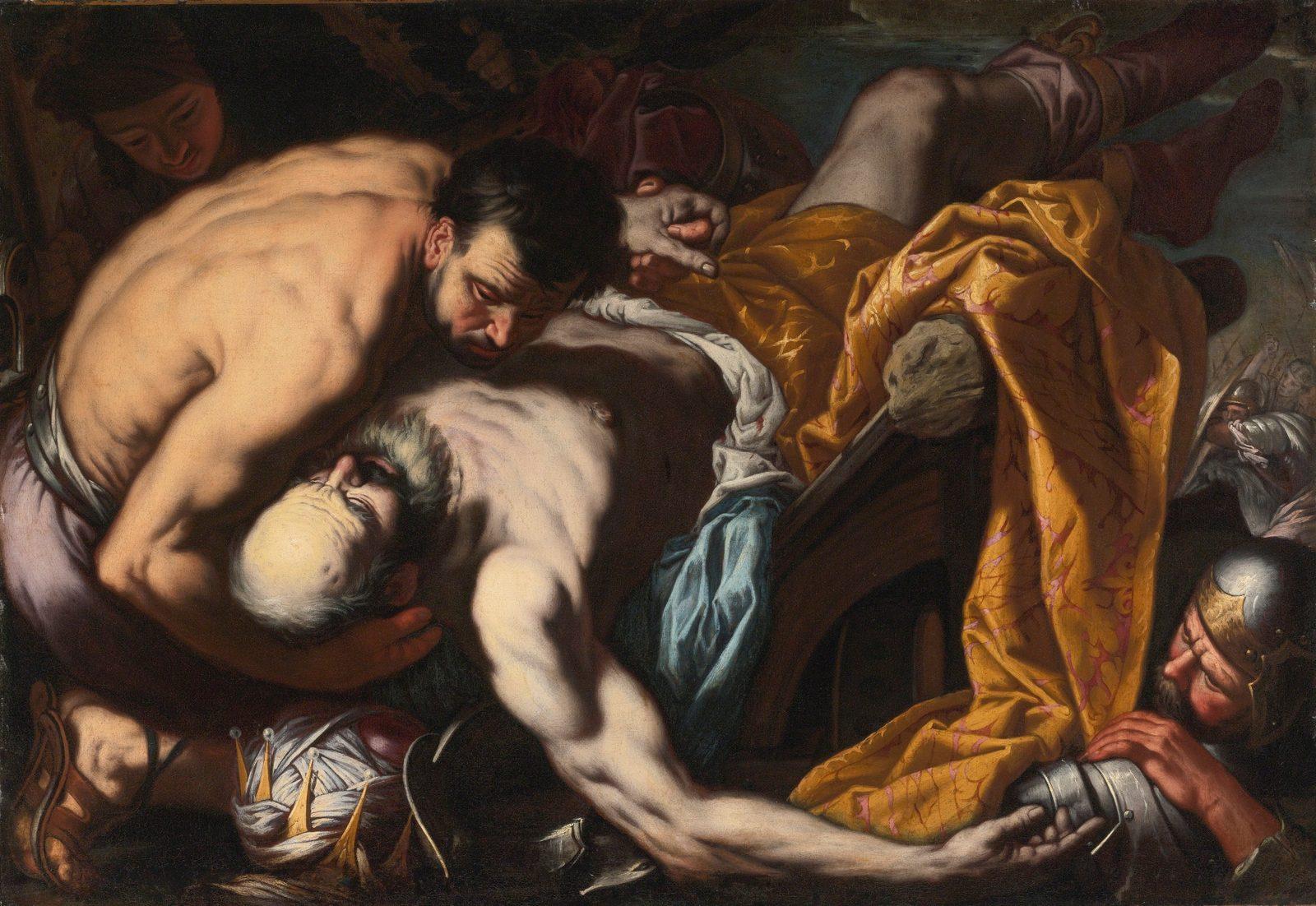
Antonio Zanchi, The Death of King Josiah. Public domain.
2 Kings 22 and 23 and 2 Chronicles 34 and 35 · Person · Featured Study
Josiah
Josiah son of Amon became king of Judah at eight and reigned thirty-one years in Jerusalem.
Neither before nor after Josiah was there any king like him, who turned to the LORD with all his heart and with all his soul and with all his strength, according to all the Law of Moses.
- Family
- father: Amon; mother: Jedidah daughter of Adaiah; son: Johanan; son: Jehoiakim; son: Zedekiah; son: Shallum
- Places
- Jerusalem, Bethel, Samaria, Megiddo
- First named
- 1 Kings 13:2 “…LORD says: ‘A son named Josiah will be…”
- Last named
- Matthew 1:11 “and Josiah the father…”
Josiah was named at Bethel before he was born, and an archer's arrow found him at Megiddo.
Summary
Josiah came to the throne as a boy after his father's murder. He turned Judah back to the LORD in the years before and after the Book of the Law was found. He fell at Megiddo going out against Pharaoh Neco, and Jeremiah lamented him.
- Jeremiah was called and Zephaniah prophesied in his reign.
- Three of his sons reigned after him.
- Jeremiah set his justice to the poor before his son Jehoiakim.
Where Josiah Stands in Scripture
He stands in 1 and 2 Kings, Chronicles, Jeremiah, Zephaniah and Matthew.
His name first appears in 1 Kings 13:2. Second Kings 22 and 23 and 2 Chronicles 34 and 35 tell his reign.
And he cried out against the altar by the word of the LORD, “O altar, O altar, this is what the LORD says: ‘A son named Josiah will be born to the house of David, and upon you he will sacrifice the priests of the high places who burn incense upon you, and human bones will be burned upon you.’”A man of God from Judah spoke this as Jeroboam stood at the altar.
His Life, Turn by Turn
His reign runs from a murder in the palace to the battle at Megiddo.
Josiah's turns run from his father's death to his own at Megiddo.
- Made king at eight after his father's murderJerusalem2 Kings 21:24
- Begins to seek the God of David in his eighth yearJerusalem2 Chronicles 34:3
- Begins to cleanse Judah in his twelfth yearJudah and Jerusalem2 Chronicles 34:3
- Sends Shaphan to the temple in his eighteenth yearthe house of the LORD2 Kings 22:3
- Tears his clothes at the words of the bookJerusalem2 Kings 22:11
- Makes a covenant by the pillarthe house of the LORD2 Kings 23:3
- Pulls down the altar at BethelBethel2 Kings 23:15
- Removes the shrines in the cities of SamariaSamaria2 Kings 23:19
- Keeps the PassoverJerusalem2 Chronicles 35:1
- Goes out to confront Necothe Plain of Megiddo2 Chronicles 35:22
- Shot by archers and carried backMegiddo to Jerusalem2 Chronicles 35:23 to 24
- Mourned by all Judah and lamented by JeremiahJerusalem2 Chronicles 35:24 to 25
Twelve turns of his life, each with its verse.
Pulls down the altar at Bethel, Removes the shrines in the cities of Samaria, Keeps the Passover, Goes out to confront Neco, Shot by archers and carried back, Mourned by all Judah and lamented by Jeremiah
The King Who Turned
His story runs through 2 Kings 22 and 23 and 2 Chronicles 34 and 35.
Josiah came to the throne as a child and fell in battle with Egypt.
The boy king2 Kings 21:24 to 22:2
Josiah's mother was Jedidah daughter of Adaiah, from Bozkath.
And he did what was right in the eyes of the LORD and walked in the ways of his father David; he did not turn aside to the right or to the left.Kings gives no year for the start of his seeking.
The book and the covenant2 Kings 22:3 to 23:3
While the temple was being repaired, Hilkiah the high priest found the Book of the Law. When the king heard its words, he tore his clothes and sent to ask of the LORD.
because your heart was tender and you humbled yourself before the LORD when you heard what I spoke against this place and against its people, that they would become a desolation and a curse, and because you have torn your clothes and wept before Me, I have heard you,’ declares the LORD.The answer came through Huldah the prophetess.
The purge and the Passover2 Kings 23:4 to 23; 2 Chronicles 35:1 to 19
He commanded the Passover as it was written in the Book of the Covenant.
No such Passover had been observed from the days of the judges who had governed Israel through all the days of the kings of Israel and Judah.Chronicles counts back to the days of Samuel the prophet.
Megiddo2 Kings 23:29 and 30; 2 Chronicles 35:20 to 24
Pharaoh Neco marched up to the Euphrates to help the king of Assyria, and Josiah went out to confront him.
From Megiddo his servants carried his body in a chariot, brought him to Jerusalem, and buried him in his own tomb. Then the people of the land took Jehoahaz son of Josiah, anointed him, and made him king in place of his father.Kings and Chronicles agree that he was buried in Jerusalem.
The lament2 Chronicles 35:25 and Jeremiah 22:10
The singers kept the laments over Josiah as a statute in Israel.
Do not weep for the dead king; do not mourn his loss. Weep bitterly for the one who is exiled, for he will never return to see his native land.Jeremiah spoke this after Josiah's death, of the dead king and his exiled son.
Jeremiah and Zephaniah
Two prophets dated their words by his reign.
The word of the LORD came to Jeremiah in the thirteenth year of Josiah. Zephaniah prophesied in Josiah's days.
This is the word of the LORD that came to Zephaniah son of Cushi, the son of Gedaliah, the son of Amariah, the son of Hezekiah, in the days of Josiah son of Amon king of Judah:Zephaniah's line runs back four generations to a Hezekiah, whom the verse does not call king.
Jeremiah's words to faithless Israel in Jeremiah 3 are dated in the days of King Josiah.
The Circle of Josiah
Ten people stand around him in the text.
His circle ran from his parents to his sons.
Generation 1
- AmonHis father, killed in his palace
- Jedidah daughter of AdaiahHis mother, from Bozkath
Generation 2
Generation 3
Two of the ten were his parents, and three his sons.
The Places of His Life
Six places mark his life and death.
Josiah's reform reached Bethel and the cities of Samaria.
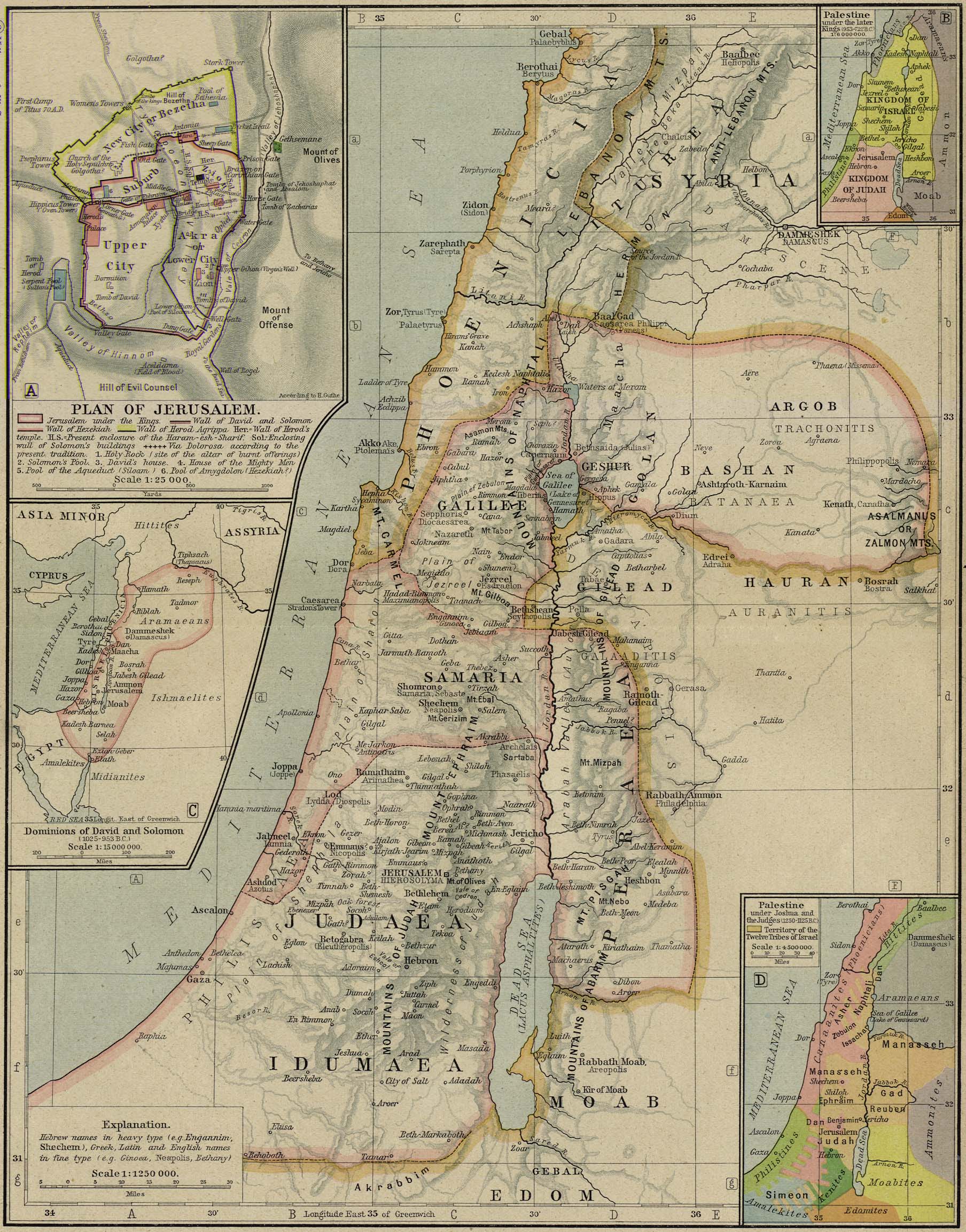
- Located: the site is known
- Identified: the point stands for an area, or is rounded
- 1Bozkath, His mother's town. 2 Kings 22:1
- 2Jerusalem, The city where he was buried in his own tomb. 2 Kings 23:30
- 3Bethel, The altar of Jeroboam he pulled down. 2 Kings 23:15
- 4The cities of Samaria, The shrines of the kings of Israel he removed. 2 Kings 23:19
- 5The Plain of Megiddo, The field where the archers shot him. 2 Chronicles 35:22
- 6Carchemish, The city on the Euphrates where Neco was going to fight. 2 Chronicles 35:20
Not placed: Bozkath (1), The Plain of Megiddo (5), Carchemish (6).
Base map: Reference map of ancient Palestine, Rand McNally reference map (1926), public domain. Each place stands at its place page's coordinates, set on the plate by Jerusalem and Damascus, as the plate prints them.
Three of the six are not placed on the map.
Questions His Life Raises
Two questions about his youth and his sons have answers in the text.
How young was he when he began to seek the LORD?2 Chronicles 34:3; John Wesley
In the eighth year of his reign, while he was still young, Josiah began to seek the God of his father David, and in the twelfth year he began to cleanse Judah and Jerusalem of the high places, the Asherah poles, the carved idols, and the cast images.Chronicles counts these years from the start of his reign.
John Wesley counted the eighth year of his reign as the sixteenth of his age. He noted that Josiah then ruled in his own right, with no one to restrain him.
Who were the sons of Josiah?1 Chronicles 3:15 and Jeremiah 22:11
The sons of Josiah: Johanan was the firstborn, Jehoiakim the second, Zedekiah the third, and Shallum the fourth.What the Text Leaves Unsaid
The text leaves three things about him untold.
Is This Not to Know Me?
Jeremiah 22 sets a father beside his son.
Jeremiah rebuked Jehoiakim for building his palace with unpaid labour, and set his father's justice before him.
Does it make you a king to excel in cedar? Did not your father have food and drink? He administered justice and righteousness, and so it went well with him. He took up the cause of the poor and needy, and so it went well with him. Is this not what it means to know Me?” declares the LORD.Jeremiah spoke to Jehoiakim son of Josiah.
Matthew Henry read the verse to mean that the right knowledge of God shows in doing the duty of one's place.
Voices on Josiah
Matthew Henry's commentary appeared in 1710.
Matthew Henry (1662 to 1714)
Commentary on the Whole Bible
Matthew Henry drew an English parallel to the boy king.
“Solomon says, Woe unto thee, O land! when thy king is a child; but happy art thou, O land! when thy king is such a child. Our English Israel had once a king that was such a child, Edward VI. Josiah, being young, had not received any bad impressions from the example of his father and grandfather, but soon saw their errors, and God gave his grace to take warning by them.”
on 2 Kings 22:1Puritan
Whose Word Did Neco Speak?
Two readings answer whether God spoke through Pharaoh Neco.
But Neco sent messengers to him, saying, “What is the issue between you and me, O king of Judah? I have not come against you today, but I am fighting another dynasty. God told me to hurry; so stop opposing God, who is with me, or He will destroy you!” Josiah, however, did not turn away from him; instead, in order to engage him in battle, he disguised himself. He did not listen to Neco’s words from the mouth of God, but went to fight him on the Plain of Megiddo.Josiah went against the will of GodKeil and Henry
C. F. Keil holds that the God Neco named is the true God, though no prophet's message reached Neco. Josiah, he says, went into battle against the will of God.
Matthew Henry held that Josiah failed to heed fair reasonings, left to it in wrath on a nation unworthy of so good a king.
The objection is Julius Wellhausen's: the warning is the Chronicler's own way to account for the defeat.
The Chronicler's explanation of the defeatJulius Wellhausen
Julius Wellhausen holds that Chronicles attached the blame of not heeding Neco to Josiah in order to justify his defeat and death at Megiddo. Second Kings 23:29 records no warning from Neco.
Against this stands C. F. Keil's reading that the Chronicler judged the war from the religious point of view.
Books to Read Next
Both works are in the public domain, and each has a free copy to read.
The Books of the Chronicles
C. F. Keil · 1872
Keil discusses Neco's warning and the battle in his notes on 2 Chronicles 35.
Read at the Internet ArchiveProlegomena to the History of Israel
Julius Wellhausen · 1883
Wellhausen sets out his reading of Chronicles, Josiah's death among its cases, in chapter 6.
Read at Project GutenbergWith All His Heart
Kings measures Josiah by the great command of Deuteronomy, and it gives Hezekiah a like praise for his trust.
And you shall love the LORD your God with all your heart and with all your soul and with all your strength.Kings uses the same three words of Josiah in 2 Kings 23:25.
Sources
Scripture is the Berean Standard Bible.
- C. F. Keil, The Books of the Chronicles, translated by Andrew Harper, T. and T. Clark, 1872, pp. 505 to 506.
- Julius Wellhausen, Prolegomena to the History of Israel (Berlin, 1883), translated by J. Sutherland Black and Allan Menzies, chapter 6, section 2, part 3.
- Matthew Henry, Commentary on the Whole Bible, 1710, on 2 Kings 22:1, 2 Chronicles 35:22 and Jeremiah 22:16.
- John Wesley, Explanatory Notes upon the Old Testament, 1765, on 2 Chronicles 34:3.
- Jamieson, Fausset and Brown, Commentary Critical and Explanatory on the Whole Bible, 1871, on 2 Chronicles 35:25.
Keep Studying
Read it4
People and groups10