
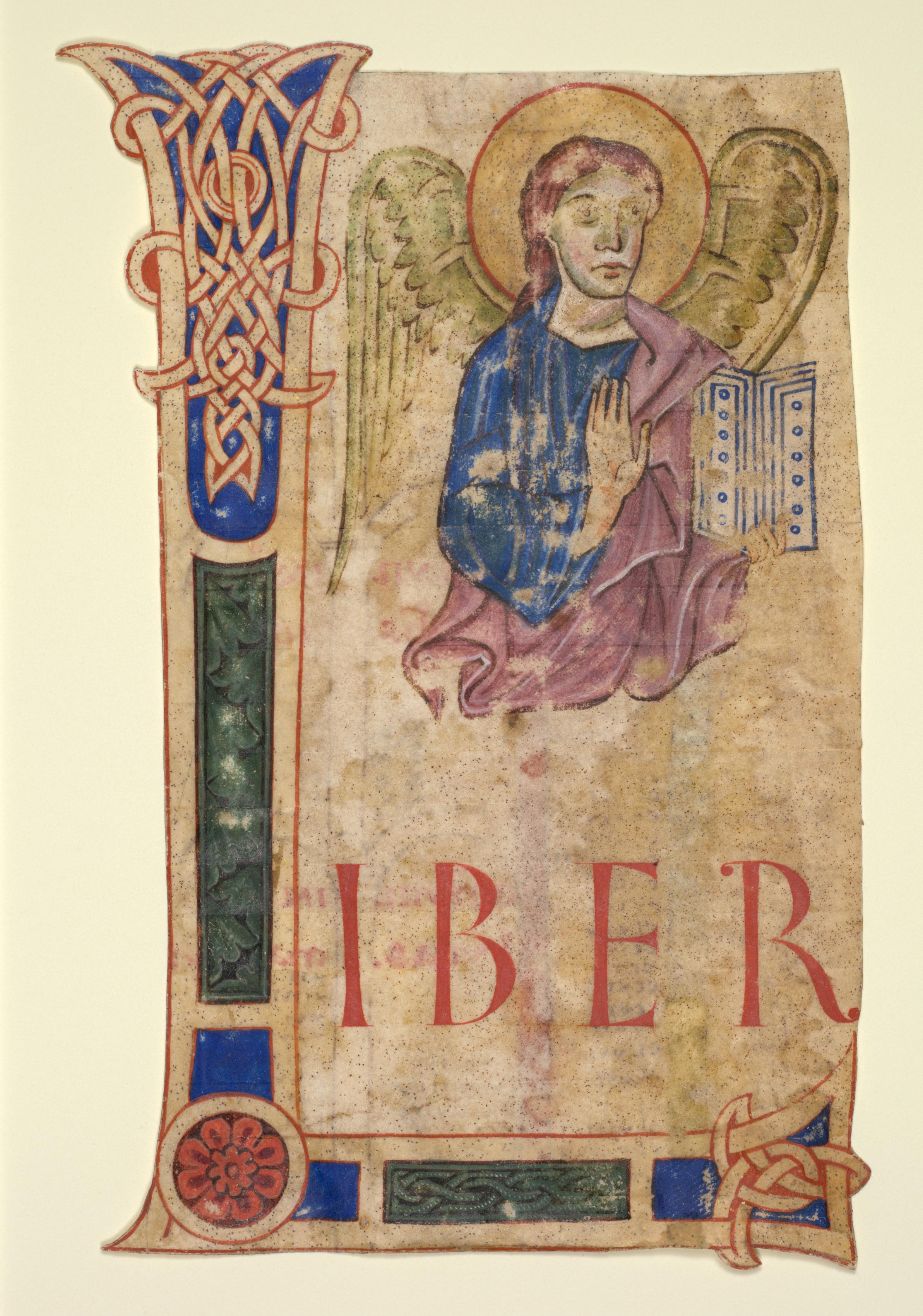
Leaf from a Gospel book, Florence, 1125 to 1150. CC0.
Mark 1 to 16 · Debate · Featured Study
The Synoptic Problem
Matthew, Mark and Luke share long runs of the same words, and readers still argue over who wrote first.
Burnett Hillman Streeter wrote in 1924 that Matthew reproduces 90 percent of the matter of Mark.
Therefore, having carefully investigated everything from the beginning, it seemed good also to me to write an orderly account for you, most excellent Theophilus,
Therefore, having carefully investigated everything from the beginning, it seemed good also to me to write an orderly account for you, most excellent Theophilus,
- The question
- Which of the first three Gospels was written first, and did any writer use a source now lost?
- The texts
- Luke 1:1 to 3, Mark 14:65, Matthew 26:68, Luke 22:64
Summary
Five answers stand on the question, and each names its own order of writing. Each has holders who argue it from the texts.
- Two answers put Matthew first, two put Mark first, and one finds no copying at all.
- Only one answer needs a book of sayings that no one has found.
- Luke is the only one of the three to mention other written accounts.
Many Accounts Before Luke
Luke's preface and a report of Papias speak of how three of the Gospels were written.
Many have undertaken to compose an account of the things that have been fulfilled among us, just as they were handed down to us by the initial eyewitnesses and servants of the word.The preface is Luke's own word on how his Gospel was made.
Five Answers Side by Side
Each answer is set against the same three questions.
Each holder answers the same three questions in a different way.
| Held by | Written first | A lost book of sayings | Why the three keep one order |
|---|---|---|---|
| Augustine; B. C. Butler | Matthew | None | Each writer knew the work of those before him. |
| J. J. Griesbach; William R. Farmer | Matthew, then Luke | None | Mark wrote last, after the other two. |
| H. J. Holtzmann; B. H. Streeter | Mark, or an earlier form of it | Yes, the source later called Q | Matthew and Luke each followed Mark. |
| Austin Farrer; Mark Goodacre | Mark | None | Matthew follows Mark, and Luke follows Mark's order. |
| Eta Linnemann | Each Gospel written on its own | None | Each writer drew on the same tradition. |
The Answers in Their Order
The holders argue from wording, from order and from style.
Augustine's orderAugustine, The Harmony of the Gospels 1.2.3 to 4 and 4.10.11; B. C. Butler, The Originality of St Matthew (1951)
B. C. Butler, abbot of Downside, argued in 1951 that Mark depended on Matthew, as a review of his book in the journal Scripture reports.
The Griesbach answerJ. J. Griesbach, Commentatio (1789 to 1790); William R. Farmer, The Synoptic Problem (1964)
J. J. Griesbach published his case in 1789 and 1790 under a Latin title that means a treatise showing that the whole Gospel of Mark was taken from the commentaries of Matthew and Luke. Bo Reicke gives the dates in the Cambridge volume on Griesbach of 1979.
William R. Farmer revived the answer in 1964. A book notice in BYU Studies reports that he defended Mark as the editor of Matthew and Luke.
The two-source answerH. J. Holtzmann, Die synoptischen Evangelien (1863); B. H. Streeter, The Four Gospels (1924)
Before them, Karl Lachmann wrote in 1835 that the order of the stories differs widely when Matthew and Luke are compared, and only a little when Mark is compared with either. Stephen Carlson reports that Holtzmann, in 1863, proposed two sources: an early gospel like Mark, and a source of sayings used by Matthew and Luke.
Streeter argued that wherever Matthew departs from Mark's order Luke supports Mark, and wherever Luke departs from it Matthew agrees with Mark. He also pointed to Mark's rough style and grammar and to the Aramaic words that Mark keeps.
The Farrer answerAustin Farrer, On Dispensing with Q (1955); Mark Goodacre, The Case Against Q (2002)
Austin Farrer argued that the evidence is what one would expect if Luke had read Matthew and then chose to work directly on Mark's older narrative. Mark Goodacre argues the same case on his web pages, The Case Against Q.
The independence answerEta Linnemann, Is There a Synoptic Problem? (1992)
Eta Linnemann argued that the three Gospels are independent of one another as written works. Craig Blomberg's review in Themelios reports her reason, that the Gospels differ too much to depend on one another.
Who Hit You?
At the mocking of Jesus, Matthew and Luke give a question that Mark leaves out.
Then some of them began to spit on Him. They blindfolded Him, struck Him with their fists, and said to Him, “Prophesy!” And the officers received Him with slaps in His face.Mark has the blindfold and the word Prophesy, and no question after it.
and said, “Prophesy to us, Christ! Who hit You?”Matthew adds the question Who hit You, though his account has no blindfold.
They blindfolded Him and kept demanding, “Prophesy! Who hit You?”The verse is the second witness to the question that Mark lacks.
Streeter calls places like this minor agreements, where Matthew and Luke share words that are missing from Mark.
He called this one the most remarkable of all. He argued that the question makes sense only where Jesus is blindfolded, so the words belong to Luke, and that they later got into all the texts of Matthew.
Mark Goodacre lists this passage among the minor agreements in his case against Q as a source.
What the Gospels Leave Unsaid
Readers can learn the order of writing only by comparing the texts.
Who the Many Were
Adam Clarke and Albert Barnes read Luke's preface in two ways.
Albert Barnes (1798 to 1870)
Albert Barnes, the Presbyterian commentator, held that the many could not be the other evangelists. John had not yet written, he noted, and many means more than two, so the many were other writings now unknown.
The Answers Weighed
The objections come from four writers, one of them a holder of the answer he questions.
Every answer meets an objection in print, two of them from Streeter.
| The answer | Representative work | The objection |
|---|---|---|
| Augustine's order | Augustine, The Harmony of the Gospels | Augustine himself, in book 4, judged it more probable that Mark keeps company with both Matthew and Luke. |
| The Griesbach answer | Farmer, The Synoptic Problem (1964) | Streeter: Mark keeps phrases likely to cause offence, which Matthew and Luke leave out or tone down. |
| The two-source answer | Streeter, The Four Gospels (1924) | Goodacre: Matthew and Luke agree against Mark even in the Passion narrative, where no one places Q. |
| The Farrer answer | Farrer, On Dispensing with Q (1955) | Streeter: Matthew and Luke never set a shared saying at the same point of Mark's outline after the Temptation. |
| The independence answer | Linnemann, Is There a Synoptic Problem? (1992) | Blomberg: she grants 40 percent shared wording between Matthew and Mark. |
Books to Read Next
Three of the works are free to read online.
The Four Gospels: A Study of Origins
B. H. Streeter · 1924
Streeter replaces the two-document answer with a four-document answer in his ninth chapter.
Read it free at the Internet ArchiveThe Harmony of the Gospels
Augustine · about 400
The work holds both of Augustine's statements on Mark, in books 1 and 4.
Read it free at New AdventOn Dispensing with Q
Austin Farrer · 1955
The essay first appeared in Studies in the Gospels, edited by D. E. Nineham.
Read it free on Mark Goodacre's siteThe Four Together
The study of the Gospels teaches the four books as one witness to Jesus.
Sources
Scripture is the Berean Standard Bible.
- Augustine, The Harmony of the Gospels 1.2.3 to 4 and 4.10.11, tr. S. D. F. Salmond (Nicene and Post-Nicene Fathers, first series, volume 6, 1888); public domain.
- Eusebius, Church History 3.39.15 to 16, quoting Papias, tr. A. C. McGiffert (Nicene and Post-Nicene Fathers, second series, volume 1, 1890); public domain.
- B. H. Streeter, The Four Gospels: A Study of Origins (Macmillan, 1924; the New York printing of January 1925 read), pp. 151 to 162, 183, 234 to 235 and 325 to 327; public domain.
- Karl Lachmann, De ordine narrationum in evangeliis synopticis, Theologische Studien und Kritiken 8 (1835), pp. 570 to 586; public domain; the English given is a free rendering.
- H. J. Holtzmann, Die synoptischen Evangelien: ihr Ursprung und geschichtlicher Charakter (Leipzig, 1863), as reported by Stephen C. Carlson, Chronology of the Synoptic Problem (2004)
- J. J. Griesbach, Commentatio qua Marci Evangelium totum e Matthaei et Lucae commentariis decerptum esse monstratur (1789 to 1790), as listed in B. Orchard and T. R. W. Longstaff (eds.), J. J. Griesbach: Synoptic and Text-Critical Studies 1776 to 1976 (Cambridge, 1979), with Bo Reicke's chapter; cite-only.
- William R. Farmer, The Synoptic Problem: A Critical Analysis (Macmillan, 1964), as reported by the book notice in BYU Studies 7:1, p. 89; cite-only.
- B. C. Butler, The Originality of St Matthew (Cambridge, 1951), as reported by A. J. van der Voort's review in Scripture 5.3 (1952), pp. 72 to 73; cite-only.
- Austin Farrer, On Dispensing with Q, in D. E. Nineham (ed.), Studies in the Gospels (Blackwell, 1955), pp. 55 to 88, p. 61; cite-only.
- Mark Goodacre, The Case Against Q: Ten Reasons, web page updated 10 January 2003; cite-only.
- Eta Linnemann, Is There a Synoptic Problem?, tr. Robert W. Yarbrough (Baker, 1992), as reported by Craig L. Blomberg's review in Themelios 19.1; cite-only.
- A. T. Robertson, A Harmony of the Gospels for Students of the Life of Christ (Harper, 1922), as the site's harmony data carries its 185 sections; public domain.
- Adam Clarke, Commentary on the Bible (1832), on Luke 1:2.
- Albert Barnes, Notes, Explanatory and Practical, on Luke 1:1.
Keep Studying
Studies7