
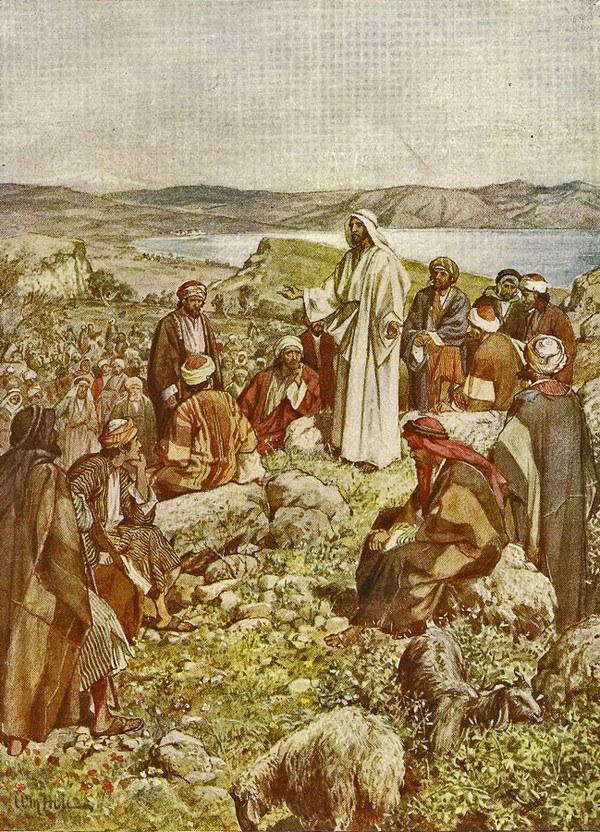
William Brassey Hole, The Sermon on the Mount, about 1906. Public domain.
Matthew 5 to 25 · Subject · Featured Study
The Five Discourses of Matthew
The Sermon on the Mount is the first of five long blocks of teaching in Matthew's Gospel.
Each block of teaching has its own hearers: the crowds, the Twelve, or the disciples alone.
When Jesus had finished saying these things, the crowds were astonished at His teaching,
When Jesus had finished saying these things, the crowds were astonished at His teaching,
- Book
- Matthew
- Hold in memory
- Matthew 7:28, Matthew 28:20
Summary
Matthew gathers the words of Jesus into five discourses, and he closes each one with a set phrase.
- The five closing lines stand at Matthew 7:28, Matthew 11:1, Matthew 13:53, Matthew 19:1 and Matthew 26:1.
- The five teach the kingdom, the mission, the parables, life together and the end of the age.
- Benjamin Bacon argued in 1918 that the five answer to the five books of the Law.
- Edgar Krentz, Jack Dean Kingsbury and David Bauer divide Matthew in three at Matthew 4:17 and Matthew 16:21.
When Jesus Had Finished
The five closing lines share one verb and one pattern.
When Jesus had finished saying all these things, He told His disciples,The last of the five closings adds the word all and turns to the passion.
Each closing uses the Greek verb teleō, to finish, and then turns to what follows: the crowd's astonishment, a move to a new place, or a new word to the disciples. Rabanus Maurus heard two meanings in the line, the end of the words and the completeness of the teaching.
Five Blocks of Teaching Between the Stories
The book alternates story and teaching from the birth to the resurrection.
Matthew sets five blocks of teaching between six stretches of story.
| Part | What it holds | Chapters |
|---|---|---|
| Story | The birth, the baptism and the testing in the wilderness | Matthew 1 to 4 |
| First discourse | The Sermon on the Mount, closed at Matthew 7:28 | Matthew 5 to 7 |
| Story | Healings, a storm stilled and the call of Matthew | Matthew 8 to 9 |
| Second discourse | The sending of the Twelve, closed at Matthew 11:1 | Matthew 10 |
| Story | John's question and the rising opposition | Matthew 11 to 12 |
| Third discourse | The parables of the kingdom, closed at Matthew 13:53 | Matthew 13 |
| Story | The feedings, Peter's confession and the transfiguration | Matthew 14 to 17 |
| Fourth discourse | Life among the disciples, closed at Matthew 19:1 | Matthew 18 |
| Story | The road to Jerusalem and the debates in the temple | Matthew 19 to 23 |
| Fifth discourse | The end of the age, closed at Matthew 26:1 | Matthew 24 to 25 |
| Story | The passion and the resurrection | Matthew 26 to 28 |
Story, Fourth discourse, Fifth discourse
What Comes After Each Discourse
Commentators have read the closing lines both as an ending and as a turn to the story.
Adam Clarke read Matthew 11:1 as an ending. He held that the verse belongs to the chapter before it and has no tie to the chapter after it.
Benjamin Bacon read each closing as a turn. In his view the line couples the teaching to the story that follows rather than rounding it off.
Hilary of Poitiers read the last closing as the turn from the promise of glory to the passion. In his reading the disciples were to learn how closely the cross and the glory belong together.
The Five Discourses in Order
Each discourse opens with its setting and its hearers.
The Sermon on the MountMatthew 5 to 7
When Jesus saw the crowds, He went up on the mountain and sat down. His disciples came to Him, and He began to teach them, saying:Matthew opens the first block by giving its place and its first hearers.
The sermon teaches the righteousness of the kingdom, from the Beatitudes to the two builders.
The sending of the TwelveMatthew 10
These twelve Jesus sent out with the following instructions: “Do not go onto the road of the Gentiles or enter any town of the Samaritans.This verse shows that the charge first sent the Twelve only to Israel.
The charge goes on to warn of councils, floggings and trials before governors and kings (Matthew 10:17 to 18).
The parables of the kingdomMatthew 13
That same day Jesus went out of the house and sat by the sea. Such large crowds gathered around Him that He got into a boat and sat down, while all the people stood on the shore.The shore and the house, where Jesus later explained the parable of the weeds (Matthew 13:36), divide the third discourse in two.
Six of the parables open with the words the kingdom of heaven is like (Matthew 13:24 to 47).
Life among the disciplesMatthew 18
At that time the disciples came to Jesus and asked, “Who then is the greatest in the kingdom of heaven?”The disciples' question about rank opens the teaching on humility and forgiveness.
The discourse ends with the parable of the unforgiving servant (Matthew 18:21 to 35).
The end of the ageMatthew 24 to 25
While Jesus was sitting on the Mount of Olives, the disciples came to Him privately. “Tell us,” they said, “when will these things happen, and what will be the sign of Your coming and of the end of the age?”The last block begins as the answer to a private question.
The discourse closes with the judgment of the sheep and the goats (Matthew 25:31 to 46).
The Words of the Closing Line
Two Greek words of the first closing line, at Matthew 7:28.
τελέω teleō
28 uses in the canon
To end or complete, as a task is concluded or a debt discharged.
διδαχή didachē
30 uses in the canon
Teaching, the word for what astonished the crowds after the sermon.
Five Books Like the Law of Moses?
Scholars of the twentieth century outlined Matthew in five parts and in three.
Five books of the teaching of JesusBenjamin W. Bacon, The Five Books of Matthew against the Jews, The Expositor, 1918
Bacon held that Matthew built his Gospel as a fivefold law of Jesus. Each book pairs a stretch of story with the discourse it leads up to, as the codes of the Pentateuch stand in a frame of story.
In Bacon's outline the birth stories are a prologue and the passion and resurrection an epilogue.
The objection: Wim Weren judged it hardly convincing to set Matthew 26 to 28 outside the five books.
Three parts, from Matthew 4:17 and Matthew 16:21Jack Dean Kingsbury and David Bauer after Edgar Krentz, as Wim Weren reports them in Biblica, 2006
From that time on Jesus began to preach, “Repent, for the kingdom of heaven is near.”This verse begins the preaching in Galilee with a phrase Matthew repeats at Matthew 16:21.
From that time on Jesus began to show His disciples that He must go to Jerusalem and suffer many things at the hands of the elders, chief priests, and scribes, and that He must be killed and on the third day be raised to life.This verse begins the teaching about the cross with the same phrase.
Weren reports that these readers take the two verses as the captions of two long sections, after an opening at Matthew 1:1 to 4:16.
The objection: Weren judged that both outlines depart from rigid breaks between the sections.
The Charge to Teach the Nations
The risen Jesus gives His last charge in Matthew 28:18 to 20.
Therefore go and make disciples of all nations, baptizing them in the name of the Father, and of the Son, and of the Holy Spirit, and teaching them to obey all that I have commanded you. And surely I am with you always, even to the end of the age.”This charge ties the disciples' mission to everything Jesus taught in the five blocks.
Matthew writes no sixth closing formula after these words.
Sources
Scripture is the Berean Standard Bible.
- Benjamin W. Bacon, The Five Books of Matthew against the Jews, The Expositor, eighth series, vol. 15 (1918), pp. 56 to 66.
- Wim J. C. Weren, The Macrostructure of Matthew's Gospel: A New Proposal, Biblica 87 (2006), pp. 171 to 200.
- Rabanus Maurus, on Matthew 7:28 to 29, in Thomas Aquinas, Catena Aurea.
- Adam Clarke, Commentary on the Bible (1832), on Matthew 11:1.
- Hilary of Poitiers, on Matthew 26:1 to 2, in Thomas Aquinas, Catena Aurea.
Keep Studying
Read it4
People and groups3
Places1
Doctrines5
Go further1
Trials of life1