
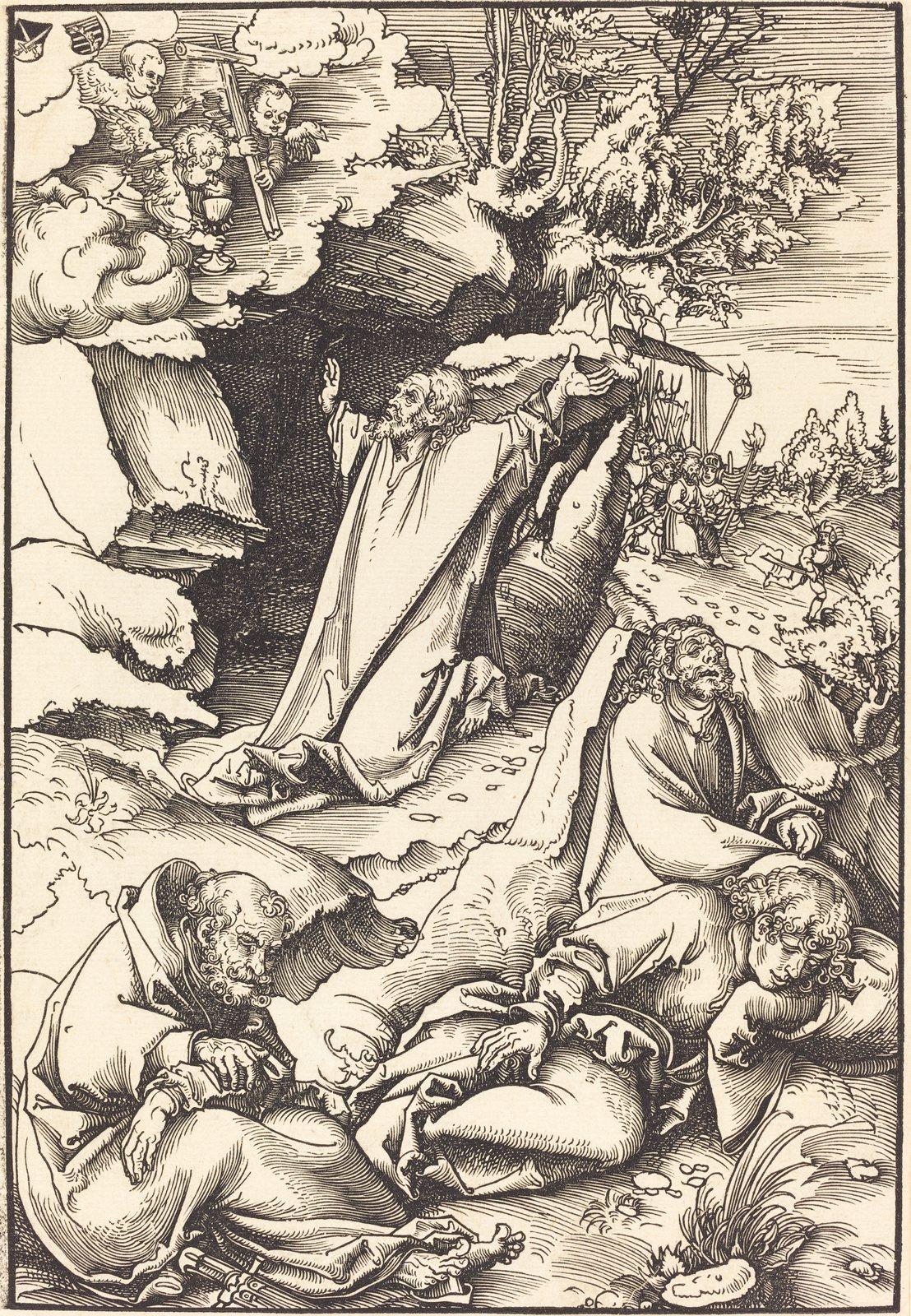
Lucas Cranach the Elder, Christ on the Mount of Olives, by 1509. Public domain.
Psalm 75 · Symbol · Featured Study
The Cup of the LORD's Wrath
The image runs from Psalm 75 through Isaiah and Jeremiah to Gethsemane and Revelation.
A cup of wine stood for judgment long before Gethsemane.
If they refuse to take the cup from your hand and drink it, you are to tell them that this is what the LORD of Hosts says: ‘You most certainly must drink it!
If they refuse to take the cup from your hand and drink it, you are to tell them that this is what the LORD of Hosts says: ‘You most certainly must drink it!
- The word
- כּוֹס (kos), H3563
- First appears
- Genesis 40:11 “Pharaoh’s cup was in…”
Summary
Scripture pictures God's judgment as a cup that He pours and others must drink. Readers differ over what filled the cup Jesus drank.
- The Hebrew word kos means a cup in 31 places in 26 verses, and the Greek word for cup stands in 28 verses.
- Jeremiah sends the cup to Jerusalem first and then to the nations.
- Cranach cut the prayer in the garden with angels holding out a chalice and a cross.
A Cup in the LORD's Hand
Strong, Ellicott and Wesley read the figure of the cup.
For a cup is in the hand of the LORD, full of foaming wine mixed with spices. He pours from His cup, and all the wicked of the earth drink it down to the dregs.Here the cup belongs to God, and the wicked receive it.
Why does Scripture put a cup in God's hand? James Strong glosses kos (H3563) as a cup, often in a figure a lot, as if a potion. Ellicott holds that the cup of divine fury in this psalm grows out of an older picture. In it a life is a draught to be drunk, bitter or sweet, by the portion God assigns.
John Wesley reads God here as the master of a feast, who gives each guest a portion of meat and drink. Psalm 16:5 calls the LORD the psalmist's portion and cup.
Where the Cup Is Poured
Eight more verses hand someone the cup of wrath.
The cup passes to Jerusalem, to Edom and to Babylon.
| Who drinks | Where it stands and what it is called | Book |
|---|---|---|
| The wicked | In Psalm 11:6 the Hebrew has kos, and the Berean text reads their portion. | Psalms |
| Jerusalem | In Isaiah 51:17 she has drunk the cup of His fury. | Isaiah |
| Edom | In Jeremiah 49:12 Edom must drink the cup as well. | Jeremiah |
| The whole earth | In Jeremiah 51:7 Babylon is a gold cup in the LORD's hand that makes the earth drunk. | Jeremiah |
| The Daughter of Edom | In Lamentations 4:21 the cup passes to her too. | Lamentations |
| Oholibah, Jerusalem | In Ezekiel 23:32 she drinks her sister's cup, deep and wide. | Ezekiel |
| The Chaldean | In Habakkuk 2:16 the cup in the LORD's right hand comes around to him. | Habakkuk |
| Babylon the great | In Revelation 16:19 she is given the cup of the wine of the fury of His wrath. | Revelation |
The Chaldean, Babylon the great
The Cup Passes from Hand to Hand
The nations drink in turn, and Jerusalem's turn ends.
This is what the LORD, the God of Israel, said to me: “Take from My hand this cup of the wine of wrath, and make all the nations to whom I send you drink from it.The command comes before the list of nations in verses 18 to 26.
Jeremiah names who must drink, beginning with Jerusalem and the cities of Judah and running through Egypt, Edom, Moab and the kings of the north.
Thus says your Lord, the LORD, even your God, who defends His people: “See, I have removed from your hand the cup of staggering. From that goblet, the cup of My fury, you will never drink again.Verse 23 hands the same cup to those who walked over her.
Albert Barnes on Habakkuk 2:16 sees the cup going round the circle of the nations the Chaldean had been sent to punish. When the circle is complete, it comes back to the Chaldean himself.
The Cup in Gethsemane
Jesus names the cup before the garden and again at His arrest.
“You do not know what you are asking,” Jesus replied. “Can you drink the cup I am going to drink?” “We can,” the brothers answered.Two disciples ask for the seats beside Him, and He asks them about His cup.
Barnes on Matthew 20:22 takes the figure from a feast, where the master holds out a cup to each guest. He sets Isaiah 51:17, Psalm 75:8 and Jeremiah 25:15 beside it.
“Put your sword back in its sheath!” Jesus said to Peter. “Shall I not drink the cup the Father has given Me?”The words come after the arrest party has fallen back.
The Wine Poured Undiluted
Revelation pours the cup for those who worship the beast.
he too will drink the wine of God’s anger, poured undiluted into the cup of His wrath. And he will be tormented in fire and sulfur in the presence of the holy angels and of the Lamb.Jamieson, Fausset and Brown hear the cup of Psalm 75 in this verse.
Jamieson, Fausset and Brown note that wine was so often mixed with water that to mix wine was the Greek way of saying to pour it out. This wine of God's wrath, they write, has no drop of water to cool its heat.
Two Voices on the Cup
Gregory of Nazianzus and Matthew Henry wrote on the cup in the LORD's hand.
Gregory of Nazianzus (died 390)
ON HIS FATHER'S SILENCE, ORATION 16:4
The first voice finds room for mercy in the cup.
“Anger, which is called ‘the cup in the hand of the Lord’ and ‘the cup of falling that is drained,’ is in proportion to transgressions, even though he abates to all some of what is their due and dilutes with compassion the unmixed draught of his wrath. For he inclines from severity to indulgence toward those who accept chastisement with fear, and who after a slight affliction conceive and are in pain with conversion and bring forth the perfect spirit of salvation.”
on Isaiah 51:17Patristic
Matthew Henry (1662 to 1714)
Commentary on the Whole Bible
The second voice reads the colour of the wine.
“The sufferings of Christ are called a cup, Matt. xx. The judgments of God upon sinners are the cup of the Lord's right hand, Hab. ii. The wine is red, denoting the wrath of God, which is infused into the judgments executed on sinners, and is the wormwood and the gall in the affliction and the misery.”
on Psalm 75:8Puritan
Three Readings of the Cup Jesus Drank
Three readings have their holders and their objections.
The wrath of God against sinJohn Gill; Matthew Henry
John Gill on Matthew 20:22 reads the cup as His reproaches, sorrows, sufferings and death. He compares them, Gill writes, to a bitter cup of vengeance, wrath, fury and indignation.
The objection: Dionysius of Alexandria reads the cup as the work of trial the Father had set, to be drunk with courage.
The final sufferings appointed to HimAdam Clarke; Albert Barnes; Dionysius of Alexandria
Adam Clarke on John 18:11 notes that the cup sometimes signifies the lot of a life, and holds that here it signifies the final sufferings of Christ. Barnes on Matthew 26:39 calls it these bitter sufferings and these approaching trials.
The objection: Jamieson, Fausset and Brown read the wine cup of the prophets as a figure of stupefying judgments.
The guilt of the people who would kill HimJerome, in Thomas Aquinas's Catena Aurea
Jerome reads this cup as the cup of the people who would put Him to death. They would have no excuse, he writes, since they had the Law and the Prophets that spoke of Him.
The objection: at the arrest Jesus calls it the cup the Father has given Him (John 18:11).
The Cup of Salvation
The Psalms also hold a second cup. Origen, in his Exhortation to Martyrdom, reads the cup of salvation of Psalm 116 as the death of the martyrs. Two verses later the psalm calls the death of His saints precious.
I will lift the cup of salvation and call on the name of the LORD.The psalm answers its own question of how to repay the LORD with a cup of thanks.
Sources
Scripture is the Berean Standard Bible.
- James Strong, Exhaustive Concordance of the Bible, entries H3563 and G4221, with every verse that carries each word.
- On Psalm 75:8: Ellicott's Commentary for English Readers.
- On Habakkuk 2:16: Albert Barnes, Notes on the Bible.
- On Matthew 20:22 and 26:39: Albert Barnes, Notes on the Bible; John Gill, Exposition of the Entire Bible.
- On Jeremiah 25:15: Jamieson, Fausset and Brown, Commentary Critical and Explanatory.
- On Revelation 14:10: Jamieson, Fausset and Brown, Commentary Critical and Explanatory.
- John Wesley (1765) on Psalm 75:8; Adam Clarke (1832) on John 18:11; Dionysius of Alexandria on John 18:11; Jerome on Matthew 26:39, in Thomas Aquinas, Catena Aurea; Origen, Exhortation to Martyrdom 29.
- Gregory of Nazianzus, Oration 16, On His Father's Silence, on Isaiah 51:17.
- Matthew Henry, Commentary on the Whole Bible (1710), on Psalm 75:8.
Keep Studying
Read it6
Doctrines1
Places1