
Matthew 26:41 · Passage · Watchfulness
Watch and Pray
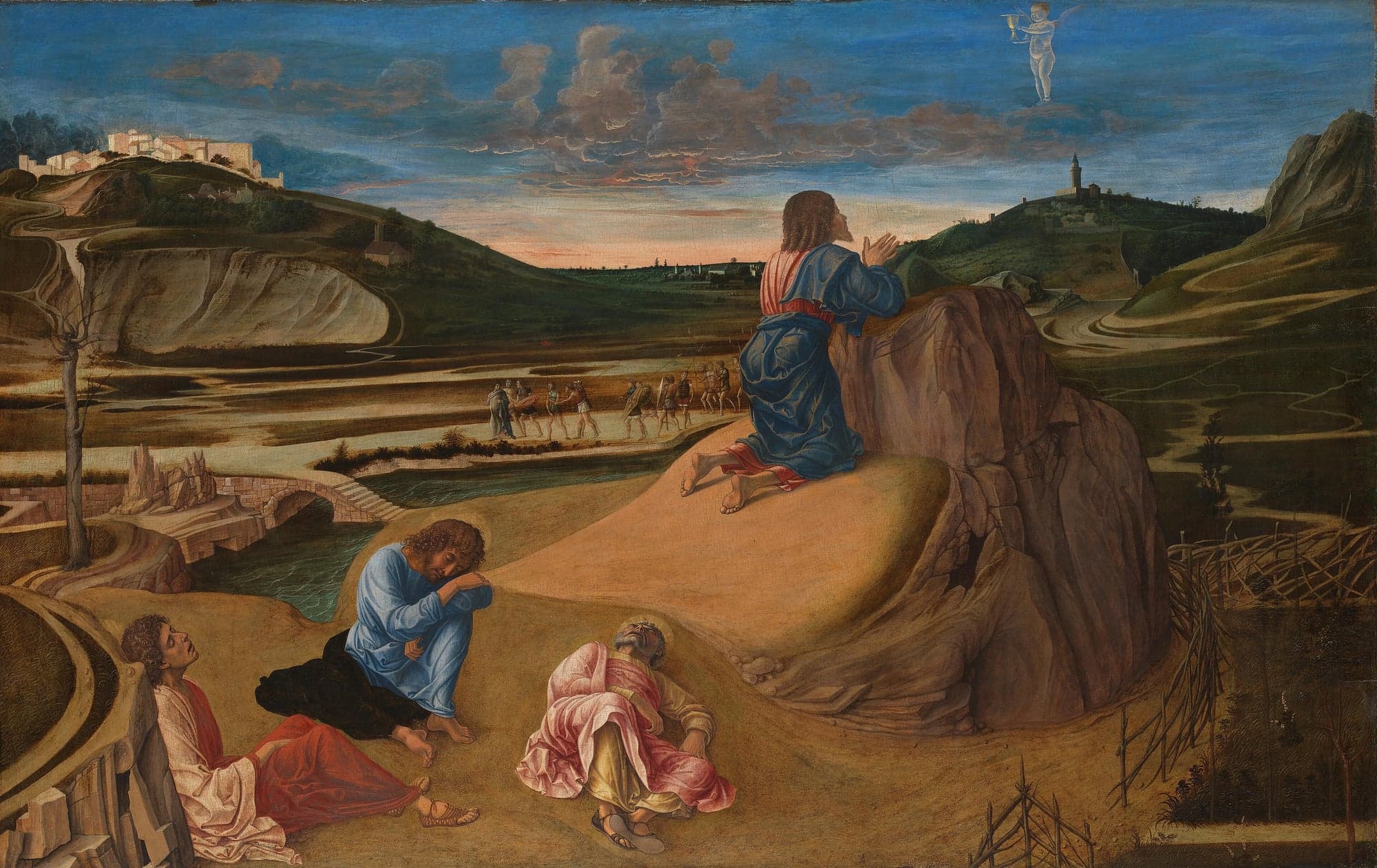
Matthew 26:41 is the order to watch and pray that the three disciples heard in Gethsemane on the night of the arrest.
On the way to the garden Peter told Jesus, “Even if I have to die with You, I will never deny You” (Matthew 26:35).
“Watch and pray so that you will not enter into temptation. For the spirit is willing, but the body is weak.”
- The passage
- Matthew 26:36 to 46, Mark 14:32 to 42, Luke 22:39 to 46
- Books
- Matthew, Mark, Luke
- Hold in memory
- Matthew 26:41, Colossians 4:2
Summary
Jesus gave a reason with the command of Matthew 26:41, a willing spirit joined to a weak body, so the watch has to be kept by prayer. Each time He came back from prayer He found the three asleep. The letters of Paul and Peter later join watching to prayer and to a sober mind, and they ask it of whole churches.
- Matthew uses the verb gregoreo three times in the scene, in the charge, the rebuke and the command itself (Matthew 26:38 to 41).
- In the reason Jesus gives, the Berean text renders the Greek sarx, the flesh, as body.
- Mark's account gives the command in the same Berean words.
The Charge to Keep Watch
Jesus foretold on the road that every disciple would fall away that night.
Watch and Pray studies Matthew 26:36 to 46, the night in Gethsemane told from the side of the disciples. It belongs to the value of watchfulness, because here Jesus gives the command to watch in its plainest form and the men closest to Him fail to keep it.
The question the study answers is what Jesus asked of Peter, James and John, why He joined prayer to the watch, and what came of their sleep. The study gives the night in nine steps and the Greek words of Matthew 26:41. It sets the accounts of Mark and Luke beside Matthew's and gives the two readings of the line on the willing spirit.
When they had sung a hymn, they went out to the Mount of Olives, and Jesus told them, “This very night you will all fall away on account of Me” (Matthew 26:31).
The Night in Nine Steps
Three prayers alternate with three returns, from the arrival in the garden to the approach of the betrayer.
Jesus went away to pray three times and came back three times, and His command to watch and pray stands between the first return and the second prayer.
- They arriveSit here while I go over there and pray.Matthew 26:36
- The chargeStay here and keep watch with Me.Matthew 26:38
- The first prayerMy Father, if it is possible, let this cup pass from Me.Matthew 26:39
- The first returnWere you not able to keep watch with Me for one hour?Matthew 26:40
- The second prayerMy Father, if this cup cannot pass unless I drink it, may Your will be done.Matthew 26:42
- The second returnAnd again Jesus returned and found them sleepingMatthew 26:43
- The third prayerprayed a third time, saying the same thingMatthew 26:44
- The third returnAre you still sleeping and resting?Matthew 26:45
- The betrayer comesRise, let us go! See, My betrayer is approaching!Matthew 26:46
A timeline of nine steps in Matthew 26:36 to 46, each with the Berean words and its verse.
The third prayer, The third return, The betrayer comes
The Words of Matthew 26:41
Jesus joins two commands to a reason, and the reason turns on two Greek nouns.
The tagged Greek text marks grēgoreite and proseuchesthe as plural imperatives of the present tense (V-PAM-2P and V-PNM-2P), so both commands reach all three disciples. Origen, in a comment that Thomas Aquinas gathered into the Catena Aurea, read the order of the two: “that first we should watch, and so watching pray.”
Spirit is pneuma, and the adjective rendered willing is prothumos, which Strong's glosses as “forward in spirit, i.e. predisposed”. Strong's gives sarx the first sense “flesh (as stripped of the skin)”. It extends the word to the body set over against the soul or spirit and to human nature with its frailties.
Mark and Luke Beside Matthew
Mark adds the disciples' silence, and Luke frames the night with prayer.
After the second return Mark adds, “And they did not know what to answer Him” (Mark 14:40). Luke tells the night more briefly and opens it with the same call to prayer that closes it (Luke 22:40).
Then Jesus returned and found them sleeping. “Simon, are you asleep?” He asked. “Were you not able to keep watch for one hour?Mark names Peter as Simon in the rebuke, which ties the sleep to the disciple who had promised the most.
When Jesus rose from prayer and returned to the disciples, He found them asleep, exhausted from sorrow. “Why are you sleeping?” He asked. “Get up and pray so that you will not enter into temptation.”Luke alone gives a cause for the sleep, and the cause he gives is sorrow.
What Followed the Sleep
The arrest scattered the disciples and the courtyard tested Peter.
But this has all happened so that the writings of the prophets would be fulfilled.” Then all the disciples deserted Him and fled.The flight of all the disciples shows where the night's sleep ended.
Then Peter remembered the word that Jesus had spoken: “Before the rooster crows, you will deny Me three times.” And he went outside and wept bitterly.Matthew closes the night with Peter's tears, the end of the promise he had made on the road.
The letter that opens “Peter, an apostle of Jesus Christ” (1 Peter 1:1) calls its readers to be sober-minded and alert (1 Peter 5:8).
Devote yourselves to prayer, being watchful and thankful,Paul sets devotion to prayer beside the watchful mind that Jesus asked of the three.
Pray in the Spirit at all times, with every kind of prayer and petition. To this end, stay alert with all perseverance in your prayers for all the saints.Paul asks the church to stay alert in prayer for all the saints, a watch kept for others.
Colossians 4:2, Ephesians 6:18
Mercy or Warning
Teachers differ on whether the saying on the willing spirit excuses the three or warns them.
A word of mercyJohn Chrysostom
John Chrysostom, in his eighty-third homily on Matthew (Nicene and Post-Nicene Fathers, first series, volume 10, 1888), read the saying as kindness. He wrote that Jesus spoke it “that He might not seem to make His language altogether condemnatory”.
The objection: the saying comes in the same breath as the order of Matthew 26:41, and so it serves as the reason for that order.
A warning against self-confidenceJerome
Jerome, in a comment that the Catena Aurea also preserves, wrote, “This is against those rash persons who think that whatever they believe they can perform. The more confident we are of our zeal, the more mistrustful should we be of the frailty of the flesh.”
The objection: the saying grants that the spirit is willing, and the rebuke falls on the sleep of the disciples rather than on their spirit.
Standing Firm
Paul turns the danger of overconfidence into a warning and a promise.
Jesus gave prayer as the means of keeping the watch, and He gave it while He was keeping one Himself.
So the one who thinks he is standing firm should be careful not to fall. No temptation has seized you except what is common to man. And God is faithful; He will not let you be tempted beyond what you can bear. But when you are tempted, He will also provide an escape, so that you can stand up under it.Paul warns the confident to take care, and he promises God's faithfulness in the temptation that Jesus told the three to pray against.
Sources
Scripture is the Berean Standard Bible.
- STEP Bible, Translators Amalgamated Greek New Testament, the tagged text (Tyndale House, Cambridge), CC BY 4.0.
- STEP Bible, Translators Brief lexicon of Extended Strongs for Greek (Tyndale House, Cambridge), CC BY 4.0, based on Abbott-Smith (1922)
- John Chrysostom, Homilies on the Gospel of Matthew, homily 83, translated by George Prevost, Nicene and Post-Nicene Fathers, first series, volume 10 (Buffalo: Christian Literature Publishing, 1888)
- Thomas Aquinas, Catena Aurea, Gospel of Matthew, on Matthew 26:41, with the comments of Origen and Jerome (London: J. G. F. and J. Rivington, 1842)
Keep Studying
Studies2
People and groups7
Show the next 1 title
Symbols2