
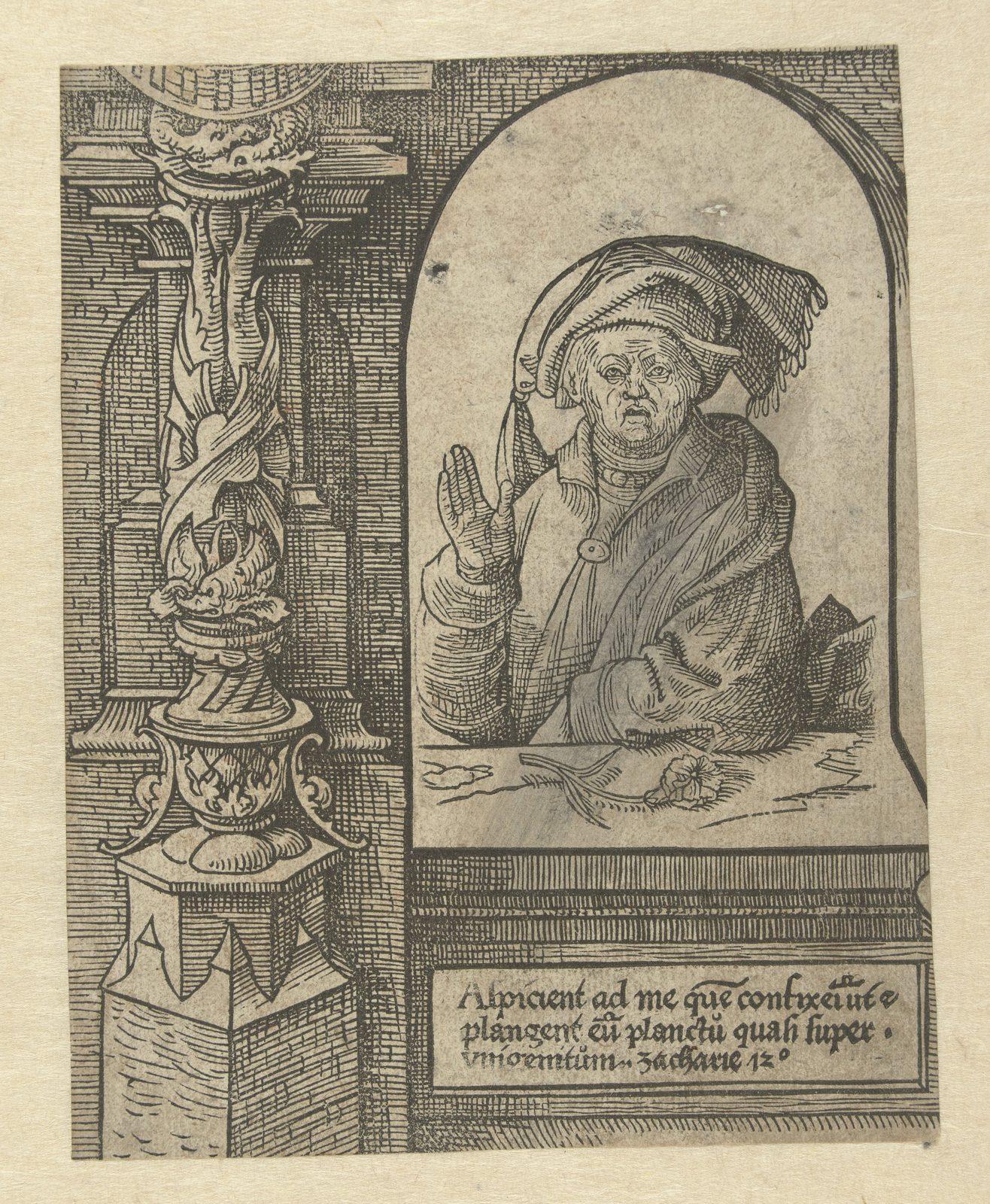
Jacob Cornelisz van Oostsanen, The Prophet Zechariah, 1521 to 1525. Public domain.
Zechariah 9 to 14 · Debate · Featured Study
The Two Burdens and the Unity of Zechariah
Readers have dated the last six chapters of Zechariah by their headings, their Greeks and a citation in Matthew.
Three dates head the messages of Zechariah 1 to 8, and no date heads chapters 9 to 14.
This is the burden of the word of the LORD against the land of Hadrach and Damascus its resting place—for the eyes of men and of all the tribes of Israel are upon the LORD—
- The question
- Did the prophet of Zechariah 1 to 8 write the two burdens of chapters 9 to 14, or did an older or a later hand write them?
- The texts
- Zechariah 9:1, Zechariah 12:1, Malachi 1:1, Zechariah 9:13, Matthew 27:9
Summary
Zechariah 9 and 12 each open with the burden of the word of the LORD, and so does Malachi. Since Mede, readers have asked who wrote these chapters.
- Three readings answer who wrote the chapters and when.
- Augustine, Jerome and Lightfoot each explain why Matthew names Jeremiah.
- The Gospels quote the burdens at the betrayal, the arrest and the cross.
One Heading Three Times
The heading names no prophet in Zechariah, and names Malachi in the last book.
This is the burden of the word of the LORD concerning Israel. Thus declares the LORD, who stretches out the heavens and lays the foundation of the earth, who forms the spirit of man within him:The second burden turns from the nations to Israel.
This is the burden of the word of the LORD to Israel through Malachi:The last book of the Twelve opens with the same heading.
The Readings on the Same Questions
Pusey and Keil, Mede and Newcome, and Stade and Driver stand for the three readings.
The three readings answer the same two questions in three ways.
| Question | One prophet | Older hands before the exile | Later hands after Alexander |
|---|---|---|---|
| Who wrote chapters 9 to 14? | Zechariah himself (Pusey, Keil) | Jeremiah wrote part or all of them (Mede, Hammond, Kidder, Whiston, Newcome) | A prophet after the exile wrote or reshaped them (Stade, Driver) |
| When were they written? | They come after the captivity, as the name Javan shows (Keil) | Chapters 9 to 11 late in the reign of Jeroboam II, and 12 to 14 under the last kings of Judah (Newcome, Ewald, Bleek) | After the exile, when the Greeks had risen (Driver) |
Three Readings of the Burdens
Each reading rests on an argument, and each meets an objection.
One prophet for all fourteen chaptersE. B. Pusey, The Minor Prophets with a Commentary; C. F. Keil, The Twelve Minor Prophets (1878)
Pusey found four parts in the book, different in outward character but one in purpose and end. Keil judged that the differences between the first two prophecies and the last two do not point to two or three prophets.
The objection: Driver judged it hardly possible that the author of chapters 1 to 8 wrote either of the two burdens.
Older prophets before the exileMede, as C. H. H. Wright reports him, Zechariah and his Prophecies (1879); Archbishop Newcome, Ewald and Bleek, as S. R. Driver lists them
Wright reports that Mede first doubted the author of the second part, mainly because Matthew 27:9 gives Zechariah 11:12 to 13 to Jeremiah. Hammond, Kidder, Whiston and Newcome took up his view.
The objection: Driver answered that the Greeks of the first burden appear as a world power, a place they reached only after Alexander.
Later hands in the Greek periodStade, as S. R. Driver reports him; S. R. Driver, An Introduction to the Literature of the Old Testament (1891)
Driver reports that Stade placed the prophecy about 300 BC. Driver himself dated chapters 9 to 11 to the eighth century BC in their first form.
The objection: Keil held the integrity of the whole book beyond doubt by the testimony of tradition.
The Sons of Greece
Zechariah 9:13 names Greece, and Keil and Wesley read it of the Maccabees.
For I will bend Judah as My bow and fit it with Ephraim. I will rouse your sons, O Zion, against the sons of Greece. I will make you like the sword of a mighty man.Driver dated the first burden by this verse, so it stands at the centre of the debate.
Keil held that the prophet took the name Javan from Daniel 8:21, and read the verse of the Greek kingdom as a world power. He found its first fulfilment in the wars of the Maccabees against the Seleucids. John Wesley also read the verse of the wars under the Maccabees.
Jeremiah in Matthew 27:9
Matthew gives to Jeremiah the thirty pieces of silver and the potter of Zechariah 11.
And the LORD said to me, “Throw it to the potter”—this magnificent price at which they valued me. So I took the thirty pieces of silver and threw them to the potter in the house of the LORD.The prophet's wages go to the potter in the temple, the act Matthew's verse recalls.
Then what was spoken through Jeremiah the prophet was fulfilled: “They took the thirty pieces of silver, the price set on Him by the people of Israel, and they gave them for the potter’s field, as the Lord had commanded me.”Matthew sets the price of the betrayal beside a prophet's words.
Augustine allowed that the name Jeremiah came to Matthew's mind in place of Zechariah, and held it consistent to credit Jeremiah with a sentence Zechariah spoke. Jerome wrote that the passage stands in Zechariah, in other words and another order.
John Lightfoot cited the order of the Prophets in the Talmud, Bava Batra 14b, where the books after Kings open with Jeremiah, ahead of Ezekiel and Isaiah. He held that Matthew cited the volume of the prophets under the name of the prophet who stood first in it.
“Hence Mt 27:9, in English Version, and in the oldest authorities, quotes Zechariah's words as Jeremiah's, the latter being the original author from whom Zechariah derived the groundwork of the prophecy. Compare the parallel case of Mr 1:2, 3 in the oldest manuscripts (though not in English Version), quoting Malachi's words as those of ‘Isaiah,’ the original source of the prophecy.”
Jamieson, Fausset & Brown · Commentary Critical and Explanatory on the Whole Bible · on Zechariah 11:13Reformed
The Burdens in the Gospels
The second burden is quoted on the night of the arrest and at the cross.
Then Jesus said to them, “This very night you will all fall away on account of Me. For it is written: ‘I will strike the Shepherd, and the sheep of the flock will be scattered.’Jesus applies Zechariah 13:7 to Himself and to His disciples before they scatter.
And, as another Scripture says: “They will look on the One they have pierced.”John reads the spear thrust at the cross by Zechariah 12:10.
Books to Read Next
Four older studies of the question are free to read.
The Minor Prophets with a Commentary, volume 8, Zechariah
E. B. Pusey · 1907 reprint
Pusey's introduction sets out the plan of the whole book, and he answers the argument from the Greeks.
Read it free at the Internet ArchiveBiblical Commentary on the Old Testament: The Twelve Minor Prophets, volume 2
C. F. Keil · 1878
Keil's introduction to Zechariah defends the unity of the book.
Read it free at the Internet ArchiveAn Introduction to the Literature of the Old Testament
S. R. Driver · 1891
Driver lists the holders of each date and argues for a date after the exile.
Read it free at the Internet ArchiveZechariah and his Prophecies
C. H. H. Wright · 1879
In his Bampton Lectures, Wright traces the doubt about the second part back to Mede.
Read it free at the Internet ArchiveWhere the First Burden Opens
The first burden opens with the cities from Hadrach to Ashdod, which Pusey and Keil read by Alexander's march.
Sources
Scripture is the Berean Standard Bible.
- E. B. Pusey, The Minor Prophets with a Commentary, vol. viii, Zechariah (Nisbet, 1907 reprint), Introduction, pp. 3 and 24 to 25; public domain.
- C. F. Keil, Biblical Commentary on the Old Testament: The Twelve Minor Prophets, vol. 2 (T. and T. Clark, 1878), Introduction to Zechariah, pp. 221 to 222, and on Zechariah 9:13, p. 341; public domain.
- S. R. Driver, An Introduction to the Literature of the Old Testament (1891), pp. 325 to 331; public domain.
- C. H. H. Wright, Zechariah and his Prophecies (Bampton Lectures, 1879), Introduction, section 5, p. xxv; public domain.
- Augustine, The Harmony of the Gospels 3.7.29 to 30, translated by S. D. F. Salmond (1888); public domain.
- Jerome, Letter 57, to Pammachius, translated by W. H. Fremantle (1893); public domain.
- John Lightfoot, Horae Hebraicae et Talmudicae, on Matthew 27:9 (ed. Gandell, Oxford, 1859), vol. 2, pp. 362 to 363; public domain.
- Babylonian Talmud, Bava Batra 14b, the order of the Prophets.
- Jamieson, Fausset and Brown, Commentary Critical and Explanatory on the Whole Bible (1871), on Zechariah 11:13; John Wesley, Explanatory Notes upon the Old Testament (1765), on Zechariah 9:13.
Keep Studying
Read it6
Studies8
People and groups5