
Markchapter 1
45 verses · Mark · AD 55 to 65 · The Gospels
This is the beginning of the gospel of Jesus Christ, the Son of God.
Introduction
Mark, The Gospels, Mark Overview.
Mark opens his Gospel with no birth story and no family line. By the church's early testimony he set down the preaching of Peter for believers in Rome, many of them Gentiles who had never seen Galilee. This first chapter moves from the desert to a lakeside town in a few pages, and it states who Jesus is before anyone in the story understands it. Listen for the word immediately and for how quickly the scenes change. Listen also for who recognises Jesus first and who is told to keep quiet. Read it as the opening of a report that expects an answer.
Context
- Who
- Roman readers with no Jewish background, being handed the story at a run
- What
- The opening of Mark's Gospel, which introduces John the Baptist and Jesus and follows the first days of His work in Galilee.
- Where
- The wilderness by the Jordan River, then Capernaum and the towns of Galilee around the lake.
- When
- The start of Jesus' public ministry in Galilee, about AD 28, after John had been put in prison.
- Why
- To tell the reader at the start that Jesus is the Christ and the Son of God, and to show His authority before any argument about Him begins.
Historical context
Mark starts with no genealogy and no birth story. For readers in Rome, a herald's announcement was a familiar form: an emperor's accession was proclaimed as good news across the provinces. Mark opens with those words about someone else entirely.
Show the rest of the historical context, 3 more paragraphs
John's clothing was a signal to anyone who knew the Scriptures, camel hair and a leather belt is how Elijah is described. His food was what the wilderness gave: wild honey and locusts, which the Law lists among the few insects Israelites could eat.
Capernaum, where the first day unfolds, was a lakeside town of basalt houses on the trade road from Damascus. Its synagogue was the local meeting house where the scrolls were read and explained each Sabbath by whoever was competent, which is how a visiting teacher got the floor. Excavations there have uncovered the black basalt foundation of a first-century synagogue beneath the later white limestone building.
One economic detail is easy to miss. When James and John leave, they leave their father Zebedee in the boat with the hired men, meaning this was a fishing business with employees, not a subsistence family. Walking away cost them something measurable.
Significance
Everything in this chapter moves at a sprint, and the word Mark keeps using is immediately. For a church under pressure in Rome, that pace was the message: this is urgent, and it is already happening.
Show the rest of the significance, 1 more paragraph
The first thing anyone in the story says about Jesus' identity comes from a demon in the synagogue. Roman readers, surrounded by shrines and spirits and a world thick with unseen powers, were being told at once who holds authority over that whole realm, and that the powers recognised him before the people did.
The heads below are this chapter's scenes. The numbered points under each are its verses.
The Voice Crying in the Wilderness
beginning of the gospel of Jesus Christ, the Son of God: Mark states his thesis before any narrative begins: the gospel of Jesus Christ, the Son of God. The confession returns from unclean spirits at 3:11, from the Father's voice at 9:7, and at last from a Gentile centurion at 15:39.
Mark 1:1
“The beginning of the gospel - The word “gospel” literally signifies good news, and particularly the good tidings respecting the way of salvation by the Lord Jesus Christ. Some have understood the word “gospel” here to mean “history” or “life - the beginning of the history,” etc.; but Mark says nothing of the early life of the Saviour. The word “gospel” here has reference rather to the preaching of John, an account of which immediately follows, and means the beginning of the good news, or annunciation respecting the Messiah.”
2 more voices on this verseWhat preachers and commentators have said about this verse, in their own words.
Mark 1:1
“The beginning of the Gospel of Jesus Christ - The evangelist speaks with strict propriety: for the beginning of the Gospel is in the account of John the Baptist, contained in the first paragraph; the Gospel itself in the rest of the book.”
John Wesley · Explanatory Notes upon the New Testament (1755)evangelical
Mark 1:1
“The Gospel of Mark, which we now begin, is in some respects unlike the other three Gospels. It tells us nothing about the birth and early life of our Lord Jesus Christ. It contains comparatively few of His sayings and discourses. Of all the four inspired histories of our Lord's earthly ministry, this is by far the shortest. But we must not allow these peculiarities to make us undervalue Mark's Gospel. It is a Gospel singularly full of precious facts about the Lord Jesus, narrated in a simple, terse, pithy, and condensed style.”
Mark 1:2-3
As it is written in Isaiah the prophet: The citation joins two prophets, the messenger of Malachi 3:1 and the voice in the wilderness of Isaiah 40:3, under one name. John is the one who prepares that way, and the way becomes a thread this Gospel runs through its central section.
Mark 1:2
Wherefore also Mark, the interpreter and follower of Peter, does thus commence his Gospel narrative: "The beginning of the Gospel of Jesus Christ, the Son of God; as it is written in the prophets, Behold, I send My messenger before Thy face, which shall prepare Thy way. The voice of one crying in the wilderness, Prepare ye the way of the Lord, make the paths straight before our God."
Irenaeus · written before 202 · Against Heresies Book IIIpatristic
3 more voices on this verse
Mark 1:2
“As it is written in the prophets,.... Malachi and Isaiah; for passages out of both follow; though the Vulgate Latin, Syriac, and Persic versions read, "as it is written in the prophet Isaias"; and so it is in some Greek copies: but the former seems to be the better reading, since two prophets are cited, and Isaiah is the last; to which agree the Arabic and Ethiopic versions, and the greater number of Greek copies.”
Mark 1:2
“As it is written in the prophets - Rather, As it is written by Isaiah the prophet. I think this reading should be adopted, instead of that in the common text. It is the reading of the Codex Bezae, Vatican, and several other MSS. of great repute. It is found also in the Syriac, Persic, Coptic, Armenian, Gothic, Vulgate, and Itala versions, and in several of the fathers. As this prophecy is found both in Isaiah and Malachi, probably the reading was changed to τοις προφηταις, the prophets, that it might comprehend both.”
Adam Clarke · Commentary on the Bible (1810-1826)evangelical
Mark 1:2
“Quotations are here borrowed from two prophecies--that of Isaiah, which was the longest, and that of Malachi, which was the latest (and there were above three hundred years between them), both of whom spoke to the same purport concerning the beginning of the gospel of Jesus Christ, in the ministry of John.”
Matthew Henry · Commentary on the Whole Bible (1707-1721)puritan
Cross references
Mark 1:2
- QuotingIsaiah 40:3“A voice of one calling: “Prepare the way for the LORD in the wilderness; make a straight highway for our God in the desert.”
kathos gegraptai heading Mark's whole Gospel (composite frame, w/ Mal 3:1), the formula placed at a book's very threshold
- QuotingMalachi 3:1“Behold, I will send My messenger, who will prepare the way before Me. Then the Lord whom you seek will suddenly come to His temple—the Messenger of the covenant, in whom you delight—see, He is coming,” says the LORD of Hosts.
'Behold, I send my messenger' (Mark's composite 'as it is written in the prophets', w/ Isa 40:3)
ConnectionsMalachi 3:1
Jerome asked why Mark names only Isaiah. The first words come from Malachi, and Augustine answered that Mark gathers both sayings under the elder prophet, who first gave their sense. Jerome reads the prepared way as repentance, where John's preaching begins.
Mark 1:3
“The quotation is made up from two prophets, Malachi and Isaiah. From the first part: "Behold I send my messenger to prepare the way before me," occurs at the close of Malachi. But the second part: "The voice of one crying," etc., we read in Isaiah. On what ground then has Mark in the very beginning of his book set the words: "As it is written in the prophet Isaiah, Behold I send my messenger," when, as we have said, it is [in part] not written in Isaiah at all, but in Malachi, the last of the twelve prophets?”
Jerome · written before 420 · Letter 57 to Pammachius 9patristic
Cross references
Mark 1:3
- QuotingIsaiah 40:3“A voice of one calling: “Prepare the way for the LORD in the wilderness; make a straight highway for our God in the desert.”
'The voice of one crying in the wilderness'
Mark 1:4-6
John the Baptist appeared in the wilderness: John was clothed in camel’s hair, with a leather belt around his waist, the dress of Elijah in 2 Kings 1:8. His clothing shows him as the figure Malachi 4:5 promised.
Mark 1:4
“Those who sought the baptism of repentance were dealt with as if candidates preparing for the baptismal remission and sanctification that were soon to follow in the ministry of Christ. When John preached baptism for "the remission of sins," the declaration was made with reference to a future remission. If so, John's call to repentance is to lead the way, and actual remission is to follow. This is what is meant by "preparing the way." But one who prepares does not himself perfect, but rather makes ready for another to perfect.”
Tertullian · written before 220 · On Baptism 10patristic
1 more voice on this verse
Mark 1:4
“John - The original name is nearly lost in the Greek Ιωαννης, and in the Latin Johannes, and almost totally so in the English John. The original name is יהוחנן Yehochanan, compounded of יהוה חנן Yehovah chanan, the grace or mercy of Jehovah: a most proper and significant name for the forerunner of the God of All Grace. It was John’s business to proclaim the Gospel of the grace of God, and to point out that Lamb or sacrifice of God which takes away the sin of the world.”
Adam Clarke · Commentary on the Bible (1810-1826)evangelical
Confessing their sins: Adam Clarke notes that the Jews baptized a Gentile convert only after he had solemnly renounced idolatry and pledged himself to the law of Moses. John asked a public confession of Jews born under that law. Jerome adds that this baptism looked ahead to a forgiveness Christ would bring.
Mark 1:5
“Let us here treat briefly of the different kinds of baptism. Moses baptized, but in water, in the cloud and in the sea; but this he did figuratively. John also baptized, not indeed in the rite of the Jews, not solely in water, but also for the remission of sins; yet not in an entirely spiritual manner, for he had not added: "in the spirit." Jesus baptized, but in the Spirit; and this is perfection.”
Gregory of Nazianzus · written before 390 · Oration 39, on the Holy Lightspatristic
1 more voice on this verse
Mark 1:5
“All the land - See on Mat 3:4-6 (note). Confessing their sins - It was an invariable custom among the Jews to admit no proselyte to baptism, till he had, in the most solemn manner, declared that he forever had renounced all idolatrous worship, all heathenish superstitions, and promised an entire and unreserved submission to the law of Moses. This was necessary for a proselyte adult - a child dedicated to God by baptism must be brought up in this faith.”
Adam Clarke · Commentary on the Bible (1810-1826)evangelical
His food was locusts and wild honey: Jerome points out that John was a priest's son. He could have lived in his father's house, yet he chose the desert, with rough dress and plain food, to train himself in self-control. John Chrysostom adds that John needed no plough and no roof.
Mark 1:6
“John the Baptist had a religious mother and his father was a priest. Yet neither his mother's affection nor his father's affluence could induce him to live in his parents' house at the risk of the world's temptations. So he lived in the desert. Seeking Christ with his eyes, he refused to look at anything else. His rough garb, his girdle made of skins, his diet of locusts and wild honey were all alike designed to encourage virtue and continence.”
Jerome · written before 420 · Letter 125, to Rusticus 7patristic
Mark 1:7-8
John baptizes with water, but of the One after him he says, He will baptize you with the Holy Spirit. The prophets assign that act to God himself at Joel 2:28 and Ezekiel 36:25-27.
Mark 1:7
"One mightier than I is coming after me, the thong of whose sandals I am not worthy to stoop down and untie." The meaning of the words: "He must increase, I must decrease," is that the gospel must increase, but I, the law, must decrease. John, that is, the law in John, was clothed, therefore, in the hair of a camel, for he could not wear a tunic of the lamb of whom it is said: "Behold the lamb of God who takes away the sin of the world;" and again: "He is led like a lamb to the slaughter."
Jerome · written before 420 · HOMILY 75patristic
Jerome states the difference simply. Water is given by a man's hand, but the Spirit is given by God. Origen notes that Jesus left water baptism to His disciples and kept the baptism in the Spirit for Himself.
Mark 1:8
“I indeed have baptized you with water,.... This was spoken to the baptized persons, partly to take off their dependence upon him and his baptism; and partly to direct their views to Christ, from whom the gifts and graces of the Spirit are alone to be had: but he shall baptize you with the Holy Ghost; See Gill on Mat 3:11. One copy adds, "and with fire", as there: a Jewish writer says, the holy blessed God baptizeth with fire, and the wise shall understand (p). (p) R. Menachem in Lev. viii. apud Ainsworth on Gen. xvii. 12.”
2 more voices on this verse
Mark 1:8
“I indeed have baptized you with water - As if he had said: This baptism is not to be rested in; it is only an emblem of that which you must receive from him who is mightier than I. It is he only who can communicate the Holy Spirit; and water baptism is nothing, but as it points out, and leads to, the baptism of the Holy Ghost. The subject of these two verses is not found in Matthew nor John; but is mentioned with some varying circumstances by Luke, Luk 3:16.”
Adam Clarke · Commentary on the Bible (1810-1826)evangelical
Mark 1:8
“The baptism which was handed down through Moses recognized, first, a distinction among sins, for the grace of pardon was not accorded all transgressions. It also required various sacrifices, laid down precise rules for purification, and segregated for a time those who were in a state of impurity and defilement. It appointed the observance of days and seasons, and only then baptism was received as the seal of purification.”
Basil of Caesarea · written before 379 · Concerning Baptism 31.2patristic
Baptized, Anointed, and Driven to the Wilderness
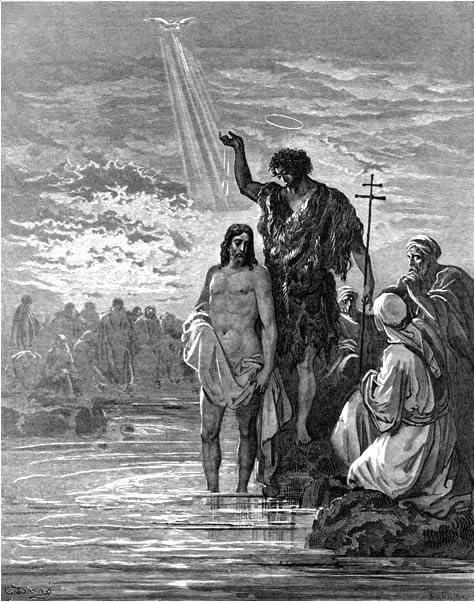
Jesus came from Nazareth in Galilee: In those days Jesus came from Nazareth in Galilee, a walk of roughly seventy miles to the Jordan, for a baptism He did not need. Mark states the fact in one line, that He was baptized by John in the Jordan, while Matthew also records the hesitation of John.
Mark 1:9
“As man he was baptized, but he absolved sins as God. He needed no purifying rites himself—his purpose was to hallow water.”
Gregory of Nazianzus · written before 390 · Oration 29, on the Sonpatristic
1 more voice on this verse
Mark 1:9
“This passage is singularly full of matter. It is a striking instance of that brevity of style, which is the peculiar characteristic of Mark's Gospel. The baptism of our Lord, His temptation in the wilderness, the commencement of his preaching, and the calling of His first disciples are related here in eleven verses. Let us notice, in the first place, the voice from heaven which was heard at our Lord's baptism. We read, "There came a voice from heaven, saying, You are my beloved Son, in whom I am well pleased." That voice was the voice of God the Father.”
Mark 1:10-11
He saw the heavens breaking open: Jesus saw the heavens breaking open, and the Greek verb behind those words returns once more in Mark, at 15:38. There it describes the temple veil torn in two.
Mark 1:10
“Christ descended, and John stood who was baptizing, and behold, as if a dove the Holy Spirit descended. It was not a dove that descended, but as if a dove. Remember what I said: Christ took on flesh, not like flesh; but he took on the truth of that flesh, true flesh Christ took on: But the Holy Spirit did not descend in the truth of a dove, but in the likeness of a dove from heaven. Therefore, John saw and believed. Christ descended, the Holy Spirit descended as well.”
Ambrose of Milan · written before 397 · On the Sacraments, Book 1, Chapter 5patristic
Matthew reports the voice speaking about the Son. Mark has it speak to Him, and Augustine answers that the Gospel writers may vary the words while keeping one meaning. He reads the Father's pleasure as the work the Father delights to do through the Son.
Mark 1:11
“These words are not to be understood, when we speak of God, as when we speak of bodies. The generation of the Son is incomprehensible, the Father begets without changing his nature. Yet this begottenness is of himself. In ages inconceivably remote the true God has begotten one who is truly God.”
Ambrose of Milan · written before 397 · Exposition of the Christian Faith 1.10.67patristic
Mark 1:12-13
At once the Spirit drove Jesus into the wilderness: Mark gives the temptation in one line, being tempted by Satan, and alone adds that He was with the wild animals. Jesus stands firm in a wilderness where the first Adam fell in a garden.
Mark 1:12
“It is often doubted by some by what spirit Jesus was led into the desert. This question is properly understood if we believe he was led into the desert by the Holy Spirit, so that his own Spirit would lead him there, where the evil spirit would then find him to tempt him. Therefore it is not unworthy of our Redeemer that he willed to be tempted, he who had come to be killed. For it was just that he should overcome our temptations by his temptations, just as he had come to conquer our death by his death.”
Gregory the Dialogist · written before 604 · Forty Gospel Homilies, Homily 16patristic
1 more voice on this verse
Mark 1:12
“The Spirit driveth him - Εκβαλλει, putteth him forth. St. Matthew says, Mat 4:1, ανηχθη, was brought up. See this important subject of our Lord’s temptation explained at large, Mat 4:1-11 (note).”
Adam Clarke · Commentary on the Bible (1810-1826)evangelical
He was with the wild animals: John Chrysostom notes that the testing came straight after the baptism. He reads this as a lesson for every baptized believer, who should expect temptation and bear it without alarm. Adam Clarke takes the wild animals to mean Jesus was in the most remote and unvisited part of the desert.
Mark 1:13
“The ancient enemy raised himself against the first man, our parent, in three temptations, because he tempted him with gluttony, vainglory, and avarice; but by tempting he overcame him, because he subjected him to himself through consent. But by the same means by which he overthrew the first man, by those same means he was overcome when he tempted the second man, so that he might depart from our hearts, captured at the very entrance by which he had entered and held us. But it should be noted what follows: that when the devil departed, angels ministered to him.”
Gregory the Dialogist · written before 604 · Forty Gospel Homilies, Homily 16patristic
1 more voice on this verse
Mark 1:13
“With the wild beasts - This is a curious circumstance, which is mentioned by none of the other evangelists; and seems to intimate that he was in the most remote, unfrequented, and savage part of the desert; which, together with the diabolic influence, tended to render the whole scene the more horrid. Perhaps this very circumstance is mentioned, as emblematical of that savage and brutal cruelty with which he was persecuted to death by the Jews and Gentiles, instigated thereto by the malice of Satan.”
Adam Clarke · Commentary on the Bible (1810-1826)evangelical
Come After Me: I Will Make You Fishers of Men
Mark 1:14-15
After the arrest of John, Jesus went into Galilee: and proclaimed the gospel of God, the same gospel word Mark opened with at 1:1. The thesis of 1:1 is now preached aloud, with two commands joined to it, Repent and believe in the gospel.
Mark 1:14
“Or, then the beasts dwell with us in peace, as in the ark clean animals with the unclean, when the flesh lusts not against the spirit. After this, ministering Angels are sent to us, that they may give answers and comforts to hearts that watch. When the shadow ceases, the truth comes on; first, John in prison, the Law in Judæa; then, Jesus in Galilee, Paul among the Gentiles preaching the Gospel of the kingdom.”
Pseudo-Jerome · Catena Aurea by Aquinaspatristic
4 more voices on this verse
Mark 1:14
“Now after that John was put in prison - John was imprisoned by Herod, Mat 14:3. Jesus came into Galilee - He left Judea and went into the more retired country of Galilee. He supposed that if he remained in Judea, Herod would also persecute him and attempt to take his life. His time of death had not come, and he therefore prudently sought safety in retirement. Hence, we may learn that when we have great duties to perform for the church of God, we are not to endanger our lives wantonly.”
Mark 1:14
“Hearing that John had been delivered into prison, Jesus withdraws into Galilee, in order to show us as well that we must not throw ourselves into temptations, but avoid them, and when we fall into them, endure them.”
Theophylact of Ohrid · written before 1107 · Commentary on Markpatristic
Mark 1:14
“He also appointed him, (1.) To show himself to the priest, that the priest by his own judgment of this leper might be a witness for Christ, that he was the Messiah, Matt. xi. (2.) Till he had done that, not to say any thing of it to any man: this is an instance of the humility of Christ and his self-denial, that he did not seek his own honour, did not strive or cry, Isa. xlii.”
Matthew Henry · Commentary on the Whole Bible (1707-1721)puritan
Mark 1:14
“Preaching the Gospel of the kingdom - See the notes on Mat 3:2; and on the office of the preacher, or herald, at the end of that chapter.”
Adam Clarke · Commentary on the Bible (1810-1826)evangelical
Adam Clarke links the fulfilled time to the period foretold in Daniel 9:24-27, and sees in it a plan carried out on God's own schedule. Albert Barnes notes that to believe here means to trust. Faith rests on the good news of salvation itself.
Mark 1:15
“The time is fulfilled - That is, the time for the appearance of the Messiah, the time so long foretold, has come. “The kingdom of God is at hand.” See the notes at Mat 3:2. Repent ye - Exercise sorrow for sins, and turn from them. And believe the gospel - Literally, trust in the gospel, or believe the good tidings - to wit, respecting salvation. See the notes at Mat 4:17.”
Mark 1:16-18
He saw Simon and his brother Andrew: Jesus calls two fishermen at work, and the call turns their trade into a new one, I will make you fishers of men. And at once they left their nets and followed Him, the cost stated without comment.
Mark 1:16
“As he walked by the sea, etc. - See on Mat 4:18-22 (note). Andrew his brother - Instead of the common reading, αδελφον αυτου, his brother, the best MSS. and versions have αδελφου του Σιμωνος, the brother of Simon, which should be received into the text. The most eminent critics approve of this reading.”
Adam Clarke · Commentary on the Bible (1810-1826)evangelical
1 more voice on this verse
Mark 1:16
“And you yourself may realize the divine elements of this power, if you reflect on the nature and grandeur of a Being who could associate with Himself poor men of the lowly fisherman's class, and use them as agents in carrying through a work that transcends all reason.”
Eusebius of Caesarea · written before 339 · The Proof of the Gospel, Book 3patristic
ConnectionsMark 16:7
Eusebius saw divine power at work in the fact that plain fishermen obeyed this first word at all. John Gill notes that the new work surpasses the old, since people are worth more than fish. Jesus promises to make them fit for it.
Mark 1:17
“And Jesus said unto them, come ye after me,.... Leave your worldly employments, and become my disciples, and I will make you to become fishers of men: which will be a much more excellent and honourable employment, as men, and the souls of men, are more excellent, and of more worth than fishes; See Gill on Mat 4:19.”
they left their nets: Augustine explains that Andrew and another disciple had met Jesus earlier, as John's Gospel records, but only visited Him then. From this call on they stayed with Him for good. Gregory the Dialogist notes they had seen no miracle yet.
Mark 1:18
“You have heard, dearest brothers, that at the voice of a single command, Peter and Andrew, leaving their nets, followed the Redeemer. They had seen him perform no miracles yet, they had heard nothing from him about the reward of eternal recompense; and yet at one command of the Lord they forgot what they seemed to possess. How many of his miracles do we see, with how many scourges are we afflicted, by how many harsh threats are we deterred, and yet we disdain to follow him when he calls?”
Gregory the Dialogist · written before 604 · Forty Gospel Homilies, Homily 5patristic
Mark 1:19-20
He saw James son of Zebedee and his brother John: They left their father Zebedee in the boat with the hired men. The hired men show a family business large enough to employ help, so the brothers left a working livelihood.
Mark 1:19
“Do you hesitate about arts, and trades, and about professions likewise, for the sake of children and parents? Even there was it demonstrated to us, that both "dear pledges," and handicrafts, and trades, are to be quite left behind for the Lord's sake; while James and John, called by the Lord, do leave quite behind both father and ship; while Matthew is roused up from the toll-booth; while even burying a father was too tardy a business for faith.”
Tertullian · written before 220 · On Idolatrypatristic
they left their father Zebedee in the boat: Jerome asks why grown men would leave a father to follow a stranger, and answers that something in the Savior's face drew them. They left a father, he says, and found a Father. John Gill reads the call as an appointment made long before.
Mark 1:20
“There must have been something divinely compelling in the face of the Savior. Otherwise they would not have acted so irrationally as to follow a man whom they had never seen before. Does one leave a father to follow a man in whom he sees nothing more than he sees in his father? They left their father of the flesh to follow the Father of the spirit. They did not leave a father; they found a Father. What is the point of this digression?”
Jerome · written before 420 · Commentary (church-history corpus)patristic
Authority Over an Unclean Spirit at Capernaum
Mark 1:21-22
Jesus and His companions went to Capernaum: Jesus taught in the synagogue at Capernaum, and the people were astonished at His teaching, because He taught as one who had authority. The scribes leaned on chains of earlier authorities.
Mark 1:21
“See also Luk 4:31-37. Mar 1:21 And they went into Capernaum - For the situation of Capernaum see the notes at Mat 4:13. Straightway - Immediately. On the following Sabbath. The synagogue - See the notes at Mat 4:23. And taught - In the synagogue, the presiding elder, after reading the Scriptures, invited anyone who chose to address the people, Act 13:15. Though our Saviour was not a “priest” of the Levitical order or an “officer” of the synagogue, yet we find him often availing himself of this privilege, and delivering his doctrines to the Jews.”
1 more voice on this verse
Mark 1:21
These verses begin the long list of miracles which Mark's Gospel contains. They tell us how our Lord cast out devils in Capernaum, and healed Peter's wife's mother of a fever. We learn, in the first place, from these verses, the uselessness of a mere intellectual knowledge of religion . Twice we are specially told that the unclean spirits know our Lord. In one place it says, "they knew Him." to another, the devil cries out, "I know you who you are, the Holy One of God."
as one who had authority: Charles Spurgeon separates two things here. No one dared question His teaching, and every hearer felt the force of it. Adam Clarke explains the contrast with the scribes: they held no commission from God, so their teaching carried no divine power.
Mark 1:22
“As one that had authority - From God, to do what he was doing; and to teach a pure and beneficent system of truth. And not as the scribes - Who had no such authority, and whose teaching was not accompanied by the power of God to the souls of the people: 1. because the matter of the teaching did not come from God; and 2. because the teachers themselves were not commissioned by the Most High. See the note on Mat 7:28.”
Adam Clarke · Commentary on the Bible (1810-1826)evangelical
Mark 1:23-26
a man with an unclean spirit cried out in the synagogue: Jesus rebuked the spirit and silenced it at once, the same verb Mark uses for the storm at 4:39. The shared verb joins this exorcism and the calming of the sea as one authority over chaos.
Mark 1:23
“A man with an unclean spirit - This demoniac is only mentioned by Mark and Luke, Luk 4:33. It seems the man had lucid intervals; else he could not have been admitted into the synagogue. Unclean or impure spirit - a common epithet for those fallen spirits: but here it may mean, one who filled the heart of him he possessed with Lascivious thoughts, images, desires, and propensities. By giving way to the first attacks of such a spirit, he may soon get in, and take full possession of the whole soul.”
Adam Clarke · Commentary on the Bible (1810-1826)evangelical
Augustine compares this cry with Peter's confession, which says almost the same thing. Peter spoke from love, he writes, and the demons from fear. Jamieson, Fausset and Brown trace the title Holy One of God to Psalm 16:10.
Mark 1:24
And through the Word Himself who had been made visible and palpable, was the Father shown forth, although all did not equally believe in Him; but all saw the Father in the Son: for the Father is the invisible of the Son, but the Son the visible of the Father. And for this reason all spake with Christ when He was present [upon earth], and they named Him God. Yea, even the demons exclaimed, on beholding the Son: "We know Thee who Thou art, the Holy One of God."
Irenaeus · written before 202 · Against Heresies Book IVpatristic
3 more voices on this verse
Mark 1:24
But a Wiser than either was here, who invariably rejected and silenced the testimonies that came to Him from beneath, and thus was able to rebut the imputations of His enemies against Him (Mt 12:24-30). The expression, "Holy One of God," seems evidently taken from that Messianic Psalm (Ps 16:10), in which He is styled "Thine Holy One."
Jamieson, Fausset & Brown · Commentary Critical and Explanatory on the Whole Bible (1871)reformed
Mark 1:24
“Saying, let us alone, &c. Meaning with himself, the rest of the unclean spirits, that had possessed the bodies of men in Galilee, and in all Judea; knowing that Christ had power to dislodge them, and fearing he would, entreats him he would let them alone, quietly to dwell in their beloved habitations: what have we to do with thee?”
Mark 1:24
“What have we to do with thee - Or, What is it to us and to thee? or, What business hast thou with us? That this is the meaning of the original, τι ἡμιν και σοι, Kypke has sufficiently shown. There is a phrase exactly like it in 2Sa 16:10. What have I to do with you, ye sons of Zeruiah? מה לי ולכם בני צרויה ma li v'lacem beney Tseruiah, What business have ye with me, or, Why do ye trouble me, ye sons of Tseruiah?”
Adam Clarke · Commentary on the Bible (1810-1826)evangelical
Jamieson, Fausset and Brown cite Bengel, who observed that Jesus silenced only the demon's witness about Himself. Athanasius adds that He curbed such mouths even when they spoke truly. Such a spirit yields to His power alone, notes Adam Clarke.
Mark 1:25
“And Jesus rebuked him, saying, Hold thy peace, and come out of him--A glorious word of command. BENGEL remarks that it was only the testimony borne to Himself which our Lord meant to silence.”
Jamieson, Fausset & Brown · Commentary Critical and Explanatory on the Whole Bible (1871)reformed
1 more voice on this verse
Mark 1:25
“And again, when He put a curb in the mouths of the demons that cried after Him from the tombs. For although what they said was true, and they lied not then, saying, 'Thou art the Son of God,' and 'the Holy One of Gods;' yet He would not that the truth should proceed from an unclean mouth, and especially from such as them, lest under pretence thereof they should mingle with it their own malicious devices, and sow these also while men slept.”
Athanasius of Alexandria · written before 373 · To the Bishops of Egypt 1.3patristic
threw the man into convulsions: Adam Clarke notes from Luke 4:35 that the spirit threw the man down in the middle of the synagogue. Matthew Henry sees a pattern in the violence of the exit. Satan troubles those he can no longer keep.
Mark 1:26
“And when the unclean spirit had torn him - And had thrown him down in the midst, Luk 4:35, και σπαραξαν, and convulsed him. Never was there a person possessed by an unclean spirit who did not suffer a convulsion, perhaps a total ruin of nature by it. Sins of uncleanness, as the apostle intimates, are against the body; they sap the foundation of life, so that there are very few of this class, whether male or female, that live out half their days: they generally die martyrs to their lusts.”
Adam Clarke · Commentary on the Bible (1810-1826)evangelical
Mark 1:27-28
All the people were amazed: The crowd calls this a new teaching with authority, the amazement of verse 22 returning. The authority claimed for His words is now shown in deed, He commands even the unclean spirits, and they obey Him.
Mark 1:27
“What thing is this? - Words of surprise and astonishment. And what new doctrine - I have added the particle and, from the Syriac, as it helps the better to distinguish the members of the sentence; but there is a vast diversity in the MSS. on this verse. See Griesbach. For with authority - They had never heard such a gracious doctrine, and never saw any teaching supported by miracles before. How much must this person be superior to men! - they are brought into subjection by unclean spirits; this person subjects unclean spirits to himself.”
Adam Clarke · Commentary on the Bible (1810-1826)evangelical
1 more voice on this verse
Mark 1:27
“What thing is this? what new doctrine--teaching is this?--The audience, rightly apprehending that the miracle was wrought to illustrate the teaching and display the character and glory of the Teacher, begin by asking what novel kind of teaching this could be, which was so marvellously attested.”
Jamieson, Fausset & Brown · Commentary Critical and Explanatory on the Whole Bible (1871)reformed
spread quickly through the whole region of Galilee: Adam Clarke gives three reasons the report travelled so fast. The miracle was great, it was kind, and it was done in public in the synagogue. John Gill notes that the news moved beyond Capernaum into the country bordering Galilee as well.
Mark 1:28
“And immediately his fame spread abroad - The miracle which he had performed was - 1. great; 2. evidenced much benevolence in the worker of it; and 3. was very public, being wrought in the synagogue. The many who saw it published it wherever they went; and thus the fame of Christ, as an incomparable teacher, and unparalleled worker of miracles, became soon spread abroad through the land.”
Adam Clarke · Commentary on the Bible (1810-1826)evangelical
A Whole City at the Door; Prayer Before Dawn
Mark 1:29-31
As soon as Jesus and His companions had left the synagogue: At the home of Simon and Andrew, Simon’s mother-in-law was sick in bed with a fever, which shows Peter was married. Paul assumes the same at 1 Corinthians 9:5.
Mark 1:29
“And forthwith, when they were come out of the synagogue--so also in Lu 4:38. they entered into the house of Simon and Andrew, with James and John--The mention of these four--which is peculiar to Mark--is the first of those traces of Peter's hand in this Gospel, of which we shall find many more.”
Jamieson, Fausset & Brown · Commentary Critical and Explanatory on the Whole Bible (1871)reformed
2 more voices on this verse
Mark 1:29
“Such eye-witnesses the Lord in infancy found; no different ones had He in adult age. Peter alone do I find-through (the mention of) his "mother-in-law" ,-to have been married.”
Tertullian · written before 220 · On Monogamypatristic
Mark 1:29
“WE SEE BEFORE US small beginnings and grand endings. One man is called by the voice of Jesus, and then another; the house wherein they dwell is consecrated by the Lord's presence, and by-and-by the whole city is stirred from end to end with the name and fame of the Great Teacher.”
they promptly told Jesus about her: Charles Spurgeon traces a line of small beginnings here. One man is called and then another, their house receives the Lord, and soon the whole town is stirred. The disciples' first act in their own home is to bring its need to Jesus.
Mark 1:30
“Can you imagine Jesus standing before your bed and you continue sleeping? It is absurd that you would remain in bed in his presence. Where is Jesus? He is already here offering himself to us. "In the middle," he says, "among you he stands, whom you do not recognize." "The kingdom of God is in your midst." Faith beholds Jesus among us. If we are unable to seize his hand, let us prostrate ourselves at his feet. If we are unable to reach his head, let us wash his feet with our tears.”
Jerome · written before 420 · Tractate on Mark's Gospel 2patristic
took her by the hand: Jamieson, Fausset and Brown note that only Mark records Jesus lifting her up by the hand. They suggest Peter felt that kindness most. Her service was likely the sabbath meal, a sign of thanks as well as of health restored.
Mark 1:31
“The beloved physician again is very specific: "And He stood over her." and lifted her up--This act of condescension, most felt doubtless by Peter, is recorded only by Mark. and immediately the fever left her, and she ministered unto them--preparing their sabbath-meal: in token both of the perfectness and immediateness of the cure, and of her gratitude to the glorious Healer.”
Jamieson, Fausset & Brown · Commentary Critical and Explanatory on the Whole Bible (1871)reformed
Mark 1:32-34
That evening, after sunset: He would not allow the demons to speak, because they knew who He was, the silencing of verse 25 repeated. Jesus refuses a true confession from an unclean source.
Mark 1:32
“See the notes at Mat 8:16-17. And at even, when the sun did set - See the notes at Mat 8:16. Mar 1:33 All the city - A great part of the city. A great multitude from the city. Mar 1:34 And suffered not the devils to speak, because they knew him - They knew that he was the Messiah. If they had spoken, they would have made that known to the people. Jesus was not desirous at that time that that should be publicly known, or that his name should be blazoned abroad.”
the whole town gathered at the door: Jamieson, Fausset and Brown take the door to be that of Peter's house. The crowd held the sick, their bearers, and the curious. John Gill traces the gathering to the news of the synagogue deliverance earlier that day.
Mark 1:33
“And all the city was gathered together at the door--of Peter's house; that is, the sick and those who brought them, and the wondering spectators. This bespeaks the presence of an eye-witness, and is one of those lively examples of word-painting so frequent in this Gospel.”
Jamieson, Fausset & Brown · Commentary Critical and Explanatory on the Whole Bible (1871)reformed
because they knew who He was: Several ancient manuscripts add that the demons knew Him as the Christ. Adam Clarke judges the addition a later gloss. Jamieson, Fausset and Brown point to Matthew 8:17, which reads these healings as the fulfilment of Isaiah 53:4.
Mark 1:34
“Because they knew him - To be the Christ, is added here by several ancient and respectable MSS. and versions; but it appears to be only a gloss.”
Adam Clarke · Commentary on the Bible (1810-1826)evangelical
1 more voice on this verse
Mark 1:34
After this account of His miracles of healing, we have in Mt 8:17 this pregnant quotation, "That it might be fulfilled which was spoken by Esaias the prophet, saying (Isa 53:4), Himself took our infirmities, and bare our sicknesses."
Jamieson, Fausset & Brown · Commentary Critical and Explanatory on the Whole Bible (1871)reformed
Mark 1:35-37
Early in the morning, while it was still dark: Jesus got up while it was still dark and slipped out to a solitary place to pray. It is the only note of His private prayer in this chapter, and He keeps this pattern of withdrawal as the demand for Him grows.
Mark 1:35
Jesus prayed and did not pray in vain, since he received what he asked for in prayer when he might have done so without prayer. If so, who among us would neglect to pray? Mark says that "in the morning, a great while before day, he rose and went out to a lonely place, and there he prayed." And Luke says, "He was praying in a certain place, and when he ceased, one of his disciples said to him, 'Lord, teach us to pray,' " and elsewhere, "And all night he continued in prayer to God."
Origen of Alexandria · written before 253 · On Prayer 13.1patristic
2 more voices on this verse
Mark 1:35
“When morning came, Peter, loath to break in upon the repose of his glorious Guest, would await His appearance beyond the usual hour; but at length, wondering at the stillness, and gently coming to see where the Lord lay, he finds it--like the sepulchre afterwards--empty! Speedily a party is made up to go in search of Him, Peter naturally leading the way.”
Jamieson, Fausset & Brown · Commentary Critical and Explanatory on the Whole Bible (1871)reformed
Mark 1:35
“He prayed, prayed alone; to set us an example of secret prayer. Though as God he was prayed to, as man he prayed. Though he was glorifying God, and doing good, in his public work, yet he found time to be alone with his Father; and thus it became him to fulfil all righteousness.”
Matthew Henry · Commentary on the Whole Bible (1707-1721)puritan
went to look for Him: Adam Clarke notes that the Greek verb means eager pursuit. John Gill adds that Jesus had slipped away privately, so they searched for some time before finding Him. Their eagerness shows how much the first day had meant to them.
Mark 1:36
“And Simon - followed after him - Κατεδιωξαν, followed him eagerly. They had now begun to taste the good word of God, and thought they could never hear too much of it. Many possess this spirit when first converted to God. O! what a pity that they should ever lose it! The soul that relishes God’s word is ever growing in grace by it.”
Adam Clarke · Commentary on the Bible (1810-1826)evangelical
Adam Clarke notes that the crowd sought Jesus for different reasons. Some came to hear, some to be healed, and some from no good motive. Matthew Henry reads the disciples' report as a wish to keep their Master in their own city, a wish verse 38 answers.
Mark 1:37
“All men seek for thee - Some to hear; some to be healed; some to be saved; and some, perhaps, through no good motive. There are all sorts of followers in the train of Christ; but how few walk steadily, and persevere unto the end!”
Adam Clarke · Commentary on the Bible (1810-1826)evangelical
Mark 1:38-39
Jesus answers the pull of Capernaum with a plain purpose, so I can preach there as well, for that is why I have come. Preaching is named first and the driving out of demons second, the order of His own stated purpose.
Mark 1:38
“The next towns - Κωμοπολεις properly signifies such towns as resembled cities for magnitude and number of inhabitants, but which were not walled as were cities. The Codex Bezae, most of the versions, and all the Itala, read, Let us go into the neighboring villages, And Into The Cities. For therefore came I forth - Εις τουτο, for this purpose am I come forth - to preach the Gospel to every creature, that all might hear, and fear, and return unto the Lord.”
Adam Clarke · Commentary on the Bible (1810-1826)evangelical
1 more voice on this verse
Mark 1:38
“Compare Joh 16:28, "I came forth from the Father, and am come into the world," &c.--another proof, by the way, that the lofty phraseology of the Fourth Gospel was not unknown to the authors of the others, though their design and point of view are different.”
Jamieson, Fausset & Brown · Commentary Critical and Explanatory on the Whole Bible (1871)reformed
preaching in their synagogues: Augustine holds that this tour includes the Sermon on the Mount, which Matthew records and Mark passes over. Matthew Henry reads the casting out of demons as proof of the preaching. In his words, Christ's doctrine is Satan's destruction.
Mark 1:39
“He also mingled action with teaching, for whilst employed in preaching, He afterwards put to flight devils. For there follows: And casting out devils. For unless Christ showed forth miracles, His teaching would not be believed; so do thou also, after teaching, work, that thy word be not fruitless in thyself.”
Theophylact of Ohrid · written before 1107 · Catena Aurea by Aquinaspatristic
1 more voice on this verse
Mark 1:39
“And he preached - He continued preaching - Ην κηρυσσων: this is the proper meaning of the words: he never slackened his pace - he continued proclaiming the glad tidings of salvation to all - there was no time to be lost - immortal souls were perishing for lack of knowledge; and the grand adversary was prowling about, seeking whom he might devour. This zealous, affectionate, and persevering diligence of Christ should be copied by all his servants in the ministry; it is not less necessary now than it was then.”
Adam Clarke · Commentary on the Bible (1810-1826)evangelical
A Leper Cleansed by a Willing Touch
Mark 1:40-42
a leper came to Jesus, begging on his knees: Jesus reached out His hand and touched the man, a touch that under the law would carry uncleanness to the clean. At His word the cleansing runs from the clean One to the unclean.
Mark 1:40
“We read in these verses how our Lord Jesus Christ healed a leper. Of all our Lord's miracles of healing none were probably more marvelous than those performed on leprous people. Two cases only have been fully described in the Gospel history. Of these two, the case before us is one. Let us try to realize, in the first place, the dreadful nature of the disease which Jesus cured . Leprosy is a complaint of which we know little or nothing in our northern climate. In Bible lands it is far more common.”
1 more voice on this verse
Mark 1:40
“His address is not in the form of prayer, yet Christ answered it as a request. Note, Affectionate professions of faith in Christ, and resignations to him, are the most prevailing petitions for mercy from him, and shall speed accordingly. (1.) Christ was moved with compassion.”
Matthew Henry · Commentary on the Whole Bible (1707-1721)puritan
Note on the text · Mark 1:41
Nearly every manuscript says Jesus was moved with compassion toward the leper; a few say he was moved with anger, and the rule that the harder reading is usually original points, uncomfortably, toward anger.
The witnesses, and what each reads here
- Codex Sinaiticus, Codex Vaticanus, Codex Alexandrinus, and the Byzantine majority · 4th, 15th centuries*splanchnistheis*, "moved with compassion."
- Codex Bezae and a small group of Old Latin manuscripts · 5th century and later, reflecting an older Western text*orgistheis*, "moved with anger" or "indignant."
- Matthew 8:3 and Luke 5:13, telling the same story · All periodsNo emotion word at all. Both later Gospels drop whatever Mark had, which is easier to explain if Mark's word was startling than if it was tender.
- Later Greek and Syriac tradition · 5th century onwardCompassion, essentially without exception.
touched the man: John Chrysostom asks why Jesus touched the man when a word would have healed him. He answers that the touch showed the law was in Christ's hands, and that He healed as Lord. The leprosy could not defile the hand that cleansed it.
Mark 1:41
“And why did he touch him, since the law forbade the touching of a leper? He touched him to show that "all things are clean to the clean." Because the filth that is in one person does not adhere to others, nor does external uncleanness defile the clean of heart.”
Origen of Alexandria · written before 253 · Fragments on Matthew 2.2-3patristic
immediately the leprosy left him: John Chrysostom notes that the cure confirmed what the leper had believed. The man had said Jesus could heal if He was willing, and Jesus made that word true in deed. John Gill stresses that the change was complete in an instant.
Mark 1:42
“What to do when we have received mercy from Christ. We must with his favours receive his commands. When Christ had cured him, he strictly charged him; the word here is very significant, embrimesamenos -- graviter interminatus--prohibiting with threats.”
Matthew Henry · Commentary on the Whole Bible (1707-1721)puritan
Mark 1:43-45
Jesus promptly sent him away with a stern warning: Jesus warned the man to tell no one. But the man went out and openly began to proclaim and spread the news. Consequently, Jesus could no longer enter a town in plain view.
Mark 1:43
“And he straitly charged him;.... Either with the sin which had been the cause of this leprosy, and to take care that he sinned that sin no more, lest a worse evil should befall him; for sin was usually the cause of leprosy, as the cases of Miriam, Gehazi, and Uzziah show. It is said to come upon men for seven things.”
show yourself to the priest: John Chrysostom explains that the priest had to test the cure before the man could return to worship among the people. John Gill notes that any priest could judge a leper's cleansing. The visit restored the man to Israel's worship.
Mark 1:44
“And saith unto him, see thou say nothing to any man,.... By the way, till he came to the priest; but go thy way, show thyself to the priest: the Syriac and Persic versions read, "to the priests"; and the Vulgate Latin renders it, "to the chief priest"; but any priest might judge of the cleansing of a leper; and offer for thy cleansing those things which Moses commanded for a testimony unto them; See Gill on Mat 8:4.”
2 more voices on this verse
Mark 1:44
Which law is so very holy and righteous, that even our Saviour, when on a certain time He healed one leper, and afterwards nine, said to the first, "Go, show thyself to the high priest, and offer the gift which Moses commanded for a testimony unto them;" and afterwards to the nine, "Go, show yourselves to the priests." For He nowhere has dissolved the law, as Simon pretends, but fulfilled it; for He says: "One iota, or one tittle, shall not pass from the law until all be fulfilled."
Apostolic Constitutions · written before 380 · Constitutions of the Holy Apostles Book 6patristic
Mark 1:44
“If he has made us clean from our leprosy of sin, we are not commanded to conceal it. On the contrary, it is our duty to publish it abroad, both for the honour of our Benefactor, and that others who are sick of sin may be encouraged to ask and hope for the same benefit.”
John Wesley · Explanatory Notes upon the New Testament (1755)evangelical
Yet people came to Him from every quarter: John Chrysostom notes that the leper's report drew such crowds that Jesus could no longer preach in the towns. Charles Spurgeon observes that He could not be hidden. Adam Clarke suggests He also kept from the towns to avoid stirring the jealousy of the rulers.
Mark 1:45
“Began to publish it much - Began to publish πολλα, many things; probably all that he had heard about our Lord’s miraculous works. And to blaze abroad the matter - That is, his own healing; thinking he could never speak too much, nor too well, of him who had thus mercifully and miraculously cleansed him. Jesus could no more openly enter into the city - A city of Galilee, probably Chorazin or Bethsaida, in which he did not appear, for fear of exciting the jealousy of the secular government, or the envy and malice of the Jewish rulers.”
Adam Clarke · Commentary on the Bible (1810-1826)evangelical
1 more voice on this verse
Mark 1:45
“THE fact as it stands is well worthy of our notice and offers considerable encouragement to us. The multitudes came to hear our Lord and to see His miracles. He could not be hidden—wherever He appeared a congregation soon assembled. Indeed, the crowds became too large and too pressing, "insomuch that they trod one upon another." Few preachers suffer from our Lord's difficulty, but it was a frequent necessity with Him to use means to diminish the crowds and, therefore, He repaired to desert places, or took boats and crossed the sea.”
This site records the readings below for this chapter. Spelling and word-order differences that change no meaning are passed over.
- Compassion or anger? Jesus and the leper Mark 1:41, at the verse ↑
Keep studying
Studies23
Show the next 6 titles
Words12
Subjects2
Sources for this chapter
The summary
Jamieson, Fausset & Brown, Commentary Critical and Explanatory; John Calvin, Commentaries; John Wesley, Explanatory Notes Upon the New Testament and Matthew Henry, Complete Commentary.
The context
E. B. Pusey, The Minor Prophets: A Commentary and Matthew Henry, Commentary on the Whole Bible.
The exposition
Adam Clarke, Commentary on the Bible; Albert Barnes; Alexander Maclaren, Expositions of Holy Scripture, Mark; Athanasius of Alexandria, TO THE BISHOPS OF EGYPT 1.3; Augustine of Hippo; Bede, Exposition on the Gospel of Mark; Charles Spurgeon; Eusebius of Caesarea, The Proof of the Gospel, Book 3; Gregory the Dialogist, Forty Gospel Homilies, Homily 5; J. C. Ryle, Expository Thoughts on the Gospels, Mark; Jamieson, Fausset & Brown, Commentary Critical and Explanatory on the Whole Bible; Jerome; John Calvin, Commentary on a Harmony of the Evangelists; John Chrysostom; John Gill; John Wesley, Explanatory Notes upon the New Testament; Matthew Henry, Commentary on the Whole Bible and Origen of Alexandria, COMMENTARY ON JOHN 6.23.
The painting
John the Baptist Baptizes Jesus, Gustave Doré (engraving), public domain