
Mark 1:5
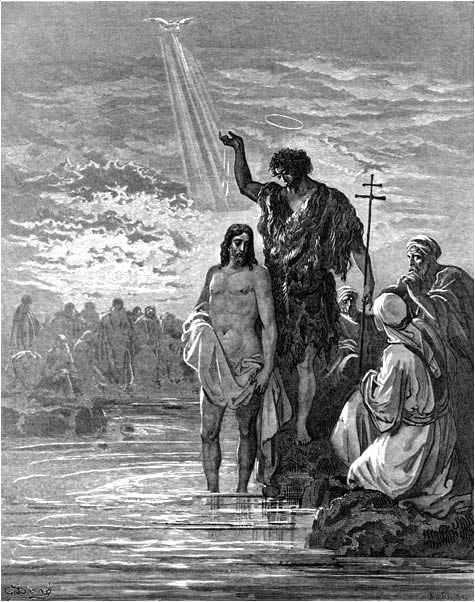
in Mark 1People went out to him from all of Jerusalem and the countryside of Judea. Confessing their sins, they were baptized by him in the Jordan River.
BSB
The same verse in ASV and KJV ▾
ASV
And there went out unto him all the country of Judæa, and all they of Jerusalem; and they were baptized of him in the river Jordan, confessing their sins.
KJV
And there went out unto him all the land of Judea, and they of Jerusalem, and were all baptized of him in the river of Jordan, confessing their sins.
⋯
This verse in Mark 1
Commentary
10 notes on this verseLet us here treat briefly of the different kinds of baptism. Moses baptized, but in water, in the cloud and in the sea; but this he did figuratively. John also baptized, not indeed in the rite of the Jews, not solely in water, but also for the remission of sins; yet not in an entirely spiritual manner, for he had not added: "in the spirit." Jesus baptized, but in the Spirit; and this is perfection.
This site's exposition
John the Baptist appeared in the wilderness
on Mark 1:4-6
John was clothed in camel’s hair, with a leather belt around his waist, the dress of Elijah in 2 Kings 1:8. His clothing shows him as the figure Malachi 4:5 promised.
This site's exposition
Confessing their sins
Adam Clarke notes that the Jews baptized a Gentile convert only after he had solemnly renounced idolatry and pledged himself to the law of Moses. John asked a public confession of Jews born under that law. Jerome adds that this baptism looked ahead to a forgiveness Christ would bring.
The record, by era
The Church Fathers1 voice
The baptism of John did not so much consist in the forgiveness of sins as in being a baptism of repentance for the remission of sins, that is, for a future remission, which was to follow through the sanctification of Christ.
The Medieval Church2 voices
Now by John as by the bride-groom's friend, the bride is brought to Christ, as by a servant Rebecca was brought to Isaac; wherefore there follows, And there went out to him all, (Gen. 24:61) &c. For confession and beauty are in his presence, (Ps. 95:6. Vulg.) that is, the presence of the bridegroom. And the bride leaping down from her camel signifies the Church, who humbles herself on seeing her husband Isaac, that is, Christ. But the interpretation of Jordan, where sins are washed away, is 'an alien descent.' For we heretofore aliens to God by pride, are by the sign (symbolum) of Baptism made lowly, and thus exalted on highd.
(ubi sup.) An example of confessing their sins and of promising to lead a new life, is held out to those who desire to be baptized, by those words which follow, confessing their sins.
The Puritans and the Awakening1 voice
And there went out unto him all the land of Judea,....
The Nineteenth Century1 voice
All the land - See on Mat 3:4-6 (note). Confessing their sins - It was an invariable custom among the Jews to admit no proselyte to baptism, till he had, in the most solemn manner, declared that he forever had renounced all idolatrous worship, all heathenish superstitions, and promised an entire and unreserved submission to the law of Moses. This was necessary for a proselyte adult - a child dedicated to God by baptism must be brought up in this faith.
2 more voices on this verse
The Nineteenth Century2 voices
A commentator
J.C. Ryle1816–1900
Expository Thoughts on the Gospels: Mark (lightly modernized text, Grace Gems edition) (1857)
The Gospel of Mark, which we now begin, is in some respects unlike the other three Gospels. It tells us nothing about the birth and early life of our Lord Jesus Christ. It contains comparatively few of His sayings and discourses. Of all the four inspired histories of our Lord's earthly ministry, this is by far the shortest. But we must not allow these peculiarities to make us undervalue Mark's Gospel. It is a Gospel singularly full of precious facts about the Lord Jesus, narrated in a simple, terse, pithy, and condensed style.
A commentator
J.C. Ryle1816–1900
Expository Thoughts on the Gospels: Mark (lightly modernized text, Grace Gems edition) (1857)
proposed
The Gospel of Mark, which we now begin, is in some respects unlike the other three Gospels. It tells us nothing about the birth and early life of our Lord Jesus Christ. It contains comparatively few of His sayings and discourses. Of all the four inspired histories of our Lord's earthly ministry, this is by far the shortest. But we must not allow these peculiarities to make us undervalue Mark's Gospel. It is a Gospel singularly full of precious facts about the Lord Jesus, narrated in a simple, terse, pithy, and condensed style. If it tells us few of our Lord's SAYINGS, it is eminently rich in its catalogue of His DOINGS. It often contains minute historical detail of deep interest, which are wholly omitted in Matthew, Luke and John. In short, it is no mere abridged copy of Matthew, as some have rashly asserted, but the independent narrative of an independent witness, who was inspired to write a history of our Lord's WORKS , rather than of His WORDS . Let us read it with holy reverence. Like all the rest of Scripture, every word of Mark is "given by inspiration of God," and every word is "profitable." Let us observe, in these verses, what a full declaration we have of the dignity of our Lord Jesus Christ's person. The very first sentence speaks of Him as "the Son of God." These words, "the Son of God," conveyed far more to Jewish minds than they do to ours. They were nothing less than an assertion of our Lord's divinity. They were a declaration that Jesus was Himself very God, and "equal with God." (John 5:18.) There is a beautiful fitness in placing this truth in the very beginning of a Gospel. The divinity of Christ is the citadel and keep of Christianity. Here lies the infinite value of the atoning sacrifice He made upon the cross. Here lies the peculiar merit of His atoning death for sinners.
The words behind it
24 Greek wordsEvery Greek word of this verse in the order it stands, with what it means and the door to its own study. The last column counts the times a word stands in the whole Bible: the rarer the word, the more the places it appears belong together.
| Greek | Sound | Meaning | Word study | In the Bible |
|---|---|---|---|---|
| καὶ | kai | And | G2532 → | 9120 times |
| ἐξεπορεύετο | exeporeueto | were going out | G1607 → | 33 times |
| πρὸς | pros | to | G4314 → | 700 times |
| αὐτὸν | auton | him | G846 → | 5565 times |
| πᾶσα | pasa | all | G3956 → | 1235 times |
| ἡ | he | the | G3588 → | 19766 times |
| Ἰουδαία | ioudaia | of Judea | G2449 → | 44 times |
| χώρα | chora | region | G5561 → | 28 times |
| καὶ | kai | and | G2532 → | 9120 times |
| οἱ | hoi | <the> | G3588 → | 19766 times |
| Ἱεροσολυμῖται | hi'erosolumitai | of Jerusalem | G2415 → | |
| πάντες, | pantes | all | G3956 → | 1235 times |
| καὶ | kai | and | G2532 → | 9120 times |
| ἐβαπτίζοντο | ebaptizonto | were being baptized | G907 → | 76 times |
| ὑπ᾽ | hup᾽ | by | G5259 → | 219 times |
| αὐτοῦ | autou | him | G846 → | 5565 times |
| ἐν | en | in | G1722 → | 2738 times |
| τῷ | to | the | G3588 → | 19766 times |
| Ἰορδάνῃ | iordane | Jordan | G2446 → | 15 times |
| ποταμῷ | potamo | river | G4215 → | |
| ἐξομολογούμενοι | exomologoumenoi | confessing | G1843 → | |
| τὰς | tas | the | G3588 → | 19766 times |
| ἁμαρτίας | hamartias | sins | G266 → | 173 times |
| αὐτῶν. | auton | of them. | G846 → | 5565 times |
καὶAnd
kaiG2532 →9120 times
ἐξεπορεύετοwere going out
exeporeuetoG1607 →33 times
πρὸςto
prosG4314 →700 times
αὐτὸνhim
autonG846 →5565 times
πᾶσαall
pasaG3956 →1235 times
ἡthe
heG3588 →19766 times
Ἰουδαίαof Judea
ioudaiaG2449 →44 times
χώραregion
choraG5561 →28 times
καὶand
kaiG2532 →9120 times
οἱ<the>
hoiG3588 →19766 times
Ἱεροσολυμῖταιof Jerusalem
hi'erosolumitaiG2415 →
πάντες,all
pantesG3956 →1235 times
καὶand
kaiG2532 →9120 times
ἐβαπτίζοντοwere being baptized
ebaptizontoG907 →76 times
ὑπ᾽by
hup᾽G5259 →219 times
αὐτοῦhim
autouG846 →5565 times
ἐνin
enG1722 →2738 times
τῷthe
toG3588 →19766 times
ἸορδάνῃJordan
iordaneG2446 →15 times
ποταμῷriver
potamoG4215 →
ἐξομολογούμενοιconfessing
exomologoumenoiG1843 →
τὰςthe
tasG3588 →19766 times
ἁμαρτίαςsins
hamartiasG266 →173 times
αὐτῶν.of them.
autonG846 →5565 times
A shaded row is a word that stands 400 times or fewer in the Bible.
The walk
8 stopsEach card is a verse this one points to, and under it the verses that one points to in turn. Where several paths arrive at the same place, that place is listed first: the text keeps returning to it.
Through
Acts 2:38Peter replied, “Repent and be baptized, every one of you, in the name of Jesus Christ for the forgiveness of your sins, and you will receive the gift of the Holy Spirit.
it leads to
- Acts 22:16
And now what are you waiting for? Get up, be baptized, and wash your sins away, calling on His name.’
- Mark 16:16
Whoever believes and is baptized will be saved, but whoever does not believe will be condemned.
- Acts 8:12
But when they believed Philip as he preached the gospel of the kingdom of God and the name of Jesus Christ, they were baptized, both men and women.
- Luke 24:47
and in His name repentance and forgiveness of sins will be proclaimed to all nations, beginning in Jerusalem.
- Acts 3:19
Repent, then, and turn back, so that your sins may be wiped away,
- Acts 22:16
Through
Joshua 7:19So Joshua said to Achan, “My son, give glory to the LORD, the God of Israel, and make a confession to Him. I urge you to tell me what you have done; do not…
it leads to
- 1 Samuel 6:5
Make images of your tumors and of the rats that are ravaging the land. Give glory to the God of Israel, and perhaps He will lift His hand from you and your gods and…
- Jeremiah 13:16
Give glory to the LORD your God before He brings darkness, before your feet stumble on the dusky mountains. You wait for light, but He turns it into deep gloom and thick darkness.
- John 9:24
So a second time they called for the man who had been blind and said, “Give glory to God! We know that this man is a sinner.”
- 1 Samuel 6:5
Where this verse is studied
On this page
Studies22
On this verse
On this chapter
Show the next 6 titles
About Mark
Who and where
1 name in this verse with a page on the site.
This page draws on 9 works. Open the list of works
This page draws on Adam Clarke, Commentary on the Bible; Bede, Catena Aurea by Aquinas; Gregory of Nazianzus, ORATION 39, ON THE HOLY LIGHTS; J.C. Ryle, Expository Thoughts on the Gospels: Mark (lightly modernized text, Grace Gems edition); Jerome, THE DIALOGUE AGAINST THE LUCIFERIANS 7; John Gill, Exposition of the New Testament; John Gill, Exposition of the New Testament (1746-1748); Matthew Henry, Commentary on the Whole Bible and Pseudo-Jerome, Catena Aurea by Aquinas.