
Mark 1:11
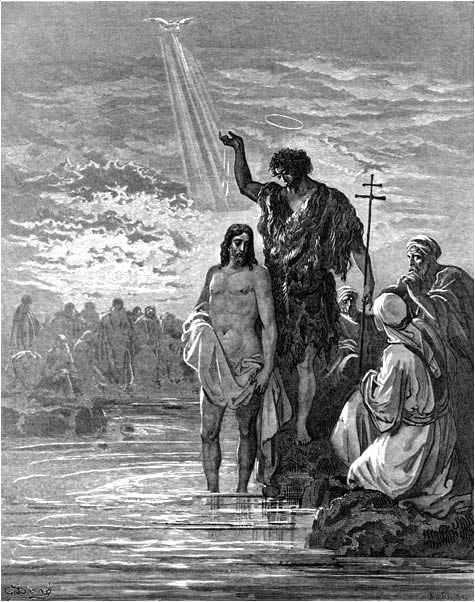
in Mark 1And a voice came from heaven: “You are My beloved Son; in You I am well pleased.”
BSB
The same verse in ASV and KJV ▾
ASV
and a voice came out of the heavens, Thou art my beloved Son, in thee I am well pleased.
KJV
And there came a voice from heaven, saying, Thou art my beloved Son, in whom I am well pleased.
⋯
This verse in Mark 1
Commentary
19 notes on this verseThese words are not to be understood, when we speak of God, as when we speak of bodies. The generation of the Son is incomprehensible, the Father begets without changing his nature. Yet this begottenness is of himself. In ages inconceivably remote the true God has begotten one who is truly God.
This site's exposition
He saw the heavens breaking open
on Mark 1:10-11
Jesus saw the heavens breaking open, and the Greek verb behind those words returns once more in Mark, at 15:38. There it describes the temple veil torn in two.
This site's exposition
You are My beloved Son
Matthew reports the voice speaking about the Son. Mark has it speak to Him, and Augustine answers that the Gospel writers may vary the words while keeping one meaning. He reads the Father's pleasure as the work the Father delights to do through the Son.
The record, by era
The Church Fathers5 voices
(de Cons. Ev. ii. 14) Wherefore Matthew relates that the voice said, This is my beloved Son; for he wished to show that the words, This is My Son, were in fact said, that thus the persons who heard it might know that He, and not another, was the Son of God. But, if you ask, which of these two sounded forth in that voice, take which you will, only remember, that the Evangelists, though not relating the same form of speaking, relate the same meaning. And that God delighted Himself in His Son, we are reminded in these words, In thee I am well pleased.
The Trinity appears very clearly: the Father in the voice, the Son in the man, the Spirit in the dove.
In the Scripture many details are mentioned distinguishably of each of the triune Persons individually, such as cannot be said of them jointly, even though they are inseparably together, as when they are made manifest by corporeal sounds. So in certain passages of Scripture and through certain created beings they are shown separately and successively, as the Father in the voice which is heard: "Thou art my Son," and the Son in the human nature which he took from the Virgin, and the Holy Spirit in the physical appearance of a dove. These are mentioned distinguishably, it is true, but they do not prove that the Three are separated. To explicate this, we take as an example the unity of our memory, our understanding, our will. Although we list these distinguishably, individually and in their various functions, there is nothing we do or say which proceeds from one of them without the other two. However, we are not to think that these three faculties are compared to the Trinity so as to resemble it at every point, for a comparison is never given such importance in an argument that it exactly fits the thing to which it is compared. Besides, when can any likeness in a created being be applied to the Creator?
Whichever of the Evangelists may have preserved for us the words as they were literally uttered by the heavenly voice, the others have varied the terms only with the object of setting forth the same sense more familiarly, so that what is thus given by all of them might be understood as if the expression were: In You I have set my good pleasure; that is to say, by You I am doing what is my pleasure.
For this reason did the Father send down the Holy Spirit from heaven upon the One who was baptized.… For what reason? That the faithfulness of the Father's voice might be made known.… Listen to the Father's voice: "This is my beloved Son, in whom I am well pleased." This is he who is named the son of Joseph, who according to the divine essence is my only begotten. "This is my beloved Son," yes, none other than the One who himself becomes hungry, yet feeds countless numbers. He is my Son who himself becomes weary, yet gives rest to the weary. He has no place to lay his head, yet bears up all things in his hand. He suffers, yet heals sufferings. He is beaten, yet confers liberty upon the world. He is pierced in his side, yet repairs the side of Adam.
11 more voices on this verse
The Church Fathers3 voices
This is spoken to him by God, with whom all time is today. For there is no evening with God, as I see it, and there is no morning—nothing but time that stretches out, along with his unbeginning and unseen life. The day is today with him in which the Son was begotten. Thus the beginning of his birth is not to be found, as neither is the day of it.
In the Jordan the Trinity was manifested to humanity. The Father bore witness, the Son received witness, and the Holy Spirit gave confirmation.
Today the Source of all the graces of baptism comes himself to be baptized in the river Jordan, there to make himself known to the world. Seeing him approach, John stretches out his hand to hold him back, protesting: Lord, by your own baptism you …
The Medieval Church5 voices
(ubi sup.) Now the Dove sat on the head of Jesus, lest any one should think that the voice of the Father was addressed to John and not to Christ. And well did he add, abiding on Him; for this is peculiar to Christ, that the Holy Ghost once filling Him should never leave Him. For sometimes to His faithful disciples the grace of the Spirit is conferred for signs of virtue, and for the working of miracles, sometimes it is taken away; though for the working of piety and righteousness, for the preservation of love to God and to one's neighbour, the grace of the Spirit is never absent. But the voice of the Father showed, that He Himself, who came to John to be baptized with the others, was the very Son of God, willing to baptize with the Holy Spirit, whence there follows, And there came a voice from heaven, Thou art my beloved Son, in thee I am well pleased. Not that this informed the Son Himself of a thing of which He was ignorant, but it shows to us what we ought to believe.
(ubi sup.) The same voice has taught us, that we also, by the water of cleansing, and by the Spirit of sanctification, may be made the sons of God. The mystery of the Trinity also is shown forth in the baptism; the Son is baptized, the Spirit comes down in the shape of a dove, the voice of the Father bearing witness to the Son is heard.
Morally also it may be interpreted; we also, drawn aside from the fleeting world by the smell and purity of flowers, run with the young maidens after the bridegroom, (v. Cant. 1:2. 3.) and are washed in the sacrament of baptism, from the two fountains of the love of God, and of our neighbour, by the grace of remission, and mounting up by hope gaze upon heavenly mysteries with the eyes of a clean heart. Then we receive in a contrite and lowly spirit, with simplicity of heart, the Holy Spirit, who comes down to the meek, and abides in us, by a never-failing charity. And the voice of the Lord from heaven is directed to us the beloved of God; Blessed are the peacemakers, for they shall be called the sons of God; (Matt. 5:9) and then the Father, with the Son and the Holy Spirit, is well-pleased with us, when we are made one spirit with God.
Again, the Holy Spirit came down in the shape of a dove, because in the Canticles it is sung of the Church: "My bride, my love, my beloved, my dove." "Bride" in the Patriarchs, "love" in the Prophets, "near of kin" in Joseph and Mary, "beloved" in John the Baptist, "dove" in Christ and His Apostles: to whom it is said, "Be ye wise as serpents, and harmless as doves." Morally also it may be interpreted; we also, drawn aside from the fleeting world by the smell and purity of flowers, run with the young maidens after the bridegroom, and are washed in the sacrament of baptism, from the two fountains of the love of God, and of our neighbour, by the grace of remission, and mounting up by hope gaze upon heavenly mysteries with the eyes of a clean heart. Then we receive in a contrite and lowly spirit, with simplicity of heart, the Holy Spirit, who comes down to the meek, and abides in us, by the never-failing charity. And the voice of the Lord from heaven is directed to us the beloved of God; "Blessed are the peacemakers, for they shall be called the sons of God;" and then the Father, with the Son and the Holy Spirit, is well-pleased with us, when we are made one spirit with God.
At the descent of the Holy Spirit, the testimony was immediately spoken as well. Since the Father spoke from above, "You are My Son," then, lest the hearers suppose that He was speaking of John, the Spirit descends upon Jesus, showing that this was said …
The Puritans and the Awakening1 voice
And there came a voice from heaven,....
The Nineteenth Century2 voices
A commentator
J.C. Ryle1816–1900
Expository Thoughts on the Gospels: Mark (lightly modernized text, Grace Gems edition) (1857)
This passage is singularly full of matter. It is a striking instance of that brevity of style, which is the peculiar characteristic of Mark's Gospel. The baptism of our Lord, His temptation in the wilderness, the commencement of his preaching, and the calling of His first disciples are related here in eleven verses. Let us notice, in the first place, the voice from heaven which was heard at our Lord's baptism. We read, "There came a voice from heaven, saying, You are my beloved Son, in whom I am well pleased." That voice was the voice of God the Father.
A commentator
J.C. Ryle1816–1900
Expository Thoughts on the Gospels: Mark (lightly modernized text, Grace Gems edition) (1857)
proposed
This passage is singularly full of matter. It is a striking instance of that brevity of style, which is the peculiar characteristic of Mark's Gospel. The baptism of our Lord, His temptation in the wilderness, the commencement of his preaching, and the calling of His first disciples are related here in eleven verses. Let us notice, in the first place, the voice from heaven which was heard at our Lord's baptism. We read, "There came a voice from heaven, saying, You are my beloved Son, in whom I am well pleased." That voice was the voice of God the Father. It declared the wondrous and ineffable love which has existed between the Father and the Son from all eternity. "The Father loves the Son, and has given all things into His hand." (John 3:35.) It proclaimed the Father's full and complete approbation of Christ's mission to seek and save the lost. It announced the Father's acceptance of the Son as the Mediator, Substitute, and Surety of the new covenant. There is a rich mine of comfort, in these words, for all Christ's believing members. In themselves, and in their own doings, they see nothing to please God. They are daily sensible of weakness, shortcoming, and imperfection in all their ways. But let them recollect that the Father regards them as members of His beloved Son Jesus Christ. He sees no spot in them. (Cant. 4:7.) He beholds them as "in Christ," clothed in His righteousness, and invested with His merit. They are "accepted in the Beloved," and when the holy eye of God looks at them, He is "well pleased." Let us notice, in the second place, the nature of Christ's preaching. We read that he came saying, "Repent, and believe the Gospel." This is that old sermon which all the faithful witnesses of God have continually preached, from the very beginning of the world.
The words behind it
16 Greek wordsEvery Greek word of this verse in the order it stands, with what it means and the door to its own study. The last column counts the times a word stands in the whole Bible: the rarer the word, the more the places it appears belong together.
| Greek | Sound | Meaning | Word study | In the Bible |
|---|---|---|---|---|
| καὶ | kai | And | G2532 → | 9120 times |
| φωνὴ | phone | a voice | G5456 → | 139 times |
| ἐγένετο | egeneto | came | G1096 → | 667 times |
| ἐκ | ek | out of | G1537 → | 911 times |
| τῶν | ton | the | G3588 → | 19766 times |
| οὐρανῶν· | ouranon | heavens: | G3772 → | 272 times |
| σὺ | su | You yourself | G4771 → | 2973 times |
| εἶ | ei | are | G1510 → | 2333 times |
| ὁ | ho | the | G3588 → | 19766 times |
| υἱός | huios | Son | G5207 → | 377 times |
| μου | mou | of Mine | G3165 → | 1936 times |
| ὁ | ho | the | G3588 → | 19766 times |
| ἀγαπητός, | agapetos | beloved, | G27 → | 61 times |
| ἐν | en | in | G1722 → | 2738 times |
| σοὶ | soi | you | G4771 → | 2973 times |
| εὐδόκησα.¶ | eudokesa | I am well pleased. | G2106 → |
καὶAnd
kaiG2532 →9120 times
φωνὴa voice
phoneG5456 →139 times
ἐγένετοcame
egenetoG1096 →667 times
ἐκout of
ekG1537 →911 times
τῶνthe
tonG3588 →19766 times
οὐρανῶν·heavens:
ouranonG3772 →272 times
σὺYou yourself
suG4771 →2973 times
εἶare
eiG1510 →2333 times
ὁthe
hoG3588 →19766 times
υἱόςSon
huiosG5207 →377 times
μουof Mine
mouG3165 →1936 times
ὁthe
hoG3588 →19766 times
ἀγαπητός,beloved,
agapetosG27 →61 times
ἐνin
enG1722 →2738 times
σοὶyou
soiG4771 →2973 times
εὐδόκησα.¶I am well pleased.
eudokesaG2106 →
A shaded row is a word that stands 400 times or fewer in the Bible.
The walk
8 stopsEach card is a verse this one points to, and under it the verses that one points to in turn. Where several paths arrive at the same place, that place is listed first: the text keeps returning to it.
Through
Colossians 1:13He has rescued us from the dominion of darkness and brought us into the kingdom of His beloved Son,
it leads to
- Ephesians 5:8
For you were once darkness, but now you are light in the Lord. Walk as children of light,
- Acts 26:18
to open their eyes, so that they may turn from darkness to light and from the power of Satan to God, that they may receive forgiveness of sins and an inheritance among those sanctified…
- 1 Peter 2:9
But you are a chosen people, a royal priesthood, a holy nation, a people for God’s own possession, to proclaim the virtues of Him who called you out of darkness into His marvelous light.
- Titus 3:3–6
For at one time we too were foolish, disobedient, misled, and enslaved to all sorts of desires and pleasures—living in malice and envy, being hated and hating one another.
- 1 Thessalonians 2:12
encouraging you, comforting you, and urging you to walk in a manner worthy of God, who calls you into His own kingdom and glory.
- Ephesians 5:8
Through
Psalms 2:7I will proclaim the decree spoken to Me by the LORD: “You are My Son; today I have become Your Father.
it leads to
- Hebrews 5:5
So also Christ did not take upon Himself the glory of becoming a high priest, but He was called by the One who said to Him: “You are My Son; today I have become…
- Acts 13:33
He has fulfilled for us, their children, by raising up Jesus. As it is written in the second Psalm: ‘You are My Son; today I have become Your Father.’
- Hebrews 5:5
Through
Matthew 3:17And a voice from heaven said, “This is My beloved Son, in whom I am well pleased!”
it leads to
- Matthew 17:5
While Peter was still speaking, a bright cloud enveloped them, and a voice from the cloud said, “This is My beloved Son, in whom I am well pleased. Listen to Him!”
Reached by 2 separate paths from here.
- Matthew 17:5
Where this verse is studied
On this page
Studies22
On this verse
On this chapter
Show the next 6 titles
About Mark
This page draws on 16 works. Open the list of works
This page draws on Adam Clarke, Commentary on the Bible; Alexander Maclaren, Expositions of Holy Scripture, Mark; Ambrose of Milan, EXPOSITION OF THE CHRISTIAN FAITH 1.10.67; Augustine of Hippo, Catena Aurea by Aquinas; Augustine of Hippo, HARMONY OF THE GOSPELS 2.14.31; Augustine of Hippo, TRACTATE ON JOHN 6.5.1; Augustine of Hippo, LETTER 169, TO EUODIUS; Bede, Catena Aurea by Aquinas; Ephrem the Syrian, HYMNS ON NATIVITY (EPIPHANY) 14; Hippolytus of Rome, THE DISCOURSE ON THE HOLY THEOPHANY 7; J.C. Ryle, Expository Thoughts on the Gospels: Mark (lightly modernized text, Grace Gems edition); John Gill, Exposition of the New Testament (1746-1748); Origen of Alexandria, COMMENTARY ON JOHN 1.32; Origen of Alexandria, FRAGMENTS ON MATTHEW 58; Pseudo-Jerome, Catena Aurea by Aquinas and Theophylact of Ohrid, Commentary on Mark.