
Mark 1:40
in Mark 1Then a leper came to Jesus, begging on his knees: “If You are willing, You can make me clean.”
BSB
The same verse in ASV and KJV ▾
ASV
And there cometh to him a leper, beseeching him, and kneeling down to him, and saying unto him, If thou wilt, thou canst make me clean.
KJV
And there came a leper to him, beseeching him, and kneeling down to him, and saying unto him, If thou wilt, thou canst make me clean.
⋯
This verse in Mark 1
Commentary
18 notes on this verseMystically, our leprosy is the sin of the first man, which began from the head, when he desired the kingdoms of the world. For covetousness is the root of all evil; wherefore Gehazi, engaged in an avaritious pursuit, is covered with leprosy. This leprosy is cleansed on offering an oblation to the true Priest after the order of Melchisedec; for He tells us, Give alms of such things as ye have, and, behold, all things are clean unto you. (Luke 11:41)
This site's exposition
a leper came to Jesus, begging on his knees
on Mark 1:40-42
Jesus reached out His hand and touched the man, a touch that under the law would carry uncleanness to the clean. At His word the cleansing runs from the clean One to the unclean.
The record, by era
The Church Fathers2 voices
It is not in one's own power, however admirable and trustworthy may be the knowledge one has of the facts, to determine the order in which he will recall them to memory. For the way in which one thing comes into one's mind before or after another proceeds not as we will, but simply as it occurs to us. It is reasonable enough to suppose that each of the Evangelists believed it to have been his duty to relate what he had to relate in that order in which it had pleased God to suggest it to his recollection.
(de Con. Evan. ii. 19) Mark puts together circumstances, from which one may infer that he is the same as that one whom Matthew (Matt. 8:2) relates to have been cleansed, when the Lord came down from the mount, after the sermon.
The Medieval Church3 voices
For he said not, If thou wilt, pray unto God, but, If thou wilt, as thinking Him very God.
And there came to him a leper beseeching him, etc. Concerning this leper who was cleansed, it connects that he should be understood as the one whom Matthew mentions as being cleansed when the Lord came down from the mountain after that discourse. For thus …
(in Marc. i. 7) After that the serpent-tongue of the devils was shut up, and the woman, who was first seduced, cured of a fever, in the third place, the man, who listened to the evil counsels of the woman, is cleansed from his leprosy, that the order of restoration in the Lord might be the same as was the order of the fall in our first parents; whence it goes on: And there came a leper to him, beseeching him.
11 more voices on this verse
The Medieval Church2 voices
(in Marc. i. 9) And because the Lord said that He came not to destroy the Law but to fulfill, (Matt. 5:17) he who was excluded by the Law, inferring that he was cleansed by the power of the Lord, showed that that grace, which could wash away the stain of the leper, was not from the Law, but over the Law. And truly, as in the Lord authoritative power, so in him the constancy of faith is shewn; for there follows, Lord, if thou wilt, thou canst make me clean. He falls on his face, which is at once a gesture of lowliness and of shame, to show that every man should blush for the stains of his life. But his shame did not stifle confession; he showed his wound, and begged for medicine, and the confession is full of devotion and of faith, for he refers the power to the will of the Lord.
The leper was prudent and believed; therefore he did not say: if You ask God; but believing in Him as God, he said: "if You will." Christ touches him as a sign that nothing is unclean. The Law forbade touching a leper as unclean; but …
The Puritans and the Awakening3 voices
His address is not in the form of prayer, yet Christ answered it as a request. Note, Affectionate professions of faith in Christ, and resignations to him, are the most prevailing petitions for mercy from him, and shall speed accordingly. (1.) Christ was moved with compassion.
And there came a leper to him,.... After he was come down from a certain mountain, in Galilee, where he had been preaching to the people, Mat 8:1, and when be was in a certain city, Luk 5:12, either Capernaum, or some other city of Galilee.
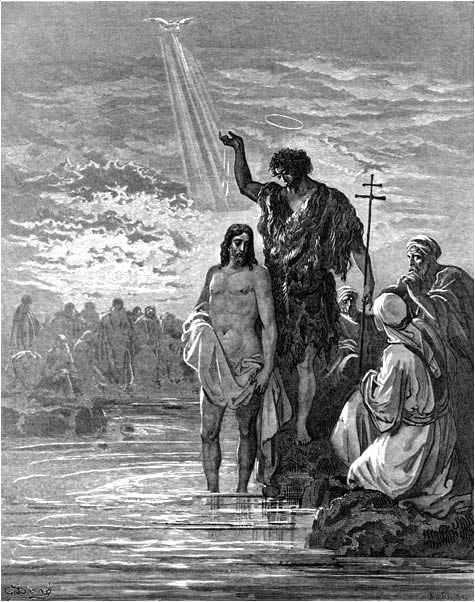
8 I indeed have baptized you with water: but he shall baptize you with the Holy Ghost. What the New Testament is--the divine testament, to which we adhere above all that is human; the new testament, which we advance above that which was old. It is the gospel of Jesus Christ the Son of God,
The Nineteenth Century6 voices
A commentator
J.C. Ryle1816–1900
Expository Thoughts on the Gospels: Mark (lightly modernized text, Grace Gems edition) (1857)
We read in these verses how our Lord Jesus Christ healed a leper. Of all our Lord's miracles of healing none were probably more marvelous than those performed on leprous people. Two cases only have been fully described in the Gospel history. Of these two, the case before us is one. Let us try to realize, in the first place, the dreadful nature of the disease which Jesus cured . Leprosy is a complaint of which we know little or nothing in our northern climate. In Bible lands it is far more common.
Beloved, we saw in the reading, that our Lord had been engaged in special prayer. He had gone alone on the mountain-side to have communion with God. Simon and the rest search for him, and he comes away in the early morning with the burrs from the hill-side upon his garments, the smell of the field upon him, even of a field that the Lord God had blessed; he comes forth among the people, charged with power which he had received in communion with the Father; and now we may expect to see wonders.
A commentator
J.C. Ryle1816–1900
Expository Thoughts on the Gospels: Mark (lightly modernized text, Grace Gems edition) (1857)
proposed
We read in these verses how our Lord Jesus Christ healed a leper. Of all our Lord's miracles of healing none were probably more marvelous than those performed on leprous people. Two cases only have been fully described in the Gospel history. Of these two, the case before us is one. Let us try to realize, in the first place, the dreadful nature of the disease which Jesus cured . Leprosy is a complaint of which we know little or nothing in our northern climate. In Bible lands it is far more common. It is a disease which is utterly incurable . It is no mere skin disorder, as some ignorantly suppose. It is a radical disease of the whole man. It attacks, not merely the skin, but the blood, the flesh, and the bones, until the unhappy patient begins to lose his extremities, and to rot by inches. Let us remember beside this, that, among the Jews, the leper was reckoned unclean, and was cut off from the congregation of Israel and the ordinances of religion. He was obliged to dwell in a separate house. None might touch him or minister to him. Let us remember all this, and then we may have some idea of the remarkable wretchedness of a leprous person. To use the words of Aaron, when he interceded for Miriam, he was "as one dead, of whom the flesh is half consumed." (Numbers 12:12.) But is there nothing like leprosy among ourselves? Yes! indeed there is. There is a foul soul-disease which is ingrained into our very nature, and cleaves to our bones and marrow with deadly force. That disease is the plague of sin. Like leprosy, it is a deep-seated disease infecting every part of our nature, heart, will, conscience, understanding, memory, and affections. Like leprosy, it makes us loathsome and abominable, unfit for the company of God, and unfit for the glory of heaven.
Beloved, we saw in the reading, that our Lord had been engaged in special prayer. He had gone alone on the mountain-side to have communion with God. Simon and the rest search for him, and he comes away in the early morning with the burrs from the hill-side upon his garments, the smell of the field upon him, even of a field that the Lord God had blessed; he comes forth among the people, charged with power which he had received in communion with the Father; and now we may expect to see wonders. And we do see them; for devils fear and fly when he speaks the word; and by-and-by, there comes to him one, an extraordinary being, condemned to live apart from the rest of men, lest he should spread defilement all around. A leper comes to him, and kneels before him, and expresses his confident faith in him, that he can make him whole. Now is the Son of Man glorious in his power to save. The Lord Jesus Christ at this day has all power in heaven and in earth. He is charged with a divine energy to bless all who come to him for healing. Oh, that we may see today some great wonder of his power and grace! Oh, for one of the days of the Son of Man here and now! To that end it is absolutely needful that we should find a case for his spiritual power to work upon. Is there not one here in whom his grace may prove its omnipotence? Not you, ye good, ye self-righteous! You yield him no space to work in. You that are whole have no need of a physician: in you there is no opportunity for him to display his miraculous force. But yonder are the men we seek for. Forlorn, and lost, full of evil, and self-condemned, you are the characters we seek. You that feel as if you were possessed with evil spirits, and you that are leprous with sin, you are the persons in whom Jesus will find ample room and verge enough for the display of his holy skill.
There came a leper - See the notes on Mat 8:2, etc. Should any be inclined to preach on this cleansing of the leper, Mark is the best evangelist to take the account from, because he is more circumstantial than either Matthew or Luke. I. Consider this leper. 1. He heard of Jesus and his miracles. 2. He came to him for a cure, conscious of his disease. 3. He earnestly besought him to grant the mercy he needed.
A commentator
Albert Barnes1798–1870
Notes, Explanatory and Practical, on the Old and New Testaments (1832-1869)
proposed
And there came a leper ... - See the notes at Mat 8:1-4. Kneeling down to him - He kneeled and inclined his face to the ground, in token of deep humiliation and earnest entreaty. Compare Luk 5:12. If thou wilt - This was an acknowledgment of the almighty power of Jesus, and an appeal to his benevolence. Make me clean - You (Jesus) can heal me of this loathsome and offensive disease, in the eye of the law justly regarded as “unclean,” and render me “legally” clean, and restore me to the privileges of the congregation. And Jesus ...touched him - It was by the law considered as unclean to touch a leprous man. See Num 5:2. The fact that Jesus touched him was evidence that the requisite power had been already put forth to heal him; that Jesus regarded him as already clean. I will - Here was a most manifest proof of his divine power. None but God can work a miracle; yet Jesus does it by his “own will” - by an exertion of his own power. Therefore, Jesus is divine. See thou say nothing to any man - The law of Moses required that a man who was healed of the leprosy should be pronounced clean by the priest before he could be admitted again to the privileges of the congregation, Lev. 14. Christ, though he had cleansed him, yet required him to be obedient to the law of the land - to go at once to the priest, and not to make delay by stopping to converse about his being healed. It was also possible that, if he did not go at once, evil-minded men would go before him and prejudice the priest, and prevent his declaring the healing to be thorough because it was done by Jesus. It was of further importance that “the priest” should pronounce it to be a genuine cure, that there might be no cavils among the Jews against its being a real miracle. Offer for thy cleansing those things ... […]
The words behind it
18 Greek wordsEvery Greek word of this verse in the order it stands, with what it means and the door to its own study. The last column counts the times a word stands in the whole Bible: the rarer the word, the more the places it appears belong together.
| Greek | Sound | Meaning | Word study | In the Bible |
|---|---|---|---|---|
| Καὶ | kai | And | G2532 → | 9120 times |
| ἔρχεται | erchetai | comes | G2064 → | 628 times |
| πρὸς | pros | to | G4314 → | 700 times |
| αὐτὸν | auton | Him | G846 → | 5565 times |
| λεπρὸς | lepros | a leper | G3015 → | |
| παρακαλῶν | parakalon | imploring | G3870 → | 108 times |
| αὐτὸν | auton | Him | G846 → | 5565 times |
| καὶ | kai | and | G2532 → | 9120 times |
| γονυπετῶν | gonupeton | kneeling down | G1120 → | |
| καὶ | kai | and | G2532 → | 9120 times |
| λέγων | legon | saying | G3004 → | 1325 times |
| αὐτῷ | auto | to Him | G846 → | 5565 times |
| ὅτι | hoti | that | G3754 → | 1292 times |
| ἐὰν | ean | If | G1437 → | 352 times |
| θέλῃς | theles | You may be willing | G2309 → | 208 times |
| δύνασαί | dunasai | You are able | G1410 → | 207 times |
| με | me | me | G3165 → | 1936 times |
| καθαρίσαι. | katharisai | to cleanse. | G2511 → | 31 times |
ΚαὶAnd
kaiG2532 →9120 times
ἔρχεταιcomes
erchetaiG2064 →628 times
πρὸςto
prosG4314 →700 times
αὐτὸνHim
autonG846 →5565 times
λεπρὸςa leper
leprosG3015 →
παρακαλῶνimploring
parakalonG3870 →108 times
αὐτὸνHim
autonG846 →5565 times
καὶand
kaiG2532 →9120 times
γονυπετῶνkneeling down
gonupetonG1120 →
καὶand
kaiG2532 →9120 times
λέγωνsaying
legonG3004 →1325 times
αὐτῷto Him
autoG846 →5565 times
ὅτιthat
hotiG3754 →1292 times
ἐὰνIf
eanG1437 →352 times
θέλῃςYou may be willing
thelesG2309 →208 times
δύνασαίYou are able
dunasaiG1410 →207 times
μεme
meG3165 →1936 times
καθαρίσαι.to cleanse.
katharisaiG2511 →31 times
A shaded row is a word that stands 400 times or fewer in the Bible.
The walk
8 stopsEach card is a verse this one points to, and under it the verses that one points to in turn. Where several paths arrive at the same place, that place is listed first: the text keeps returning to it.
Through
Matthew 17:14When they came to the crowd, a man came up to Jesus and knelt before Him.
it leads to
- Mark 9:14–29
When they returned to the other disciples, they saw a large crowd around them, and scribes arguing with them.
- Acts 10:25–26
As Peter was about to enter, Cornelius met him and fell at his feet to worship him.
- Mark 10:17
As Jesus started on His way, a man ran up and knelt before Him. “Good Teacher,” he asked, “what must I do to inherit eternal life?”
- Luke 9:37–43
The next day, when they came down from the mountain, Jesus was met by a large crowd.
- Mark 9:14–29
Through
2 Samuel 3:29May it whirl over the heads of Joab and the entire house of his father, and may the house of Joab never be without one having a discharge or skin disease, or one who…
it leads to
- Psalms 109:8–19
May his days be few; may another take his position.
- 2 Samuel 1:16
For David had said to the Amalekite, “Your blood be on your own head because your own mouth has testified against you, saying, ‘I killed the LORD’s anointed.’”
- Acts 28:4
When the islanders saw the creature hanging from his hand, they said to one another, “Surely this man is a murderer. Although he was saved from the sea, Justice has not allowed him to…
- 1 Kings 2:31–34
And the king replied, “Do just as he says. Strike him down and bury him, and so remove from me and from the house of my father the innocent blood that Joab shed.
- Psalms 109:8–19
Where this verse is studied
On this page
Studies22
On this verse
On this chapter
Show the next 6 titles
About Mark
This page draws on 14 works. Open the list of works
This page draws on Adam Clarke, Commentary on the Bible; Albert Barnes, Notes, Explanatory and Practical, on the Old and New Testaments (1832-1869); Augustine of Hippo, HARMONY OF THE GOSPELS 2.21.51; Augustine of Hippo, Catena Aurea by Aquinas; Bede, On the Gospel of Mark; Bede, Catena Aurea by Aquinas; Charles Spurgeon, The Metropolitan Tabernacle Pulpit, Sermon No. 2008: “The Lord And The Leper” (lightly modernized text, CCEL edition); J. C. Ryle, Expository Thoughts on the Gospels, Mark; J.C. Ryle, Expository Thoughts on the Gospels: Mark (lightly modernized text, Grace Gems edition); John Gill, Exposition of the New Testament (1746-1748); Matthew Henry, Commentary on the Whole Bible; Pseudo-Jerome, Catena Aurea by Aquinas; Theophylact of Ohrid, Catena Aurea by Aquinas and Theophylact of Ohrid, Commentary on Mark.